Artificial Intelligence Clinical Reasoning in Board-Style Clinical Vignettes: A Comparative Study
Lorela Gjunkshi, Ledio Gjunkshi, Kenneth A Quezada, Nadiya A Persaud, Joseph Braun

TL;DR
This study compared how well different AI systems can diagnose medical cases using USMLE-style questions, finding that some perform very accurately.
Contribution
The study evaluates and compares the diagnostic accuracy of four leading AI models in a medical reasoning task using USMLE Step 1 vignettes.
Findings
Claude Sonnet 4 achieved perfect diagnostic accuracy with a score of 20/20.
AI models showed variability in diagnostic prioritization and accuracy.
All models demonstrated clinically relevant reasoning but require cautious implementation.
Abstract
Aim: This study evaluated the diagnostic accuracy of four large language model (LLM) artificial intelligence (AI) platforms in generating primary and differential diagnoses using United States Medical Licensing Examination (USMLE) Step 1 clinical vignettes. Methods: Ten USMLE Step 1 clinical vignette questions were selected, and answer choices were removed to simulate open-ended diagnostic reasoning. Each LLM-ChatGPT GPT-4o-mini (OpenAI), Meta AI Llama 4, Google Gemini 2.0 Flash, and Claude Sonnet 4 (Anthropic)-was prompted to provide both a primary diagnosis and a ranked differential diagnosis. Responses were evaluated using a three-point scoring rubric: 2 points for a correct final diagnosis, 1 point for a correct differential diagnosis only, and 0 points for an incorrect or missing diagnosis. The total possible score per model was 20 points. Results: Claude Sonnet 4 achieved the…
Genes, proteins, chemicals, diseases, species, mutations and cell lines named across the full text — each resolved to its canonical identifier and authoritative record.
Click any figure to enlarge with its caption.
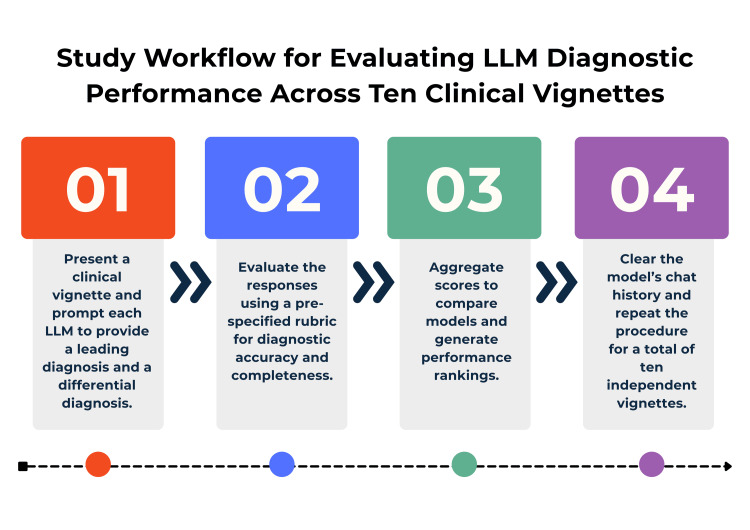 Figure 1
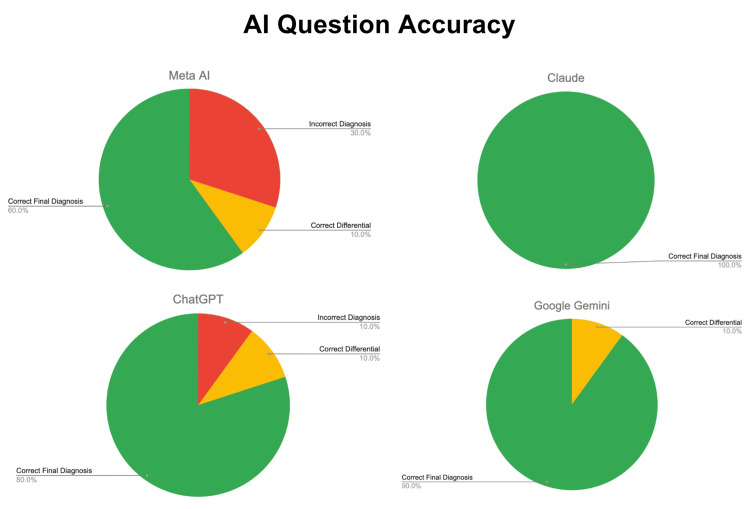 Figure 2
Peer Reviews
No public reviews on file for this paper yet. If you reviewed it on a platform where reviews are public (OpenReview, ICLR, NeurIPS, ICML), you can paste yours below so the community can read it here.
Videos
No videos yet. Explain this paper in a talk, walkthrough, or lecture? Add one.
Taxonomy
TopicsArtificial Intelligence in Healthcare and Education · Clinical Reasoning and Diagnostic Skills · Medical Imaging and Analysis
Introduction
Artificial intelligence (AI)
Artificial Intelligence (AI) is defined as a computer that can perform tasks typically done by humans. This includes decision making, reasoning, and the ability to create [1-3]. The origins of artificial intelligence can be traced to Alan Turing's foundational work in 1950, with the term “artificial intelligence” subsequently coined by John McCarthy as the field developed [4,5]. During this period, AI was primarily applied to mathematical computations, including advanced, multifactorial calculations such as determining rocket trajectories [6]. Convinced that AI held greater potential, Turing sought to test the limits of his creation and explore whether AI could truly think beyond its predetermined programming. This pursuit led to the development of the Turing test, which involved three participants: (1) a human judge, (2) an AI interlocutor, and (3) a human interlocutor [6,7]. The human judge interacted with both the AI interlocutor and the human interlocutor through a computer interface, without knowing which one they were communicating with [7]. The human judge was then provided with a set of open-ended and personal questions to pose to both the AI and human interlocutor [7]. The judge then attempted to determine, based on the responses, whether they were interacting with an AI interlocutor or a human [5]. An AI interlocutor was considered to have passed the Turing test if (1) the judge mistakes it for a human, or (2) the judge cannot reliably distinguish its responses from those of a human [6,7]. The Turing test was a landmark in history, establishing a foundational basis for the continued growth and development of artificial intelligence.
Machine learning
Following the development of artificial intelligence (AI), the evolution of AI led to the creation of machine learning (ML). Machine Learning is defined as “AI systems that learn from historical data” [3]. In 1952, Arthur Samuel developed one of the first examples of machine learning through the game of checkers and subsequently coined the term “machine learning” [8]. While machine learning falls under the broader umbrella of AI, it represents a distinct subset of the field. In 1957, Frank Rosenblatt advanced machine learning by building on Samuel’s terminology and applying a brain cell interaction model originally proposed by Donald Hebb [8]. This machine, named the “Mark I Perceptron,” was a machine learning system designed for image and visual pattern recognition [8]. While promising, the machine struggled to recognize complex patterns, such as faces, which ultimately led to the discontinuation of the research [8].
Large language models (LLMs)
Large language models (LLMs) are a category of artificial intelligence (AI) designed to understand and generate text, with the goal of mimicking human language in their responses. Similar to other AI models, LLMs can learn and adapt based on the data used to train them [9,10]. Many widely used AI models are classified as LLMs, including ChatGPT, Google Gemini, Meta Llama, Claude, and others. Because these models are open source, they are easily accessible to the general public. The speed and accessibility of LLMs have led individuals to adopt them for day-to-day tasks and problem-solving, where they have proven both helpful and time-saving.
Using LLMs in medical education
LLMs have many applications, one of which is in the context of medical education. Given the vast amount of information students must master in medical school, having a tool that can access the open web and deliver results within seconds represents a significant advancement in educational innovation and technology. LLMs are adaptive systems capable of reasoning and generating analyses on a variety of topics [10-12]. In this study, LLMs will be used to evaluate the clinical reasoning skills commonly required of medical students and practicing physicians.
In medical education, a variety of national standardized examinations are used to assess students’ clinical reasoning. The most important include the United States Medical Licensing Examination (USMLE) Step 1, Step 2, and Step 3 for students pursuing an allopathic medical degree (MD), and the Comprehensive Osteopathic Medical Licensing Examination of the United States (COMLEX-USA) Level 1, Level 2, and Level 3 for students pursuing an osteopathic medical degree (DO) [13-15]. This study will focus on USMLE Step 1 questions, evaluating the ability of an LLM to apply clinical reasoning in formulating a diagnosis.
Study objective
The objective of this study is to evaluate and compare the diagnostic accuracy of four large language models (ChatGPT, Google Gemini, Claude, and Meta AI) in formulating primary and differential diagnoses using USMLE Step 1 clinical vignettes. The goal is to determine how reliably each model applies clinical reasoning principles and to identify key differences in performance that may inform their potential use in medical education and training.
By presenting a direct comparison of LLMs using standardized medical questions, this study aims to provide clear, evidence-based insights into their diagnostic capabilities, limitations, and implications for integration into medical curricula.
Materials and methods
This study evaluated four large language models (LLMs): ChatGPT (GPT-4o-mini), Meta AI (Llama 4), Google Gemini (2.0 Flash), and Claude (Sonnet 4). To minimize bias, only the free versions of these LLMs were utilized. Each model was prompted with the same questions verbatim. Using the publicly available USMLE resources, each LLM was prompted with a USMLE Step 1 clinical vignette-style question, with the multiple-choice answer options removed. Each LLM was asked to generate a final diagnosis and a differential diagnosis based on the case presentation. The responses were then compared to the correct answer provided by the USMLE.
Sample selection
A total of ten questions were selected from the publicly available USMLE Step 1 sample question set, provided as a downloadable PDF on the official USMLE website [14,15]. Questions were selected using a stratified approach to ensure diversity in medical disciplines and complexity levels. Specifically, two questions were drawn from each of the cardiovascular, endocrine, gastrointestinal, neurologic, and infectious disease systems to provide a representative sample of Step 1 content domains. Only questions requiring diagnostic reasoning rather than recall of isolated facts were included. Questions with image-based components or numerical answer options were excluded to maintain consistency across text-only prompts.
Procedures
Each LLM was accessed via its publicly available web-based interface using a standard browser (Google Chrome, Version 128.0.6613.120, Google, Mountain View, California). Prior to each session, browser cache and cookies were cleared, and a new chat window was opened to eliminate contextual memory carryover from prior prompts. Each question was entered exactly as presented in the USMLE source, excluding answer options, followed by the standardized prompt: “What is the most likely diagnosis? What condition(s) should be on the differential, and why were they ruled out?” Models were restricted to their default settings with no plug-ins or external browsing capabilities enabled, ensuring outputs reflected each model’s intrinsic reasoning ability. Responses were collected sequentially and recorded in a Google spreadsheet for analysis.
Data analysis
Responses were independently evaluated by two reviewers trained in medical education and Step 1-style assessment. Each answer was scored using a predefined three-point rubric: 2 points if the correct diagnosis appeared as the final diagnosis, 1 point if the correct diagnosis appeared only in the differential, and 0 points if the correct diagnosis was absent entirely. Discrepancies between reviewers were resolved by consensus after joint review of the model output. Aggregate scores were calculated for each LLM, and total accuracy was expressed as both absolute score (out of 20) and percentage accuracy. Descriptive statistics, including mean scores and error counts, were used to summarize model performance. No inferential statistics were applied due to the small sample size. Figure 1 provides a schematic overview of the study design, illustrating the stepwise workflow from question selection through LLM prompting, scoring, and data recording.
Schematic representation of study methodology.LLM: large language model. Infographic designed by Nadiya A. Persaud on Canva. Software: Canva Pro (Canva Inc., Perth, Australia).
Results
Each large language model (LLM) was individually presented with the same series of ten USMLE Step 1 clinical vignettes, using an identical prompt for each question. Each response was recorded in a spreadsheet, where the LLMs were scored based on the accuracy of their diagnoses. Based on the final scoring of all of the LLMs, the results revealed that Claude Sonnet 4 demonstrated the highest performance, followed by Google Gemini 2.0 Flash, ChatGPT GPT-4o-mini, and Meta AI Llama 4.
The performance breakdown of each LLM yielded varying results. Claude Sonnet 4 answered all ten clinical vignettes correctly, earning the maximum score allotted in this study. Google Gemini 2.0 Flash had one point deducted for listing the correct diagnosis in its differential but not as its final diagnosis. ChatGPT GPT-4o-mini lost a total of three points: two for failing to include the correct diagnosis in both the final and differential lists on the final or differential list, and one for listing the correct diagnosis in the differential but not as the final answer. Meta AI Llama 4 had seven points deducted: four for missing the correct diagnosis in both the final and differential lists on two vignettes, two for refusing to answer one vignette, and one for including the correct diagnosis in the differential but not as the final diagnosis. These results were compiled and presented in a pie chart to reflect the overall performance of each model (Figure 2).
Accuracy of LLM performance on USMLE Step 1 clinical vignettes.Green indicates full points awarded; yellow indicates partial credit (one point); red indicates no points awarded. LLM: large language model; USMLE: United States Medical Licensing Examination.Chart designed by Nadiya A. Persaud on Canva. Software: Canva Pro (Canva Inc., Perth, Australia).
Discussion
Differences between large language models (LLMs)
The results indicate that, in terms of clinical reasoning accuracy, Claude performed the best, followed by Google Gemini, ChatGPT, and lastly Meta AI. One notable finding was that Meta AI refused to answer one of the clinical vignettes. Even after refreshing and opening a new window, the model continued to decline responding to that specific case.
Claude's strong performance across all ten vignettes highlights its consistency and alignment with the level of clinical reasoning expected on standardized exams such as the USMLE Step 1. In comparison, Google Gemini performed well overall but lost points when the correct diagnosis appeared only in the differential rather than as the final answer, indicating a subtle yet important lapse in prioritization and clinical judgment. ChatGPT GPT-4.o-mini demonstrated greater variability, missing some diagnoses entirely while at times identifying the correct diagnosis but failing to prioritize it appropriately. Meta AI Llama 4 showed the weakest performance, with multiple missed diagnoses, a refusal to answer one vignette, and inconsistent prioritization of correct answers.
While the majority of responses were clinically coherent, several LLMs generated inaccurate yet persuasive explanations for incorrect diagnoses. These represent examples of AI hallucinations, where false or misleading information is presented with apparent confidence and supporting rationale. Such occurrences were observed most frequently in cases where models provided detailed pathophysiologic reasoning that appeared plausible but did not align with the correct diagnosis. Although no evidence of algorithmic bias or exposure of sensitive information was detected in this dataset, the presence of hallucinations underscores a key limitation of current LLMs in clinical reasoning tasks. These findings reinforce the importance of critical human oversight and verification when interpreting AI-generated content.
From a medical education standpoint, these results provide practical guidance for medical educators seeking to integrate LLMs safely into training. LLMs can be used as supplemental tools to enhance diagnostic reasoning exercises, simulate clinical vignettes, or support learning, provided that appropriate safeguards are in place. Educators should encourage students to use LLMs as a supplementary tool rather than a primary source, requiring verification of outputs against peer-reviewed or textbook references. Faculty oversight should be incorporated to help students identify instances of hallucinations, incomplete reasoning, or bias.
Limitations
There are several limitations of this study that should be noted. The first concerns the subscription status of each large language model (LLM). Only free, publicly available versions were evaluated. It is plausible that results may differ with paid versions of these LLMs, which are marketed as more advanced. Another limitation is the small sample size, as only ten questions were used. A larger question set would have provided more robust data to assess whether one LLM consistently outperformed its counterparts. Additionally, the questions were drawn from a downloadable PDF on the United States Medical Licensing Examination (USMLE) website. This study cannot confirm whether the LLMs accessed this source directly, raising the possibility that correct answers may have been influenced by prior exposure to the material.
Artificial intelligence (AI) hallucinations
A possible explanation for the incorrect diagnoses generated by certain LLMs is the phenomenon of AI hallucinations. This occurs when an LLM produces a false or inaccurate output while presenting supporting data that makes the response appear credible. Such hallucinations represent a critical limitation of LLMs, as they necessitate users to verify information carefully, given the potential for misleading or incorrect outputs [7].
Although hallucinations were identified in the form of confidently stated but incorrect explanations, no instances of algorithmic bias or privacy violations were observed. Future research should quantify the frequency and context of these hallucinations, assess for systematic bias across patient demographics, and develop validation frameworks to mitigate these risks before clinical implementation.
Conclusions
This study provides insight into the application of artificial intelligence (AI) for clinical reasoning and evaluates the diagnostic accuracy of different large language models (LLMs). As medicine continues to evolve, open-source models offer opportunities to train diverse tools tailored to both physicians and patients, with particular value in resource-limited settings such as rural medicine. This study also highlights the importance of verifying the accuracy of information provided by open-source LLMs. While this information was easily accessible and quickly provided, several instances in this study showed that certain LLMs were inaccurate in their clinical reasoning. This demonstrates that although AI is becoming more advanced, it has not yet reached the stage where it can be relied upon as a primary resource. Further research is needed to define the strengths and weaknesses of LLMs and to guide their adaptation for medical education and clinical practice. Educators can leverage large language models as interactive teaching tools to enhance critical thinking, diagnostic reasoning, and clinical discussion. However, their use should be guided by clearly defined ethical policies, verification protocols, and curricular boundaries to ensure responsible application. Structured integration of LLMs within case-based or problem-based learning environments, under faculty supervision, can optimize educational benefit while preserving academic and clinical integrity. The importance of this lies in the evolving landscape of medicine, the necessity of keeping pace with technological advances, and the responsibility to provide patients with the best possible care.
The reference list from the paper itself. Each links out to its DOI / PubMed record.
- 1Revolutionizing healthcare: the role of artificial intelligence in clinical practice BMC Med Educ Alowais SA Alghamdi SS Alsuhebany N 6892320233774019110.1186/s 12909-023-04698-z PMC 10517477 · doi ↗ · pubmed ↗
- 2Artificial intelligence: how is it changing medical sciences and its future?Indian J Dermatol Basu K Sinha R Ong A Basu T 3653706520203316542010.4103/ijd.IJD_421_20PMC 7640807 · doi ↗ · pubmed ↗
- 3IBM: What is artificial intelligence (AI)? 6 2025 Stryker Stryker C.C. Kavlakoglu E.(2024 2024 https://www.ibm.com/think/topics/artificial-intelligence
- 4The future landscape of large language models in medicine Commun Med (Lond) Clusmann J Kolbinger FR Muti HS 141320233781683710.1038/s 43856-023-00370-1PMC 10564921 · doi ↗ · pubmed ↗
- 5Coursera: The history of AI: a timeline of artificial intelligence 6 2025 Staff Staff C.(2025 May 23 2025 https://www.coursera.org/articles/history-of-ai
- 6Coursera: What is the Turing test? Definition, examples, and more 6 2025 2025 https://www.coursera.org/articles/what-is-the-turing-test
- 7IBM: What are AI hallucinations? 6 2025 2025 https://www.ibm.com/think/topics/ai-hallucinations
- 8The potential for artificial intelligence in healthcare Future Healthc J Davenport T Kalakota R 94986201910.7861/futurehosp.6-2-94PMC 661618131363513 · doi ↗ · pubmed ↗