Complete genome sequence of bacteriophages Merry and Sunny infecting Microbacterium chocolatum strain GAI20246-6 isolated from an outdoor commercial algal pond
Alice V. Levesque, Ariel J. Rabines, Entesar Alrubaiaan, Aaron Oliver, Eric E. Allen, Dave Hazlebeck, Aga Pinowska, Jesse C. Traller, Lisa Zeigler Allen

TL;DR
This paper describes two new bacteriophages, Merry and Sunny, isolated from an algal pond and infecting a specific Microbacterium strain.
Contribution
The complete genome sequences and morphological features of two new phages infecting Microbacterium chocolatum are reported.
Findings
Phages Merry and Sunny have identical genome sizes of 53.6kb and a GC content of 67.8%.
Transmission electron microscopy revealed morphological characteristics of the phages.
The phages were isolated from an outdoor commercial algal pond.
Abstract
We report the isolation of two virulent phages from an outdoor algal pond infecting the bacteria Microbacterium chocolatum strain GAI20246-6. Their genomes are both 53.6kb with a GC content of 67.8%. Some genomic features are described as well as morphological characteristics based on transmission electron microscopy (TEM) micrographs.
Genes, proteins, chemicals, diseases, species, mutations and cell lines named across the full text — each resolved to its canonical identifier and authoritative record.
Click any figure to enlarge with its caption.
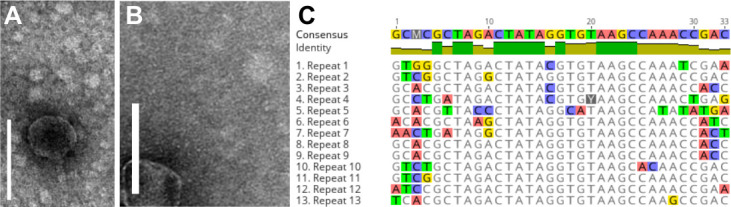 Fig 1
Fig 1| Phage ID | Morphology | Reads | Coverage (fold) | Genome (bp) | GC content (%) | No. of tRNAs | CDS | Function annotated | Coding strand | BLASTn results | ||
|---|---|---|---|---|---|---|---|---|---|---|---|---|
| Capsid size | Tail length | Post-QC | Top 3 best match | Nucleotide identity | ||||||||
| (nm) | (nm) | |||||||||||
| Merry | 1,628,150 | 5,132 | 53,640 | 67.8 | 0 | 93 | 24 | + |
| 57.09% | ||
| 63.63 | 148.36 |
| 55.97% | |||||||||
| (±2.94) | (±11.11) |
| 54.97% | |||||||||
| Sunny | 1,445,364 | 3,691 | 53,642 | 67.8 | 0 | 93 | 24 | + |
| 56.92% | ||
| 72.43 | 145.89 |
| 55.89% | |||||||||
| (±3.81) | (±7.24) |
| 55.28% | |||||||||
- —U.S. Department of Energyhttp://dx.doi.org/10.13039/100000015
- —U.S. Department of Energyhttp://dx.doi.org/10.13039/100000015
Peer Reviews
No public reviews on file for this paper yet. If you reviewed it on a platform where reviews are public (OpenReview, ICLR, NeurIPS, ICML), you can paste yours below so the community can read it here.
Videos
No videos yet. Explain this paper in a talk, walkthrough, or lecture? Add one.
Taxonomy
TopicsBacteriophages and microbial interactions · Genomics and Phylogenetic Studies · Microbial Community Ecology and Physiology
ANNOUNCEMENT
Outdoor algal ponds are a sustainable alternative to produce various biomolecules (1). At Global Algae Innovations (21.996N 159.375W, Lihue, HI, USA), Nannochloris sp. (Chlorophyta) is used and develops an associated microbiome. Microbacterium chocolatum strain GAI20246-6 was isolated from these ponds (2) and demonstrated algicidal properties in laboratory conditions when co-cultivated with Nannochloris sp. We sought to use phage therapy as a strategy to regain algal productivity, thus demonstrating the use of microbacteriophage within commercial applications. Using M. chocolatum strain GAI20246-6 as host for all assays, two phages were isolated.
Using the double-layer method, 50× concentrated (Vivaflow 50R, Sartorius) surface pond water (July 2018–January 2019) was spotted onto a host lawn (30°C Tryptic Soy Agar (TSA) 48 h). Clear viral plaques, indicative of a virulent phage, were isolated from two different samples, and a single clonal population was obtained following three rounds of purification (3). Liquid phage propagations were conducted in Tryptic Soy Broth (TSB) and incubated overnight at 30°C (200 rpm). For TEM, phage particles were stained (2% uranyl acetate) on a grid (Formvar/Carbon 200 mesh TH Copper, Ted Pella) and observed on a JEOL 1400 instrument. DNA was extracted from a phage lysate using the NucleoMag Virus kit (Machery-Nagel) and treated with RNase A (Thermo Scientific, 10 mg/mL). DNA was fragmented for size selection (Covaris S220), and libraries were constructed using Accel-NGS 2S PCR-free DNA library kit (Swift Biosciences), including eight PCR cycles (Kapa HiFi PCR, Kapa Biosystems) due to low DNA input (<10 ng). Sequencing was performed on Illumina MiSeq v2 500 cycles (2 × 150 bp). Reads were trimmed (Trimmomatic v1.2.15 [4]) for quality (minimum score 33) and to remove Illumina adapters (minimum internal and terminal hit length of 10). Viral genomes were assembled using CLC Genomics Workbench (clc_assembler) followed by VirSorter2 (5) and CheckV 1.0.1 (6). Annotation was conducted with Pharokka 1.7.1 (7), where CDS are predicted using Pyrodigal-gv 0.3.1 (8, 9) and PHANOTATE 1.5.1 (10), and tRNAs using tRNAscan-SE 2.0 (11) and Aragorn 1.2.41 (12). Each CDS function was assigned using the PHROG (13), VFDB (14) and CARD (15) databases within MMseq2 (16) and PyHMMER (17). Final annotation was manually curated, and five pairs of primers were designed to confirm genomic termini regions with PCR (2× Taq RED Master Mix, Apex). A repeated motif within both genomes was detected using Geneious Prime 2024.0.4 and aligned with MUSCLE 5.1 (18). Default parameters were used except where otherwise noted.
TEM revealed siphovirus morphology (Fig. 1A and B). BLASTn (19) showed similarity to the genera Quhwahvirus and Metamorphoovirus (Table 1). Genomic features are summarized in Table 1. The genomes differ (nucleotide identity 89%) in a 1 kb region comprising a putative head-tail adaptor gene. Both phages are complete with a circularly permuted genome confirmed through PCR. Phages were assigned to Microbacteriophage Cluster EC based on genome similarity (Table 1) (https://phagesdb.org, accessed on May 2024 [20, 21]) and shared features, such as possessing phage-encoded glycosyltransferase and UDP-glucose dehydrogenase genes, and a conserved 33 bp motif that is repeated 13 times throughout their genome in intergenic regions (Fig. 1C).
TEM micrographs of phage Merry (A) and Sunny (B) (5′-revealed a siphovirus morphology with icosahedral capsid and long flexible tail. Scale bar is 100 nm. Motif gcMcGcTAgaCTATAgGtgtAAGCcaaaccgac-3′) found 13 times throughout the phage genomes (capital letter conserved in all repeats, lower-case letter = conserved in at least 6/13 repeats, M=A/C are equal) (C). The “Y” in repeat 4 indicates a substitution of T>C at position 20 of the consensus sequence, distinguishing Sunny (T) and Merry (C).
The reference list from the paper itself. Each links out to its DOI / PubMed record.
- 1Hachicha R, Elleuch F, Ben Hlima H, Dubessay P, de Baynast H, Delattre C, Pierre G, Hachicha R, Abdelkafi S, Michaud P, Fendri I. 2022. Biomolecules from microalgae and Cyanobacteria: applications and market survey. Appl Sci (Basel) 12:1924. doi:10.3390/app 12041924 · doi ↗
- 2BD K, Frits S, Pham Q, Ravonna M, RB R. 1993. Viability and isolation of marine bacteria by dilution culture: theory, procedures, and initial results. Appl Environ Microbiol 59:881–891. doi:10.1128/aem.59.3.881-891.199316348896 PMC 202203 · doi ↗ · pubmed ↗
- 3Poxleitner M, Pope W, Jacobs-Sera D, Viknesh S, Hatfull GF. 2012. Phage discovery guide. Howard hughes medical institute: Chevy Chase, MD (USA) and the NGRI in silico phage resource guide
- 4Bolger AM, Lohse M, Usadel B. 2014. Trimmomatic: a flexible trimmer for Illumina sequence data. Bioinformatics 30:2114–2120. doi:10.1093/bioinformatics/btu 17024695404 PMC 4103590 · doi ↗ · pubmed ↗
- 5Guo J, Bolduc B, Zayed AA, Varsani A, Dominguez-Huerta G, Delmont TO, Pratama AA, Gazitúa MC, Vik D, Sullivan MB, Roux S. 2021. Vir Sorter 2: a multi-classifier, expert-guided approach to detect diverse DNA and RNA viruses. Microbiome 9:37. doi:10.1186/s 40168-020-00990-y 33522966 PMC 7852108 · doi ↗ · pubmed ↗
- 6Nayfach S, Camargo AP, Schulz F, Eloe-Fadrosh E, Roux S, Kyrpides NC. 2021. Check V assesses the quality and completeness of metagenome-assembled viral genomes. Nat Biotechnol 39:578–585. doi:10.1038/s 41587-020-00774-733349699 PMC 8116208 · doi ↗ · pubmed ↗
- 7Bouras G, Nepal R, Houtak G, Psaltis AJ, Wormald PJ, Vreugde S. 2023. Pharokka: a fast scalable bacteriophage annotation tool. Bioinformatics 39:1–4. doi:10.1093/bioinformatics/btac 776PMC 980556936453861 · doi ↗ · pubmed ↗
- 8Larralde M. 2022. Pyrodigal: python bindings and interface to Prodigal, an efficient method for gene prediction in prokaryotes. JOSS 7:4296. doi:10.21105/joss.04296 · doi ↗