Complete genome analysis of Salmonella enterica subsp. enterica serovar Typhimurium strain K79 isolated from the Buriganga river sediment in Bangladesh
Durdana Mahin Priom, Spencer Mark Mondol, Nayeema Talukder Ema, Md. Rafiul Islam, Md. Mizanur Rahaman

TL;DR
This paper presents the full genome sequence of a Salmonella strain found in river sediment in Bangladesh.
Contribution
The study provides the complete genome sequence of Salmonella Typhimurium strain K79 from Bangladesh.
Findings
The genome size is 4,825,269 bp.
It contains 4,897 coding sequences.
Abstract
We report the complete genome of a Salmonella enterica subsp. enterica serovar Typhimurium strain K79, isolated from Buriganga River sediment in Bangladesh. The genome size was 48,25,269 bp having 4,897 coding sequences.
Genes, proteins, chemicals, diseases, species, mutations and cell lines named across the full text — each resolved to its canonical identifier and authoritative record.
Click any figure to enlarge with its caption.
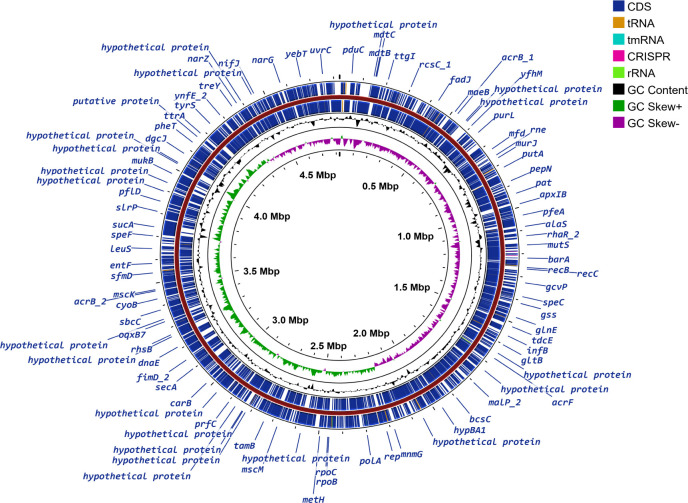 Fig 1
Fig 1| BV-BRC (RASTtk) | |
|---|---|
| Completeness of genome | 100 (CheckM) |
| Coarse consistency | 99.7 |
| Fine consistency | 99.4 |
| Contigs | 1 |
| Genome length | 4,825,269 |
| GC content | 52.158756 |
| Contig L50 | 1 |
| Contig N50 (bp) | 4,825,269 |
| CDS | 4,897 |
| CDS ratio | 1.0148658 |
| Hypothetical CDS | 594 |
| tRNA | 77 |
| rRNA | 7 |
Peer Reviews
No public reviews on file for this paper yet. If you reviewed it on a platform where reviews are public (OpenReview, ICLR, NeurIPS, ICML), you can paste yours below so the community can read it here.
Videos
No videos yet. Explain this paper in a talk, walkthrough, or lecture? Add one.
Taxonomy
TopicsGenomics and Phylogenetic Studies · Salmonella and Campylobacter epidemiology · Bacteriophages and microbial interactions
ANNOUNCEMENT
In Bangladesh, whole-genome sequencing has emerged as a vital tool for elucidating the genomic characteristics of clinically and epidemiologically significant pathogens, contributing to improved public health surveillance (1–4). The Buriganga River, a vital waterway for Dhaka, is heavily polluted due to unchecked industrial discharge and urban waste, making it a significant reservoir of antibiotic-resistant pathogens with serious implications for public and environmental health. In this study, we have isolated a strain of Salmonella enterica subsp. enterica serovar Typhimurium from sediment near Kholamora Ghat along the Buriganga River, located at 23.7154° N latitude and 90.3609° E longitude. A sample was taken from the riverbed at a depth of 5–10 cm using an auger, then preserved in a sterile plastic bag and transported to the laboratory at 4°C in an insulated box. The sample (0.1 mL) was cultured through the spread plate method on xylose lysine deoxycholate agar plate. The single colonies were subcultured at 37°C to get a pure colony. Genomic DNA was extracted using the Genomic DNA Purification Kit for gram-negative bacteria (New England Biolabs, UK) in accordance with the manufacturer’s instructions (NEB#T3010). Whole-genome sequencing was performed on the Illumina MiniSeq platform at the Bangladesh Council of Scientific and Industrial Research (BCSIR). Paired-end libraries were prepared using the Nextera XT DNA Library Preparation Kit (Catalog: FC-131-1096), generating an average insert size of approximately 150 bp. Raw sequencing reads in FASTQ format were assessed for quality using FastQC (v0.11) (5) and subsequently trimmed using Trimmomatic (v0.39) (6) to remove low-quality bases and adapter sequences by setting parameters having a minimum average quality score of 30 and a minimum read length of 50 bp. High-quality reads were assembled de novo using SPAdes (v3.15.4) (7) and scaffolded through Multi-CSAR tool (8) using default parameters. Completeness of the scaffolded genome was checked using CheckM (9). The scaffolded genome was annotated using RASTtk (10) through BV-BRC (11). The circular genome was visualized using Proksee (12), and identification was performed with KmerFinder tool (13). Multi-locus sequence typing (MLST) was performed using the MLST 2.0 tool (14). Antibiotic resistance genes were investigated through CARD:RGI (15) server using default parameters. The virulence factor genes and pathogenicity were determined using the VFDB 2.016) tool using default parameters.
After sequencing, 21,60,13,400 reads were generated. The assembly coverage was 22.5×. The scaffolded complete genome was identified as a strain (K79) of Salmonella enterica subsp. enterica serovar Typhimurium having a genome size of 48,25,269 bp and 4,897 coding sequences (CDS). Genome annotation and mapping revealed key genomic features, as detailed in Table 1 and Fig. 1. The isolate had 594 hypothetical CDS, and through in-depth analysis of these hypothetical proteins, it might be possible to find out proteins having novel functions (17). Salmonella enterica subsp. enterica serovar Typhimurium K79 harbored 26 antimicrobial resistance genes. Among the genes, aac(6')-Iaa is notable, which is an acquired aminoglycoside resistance gene. Additionally, the strain had a 93.7% probability of being a human pathogen with 1,208 pathogenic gene families. The isolate harbored virulence factors of fimbrial adherence determinants such as Fim, Csg, Bcf, Lpf, Saf, Stb, Stc, Std, Sth, Sti, and Stj. Additionally, the isolate had genes for magnesium uptake (mgtB and mgtC), nonfimbrial adherence determinants (misL, ratB, shdA, and sinH), and regulation (phoP and phoQ). The strain also encodes a type III secretion system within Salmonella pathogenicity island 1 and Salmonella pathogenicity island 2. This study provided insights into the genomic characteristics of a pathogenic Salmonella enterica strain isolated from an environmental source, highlighting the significance of adopting a “One Health” approach in the context of Bangladesh.
Circular genome map of Salmonella enterica subsp. enterica serovar Typhimurium strain K79 depicting the organization of CDS, tRNA, rRNA, tmRNA, GC content, and GC skew across the genome.
The reference list from the paper itself. Each links out to its DOI / PubMed record.
- 1Mondol SM, Islam I, Islam MR, Shakil SK, Rakhi NN, Mustary JF Amiruzzaman S Gomes DJ, Shahjalal HM, Rahaman MM. 2024. Genomic landscape of NDM-1 producing multidrug-resistant Providencia stuartii causing burn wound infections in Bangladesh. Sci Rep 14:2246. doi:10.1038/s 41598-024-51819-938278862 PMC 10817959 · doi ↗ · pubmed ↗
- 2Mondol SM, Islam MR, Rakhi NN, Shakil SK, Islam I, Mustary JF Amiruzzaman S Shahjalal HM, Gomes DJ, Rahaman MM. 2024. Unveiling a high-risk epidemic clone (ST 357) of “difficult to treat extensively drug-resistant” (DT-XDR) Pseudomonas aeruginosa from a burn patient in Bangladesh: a resilient beast revealing coexistence of four classes of beta lactamases. J Glob Antimicrob Resist 36:83–95. doi:10.1016/j.jgar.2023.11.01438122983 · doi ↗ · pubmed ↗
- 3Mondol SM, Hossain MA, Haque FKM. 2025. Comprehensive genomic insights into a highly pathogenic clone ST 656 of mcr 8.1 containing multidrug-resistant Klebsiella pneumoniae from Bangladesh. Sci Rep 15:5909. doi:10.1038/s 41598-025-90414-439966674 PMC 11836182 · doi ↗ · pubmed ↗
- 4Islam M, Mondol SM, Hossen M, Khatun M, Selim S, Amiruzzaman S, Gomes DJ, Rahaman M. 2025. First report on comprehensive genomic analysis of a multidrug-resistant Enterobacter asburiae isolated from diabetic foot infection from Bangladesh. Sci Rep 15:424. doi:10.1038/s 41598-024-84870-739748007 PMC 11696989 · doi ↗ · pubmed ↗
- 5Ward CM, To TH, Pederson SM. 2020. ngs Reports: a bioconductor package for managing Fast QC reports and other NGS related log files. Bioinformatics 36:2587–2588. doi:10.1093/bioinformatics/btz 93731841127 · doi ↗ · pubmed ↗
- 6Bolger AM, Lohse M, Usadel B. 2014. Trimmomatic: a flexible trimmer for illumina sequence data. Bioinformatics 30:2114–2120. doi:10.1093/bioinformatics/btu 17024695404 PMC 4103590 · doi ↗ · pubmed ↗
- 7Bankevich A, Nurk S, Antipov D, Gurevich AA, Dvorkin M, Kulikov AS, Lesin VM, Nikolenko SI, Pham S, Prjibelski AD, Pyshkin AV, Sirotkin AV, et al.. 2012. SP Ades: a new genome assembly algorithm and its applications to single-cell sequencing. J Comput Biol 19:455–477. doi:10.1089/cmb.2012.002122506599 PMC 3342519 · doi ↗ · pubmed ↗
- 8Liu S-C, Ju Y-R, Lu CL. 2022. Multi-CSAR: a web server for scaffolding contigs using multiple reference genomes. Nucleic Acids Res 50:W 500–W 509. doi:10.1093/nar/gkac 30135524553 PMC 9252826 · doi ↗ · pubmed ↗