Complete genome sequence of Peptostreptococcus anaerobius SB204, isolated from a human colonic adenocarcinoma
Rutika Gavate, Martha A. Zepeda-Rivera, Dakota S. Jones, Kaitlyn D. LaCourse, Susan Bullman, Christopher D. Johnston

TL;DR
This paper presents the full genome sequence of a Peptostreptococcus anaerobius strain found in a colorectal cancer tumor.
Contribution
The complete genome sequence of Peptostreptococcus anaerobius SB204 is newly reported.
Findings
The genome is a single chromosomal contig of 2.15 Mbp.
The GC content of the genome is 36.1%.
Abstract
We report the complete genome sequence of Peptostreptococcus anaerobius SB204, a strain isolated from the resected tumor of a treatment-naive patient with colorectal cancer. The genome comprises a single chromosomal contig of 2.15 Mbp with an overall GC content of 36.1%.
Genes, proteins, chemicals, diseases, species, mutations and cell lines named across the full text — each resolved to its canonical identifier and authoritative record.
Click any figure to enlarge with its caption.
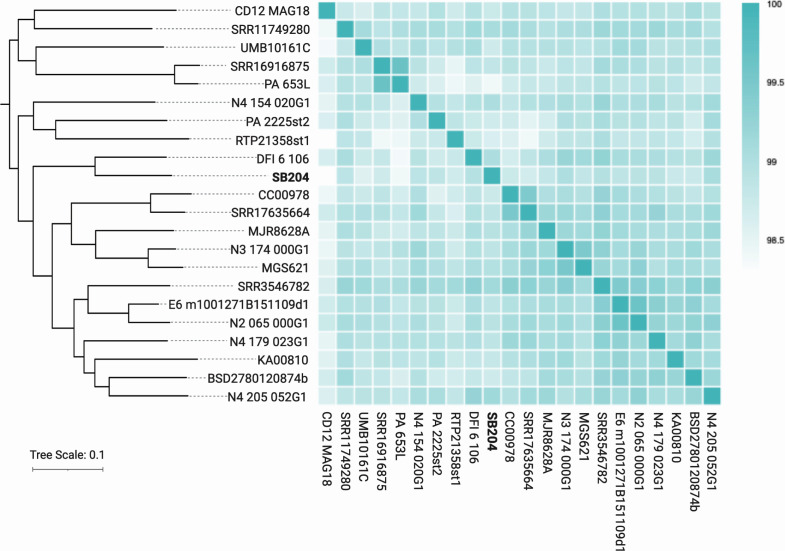 Fig 1
Fig 1| Strain | Accession no. | Isolation source |
|---|---|---|
| CD12_MAG18 |
| Mucosal tissue from Crohn’s disease patient |
| SRR11749280_bin.18_metaWRAP_v1.3_MAG |
| Vaginal metagenome |
| UMB10161C |
| Urine |
| SRR16916875_bin.10_metaWRAP_v1.3_MAG |
| Vaginal metagenome |
| PA 653-L |
| Biological product |
| N4_154_020G1_dasN4_154_020G1_abawaca.36 |
| Infant feces |
| 2225st2_D9_2225SCRN_200828 |
| NA |
| RTP21358st1_C2_RTP21358_211008 |
| NA |
| DFI.6.106 |
| Fecal sample |
| CC00978 |
| NA |
| SRR17635664_bin.8_metaWRAP_v1.3_MAG |
| NA |
| MJR8628A |
| Vagina |
| N3_174_000G1_dasN3_174_000G1_concoct_28 |
| Infant feces |
| MGS621 |
| NA |
| SRR3546782_bin.52_CONCOCT_v1.1_MAG |
| NA |
| E6_m1001271B151109d1_201121 |
| NA |
| N2_065_000G1_dasN2_065_000G1_abawaca.31 |
| Infant feces |
| N4_179_023G1_dasN4_179_023G1_concoct_1 |
| Infant feces |
| KA00810 |
| Vagina |
| BSD2780120874b_170522_E5 |
| NA |
| N4_205_052G1_dasN4_205_052G1_concoct_1 |
| Infant feces |
- —National Cancer Institutehttp://dx.doi.org/10.13039/100019346
- —National Institute of Dental and Craniofacial Researchhttp://dx.doi.org/10.13039/100000072
- —National Cancer Institutehttp://dx.doi.org/10.13039/100019346
Peer Reviews
No public reviews on file for this paper yet. If you reviewed it on a platform where reviews are public (OpenReview, ICLR, NeurIPS, ICML), you can paste yours below so the community can read it here.
Videos
No videos yet. Explain this paper in a talk, walkthrough, or lecture? Add one.
Taxonomy
TopicsGenomics and Phylogenetic Studies · Bacterial Identification and Susceptibility Testing · Infective Endocarditis Diagnosis and Management
ANNOUNCEMENT
Peptostreptococcus anaerobius was originally classified under Streptococcus in 1905 but reclassified to Peptostreptococcus in 1936 due to its distinct anaerobic growth and metabolic characteristics (1). It is a gram-positive, anaerobic, non-spore-forming coccus commonly found in the human gastrointestinal and genitourinary tracts (2–4). Although typically regarded as a commensal organism, it is implicated in a range of infections, including pelvic inflammatory disease (5), dental abscesses (6), intra-abdominal infections (7), and bacteremia (8). Here, we document the isolation and complete genome sequence of P. anaerobius strain SB204 from colorectal adenocarcinoma tissue of a treatment-naive female patient.
With written informed patient consent, approved by the Fred Hutchinson Cancer Center Institutional Review Board (protocol RG-1006552), SB204 was isolated from resected tumor specimen plated on Fastidious Anaerobic Agar (FAA; Oxoid, Thermo Fisher Scientific) supplemented with 10% defibrinated horse blood (Lampire Biological Laboratories, Fisher Scientific) and incubated under anaerobic conditions at 37°C for 48 h (AnaeroGen Gas Generating Systems, Oxoid, Thermo Fisher Scientific). BLAST analysis of the SB204 16S rRNA gene sequence determined initial taxonomic classification as P. anaerobius. High-molecular-weight genomic DNA was extracted using the MasterPure DNA Purification Kit (Epicentre, Lucigen). DNA concentration and quality were measured using the Qubit dsDNA BR Assay Kit (Thermo Fisher Scientific). DNA was sheared via G-tube (Covaris) as previously described (9) and size selected for fragments >5 kb using BluePippin (Sage Science). Sequencing library was prepared using the HiFi Assembly Kit (Pacific Biosciences). Single-molecule real-time (SMRT) sequencing (10) with base kinetics was performed on a PacBio Sequel I instrument with V3 sequencing chemistry (Pacific Biosciences). Sequencing reads were quality filtered and processed using microbial assembler in the Pacific Biosciences’ SMRTAnalysis pipeline (version 9.0.0.92188) with default parameters. Genome assembly was performed using Microbial Assembler, which included error correction and chromosomal rotation to place dnaA at the origin. Genome assembly showed 93,738 polymerase reads that were further partitioned into 591,799 mapped subreads, with an N50 value of 9,175 nucleotides and a total of 4,890,837,089 subread bases, yielding a mean coverage of 2,212×. Average nucleotide identity (ANI) analysis against publicly available P. anaerobius genomes (Table 1, Fig. 1) supported its species-level identification.
Heat map of ANI values among selected P. anaerobius genomes. (Left) Reference-free whole-genome phylogenetic tree of P. anaerobius genomes (n = 22) generated with kSNP4 (11) (kmer = 17, FCK = 0.658) with (right) corresponding heatmap of ANI values. Duplicate genomes (ANI > 99%) have been removed. ANI heatmap was generated with the pheatmap R package, RStudio version 2024.12.0+467. The tree was visualized using iTOL (12), and the figure was made with Biorender.
Genome annotation using the NCBI Prokaryotic Genome Annotation Pipeline (13) (v6.1) identified 1,872 coding sequences, a GC content of 36.1%, and 78 RNAs. PADLOC (14) (v2.0.0) and CRISPR-Cas (15) analysis predicted the presence of multiple defense systems, including Type I-B CRISPR-Cas and Type I restriction-modification (RM) systems. To identify putative nucleotide motifs modified by the Type I RM system, we performed methylome analysis via REBASE (16), which identified m6A modification of TAAYN_5_CTC/CAGN_5_RRT. Analysis via the Comprehensive Antibiotic Resistance Database (17) (v4.0.1) identified antimicrobial resistance genes associated with putative resistance to fluoroquinolones (sdrM), glycopeptides (vanT and vanW), and tetracycline (tetM).
Currently, there are 51 publicly available P. anaerobius genome assemblies, although by ANI analysis, some appear to be duplicates. Notably, SB204 is the first complete genome sequence available for this species and the first reported strain from colorectal tumor tissue (Table 1). This isolate and its genome provide a novel resource for studying the clinical role(s) of this organism, particularly in the tumor microenvironment.
The reference list from the paper itself. Each links out to its DOI / PubMed record.
- 1Murdoch DA. 1998. Gram-positive anaerobic cocci. Clin Microbiol Rev 11:81–120. doi:10.1128/CMR.11.1.819457430 PMC 121377 · doi ↗ · pubmed ↗
- 2Legaria MC, Nastro M, Camporro J, Heger F, Barberis C, Stecher D, Rodriguez CH, Vay CA. 2021. Peptostreptococcus anaerobius: pathogenicity, identification, and antimicrobial susceptibility. Review of monobacterial infections and addition of a case of urinary tract infection directly identified from a urine sample by MALDI-TOF MS. Anaerobe 72:102461. doi:10.1016/j.anaerobe.2021.10246134626800 · doi ↗ · pubmed ↗
- 3Ng J, Ng LK, Chow AW, Dillon JA. 1994. Identification of five Peptostreptococcus species isolated predominantly from the female genital tract by using the rapid ID 32A system. J Clin Microbiol 32:1302–1307. doi:10.1128/jcm.32.5.1302-1307.19948051260 PMC 263676 · doi ↗ · pubmed ↗
- 4Riggio MP, Lennon A. 2002. Development of a PCR assay specific for Peptostreptococcus anaerobius. J Med Microbiol 51:1097–1101. doi:10.1099/0022-1317-51-12-109712466408 · doi ↗ · pubmed ↗
- 5Saini S, Gupta N, Aparna, Batra G, Arora DR. 2003. Role of anaerobes in acute pelvic inflammatory disease. Indian J Med Microbiol 21:189–192. doi:10.1016/S 0255-0857(21)03071-117643017 · doi ↗ · pubmed ↗
- 6Siqueira JF Jr, Rôças IN. 2013. Microbiology and treatment of acute apical abscesses. Clin Microbiol Rev 26:255–273. doi:10.1128/CMR.00082-1223554416 PMC 3623375 · doi ↗ · pubmed ↗
- 7Alvarez JA, Baldonedo RF, Bear IG, Alvarez P, Jorge JL. 2004. Anaerobic liver abscesses as initial presentation of silent colonic cancer. HPB (Oxford) 6:41–42. doi:10.1080/1365182031001579818333045 PMC 2020643 · doi ↗ · pubmed ↗
- 8Minces LR, Shields RK, Sheridan K, Ho KS, Silveira FP. 2010. Peptostreptococcus infective endocarditis and bacteremia. Analysis of cases at a tertiary medical center and review of the literature. Anaerobe 16:327–330. doi:10.1016/j.anaerobe.2010.03.01120371296 · doi ↗ · pubmed ↗