Complete genomes of two Chlamydia psittaci isolated from ducks and pigeons in China
Xiaoxue Wang, Yihan Wang, Yanyan Wang, Junkai Zhang, Chunguo Liu, Ping Liu, Zhaocai Li, Jizhang Zhou

TL;DR
This paper presents the complete genome sequences of two Chlamydia psittaci strains from ducks and pigeons in China, highlighting their genetic differences.
Contribution
The study provides new complete genome sequences of two C. psittaci strains with distinct ompA genotypes from avian hosts in China.
Findings
The duck strain CPS-QD/LS belongs to ompA genotype A.
The pigeon strain CPS-BY/JY belongs to ompA genotype B.
Abstract
Chlamydia psittaci is an important zoonotic pathogen that can transmit from avian to human. Herein, we report complete genome sequences of two C. psittaci strains isolated from ducks and pigeons in China. The duck strain CPS-QD/LS was identified as ompA genotype A, while the pigeon strain CPS-BY/JY was identified as genotype B.
Genes, proteins, chemicals, diseases, species, mutations and cell lines named across the full text — each resolved to its canonical identifier and authoritative record.
Click any figure to enlarge with its caption.
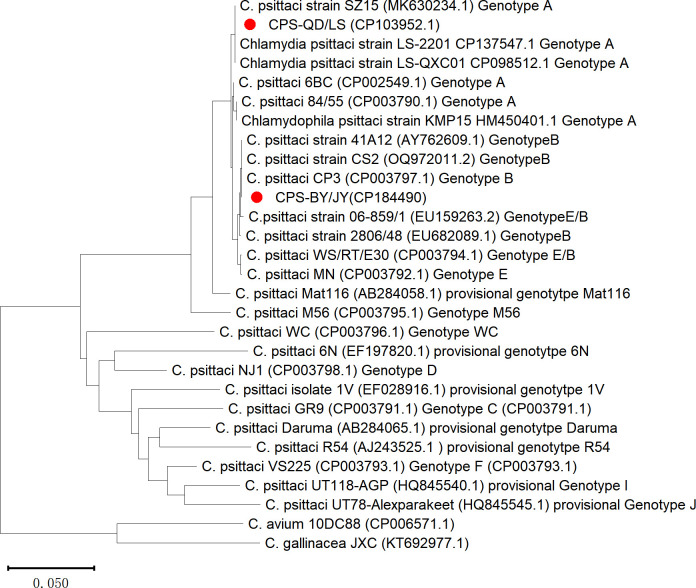 Fig 1
Fig 1| CPS-QD/LS | CPS-BY/JY | |||
|---|---|---|---|---|
| Parameters | Chromosome | Plasmid | Chromosome | Plasmid |
| GenBank accession no. |
|
|
|
|
| Clean data (bp) | 1,087,063,417 (Nanopore) | 2,137,810,282 (Nanopore) | ||
| 929,758,353 (Illumina) | 1,829,539,148 (Illumina) | |||
| Read length for Nanopore (bp) | 174,286 (N50 9.04 kb) | 473,993 (N50 5.55 kb) | ||
| Read length for PacBio (bp) | 6,339,706 | 12,381,778 | ||
| Contig length (bp) | 1,149,432 | 7,553 | 1,168,334 | 7,553 |
| G + C content (%) | 39.08 | 32.95 | 39.05 | 32.82 |
| Sequencing depth (×) | 392.5 (Nanopore) | 486.89 (Nanopore) | ||
| 468.04 (Illumina) | 305.58 (Illumina) | |||
| No. of pseudogenes | 79 | 0 | 88 | 0 |
| No. of tRNAs | 39 | 0 | 39 | 0 |
| No. of rRNAs | 3 | 0 | 3 | 0 |
| No. of tmRNAs | 3 | 0 | 1 | 0 |
| No. of misc_RNA | 3 | 0 | 2 | 0 |
| SRA accession no. |
|
| ||
Peer Reviews
No public reviews on file for this paper yet. If you reviewed it on a platform where reviews are public (OpenReview, ICLR, NeurIPS, ICML), you can paste yours below so the community can read it here.
Videos
No videos yet. Explain this paper in a talk, walkthrough, or lecture? Add one.
Taxonomy
TopicsReproductive tract infections research · Bacterial Identification and Susceptibility Testing · Diphtheria, Corynebacterium, and Tetanus
ANNOUNCEMENT
Chlamydia psittaci is a unique zoonotic intracellular bacterial pathogen that can infect avian species, mammals, and humans (1, 2). Based on ompA gene sequences, the C. psittaci isolates can be classified into nine classical (A to F, E/B, M56, and WC) and several atypical genotypes (3). Previous studies have shown that C. psittaci infections in avian species are common in China. However, few genome data are available for analysis of its genetic diversity and host specificity. During routine detection of Chlamydia species in our laboratory, genomic DNA was isolated from pure cultures of C. psittaci using the TIANamp Genomic DNA Kit (TIANGEN, Beijing) (4). We isolated two C. psittaci strains from real-time PCR-positive duck lung tissue and pigeon cloacal swab samples by inoculating the samples into specific-pathogen-free embryonated chicken eggs (5). The isolates obtained were confirmed by real-time PCR (6) and were named as CPS-QD/LS (duck strain) and CPS-BY/JY (pigeon strain) according to their host origin region. The isolates were then inoculated into the L929 cell line for propagation and purification for genome sequencing.
Purified genome DNA was prepared for sequencing using a combination of Illumina NovaSeq 6000 and Nanopore PromethION platforms. The Illumina library was prepared using the TruSeq DNA Library Prep Kit (Illumina, San Diego, USA) and amplified within the flow cell on an Illumina cBOT instrument for cluster generation (NovaSeq 6000 PE Cluster Kit, Illumina). The clustered flow cell was loaded onto a NovaSeq 6000 sequencer (Illumina) for paired-end sequencing. The purified libraries were loaded onto primed R9.4 Spot-On flow cells and sequenced on a PacBio sequencer (Pacific Biosciences, Menlo Park, USA). Raw reads were filtered with fastp (v.0.23.2) (7), yielding 929,758,353 and 1,829,539,148 bp of clean data for strains CPS-QD/LS and CPS-BY/JY, respectively. In parallel, libraries were prepared using the NEBNext Ultra II DNA Library Prep Kit (NEB, USA) and sequenced on the PromethION platform (Oxford Nanopore Technologies, Oxford, UK) (8). Raw reads were quality-filtered (Q ≥ 7) and length-filtered (≥1,600 bp), generating 1,087,063,417 and 2,137,810,282 bp of pass reads for CPS-QD/LS and CPS-BY/JY, respectively, with N50 values of 9.04 and 5.55 kb. Hybrid genome assembly of Illumina and Nanopore reads was performed using SOAPdenovo (v.2) (9). The repeat sequence analysis was performed using the software RepeatMasker (4.1.2-p1) (10). Circularization of contigs and re-orientation to the dnaA start were assessed and corrected using BLAST. Gene prediction was carried out with Prokka (v.1.14.6) (11). Promoter regions were predicted using PromPredict (v.V1) (12), and transmembrane proteins were identified with TMHMM (v.2.0c) (13). All software was run with default parameters.
The final genomes of C. psittaci were complete, and both genomes comprised a circular chromosome and a plasmid, with GenBank accession numbers CP103952.1, CP103953.1, CP184490.1, and CP184489.1. The genomes were annotated by National Center for Biotechnology Information Prokaryotic Genome Annotation Pipeline (v.6.2/v.6.9). The genome characteristics are summarized in Table 1. Sequence analysis of the ompA gene of the two obtained isolates showed that duck strain CPS-QD/LS was identical to that of a duck isolate, SZ15, and two human isolates in China (14), which could be classified to the ompA genotype A group (Fig. 1), while the ompA gene sequence of CPS-BY/JY matched the C. psittaci strains of the typical genotype B group (15), as shown in Fig. 1. These data may improve our understanding of the genetic diversity and host specificity of this Chlamydia species.
Clustering analysis of Chlamydia psittaci ompA genes.
The reference list from the paper itself. Each links out to its DOI / PubMed record.
- 1Kaleta EF, Taday EMA. 2003. Avian host range of Chlamydophila spp. based on isolation, antigen detection and serology. Avian Pathol 32:435–461. doi:10.1080/0307945031000159361314522700 · doi ↗ · pubmed ↗
- 2Li Z, Liu P, Hou J, Xu G, Zhang J, Lei Y, Lou Z, Liang L, Wen Y, Zhou J. 2020. Detection of Chlamydia psittaci and Chlamydia ibidis in the endangered crested ibis (Nipponia nippon). Epidemiol Infect 148:1–5. doi:10.1017/S 0950268819002231 PMC 701908231910921 · doi ↗ · pubmed ↗
- 3Ravichandran K, Anbazhagan S, Karthik K, Angappan M, Dhayananth B. 2021. A comprehensive review on avian chlamydiosis: a neglected zoonotic disease. Trop Anim Health Prod 53:414. doi:10.1007/s 11250-021-02859-034312716 PMC 8313243 · doi ↗ · pubmed ↗
- 4TIA Namp Genomic DNA Kit. n.d. Available from: https://en.tiangen.com/content/details_156_8223.html
- 5Pantchev A, Sting R, Bauerfeind R, Tyczka J, Sachse K. 2010. Detection of all Chlamydophila and Chlamydia spp. of veterinary interest using species-specific real-time PCR assays. Comp Immunol Microbiol Infect Dis 33:473–484. doi:10.1016/j.cimid.2009.08.00219733907 · doi ↗ · pubmed ↗
- 6Braukmann M, Sachse K, Jacobsen ID, Westermann M, Menge C, Saluz HP, Berndt A. 2012. Distinct intensity of host-pathogen interactions in Chlamydia psittaci- and Chlamydia abortus-infected chicken embryos. Infect Immun 80:2976–2988. doi:10.1128/IAI.00437-1222689815 PMC 3418749 · doi ↗ · pubmed ↗
- 7Chen S, Zhou Y, Chen Y, Gu J. 2018. Fastp: an ultra-fast all-in-one FASTQ preprocessor. Bioinformatics 34:i 884–i 890. doi:10.1093/bioinformatics/bty 56030423086 PMC 6129281 · doi ↗ · pubmed ↗
- 8Kolmogorov M, Billingsley KJ, Mastoras M, et al.. 2023. Scalable Nanopore sequencing of human genomes provides a comprehensive view of haplotype-resolved variation and methylation. Nat Methods 20:1483–1492. doi:10.1038/s 41592-023-01993-x 37710018 PMC 11222905 · doi ↗ · pubmed ↗