Complete genome sequences of Plantago lanceolata latent virus isolated from asymptomatic ribwort plantain plants in France, Italy, and Spain
Denis Filloux, Serge Galzi, Philippe Roumagnac

TL;DR
This paper reports the discovery of Plantago lanceolata latent virus in Western Europe, showing genetic similarity to a previously identified strain in Finland.
Contribution
The paper provides new complete genome sequences of PlLV from France, Italy, and Spain, expanding the geographic and genetic understanding of the virus.
Findings
Four complete genome sequences of PlLV were obtained from France, Italy, and Spain.
The new sequences share 94.17%–97.85% identity with previously identified PlLV genomes from Finland.
Abstract
Plantago lanceolata latent virus (PlLV) that infects ribwort plantain, initially discovered in Finland, is also present in Western Europe. Four complete genome sequences of PlLV from France, Italy, and Spain were obtained that shared 94.17%–97.85% genome-wide pairwise identity with complete genomes of PlLV previously obtained from Finland.
Genes, proteins, chemicals, diseases, species, mutations and cell lines named across the full text — each resolved to its canonical identifier and authoritative record.
Click any figure to enlarge with its caption.
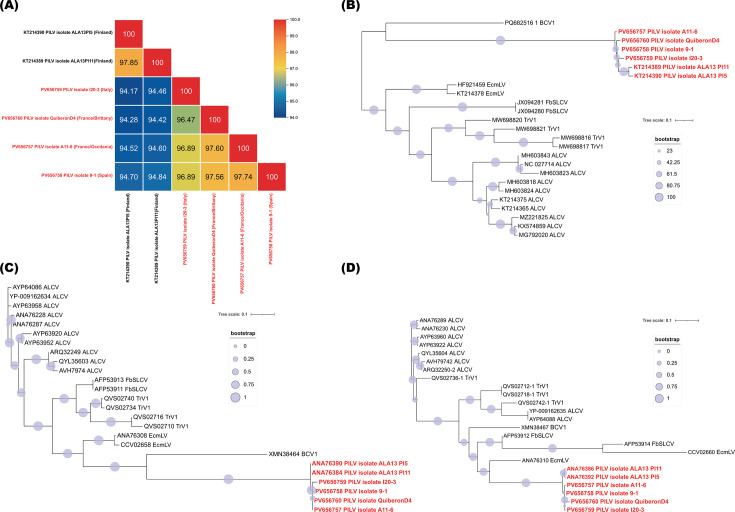 Fig 1
Fig 1| PlLV isolate | Collection date | Location | GPS coordinates | Accession number |
|---|---|---|---|---|
| A11-6 | July 2018 | Assas (Languedoc, France) | 43.702240 3.8893762 |
|
| 9-1 | August 2018 | Carnota (Galicia, Spain) | 42.80580 |
|
| I20-3 | May 2018 | Baricella (Emilia-Romagna, Italy) | 44.644715 11.531441 |
|
| QuiberonD4 | July 2018 | Saint Pierre Quiberon (Brittany, France) | 47.49957 |
|
Peer Reviews
No public reviews on file for this paper yet. If you reviewed it on a platform where reviews are public (OpenReview, ICLR, NeurIPS, ICML), you can paste yours below so the community can read it here.
Videos
No videos yet. Explain this paper in a talk, walkthrough, or lecture? Add one.
Taxonomy
TopicsPlant Virus Research Studies · Legume Nitrogen Fixing Symbiosis · Plant Disease Resistance and Genetics
ANNOUNCEMENT
Plantago lanceolata latent virus (PlLV) that belongs to the genus Capulavirus (Geminiviridae family) infects ribwort plantain (Plantago lanceolata L.) (1), a perennial herb that is native from Eurasia and is now widespread all over the world (2). This virus was discovered in 2015 from asymptomatic, uncultivated ribwort plantain plants collected in the Åland archipelago of southwestern Finland (1). We here investigated to what extent the virus was present outside of Finland, particularly in Western Europe. One hundred and thirty-one leaves from asymptomatic ribwort plantain plants were collected in 2018 from France (94 samples), Italy (17 samples), and Spain (20 samples). Total DNA of ribwort plantain plants was extracted using the DNeasy Plant Mini Kit (Qiagen, Germany). PCR-mediated detection of PlLV from the 131 plant samples was performed using PCR primers F-PlLV_729 (5′-AAGGGAAAGGCTGGTTATGG-3′) and R-PlLV_1013 (5′-GAATCTCTTCTCTGAATCGTGGTC-3′). Amplification conditions consisted of 95°C for 5 min; 30 cycles at 95°C for 45 s, 50°C for 45 s, 72°C for 30 s; and 72°C for 5 min. The PCR amplicons corresponding to visible agarose gel bands were Sanger sequenced by Azenta (Germany) using the ABI3730xl sequencer (Applied Biosystems). PCR analysis revealed that PlLV was present in 2/94 samples in France, 1/17 samples in Italy, and 3/20 samples in Spain. PCR amplification of the complete genome of 4/6 positive samples from France, Italy, and Spain (one sample was selected from each region: Brittany, Galicia, Languedoc, and Emilia-Romagna; Table 1) was performed using a pair of abutting primers, Pla_pstIF (5′-CTGCAGATCATTGTATAAATACTGTCCCAAATACG-3′) and Pla_pstIR (5′-CTGCAGTATCTGTGATATTTGTATACAAATTTCTGAC-3′), as previously described (1). Amplicon products of approximately 2.8 Kbp were excised, gel-purified, and cloned into the plasmid pGEM-T Easy and further Sanger sequenced by primer walking (Azenta). Four PlLV complete genome sequences were obtained, ranging in size from 2,832 nt to 2,834 nt (%GC content of 41.8%). Pairwise identity analyses of the full genome nucleotide sequences were further carried out using SDT v1.2 using default settings (3), and indicated that the four PlLV complete genome sequences obtained in this study and both complete genomes obtained previously from Finland (1) shared 94.17–97.85% genome-wide pairwise identity (Fig. 1A). The observed degree of similarity exceeds the species demarcation threshold recommended for the Capulavirus genus (4), indicating that the four isolates from France, Italy, and Spain could be classified as PlLV variants. The evolutionary relationships of the six PlLV isolates (four from this study and two from the study conducted in Finland) and representative members of capulaviruses were reconstructed using the complete nucleotide genome sequences, the replication-associated protein (REP), and the coat protein (CP) amino acid sequences. Alignment was carried out using MAFFT (5). Block mapping and gathering with entropy (6) were used, and a Maximum-Likelihood tree was inferred by FastTree with 1,000 bootstrap iterations (7). The three phylogenetic analyses based on the complete nucleotide genome sequences (Fig. 1B), the CP protein (Fig. 1C), and the REP protein (Fig. 1D) sequences all indicate that the four PlLV genomes from France, Italy, and Spain cluster with the other two Finnish isolates previously described. This study demonstrates that PlLV is not confined to a few islands in the Baltic Sea but is widespread in Western Europe.
(A) Pairwise identity matrix of the complete genome sequences of PlLV isolates from Finland, France, Italy, and Spain. (B) Maximum likelihood phylogenetic trees with 1,000 bootstrap replicates of complete capulavirus genome nucleotide sequences. (C) Maximum likelihood phylogenetic trees with 1,000 bootstrap replicates of capulavirus capsid protein (CP) amino acid sequences. (D) Maximum likelihood phylogenetic trees with 1,000 bootstrap replicates of capulavirus replication-associated protein (REP) amino acid sequences.
The reference list from the paper itself. Each links out to its DOI / PubMed record.
- 1Susi H, Laine AL, Filloux D, Kraberger S, Farkas K, Bernardo P, Frilander MJ, Martin DP, Varsani A, Roumagnac P. 2017. Genome sequences of a capulavirus infecting Plantago lanceolata in the Åland archipelago of Finland. Arch Virol 162:2041–2045. doi:10.1007/s 00705-017-3298-028283818 · doi ↗ · pubmed ↗
- 2Upadhyay S, Bhandari S, Sharma A, Singh BR, Taj G. 2024. Plantago lanceolata L, p 287–301. In Máthé Á, Khan IA (ed), Medicinal and aromatic plants of India. Vol. Vol 3. Springer Nature Switzerland, Cham.
- 3Muhire BM, Varsani A, Martin DP. 2014. SDT: a virus classification tool based on pairwise sequence alignment and identity calculation. P Lo S One 9:e 108277. doi:10.1371/journal.pone.010827725259891 PMC 4178126 · doi ↗ · pubmed ↗
- 4Varsani A, Roumagnac P, Fuchs M, Navas-Castillo J, Moriones E, Idris A, Briddon RW, Rivera-Bustamante R, Murilo Zerbini F, Martin DP. 2017. Capulavirus and Grablovirus: two new genera in the family Geminiviridae. Arch Virol 162:1819–1831. doi:10.1007/s 00705-017-3268-628213872 · doi ↗ · pubmed ↗
- 5Katoh K, Standley DM. 2013. MAFFT multiple sequence alignment software version 7: improvements in performance and usability. Mol Biol Evol 30:772–780. doi:10.1093/molbev/mst 01023329690 PMC 3603318 · doi ↗ · pubmed ↗
- 6Criscuolo A, Gribaldo S. 2010. BMGE (Block Mapping and Gathering with Entropy): a new software for selection of phylogenetic informative regions from multiple sequence alignments. BMC Evol Biol 10:210. doi:10.1186/1471-2148-10-21020626897 PMC 3017758 · doi ↗ · pubmed ↗
- 7Price MN, Dehal PS, Arkin AP. 2010. Fast Tree 2--approximately maximum-likelihood trees for large alignments. P Lo S One 5:e 9490. doi:10.1371/journal.pone.000949020224823 PMC 2835736 · doi ↗ · pubmed ↗