Draft genome sequence of Tetramitus sp. JP001
Atham Hari Naga Papa Rao, Lakshmanan Vighnesh, Himanshi Bhagat, Chintalapati Sasikala, Chintalapati Venkata Ramana

TL;DR
This paper presents a draft genome of a Tetramitus sp. JP001, a protist isolated from a freshwater plant's rhizoplane.
Contribution
The study provides a new draft genome sequence for a less-studied Tetramitus species.
Findings
The genome size is 34.6 Mb.
The organism was isolated using Escherichia coli JC875 as prey.
Abstract
We report a 34.6 Mb draft genome of Tetramitus sp. JP001, which was isolated from the rhizoplane of a freshwater Marsilea sp. using Escherichia coli JC875 as prey. Despite their biological and ecological implications, members of the Tetramitus genus are not as extensively studied as other protists.
Genes, proteins, chemicals, diseases, species, mutations and cell lines named across the full text — each resolved to its canonical identifier and authoritative record.
Click any figure to enlarge with its caption.
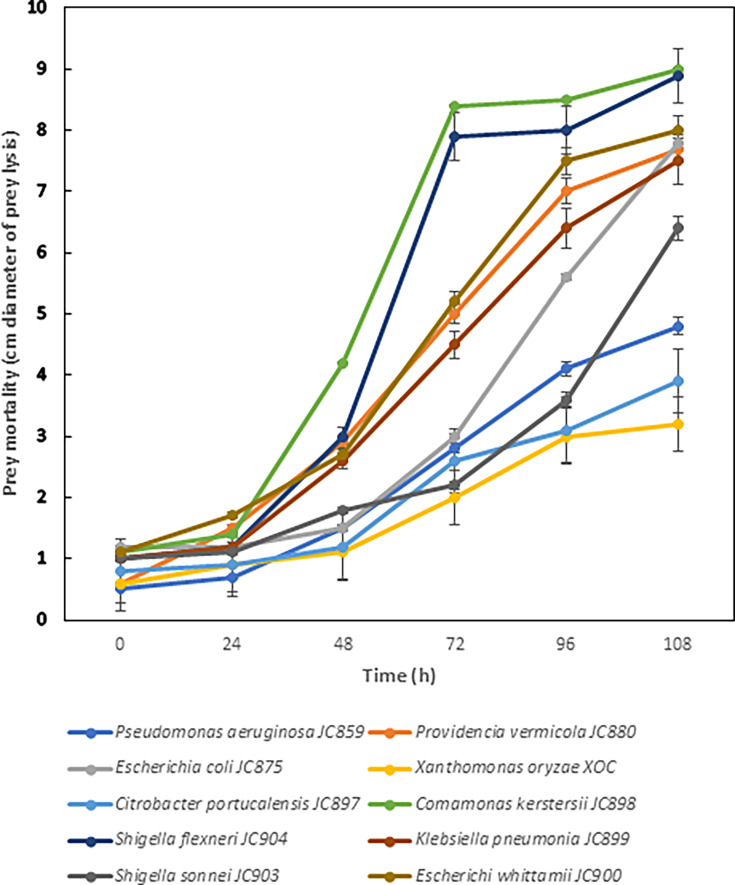 Fig 1
Fig 1Peer Reviews
No public reviews on file for this paper yet. If you reviewed it on a platform where reviews are public (OpenReview, ICLR, NeurIPS, ICML), you can paste yours below so the community can read it here.
Videos
No videos yet. Explain this paper in a talk, walkthrough, or lecture? Add one.
Taxonomy
TopicsProtist diversity and phylogeny · Microbial Community Ecology and Physiology · Genomics and Phylogenetic Studies
ANNOUNCEMENT
Tetramitus is a protozoan that belongs to the Vahlkampfiidae family and can predate on bacteria, yeast, and other protozoans. These members are inhabitants of freshwater and soil (1) and help in the maintenance of ecological balance and promote plant growth (2). This study reports the draft genome of a Tetramitus sp. strain JP001, which predates on some of the plant and animal pathogens (Fig. 1) and can be a candidate live antibiotic (3).
Predation kinetics of strain JP001 on different bacterial prey as measured by the zone of prey lysis.
Tetramitus sp. JP001 was isolated from a freshwater Marsilea sp., from the University of Hyderabad, Hyderabad, India (17.4578°N 78.3182°E). Escherichia coli JC875 lawn was prepared on L.B (Luria broth, HIMEDIA, M575) plate by incubating at 37°C for 24 h. On the surface of the lawn, the Marsilea sp. root sample (1 cm×1 cm) was inoculated. Lysis of the prey was observed after 7 days of incubation as a clear zone and increased with time. For Shotgun sequencing, the sample was prepared by culturing Tetramitus sp. on E. coli lawn at 37°C for 96 h. The lysed zone of the prey was scraped and suspended in 1 mL of saline and was outsourced to Allele Tech Private Limited, Hyderabad, for DNA extraction and sequencing. The DNA was extracted using the QIAGEN Bacterial Extraction Kit as per the manufacturer’s instructions. The Nano Photometer N60 and Qubit DNA HS Assay Kit were used for DNA quantification. The library was prepared using the QIAseq FX DNA Library Core Kit, and the paired-end (2×150 bp) sequencing was carried out by Illumina’s NovoSeq 6000 platform. A total of 25,054,035 reads were obtained, which were then processed using fastp v0.23.4 (4). E. coli reads were removed by using BBduk (5) by giving E. coli DSM 30083 as the reference genome. The decontaminated reads from BBduk were used for assembly generation. MEGAHIT v1.2.9 (6) was used to assemble the reads. The resulting assembly was then binned using MaxBin2 v2.2.4 (7), which generated a metagenome-assembled genome (MAG). All tools and software used for analyzes were either performed on the Galaxy server (8) or the Kbase platform (9) with the default parameters. Barrnap 0.9 (10) was used to retrieve rRNA gene sequences from the MAG. The 18S rRNA gene sequence (2139 bp) was retrieved from the genome, which showed the highest identity of 98.3% with Tetramitus lobospinosus ATCC30298; however, the genome sequence of this strain is not available.
The genome size of strain JP001 is 34.6 Mb, and the GC content is 39%. There are 8,354 contigs with an N50 value of 4.5 kb. The assembly was mapped back to the decontaminated reads using Bowtie2 (11), which showed a 63.73% overall alignment and 67.77 mean coverage. BUSCO v5.8.0 (12) analysis was carried out for the genome. Out of the 255 BUSCOs in the eukaryota_odb10 lineage data set, 170 complete BUSCOs were present in the genome of strain JP001.
The reference list from the paper itself. Each links out to its DOI / PubMed record.
- 1Denet E, Coupat-Goutaland B, Nazaret S, Pélandakis M, Favre-Bonté S. 2017. Diversity of free-living amoebae in soils and their associated human opportunistic bacteria. Parasitol Res 116:3151–3162. doi:10.1007/s 00436-017-5632-628988383 · doi ↗ · pubmed ↗
- 2Rosenberg K, Bertaux J, Krome K, Hartmann A, Scheu S, Bonkowski M. 2009. Soil amoebae rapidly change bacterial community composition in the rhizosphere of Arabidopsis thaliana. ISME J 3:675–684. doi:10.1038/ismej.2009.1119242534 · doi ↗ · pubmed ↗
- 3Cavallo FM, Jordana L, Friedrich AW, Glasner C, van Dijl JM. 2021. Bdellovibrio bacteriovorus: a potential “living antibiotic” to control bacterial pathogens. Crit Rev Microbiol 47:630–646. doi:10.1080/1040841 X.2021.190895633934682 · doi ↗ · pubmed ↗
- 4Chen S, Zhou Y, Chen Y, Gu J. 2018. fastp: an ultra-fast all-in-one FASTQ preprocessor. Bioinformatics 34:i 884–i 890. doi:10.1093/bioinformatics/bty 56030423086 PMC 6129281 · doi ↗ · pubmed ↗
- 5Bushnell B, Rood J, Singer E. 2017. BB Merge - accurate paired shotgun read merging via overlap. P Lo S One 12:e 0185056. doi:10.1371/journal.pone.018505629073143 PMC 5657622 · doi ↗ · pubmed ↗
- 6Li D, Liu CM, Luo R, Sadakane K, Lam TW. 2015. MEGAHIT: an ultra-fast single-node solution for large and complex metagenomics assembly via succinct de Bruijn graph. Bioinformatics 31:1674–1676. doi:10.1093/bioinformatics/btv 03325609793 · doi ↗ · pubmed ↗
- 7Wu YW, Simmons BA, Singer SW. 2016. Max Bin 2.0: an automated binning algorithm to recover genomes from multiple metagenomic datasets. Bioinformatics 32:605–607. doi:10.1093/bioinformatics/btv 63826515820 · doi ↗ · pubmed ↗
- 8Abueg LAL, Afgan E, Allart O, Awan AH, Bacon WA, Baker D, Bassetti M, Batut B, Bernt M, Blankenberg D, et al.. 2024. The galaxy platform for accessible, reproducible, and collaborative data analyses: 2024 update. Nucleic Acids Res 52:W 83–W 94. doi:10.1093/nar/gkae 41038769056 PMC 11223835 · doi ↗ · pubmed ↗