Complete genome sequence of the Niallia sp. strain Kr1, a bacterium isolated from a geothermal power plant in Iceland
Danae Bregnard, Diego Gonzalez, Deirdre E. Clark, Ásgerður K. Sigurðardóttir, Simona Regenspurg, Pilar Junier

TL;DR
This paper presents the full genome sequence of a new bacterial species from a geothermal site in Iceland.
Contribution
The study provides the complete genome sequence of a potentially new Niallia species.
Findings
The genome of Niallia sp. strain Kr1 was fully sequenced.
The bacterium was isolated from geothermal fluids in Iceland.
The strain is gram-negative and spore-forming.
Abstract
We report the complete genome sequence of the Niallia sp. strain Kr1, a gram-negative, spore-forming bacterium isolated from the geothermal fluids of an Icelandic geothermal power plant injection well. This strain belongs to a putative new species within the Niallia genus.
Genes, proteins, chemicals, diseases, species, mutations and cell lines named across the full text — each resolved to its canonical identifier and authoritative record.
Click any figure to enlarge with its caption.
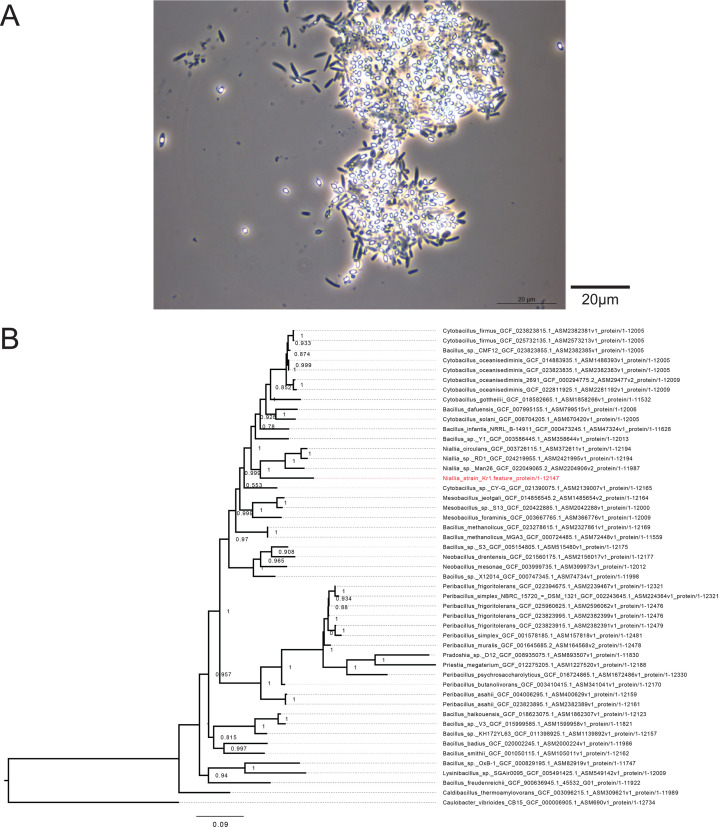 Fig 1
Fig 1- —Horizon 2020 Framework Programmehttp://dx.doi.org/10.13039/100010661
- —HORIZON EUROPE Framework Programmehttp://dx.doi.org/10.13039/100018693
- —Helmholtz-Zentrum Potsdam - Deutsches GeoForschungsZentrum GFZhttp://dx.doi.org/10.13039/501100010956
Peer Reviews
No public reviews on file for this paper yet. If you reviewed it on a platform where reviews are public (OpenReview, ICLR, NeurIPS, ICML), you can paste yours below so the community can read it here.
Videos
No videos yet. Explain this paper in a talk, walkthrough, or lecture? Add one.
Taxonomy
TopicsGenomics and Phylogenetic Studies · Bacterial Identification and Susceptibility Testing · Plant Pathogens and Fungal Diseases
ANNOUNCEMENT
The Niallia genus, recently separated from the Bacillus genus, encompasses eight bacterial species (1), including Niallia circulans (2–4), and Niallia nealsonii, isolated from the clean room of a space-craft assembly (5). Strain Kr1, a spore-forming bacterium (Fig. 1A), was isolated from geothermal fluids (well-head temperature: 106.8°C; 1L of fluids collected from the well-head in a sterile 1L Nalgen bottle; sample stored at 4°C until processing) collected from an electricity-producing power plant injection well in Iceland (65.7142293 N, 16.7303151 W). Enrichment was done in Marine Broth 2216 (BD Difco, USA) at 60°C without agitation (1 mL of sample for 25 mL of culture medium). Subsequent cultivation on solid Marine Broth 2216 (1.5% agar) led to the isolation of one bacterium.
(A) Optical microscopy image of the strain Kr1 (vegetative cells and spores) under phase-contrast (spores appear bright) (5), using a Leica DMR Fluorescence microscope with a Leica DFC7000T camera . Scale bar represents 20 µm. (B) Phylogenetic tree based on 40 conserved proteins, placing the strain Kr1 within the NNiallia genus. The placement of strain Kr1 is highlighted in red.
Genomic DNA was extracted from a culture in Marine Broth 2216 (incubation at 30°C, 110 rpm for 48 h) using the Wizard HMW DNA Extraction Kit (Promega, USA). Sequencing was performed on a Pacific Biosciences Sequel II instrument after DNA shearing, size selection, and HiFi SMRTbell Library construction according to PacBio SMRTbell prep kit 3.0 recommendations (average insert size: 8,755 bp; chemistry v.11.1.0.154383). A full circular genome was assembled and circularized from 24,461 HiFi reads (default PacBio QC and trimming) using unicycler (6) (v.0.5.0), miniasm for assembly, and racon (v.1.5.0) for polishing (average coverage: 40 ×, N50: 8,658). The arbitrary start of the linearized sequence was positioned at the start of the dnaA gene using circlator (7) (v.1.5.5). One consistently methylated motif (Gm6AYNNNNNRTARC/GYTm6AYNNNNNRTC, >99% detection rate) was identified by Smrtlink (v.11). The genome was annotated using NCBI Prokaryotic Genome Annotation Pipeline (v.6.5). Assembly quality was assessed using CheckM (8) (estimated completeness 97.14%, contamination 6.25%).
The circular complete genome had 5,151,560 bps with a 37% G+C content, including 4,748 protein-coding genes, 17 copies of each ribosomal RNA gene (5S, 16S, 23S), 193 tRNAs, nine non-coding RNAs (signal recognition particle sRNA, 6S RNA, and RNA component of RNase P, and the transfer-messenger RNA); 82 additional putative protein-coding genes were predicted to be pseudogenes. The amino acid composition of the full proteome showed a limited ERK bias around −14 (9), which suggests that the strain is moderately thermophilic (predicted optimal growth temperature 50–60°C). Its presence in geothermal waters is likely due to the production of resistant spores, as all 78 genes considered essential for sporulation in Clostridia (10) were present in the genome. Endospores have been observed in other Niallia strains (5).
GTDB-tk (v. 2.20) (11) was not capable of assigning a rank beyond the order (Bacillales) to strain Kr1. Average nucleotide identity based on pyani (12) (v.0.2.12) gave the highest ANI values with Peribacillus asahii GCF_004006295.1 (73.93%) and with N. circulans GCF_003726095.1 (73.69%). A phylogenetic tree based on a set of ribosomal and translation-related proteins (elongation factor G/ L14/L15/L16/L17/L18/L2/L22/L23/L24/L3/L36/L4/L5/L6/S10/S11/S12/S13/S14/S17/S19/S3/S4/S5/S7/S8/Tu) from all complete Firmicute genomes available on NCBI by 1 June 2023, aligned with muscle (13) (v. 3.8.31) and analyzed with iqtree (14) (v. 3.0.0), placed strain Kr1 within the Niallia genus close to the Cytobacillus genus (Fig. 1B).
The reference list from the paper itself. Each links out to its DOI / PubMed record.
- 1Yuan J, Zhang W, Dang L, Song Y, Yin Z, He Z, Xu K, Guo P, Yin H. 2025. Niallia tiangongensis sp. nov., isolated from the China Space Station. Int J Syst Evol Microbiol 75:006693. doi:10.1099/ijsem.0.00669340029317 · doi ↗ · pubmed ↗
- 2Logan NA, Old DC, Dick HM. 1985. Isolation of Bacillus circulans from a wound infection. J Clin Pathol 38:838–839. doi:10.1136/jcp.38.7.8384019805 PMC 499315 · doi ↗ · pubmed ↗
- 3Ray AK, Bairagi A, Ghosh KS, Sen SK. 2007. Optimization of fermentation conditions for cellulase production by Bacillus subtilis CY 5 and Bacillus circulans TP 3 isolated from fish gut. Acta Ichthyol Piscat 37:47–53. doi:10.3750/AIP 2007.37.1.07 · doi ↗
- 4Mehta P, Chauhan A, Mahajan R, Mahajan PK, Shirkot CK. 2010. Strain of Bacillus circulans isolated from apple rhizosphere showing plant growth promoting potential. Curr Sci 98:538–542.
- 5Venkateswaran K, Kempf M, Chen F, Satomi M, Nicholson W, Kern R. 2003. Bacillus nealsonii sp. nov., isolated from a spacecraft-assembly facility, whose spores are gamma-radiation resistant. Int J Syst Evol Microbiol 53:165–172. doi:10.1099/ijs.0.02311-012656168 · doi ↗ · pubmed ↗
- 6Wick RR, Judd LM, Gorrie CL, Holt KE. 2017. Unicycler: resolving bacterial genome assemblies from short and long sequencing reads. P Lo S Comput Biol 13:e 1005595. doi:10.1371/journal.pcbi.100559528594827 PMC 5481147 · doi ↗ · pubmed ↗
- 7Hunt M, Silva ND, Otto TD, Parkhill J, Keane JA, Harris SR. 2015. Circlator: automated circularization of genome assemblies using long sequencing reads. Genome Biol 16:294. doi:10.1186/s 13059-015-0849-026714481 PMC 4699355 · doi ↗ · pubmed ↗
- 8Parks DH, Imelfort M, Skennerton CT, Hugenholtz P, Tyson GW. 2015. Check M: assessing the quality of microbial genomes recovered from isolates, single cells, and metagenomes. Genome Res 25:1043–1055. doi:10.1101/gr.186072.11425977477 PMC 4484387 · doi ↗ · pubmed ↗