Draft genome sequences of Burkholderia and Paraburkholderia strains isolated from Panicum virgatum soil and roots at the Lux Arbor Reserve in Michigan, USA
Hanna Kehlet-Delgado, Renee H. Petipas, Amanda A. Antoch, Jeffrey S. Norman, Xiufen Li, Richard Allen White, Sarah E. Evans, Lisa K. Tiemann, Maren L. Friesen

TL;DR
This paper provides draft genome sequences of four bacteria strains found in soil and switchgrass roots in Michigan.
Contribution
The study contributes new draft genome sequences of Burkholderia and Paraburkholderia strains from a specific ecological context.
Findings
Draft genomes of two Paraburkholderia and two Burkholderia strains were sequenced.
Three strains were isolated from soil, and one from switchgrass roots.
The isolates were collected from the Lux Arbor Reserve in Michigan, USA.
Abstract
We present draft genomes of two Paraburkholderia strains and two Burkholderia strains. Three strains were isolated from surrounding soils and one from roots of switchgrass (Panicum virgatum) in Michigan, USA.
Genes, proteins, chemicals, diseases, species, mutations and cell lines named across the full text — each resolved to its canonical identifier and authoritative record.
Click any figure to enlarge with its caption.
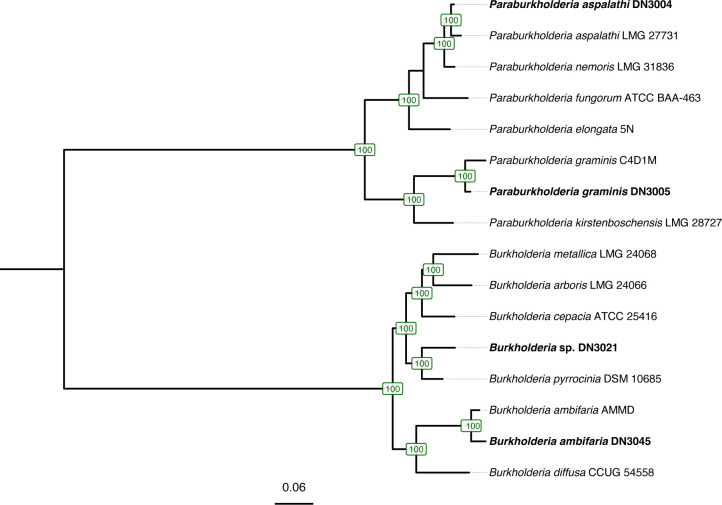 Fig 1
Fig 1| Strain | DN3021 | DN3045 | DN3004 | DN3005 |
|---|---|---|---|---|
| Taxonomic designation |
|
|
| |
| TYGS dDDH (d4 %) (type strain accession) | 60.3 | 74.0 | 83.1 ( | 88.5 ( |
| Num. reads | 7,511,444 | 7,101,634 | 7,678,508 | 8,670,830 |
| Size (bp) | 7,830,195 | 7,165,103 | 8,487,362 | 7,184,575 |
| Contigs (n) | 292 | 133 | 53 | 39 |
| GC content (%) | 66.50 | 66.75 | 61.49 | 63.01 |
| N50 (bp) | 69,387 | 95,302 | 466,079 | 511,957 |
| L50 (n) | 34 | 23 | 7 | 5 |
| Median (bp) | 8,988 | 37,443 | 37,328 | 89,241 |
| Completeness (%) | 99.94 | 99.48 | 99.94 | 99.5 |
| Contamination (%) | 0.64 | 0.08 | 0.85 | 0 |
| Coverage (x) | 151 | 143 | 175 | 155 |
| Num. coding sequences (total) | 7,358 | 6,492 | 7,544 | 6,386 |
| Num. RNAs (5S, 16S, 23S) | 2, 2, 2 | 1, 2, 4 | 1, 1, 4 | 1, 1, 2 |
| Num. tRNAs | 61 | 58 | 55 | 52 |
| Genbank accession |
|
|
|
|
| Assembly accession |
|
|
|
|
| SRA accession |
|
|
|
|
| BioSample accession |
|
|
|
|
Peer Reviews
No public reviews on file for this paper yet. If you reviewed it on a platform where reviews are public (OpenReview, ICLR, NeurIPS, ICML), you can paste yours below so the community can read it here.
Videos
No videos yet. Explain this paper in a talk, walkthrough, or lecture? Add one.
Taxonomy
TopicsPlant Disease Resistance and Genetics · Genomics and Phylogenetic Studies · Plant Pathogens and Fungal Diseases
ANNOUNCEMENT
Understanding the microbes associated with switchgrass, a dedicated biofuel crop, is critical to increase the sustainability of biofuel production. Root and soil samples used in isolations were collected from the switchgrass monoculture plots (treatment G5) at the Lux Arbor Reserve site (42.4764, −85.4519) of the Marginal Lands Experiment, established in 2015 as part of the Great Lakes Bioenergy Research Center in Michigan, USA. Here, there are four replicated blocks, each containing a switchgrass plot, and each plot contains sub-plots, treated with nitrogen at a rate of 56 kg/ha/year or no nitrogen. Soils at the site are Typic Hapludalfs (Alfisol) with a loam texture. Soils have a pH of 5.8, 0.77% total C, 0.06% total N, and 12 ppm inorganic phosphorus (1). Paraburkholderia aspalathi DN3004, Paraburkholderia graminis DN3005, and Burkholderia sp. DN3021 was isolated from 10-cm soil cores containing root material taken near switchgrass plants in unfertilized plots. Burkholderia ambifaria DN3045 was isolated from switchgrass roots collected from fertilized plots.
Soil for isolations was suspended and diluted in 0.9% NaCl buffer. Strains DN3004 and DN3005 were isolated onto Burk’s Medium (2) made with sucrose (20 g/L). DN3021 was isolated onto Burk’s with sucrose in a 2% oxygen environment. For isolating DN3045, a one-inch segment of root was surface sterilized with bleach, rinsed with sterile water, and inserted into Burk’s soft agar with mannitol. Isolation protocols were adapted from reference (3). Isolates were cultured at 30°C. After recovery from frozen stocks (−80°C), plating on Burk’s agar with sucrose and 0.5 g/L NH_4_Cl, and incubation at 30°C, checking every 24 h until growth was evident, a single colony was selected to be grown under the same conditions for genomic DNA extraction from agar-grown colonies with the DNeasy PowerLyzer Microbial Kit (Qiagen, Germantown, MD, USA). DNA was purified using Sera-Mag Speedbeads carboxylated magnetic beads (Thermo Fisher Scientific, Waltham, MA, USA) and eluted in Tris buffer. Library preparation and whole genome sequencing were done at SeqCenter (Pittsburgh, PA). DNA libraries were prepared using the Illumina DNA Prep kit and IDT 10 bp UDI indices and sequenced on an Illumina NextSeq 2000, producing 2 × 151 bp reads. Demultiplexing, quality control, and adapter trimming were performed with bcl2fastq (v2.17; Illumina). Reads were assembled with Spades v3.14.1 (4) within Shovill (v. 1.1.0) (5) with the following options: genome size 7.5 Mb; minimum contig length 500 bp, “--trim,” and minimum coverage of 20×. Genome statistics was calculated with QUAST v5.2.0 (6). Genomes were assessed for completeness and contamination with CheckM v1.2.3 (7). Genomes were annotated using the NCBI Prokaryotic Genome Annotation Pipeline (PGAP) v6.10 (8). For taxonomic identification, we used the Type Strain Genome Server (TYGS) v391 to obtain digital DNA-DNA hybridization (dDDH) values with type strains (9, 10). Within PhyloPhlAn v3.0.67 (11), Diamond v2.1.8 (12) was used to perform a search against a database of 400 amino acid marker sequences universally conserved in bacteria (11, 13) using the options “--diversity medium” and “--accurate” against proteomes from genomes of the four newly sequenced strains and 12 reference Burkholderia and Paraburkholderia downloaded from NCBI. Marker genes were aligned using Mafft v7.520 (14), trimmed with trimAl “--gappyout” (15), and concatenated for phylogenetic reconstruction (Fig. 1) with RAxML v8.2.12 (16) under the model “PROTCATLG” with 1000 rapid bootstraps. Default parameters were used for all tools unless otherwise noted. Detailed genome information and accession numbers can be found in Table 1. These genomes may help expand our knowledge of potential growth-promoting bacteria associated with switchgrass.
Phylogenetic relationships based on concatenated conserved marker gene sequences of Burkholderia and Paraburkhoderia strains isolated from switchgrass (indicated in bold) and related reference genomes were inferred through the maximum-likelihood method with RAxML v8.2.12 (15). Tree was re-rooted at the midpoint. Bootstrap values are displayed at nodes. Scale bar indicates amino acid substitutions per site.
The reference list from the paper itself. Each links out to its DOI / PubMed record.
- 1Kasmerchak CS, Schaetzl R. 2018. Soils of the GLBRC marginal land expeirment (MLE) sites. Zenodo. 10.5281/ZENODO.2578238. · doi ↗
- 2Strandberg GW, Wilson PW. 1968. Formation of the nitrogen-fixing enzyme system in Azotobacter vinelandii. Can J Microbiol 14:25–31. doi:10.1139/m 68-0055644401 · doi ↗ · pubmed ↗
- 3Mirza BS, Rodrigues JLM. 2012. Development of a direct isolation procedure for free-living diazotrophs under controlled hypoxic conditions. Appl Environ Microbiol 78:5542–5549. doi:10.1128/AEM.00714-1222660701 PMC 3406155 · doi ↗ · pubmed ↗
- 4Bankevich A, Nurk S, Antipov D, Gurevich AA, Dvorkin M, Kulikov AS, Lesin VM, Nikolenko SI, Pham S, Prjibelski AD, Pyshkin AV, Sirotkin AV, Vyahhi N, et al.. 2012. SP Ades: a new genome assembly algorithm and its applications to single-cell sequencing. J Comput Biol 19:455–477. doi:10.1089/cmb.2012.002122506599 PMC 3342519 · doi ↗ · pubmed ↗
- 5Seemann T. 2023. Perl. Shovill. Available from: https://github.com/tseemann/shovill
- 6Mikheenko A, Saveliev V, Hirsch P, Gurevich A. 2023. Web QUAST: online evaluation of genome assemblies. Nucleic Acids Res 51:W 601–W 606. doi:10.1093/nar/gkad 40637194696 PMC 10320133 · doi ↗ · pubmed ↗
- 7Parks DH, Imelfort M, Skennerton CT, Hugenholtz P, Tyson GW. 2015. Check M: assessing the quality of microbial genomes recovered from isolates, single cells, and metagenomes. Genome Res 25:1043–1055. doi:10.1101/gr.186072.11425977477 PMC 4484387 · doi ↗ · pubmed ↗
- 8Tatusova T, Di Cuccio M, Badretdin A, Chetvernin V, Nawrocki EP, Zaslavsky L, Lomsadze A, Pruitt KD, Borodovsky M, Ostell J. 2016. NCBI prokaryotic genome annotation pipeline. Nucleic Acids Res 44:6614–6624. doi:10.1093/nar/gkw 56927342282 PMC 5001611 · doi ↗ · pubmed ↗