Complete genome sequence of Bradyrhizobium lupini strain BA2, isolated from root nodules of Retama dasycarpa
Mouad Lamrabet, Zohra Chaddad, Soufiane Alami, Mustapha Missbah El Idrissi

TL;DR
This paper presents the full genome sequence of Bradyrhizobium lupini strain BA2, isolated from a plant's root nodules, providing a key reference for the species.
Contribution
The paper provides the first high-quality complete genome of Bradyrhizobium lupini in public databases.
Findings
The complete genome of Bradyrhizobium lupini strain BA2 was sequenced.
This genome serves as the reference for the B. lupini species.
Abstract
In this study, we report the complete genome of Bradyrhizobium lupini strain BA2, isolated from Retama dasycarpa root nodules. As the only high-quality complete genome of B. lupini in public databases, this assembly serves as the species reference.
Genes, proteins, chemicals, diseases, species, mutations and cell lines named across the full text — each resolved to its canonical identifier and authoritative record.
Click any figure to enlarge with its caption.
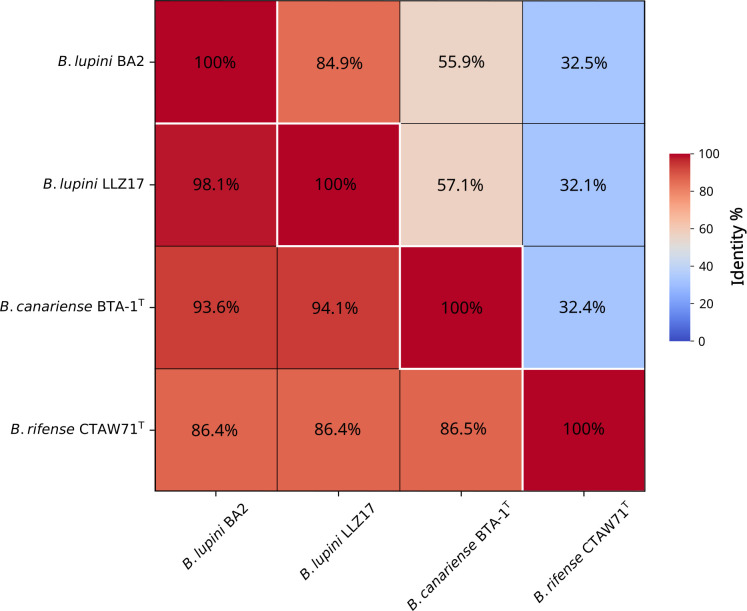 Fig 1
Fig 1| Parameter | Value for |
|---|---|
| No. of raw reads | 18,904 |
| No. of cleaned reads | 17,810 |
| Mean read length (bp) | 10,330 |
| Read N50 (bp) | 18,805 |
| No. of contigs | 2 |
| Genome length (bp) | 8,467,455 |
| Coverage (×) | 64 |
| Chromosome length (bp) | 7,971,975 |
| Plasmid length (bp) | 495,480 |
| GC content (%) | 63.08 |
| No. of CDSs | 7,532 |
| No. of rRNAs | 3 |
| No. of tRNAs | 48 |
| No. of ncRNAs | 4 |
| BioSample ID |
|
| BioProject ID |
|
| NCBI RefSeq assembly |
|
Peer Reviews
No public reviews on file for this paper yet. If you reviewed it on a platform where reviews are public (OpenReview, ICLR, NeurIPS, ICML), you can paste yours below so the community can read it here.
Videos
No videos yet. Explain this paper in a talk, walkthrough, or lecture? Add one.
Taxonomy
TopicsLegume Nitrogen Fixing Symbiosis · Plant nutrient uptake and metabolism · Botanical Research and Chemistry
ANNOUNCEMENT
Bradyrhizobium spp. are Gram-negative bacteria that fix atmospheric nitrogen in symbiosis with leguminous plants (1). Bradyrhizobium lupini strain BA2 was isolated from nodules of Retama dasycarpa growing in the Ait Benammar region of the High Atlas Mountains, Morocco (31°38′96.16″N, 7°40′86.57″W) (2). Nodules were surface-sterilized with HgCl_2_ and ethanol, crushed, and streaked onto yeast extract-mannitol agar (YEM). Plates were incubated at 28°C for 10 days, and pure cultures were obtained through repeated subculturing.
The strain BA2 appears as an efficient nitrogen-fixing bacteria that promote plant growth-promoting (PGP) activities and exhibits high tolerance to water stress (2, 3). It was previously identified as B. lupini USDA 3051^T^ based on multi-locus sequence analysis (2). In this work, we present the complete genome sequence of B. lupini BA2, which will provide valuable insights into the genomic features involved in the symbiosis, stress tolerance, and plant growth-promoting traits.
Genomic DNA (gDNA) was extracted from a 5-day bacterial culture incubated in TY liquid medium at 28°C (4), using the PureLink Genomic DNA miniKit (Invitrogen by Life Technologies). The library was prepared using the Rapid Barcoding Sequencing Kit (SQK-RBK004) and sequenced on the GridION x5 device, using FLO-MIN106 flowcell (Oxford Nanopore Technologies, Oxford, UK). Base calling was performed using MinKNOW software (v. 24.02.16) with high-accuracy base calling mode in Dorado software (version 7.3.11). The quality of the generated reads was examined using LongQC software (v. 1.2.1) (5), and the low-quality reads and adapter were trimmed and filtered using Porechop (v. 0.2.4) (6), and nanofilt (v. 2.8.0) (7), respectively. De novo assembly was performed using Flye (v. 2.9.2) (8), which assessed circularity by detecting overlapping ends in the assembly graph. Circular sequences were rotated with Circlator v1.5.5 (9), which placed the replication initiator gene (dnaA) at nucleotide position 1 on the chromosome and oriented the plasmid at its respective replication-associated genes. Then, the genome sequences were sequentially corrected using racon (v. 1.5.0) (10) and polished by Medaka (v. 1.11.3) (11) to generate consensus sequences. The completeness of the assemblies was assessed using BUSCO (v. 5.7.1) (12) and checked using Quast (v. 5.2.0) (13). The assembled genome was annotated via NCBI Prokaryotic Genome Annotation Pipeline (PGAP) (14), and the average nucleotide identity (ANI) values were calculated using Pyani software v. 0.2.12 (ANIb method) (15) against closely related type and representative genomes obtained from NCBI RefSeq. Digital DNA-DNA hybridization (dDDH) was computed with GGDC 3.0 (16), using formula 2. Default parameters were used for all software.
The complete genome assembly comprises two circular contigs: a chromosome (7,971,975 bp; 63% GC) and a plasmid (495,480 bp; 61.5% GC), with a sequencing coverage of 64×. Annotation identified 8,100 genes, including 7,532 protein-coding sequences (CDSs) and 55 RNA genes (Table 1). Phylogenomic analysis showed 98.4% ANI and 84.9% dDDH with the closest relative, B. lupini LLZ14 (GCA_040939785.1), exceeding species thresholds (95%–96% ANI, 70% dDDH) (17) (Fig. 1). These results confirm the classification of strain BA2 as B. lupini and establish it as a high-quality genomic reference for future studies on this species.
Comparative genomic analysis of Bradyrhizobium lupini BA2 and closely related type strains. The heatmap displays pairwise average nucleotide identity (ANI) percentages (lower triangle) and digital DNA-DNA hybridization (dDDH) values (upper triangle).
The reference list from the paper itself. Each links out to its DOI / PubMed record.
- 1Ormeño-Orrillo E, Martínez-Romero E. 2019. A genomotaxonomy view of the Bradyrhizobium genus. Front Microbiol 10:1334. doi:10.3389/fmicb.2019.0133431263459 PMC 6585233 · doi ↗ · pubmed ↗
- 2Lamrabet M, Chaddad Z, Bouhnik O, Alami S, Kaddouri K, Bennis M, Lamin H, Mnasri B, Bourgerie S, Morabito D, Abdelmoumen H, Bedmar EJ, Missbah El Idrissi M. 2023. Different species of Bradyrhizobium from symbiovars genistearum and retamae nodulate the endemic Retama dasycarpa in the High Atlas Mountains. FEMS Microbiol Ecol 99:fiad 038. doi:10.1093/femsec/fiad 03837019822 · doi ↗ · pubmed ↗
- 3Lamrabet M, Chaddad Z, Bouhnik O, Kaddouri K, Alami S, Bennis M, Mnasri B, Abdelmoumen H, El Idrissi MM. 2024. Effect of native plant growth promoting osmotolerant Bradyrhizobium strains on drought stress tolerance in Retama dasycarpa. Agric, Ecosyst Environ, Appl Soil Ecol 203:105662. doi:10.1016/j.apsoil.2024.105662 · doi ↗
- 4Beringer JE. 1974. R factor transfer in Rhizobium leguminosarum. Microbiology (Reading, Engl) 84:188–198. doi:10.1099/00221287-84-1-1884612098 · doi ↗ · pubmed ↗
- 5Fukasawa Y, Ermini L, Wang H, Carty K, Cheung MS. 2020. Long QC: a quality control tool for third generation sequencing long read data. G 3 Bethesda Md 10:1193–1196. doi:10.1534/g 3.119.40086432041730 PMC 7144081 · doi ↗ · pubmed ↗
- 6Wick RR, Judd LM, Gorrie CL, Holt KE. 2017. Completing bacterial genome assemblies with multiplex Min ION sequencing. Microb Genom 3:e 000132. doi:10.1099/mgen.0.00013229177090 PMC 5695209 · doi ↗ · pubmed ↗
- 7De Coster W, D’Hert S, Schultz DT, Cruts M, Van Broeckhoven C. 2018. Nano Pack: visualizing and processing long-read sequencing data. Bioinformatics 34:2666–2669. doi:10.1093/bioinformatics/bty 14929547981 PMC 6061794 · doi ↗ · pubmed ↗
- 8Kolmogorov M, Yuan J, Lin Y, Pevzner PA. 2019. Assembly of long, error-prone reads using repeat graphs. Nat Biotechnol 37:540–546. doi:10.1038/s 41587-019-0072-830936562 · doi ↗ · pubmed ↗