Complete genome sequence of nitrogen-fixing Rossellomorea marisflavi strain A1 isolated from the rhizosphere of Zea mays L. cultivar Xianyu 335
Hao Li, Qingliu Wu, Xianhong Yong, Xiaoyan Li, Shengyue Tang, Yuxiao Huang, Bin Ni

TL;DR
This paper presents the full genome sequence of a nitrogen-fixing bacterium found in the roots of a corn plant in Beijing.
Contribution
The complete genome sequence of Rossellomorea marisflavi strain A1 is newly reported.
Findings
The genome consists of a single circular chromosome of 4,417,820 bp.
It also includes a plasmid of 500,082 bp.
Abstract
We report the complete genome sequence of Rossellomorea marisflavi strain A1, a nitrogen-fixing bacterium isolated from the rhizosphere of Zea mays L. (cultivar Xianyu 335) grown in Beijing, China. The genome comprises a single circular chromosome (4,417,820 bp) and one plasmid (500,082 bp).
Genes, proteins, chemicals, diseases, species, mutations and cell lines named across the full text — each resolved to its canonical identifier and authoritative record.
Click any figure to enlarge with its caption.
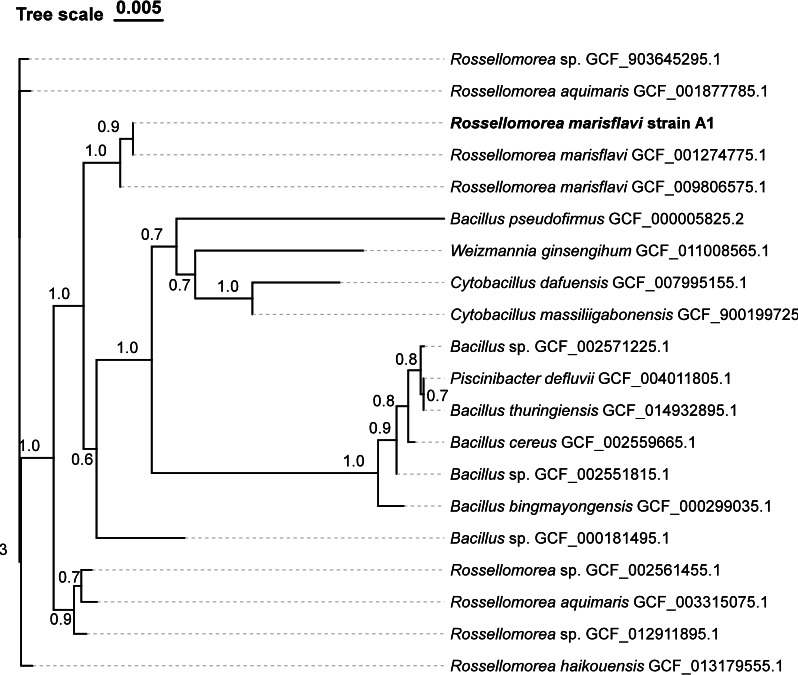 Fig 1
Fig 1| Parameter | Strain A1 |
|---|---|
| Total no. of raw reads (Illumina) | 3412234 |
| Total no. of reads (PacBio) | 49487 |
| N50 value (bp) | 9891 |
| Avg read length (bp) | 9550.57 |
| Genome size (bp) | 4417820 |
| G + C content (%) | 47.97 |
| Coverage (%) | 100 |
| Coding genes in non-redundant protein database (NCBI) | 4849 |
| Coding genes in Swiss-Prot database | 3556 |
| Coding genes in Pfam database | 3861 |
| Coding genes in COG database | 3566 |
| Coding genes in GO database | 1968 |
| Coding genes in KEGG database | 3209 |
- —National Key Research and Development Program of Chinahttp://dx.doi.org/10.13039/501100012166
- —National Natural Science Foundation of Chinahttp://dx.doi.org/10.13039/501100001809
- —Chinese Universities Scientific Fundhttp://dx.doi.org/10.13039/501100005236
Peer Reviews
No public reviews on file for this paper yet. If you reviewed it on a platform where reviews are public (OpenReview, ICLR, NeurIPS, ICML), you can paste yours below so the community can read it here.
Videos
No videos yet. Explain this paper in a talk, walkthrough, or lecture? Add one.
Taxonomy
TopicsPlant-Microbe Interactions and Immunity · Genomics and Phylogenetic Studies · Plant Disease Resistance and Genetics
ANNOUNCEMENT
Plant-associated microbes play essential roles in nutrient cycling and plant growth promotion. Nitrogen-fixing bacteria (diazotrophs), in particular, are of great interest due to their contribution to sustainable agriculture (1–3). In this study, we isolated strain A1 from the rhizosphere of maize (Zea mays L. cultivar “Xianyu 335”), which demonstrated nitrogen-fixing ability and was identified as Rossellomorea marisflavi.
Rhizosphere samples were obtained by harvesting maize plants grown for 8 weeks in greenhouse conditions using natural soil. Rhizosphere soil was collected by shaking roots in sterile water, and the resulting suspension was serially diluted in 10% Tryptic Soy Broth (TSB) to a 1:2,000 dilution. Aliquots (150 µL) were plated in 96-well plates and incubated at room temperature for 2 weeks (4). Pure culture was isolated by three rounds of continuous streaking. Strain A1 was isolated as a single colony and cultured in 50% TSB for 12 h. Taxonomic identification was performed using 16S rRNA gene sequencing with primers 27F (5′-AGAGTTTGATCCTGGCTCAG-3′) and 1492R (5′-AGAGTTTGATCCTGGCTCAG-3′). BLAST analysis against the National Center for Biotechnology Information (NCBI) NT database (20230605) identified the closest match (identity: 100%) as R. marisflavi (GenBank: GCF_001274775.1). The similarity (98.39%) between strain A1 and R. marisflavi (GCA_001274775.1) was confirmed by ANI analysis, supporting the species-level classification alongside the 16S rRNA identity. A phylogenetic tree was constructed with the Neighbor-Joining method by MEGA (v6.0) with 20 publicly available reference genomes (Fig. 1).
Phylogenetic relationships of R. marisflavi strain A1. The tree was constructed using the Neighbor-Joining method in MEGA v6.0 with 20 publicly available reference genomes. Bootstrap values (1,000 replicates) are shown at the branch nodes. Reference genomes were selected by BLAST similarity to strain A1, including the five closest matches and additional genomes chosen at every fifth rank to illustrate diversity; consequently, some genomes from related genera are included. R. marisflavi strain A1 is shown in bold.
Genomic DNA was extracted using the Wizard Genomic DNA Purification Kit (Promega, USA). Genome sequencing was conducted using a combination of PacBio RS II Single-Molecule Real-Time (SMRT) and Illumina platforms at Shanghai Majorbio Bio-Pharm Technology Co., Ltd (Shanghai, China). The sequencing methods followed those described in our previous study (5). Illumina sequencing libraries were prepared from the sheared fragments using the NEXTflex Rapid DNA-Seq Kit (Bioo Scientific, USA). For Pacific Biosciences sequencing, the g-tubes (Covaris, USA) method was used to shear the genomic DNA to approximately 8–10 kb fragments. The SMRTbell prep kit 3.0 (Pacific Biosciences, USA) was used to construct the libraries, and a 10 kb insert library was prepared and sequenced on one SMRT cell (Pacific Biosciences, USA).
The genome was determined with PacBio and Illumina (6). Illumina reads were quality-filtered using fastp (v0.20.0) (7), yielding 12,623,180 high-quality reads. Hybrid genome assembly was carried out using Unicycler (v0.4.8), with Pilon (v1.22) used for polishing (8, 9). The complete genome consists of a circular chromosome and one plasmid (500,082 bp, G + C content: 39.40%), both successfully assembled with no rotation. Genome statistics are detailed in Table 1. Gene prediction was performed using Prodigal (v2.6.3) (10) for coding DNA sequences, tRNAscan-SE (v2.0.12) (11) for tRNA genes, Barrnap (https://github.com/tseemann/barrnap) for rRNA detection, and Infernal (v1.1.5) (12) for sRNA. Functional annotation was conducted against the NCBI non-redundant protein database, Swiss-Prot (13), Pfam (14), Clusters of Orthologous Genes (COG) (15), Gene Ontology (GO), and Kyoto Encyclopedia of Genes and Genomes (KEGG) (16).
The genome contains 5,109 coding sequences, 149 tRNAs, 33 rRNAs, and 99 sRNAs, supporting its metabolic capacity and nitrogen-fixation potential.
The reference list from the paper itself. Each links out to its DOI / PubMed record.
- 1Pang Z, Mao X, Zhou S, Yu S, Liu G, Lu C, Wan J, Hu L, Xu P. 2023. Microbiota-mediated nitrogen fixation and microhabitat homeostasis in aerial root-mucilage. Microbiome 11:85. doi:10.1186/s 40168-023-01525-x 37085934 PMC 10120241 · doi ↗ · pubmed ↗
- 2Zhang L, Zhang M, Huang S, Li L, Gao Q, Wang Y, Zhang S, Huang S, Yuan L, Wen Y, Liu K, Yu X, Li D, Zhang L, Xu X, Wei H, He P, Zhou W, Philippot L, Ai C. 2022. A highly conserved core bacterial microbiota with nitrogen-fixation capacity inhabits the xylem sap in maize plants. Nat Commun 13:3361. doi:10.1038/s 41467-022-31113-w 35688828 PMC 9187771 · doi ↗ · pubmed ↗
- 3Compant S, Cassan F, Kostić T, Johnson L, Brader G, Trognitz F, Sessitsch A. 2025. Harnessing the plant microbiome for sustainable crop production. Nat Rev Microbiol 23:9–23. doi:10.1038/s 41579-024-01079-139147829 · doi ↗ · pubmed ↗
- 4Zhang J, Liu Y-X, Guo X, Qin Y, Garrido-Oter R, Schulze-Lefert P, Bai Y. 2021. High-throughput cultivation and identification of bacteria from the plant root microbiota. Nat Protoc 16:988–1012. doi:10.1038/s 41596-020-00444-733442053 · doi ↗ · pubmed ↗
- 5Li H, Wu QL, Yu PG, Ni B. 2024. Complete genome sequence of Achromobacter sp. strain E 1, an endophyte from Zea mays L (Zheng dan 958). Microbiol Resour Announc 13:e 0056024. doi:10.1128/mra.00560-2439189723 PMC 11465803 · doi ↗ · pubmed ↗
- 6Chin CS, Alexander DH, Marks P, Klammer AA, Drake J, Heiner C, Clum A, Copeland A, Huddleston J, Eichler EE, Turner SW, Korlach J. 2013. Nonhybrid, finished microbial genome assemblies from long-read SMRT sequencing data. Nat Methods 10:563–569. doi:10.1038/nmeth.247423644548 · doi ↗ · pubmed ↗
- 7Chen S, Zhou Y, Chen Y, Gu J. 2018. Fastp: an ultra-fast all-in-one FASTQ preprocessor. Bioinformatics 34:i 884–i 890. doi:10.1093/bioinformatics/bty 56030423086 PMC 6129281 · doi ↗ · pubmed ↗
- 8Wick RR, Judd LM, Gorrie CL, Holt KE. 2017. Unicycler: resolving bacterial genome assemblies from short and long sequencing reads. P Lo S Comput Biol 13:e 1005595. doi:10.1371/journal.pcbi.100559528594827 PMC 5481147 · doi ↗ · pubmed ↗