Genome sequences of Aspergillus fumigatus strains isolated from wildfowl in Southern Ontario, Canada
Oscar Romero, Magalie Galarneau, Samanta Pladwig, Boyan Liu, Sherri Cox, Jennifer Geddes-McAlister

TL;DR
This paper reports the genome sequences of four Aspergillus fumigatus strains found in wildfowl in Southern Ontario, linking the fungus to bird mortality.
Contribution
The study provides new genome sequences of A. fumigatus from wildfowl, supporting a potential link to mortality in these birds.
Findings
Four A. fumigatus strains were isolated from wildfowl in Southern Ontario.
Phenotypic and phylogenetic analysis confirmed the presence of A. fumigatus.
The findings suggest a correlation between A. fumigatus infection and wildfowl mortality.
Abstract
We present the genome sequences of four Aspergillus fumigatus strains isolated from infected wildfowl collected from Wildlife Rehabilitation Centers in Southern Ontario, Canada. Phenotypic and phylogenetic assessment confirmed infection with A. fumigatus, suggesting a correlation between fungal infection and wildfowl mortality.
Genes, proteins, chemicals, diseases, species, mutations and cell lines named across the full text — each resolved to its canonical identifier and authoritative record.
Click any figure to enlarge with its caption.
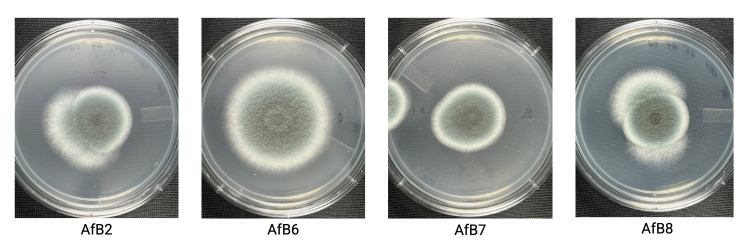 Fig 1
Fig 1| Assembly | # contigs | Largest contig | Total length | GC (%) | N50 | Coverage | Completeness |
|---|---|---|---|---|---|---|---|
| AfB2 | 279 | 760,125 | 28,135,400 | 49.47 | 221,218 | 152.68 × | 97% |
| AfB6 | 255 | 1,001,284 | 27,990,059 | 49.54 | 264,710 | 148.03 × | 97.7% |
| AfB7 | 293 | 703,397 | 27,958,471 | 49.46 | 214,179 | 168.96 × | 97% |
| AfB8 | 294 | 787,527 | 28,065,029 | 49.46 | 210,363 | 178.97 × | 96.8% |
- —Canada Research Chairshttp://dx.doi.org/10.13039/501100001804
Peer Reviews
No public reviews on file for this paper yet. If you reviewed it on a platform where reviews are public (OpenReview, ICLR, NeurIPS, ICML), you can paste yours below so the community can read it here.
Videos
No videos yet. Explain this paper in a talk, walkthrough, or lecture? Add one.
Taxonomy
TopicsMycotoxins in Agriculture and Food · Plant Pathogens and Fungal Diseases · Microbial infections and disease research
ANNOUNCEMENT
Invasive aspergillosis (IA) is a fungal infection caused by Aspergillus species affecting humans and animals, including birds (1). Such infections have severe impacts on host health, and rising rates of antifungal resistance limit the efficacy of current treatments (2). In this study, we isolated Aspergillus fumigatus from four wildfowl submitted to wildlife rehabilitation centers in Southern Ontario, Canada, with suspected cases of IA (3). Specimens included a male osprey (isolate: AfB2), a female peregrine falcon (isolate: AfB6), and male (isolate: AfB7) and female (isolate: AfB8) broad-winged hawks.
Within the avian respiratory tract (e.g., lungs and air sacs), tissue samples were collected from aspergillosis-like lesions. Samples were homogenized in microcentrifuge tubes containing 0.8 g of steel beads (2 mm, Fisher Scientific) and 1 mL of phosphate-buffered saline (PBS) using a bullet blender (Next Advance) for 2×5 min cycles. Visual assessment of fungal growth and Aspergillus spp. identification was performed by plating serial dilutions (10^2^, 10^1^) of homogenates on yeast peptone dextrose ( 1% yeast extract, 2% peptone, 2% glucose, 1.5% agar) plates for 7 d at 30 °C. The cultures yielded green mold-like colonies, characteristic of Aspergillus spp. (Fig. 1) (4). Next, a swab of the initial culture was plated for 5 d at 37 °C on potato dextrose agar (PDA; 20% potato infusion, 2% glucose, 1.5% agar). Following sufficient growth, a conidial resuspension was prepared using 5 mL PBS-Tween-20 (Thermo Scientific). Genomic DNA was extracted from the conidial suspension with the Fungi/Yeast Genomic DNA Isolation Kit (Norgen Biotek) as per manufacturer instructions. Illumina sequencing libraries were prepared with the Illumina DNA Prep Kit and custom IDT 10 bp unique dual indices with a target insert size of 280 bp. Sequencing was performed on an Illumina NovaSeq X Plus sequencer in one or more multiplexed shared-flow-cell runs, producing 2×151 bp paired-end reads. Default parameters were applied for bioinformatic tools, unless otherwise specified. Demultiplexing, quality control, and adapter trimming were performed with bcl-convert v4.2.4 (5). The short read assembly was performed with Unicycler v0.5.0 (6), and the analysis was recorded with Quast v5.2.0 (Table 1) (7). The genomes were annotated with Funannotate v1.8.15 (8) with InterProScan and eggnog mapper enabled.
Solid cultures of A. fumigatus strains isolated from wildfowl in Southern Ontario, Canada, following 3 d of growth on PDA at 37 °C.
The reference list from the paper itself. Each links out to its DOI / PubMed record.
- 1Denning DW. 2024. Global incidence and mortality of severe fungal disease. Lancet Infect Dis 24:e 428–e 438. doi:10.1016/S 1473-3099(23)00692-838224705 · doi ↗ · pubmed ↗
- 2Woods M, Mc Alister JA, Geddes-Mc Alister J. 2023. A one health approach to overcoming fungal disease and antifungal resistance. WIR Es Mech Dis 15:e 1610. doi:10.1002/wsbm.161037102189 · doi ↗ · pubmed ↗
- 3Romero O, Galarneau M, Pladwig S, Liu B, Cox S, Geddes-Mc Alister J. 2025. Aspergillus fumigatus isolated from diverse wildfowl exhibit distinct antifungal susceptibility profiles driven by genetic and non-genetic determinants. Fungal Genet Biol 180:104016. doi:10.1016/j.fgb.2025.10401640513644 · doi ↗ · pubmed ↗
- 4de Hoog S, Guarro J, Gené J, Ahmed S, Al-Hatmi AMS, Figueras MJ, Vitale R. 2019. Atlas of clinical fungi. 4th ed. Westerdijk Institute Universitat Rovira i Virgili, Utrecht / Reus.
- 5Illumina. 2025. Bcl-convert. https://support.illumina.com/sequencing/sequencing_software/bcl-convert/downloads.html.
- 6Wick RR, Judd LM, Gorrie CL, Holt KE. 2017. Unicycler: resolving bacterial genome assemblies from short and long sequencing reads. P Lo S Comput Biol 13:e 1005595. doi:10.1371/journal.pcbi.100559528594827 PMC 5481147 · doi ↗ · pubmed ↗
- 7Gurevich A, Saveliev V, Vyahhi N, Tesler G. 2013. QUAST: quality assessment tool for genome assemblies. Bioinformatics 29:1072–1075. doi:10.1093/bioinformatics/btt 08623422339 PMC 3624806 · doi ↗ · pubmed ↗
- 8Palmer JM, Stajich J. 2020. Funannotate v 1.8.1: eukaryotic genome annotation (v 1.8.1). Zenodo. doi:10.5281/zenodo.4054262 · doi ↗