Draft genome sequencing of a multidrug-resistant Escherichia coli strain MBBL25_EM1 isolated from a cow diagnosed with endometritis
Mahmuda Nasrin Juthi, Tanvir Shahriar, Md. Morshedur Rahman, Kazi Khalid Ibne Khalil, Anup Kumar Talukder, M. Nazmul Hoque, Ziban Chandra Das

TL;DR
This paper presents the draft genome of a drug-resistant Escherichia coli strain from a cow with uterine inflammation.
Contribution
The study provides a detailed genomic analysis of a multidrug-resistant E. coli strain linked to bovine endometritis.
Findings
The genome contains 50 antimicrobial resistance genes and 52 virulence factor genes.
The strain was isolated from a crossbred dairy cow diagnosed with endometritis.
Abstract
This study reports the draft genome of a multidrug-resistant Escherichia coli MBBL25_EM1, isolated from a crossbred dairy cow with endometritis. The 4.8 Mbp genome, assembled into 139 contigs, harbors 50 antimicrobial resistance genes and 52 virulence factor genes, highlighting its pathogenic potential in causing endometritis in dairy cows.
Genes, proteins, chemicals, diseases, species, mutations and cell lines named across the full text — each resolved to its canonical identifier and authoritative record.
Click any figure to enlarge with its caption.
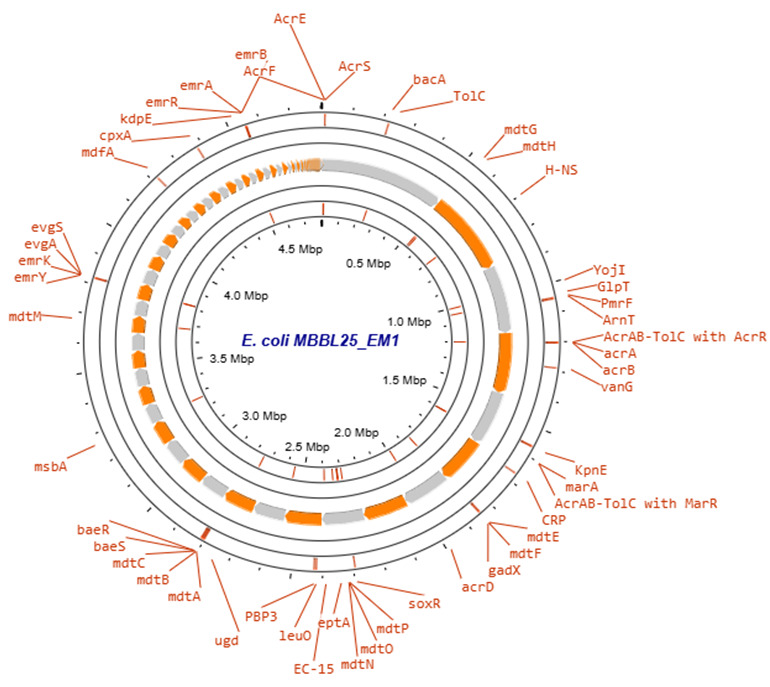 Fig 1
Fig 1| Genome feature | |
|---|---|
| GenBank accession |
|
| Assembled genome size (bp) | 4,804,213 |
| GC (%) | 50.7 |
| Coverage (×) | 103 |
| Genome completeness (%) | 99.56 |
| CheckM contamination (%) | 0.37 |
| BioSample accession no. |
|
| BioProject accession no. |
|
| 176,117 | |
| Number of contigs | 139 |
| Genes (total) | 4,720 |
| CDSs (total) | 4,638 |
| Genes (coding) | 4,519 |
| CDSs (with protein) | 4,519 |
| Genes (RNA) | 82 |
| rRNAs | 3, 3, 1 (5S, 16S, 23S) |
| Complete rRNAs | 1 (23S) |
| tRNAs | 67 |
| ncRNAs | 8 |
| Pseudogenes (total) | 119 |
| CDSs (without protein) | 119 |
| Pseudogenes (ambiguous residues) | 0 of 119 |
| Pseudogenes (frameshifted) | 53 of 119 |
| Pseudogenes (incomplete) | 62 of 119 |
| Pseudogenes (internal stop) | 23 of 119 |
| Pseudo genes (multiple problems) | 18 of 119 |
| CRISPR arrays | 2 |
| Number of ARGs | 50 |
| Number of VFGs | 52 |
| PathogenFinder score | 0.946 |
| MBBL25_EM1 matched with pathogenic families | 673 |
Peer Reviews
No public reviews on file for this paper yet. If you reviewed it on a platform where reviews are public (OpenReview, ICLR, NeurIPS, ICML), you can paste yours below so the community can read it here.
Videos
No videos yet. Explain this paper in a talk, walkthrough, or lecture? Add one.
Taxonomy
TopicsEscherichia coli research studies · Probiotics and Fermented Foods · Gut microbiota and health
ANNOUNCEMENT
Escherichia coli, a ubiquitous gram-negative bacterial pathogen, is usually responsible for infection in various hosts, such as human and animal, and known as a causative agent for endometritis of dairy cows (1). E. coli is of great concern as it has the potential to acquire multidrug resistance and is also a zoonotic pathogen (1, 2). This study aims to report the draft genome sequence of an E. coli isolate, MBBL25_EM1, isolated from the uterine discharge of a crossbred dairy cow clinically diagnosed with endometritis in a dairy farm located at the Gazipur district (23.99°N, 90.41°E) of Bangladesh. A uterine sample was collected according to the standard veterinary procedure for postpartum cows (3). For the isolation of E. coli, swab samples were enriched overnight in nutrient broth (Oxoid, UK) at 37°C under aerobic conditions, followed by a 10⁻³ serial dilution and streaking onto Eosin Methylene Blue agar (Oxoid) (2, 4, 5). Colonies exhibiting a metallic green sheen after 24 h were sub-cultured, and the isolates were identified as E. coli based on colony morphology, Gram staining (gram-negative), and biochemical tests (2, 6). Species-level identification of E. coli was performed using the VITEK-2 System v.9.01 (7). MBBL25_EM1 was tested against 15 antibiotics and showed resistance to vancomycin, oxacillin, colistin sulfate, polymyxin B, and streptomycin, as determined by Kirby-Bauer disk diffusion following Clinical and Laboratory Standards Institute M100 (2023) guidelines (8). Genomic DNA was extracted from pure colonies of MBBL25_EM1 grown on nutrient agar at 37°C for 24 h using the QIAamp DNA Mini Kit (QIAGEN, Germany) (9, 10). Sequencing libraries were prepared from 1 ng of DNA with the Nextera XT Kit (Illumina, USA) and sequenced on an Illumina MiSeq platform with 2 × 250 bp paired-end reads (11, 12).
Raw reads (n = 3,977,952) underwent trimming with Trimmomatic v.0.39 (13) and quality checking through FastQC v.0.11.7 (14). The draft genome was assembled using SPAdes v.3.15.5 (15) and annotated using the National Center for Biotechnology Information Prokaryotic Genome Annotation Pipeline v.6.10 (16). Genome completeness, antimicrobial resistance genes (ARGs), virulence factor gene (VFGs), plasmid, pathogenicity score, and clustered regularly interspaced short palindromic repeats (CRISPR) arrays in the draft genome were predicted using CheckM v.1.2.4 (17), CARD v.4.0.1 (18), VFDB v.6.0 (19), PlasmidFinder v.2.0.1 (20), PathogenFinder2 v.0.5.0 (21), and CRISPRCasFinder v.2.0.3 (22), respectively. All the tools used in this study were used with default parameters unless otherwise stated.
The features of the draft genome are presented in Table 1 and Fig. 1. We predicted 50 ARGs, 52 VFGs (e.g., gspJ, gtrA, espL1, and entB), 2 CRISPR arrays, and 3 plasmid replicons in the draft genome. Additionally, PathogenFinder predicted E. coli MBBL25_EM1 as highly pathogenic, with a score of 0.946, and matches to 673 pathogenic families. These findings underscore the significant involvement of E. coli in clinical endometritis and provide insights into its AMR and virulence for endometritis management in dairy farms.
E. coli MBBL25_EM1 circular genome representing antibiotic resistance genes. The orange and gray arrows in the middle represent the open reading frames of the genome. The circular genomic map was created using the Proksee server (https://proksee.ca/).
The reference list from the paper itself. Each links out to its DOI / PubMed record.
- 1Sheldon IM, Rycroft AN, Dogan B, Craven M, Bromfield JJ, Chandler A, Roberts MH, Price SB, Gilbert RO, Simpson KW. 2010. Specific strains of Escherichia coli are pathogenic for the endometrium of cattle and cause pelvic inflammatory disease in cattle and mice. P Lo S One 5:e 9192. doi:10.1371/journal.pone.000919220169203 PMC 2820550 · doi ↗ · pubmed ↗
- 2Hoque MN, Faisal GM, Jerin S, Moyna Z, Islam MA, Talukder AK, Alam MS, Das ZC, Isalm T, Hossain MA, Rahman A. 2024. Unveiling distinct genetic features in multidrug-resistant Escherichia coli isolated from mammary tissue and gut of mastitis induced mice. Heliyon 10:e 26723. doi:10.1016/j.heliyon.2024.e 2672338434354 PMC 10904246 · doi ↗ · pubmed ↗
- 3Mateus L, da Costa LL, Bernardo F, Silva JR. 2002. Influence of puerperal uterine infection on uterine involution and postpartum ovarian activity in dairy cows. Reprod Domest Anim 37:31–35. doi:10.1046/j.1439-0531.2002.00317.x 11882243 · doi ↗ · pubmed ↗
- 4Hoque M.N, Jerin S, Faisal GM, Das ZC, Islam T, Rahman ANMA. 2023. Whole-genome sequence of multidrug-resistant Escherichia coli strains isolated from mice with mastitis. Microbiol Resour Announc 12:e 00320–23. doi:10.1128/mra.00320-2337314348 PMC 10353464 · doi ↗ · pubmed ↗
- 5Ievy S, Hoque MN, Islam MS, Sobur MA, Ballah FM, Rahman MS, Rahman MB, Hassan J, Khan MFR, Rahman MT. 2022. Genomic characteristics, virulence, and antimicrobial resistance in avian pathogenic Escherichia coli MTR_BAU 02 strain isolated from layer farm in Bangladesh. J Glob Antimicrob Resist 30:155–162. doi:10.1016/j.jgar.2022.06.00135671989 · doi ↗ · pubmed ↗
- 6Hoque MN, Istiaq A, Clement RA, Gibson KM, Saha O, Islam OK, Abir RA, Sultana M, Siddiki AZ, Crandall KA, Hossain MA. 2020. Insights into the resistome of bovine clinical mastitis microbiome, a key factor in disease complication. Front Microbiol 11:860. doi:10.3389/fmicb.2020.0086032582039 PMC 7283587 · doi ↗ · pubmed ↗
- 7Kumaran D, Laflamme C, Ramirez-Arcos S. 2023. A multiphasic approach to solve misidentification of Cutibacterium acnes as Atopobium vaginae during routine bacterial screening of platelet concentrates using the VITEK 2 system. Access Microbiol 5:000539. doi:10.1099/acmi.0.000539.v 3PMC 1032380737424557 · doi ↗ · pubmed ↗
- 8Rai S, Dash D, Agarwal N. 2023. Introducing the new face of CLSI M 100 in 2023: an explanatory review. Indian J Med Microbiol 46:100432. doi:10.1016/j.ijmmb.2023.10043237945125 · doi ↗ · pubmed ↗