Recovering new viruses from New Mexico soils
Kelli Feeser, Reid Longley, La Verne Gallegos-Graves, Michaeline Albright, Migun Shakya

TL;DR
This study used advanced sequencing techniques to discover thousands of new viral genomes in New Mexico soils, highlighting the value of size filtering in uncovering complex viral communities.
Contribution
The study introduces a significant dataset of high-quality viral genomes from New Mexico soils and emphasizes the effectiveness of size-filtered virome sequencing.
Findings
4,157 high-quality viral genomes were recovered from New Mexico soils.
90% of the genomes came from size-filtered samples, showing the method's effectiveness.
The study highlights the diversity and complexity of soil viromes at high elevations.
Abstract
Here, we utilized metagenomic and size-filtered virome sequencing to recover 4,157 medium, high, or complete quality viral genomes from soils taken from three high elevation sites in New Mexico, USA. Among recovered viral genomes, 90% were from size-filtered samples, indicating the importance of this enrichment in assessments of complex viromes.
Genes, proteins, chemicals, diseases, species, mutations and cell lines named across the full text — each resolved to its canonical identifier and authoritative record.
Click any figure to enlarge with its caption.
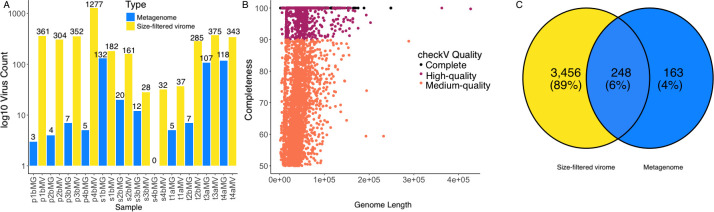 Fig 1
Fig 1| Sample | Site | Type | Raw read no. (millions) | Metagenome size (Mb) | Contig no. | N50 | %GC | Provirus no. | Complete virus no. | Elevation (m) | GPS | SRA |
|---|---|---|---|---|---|---|---|---|---|---|---|---|
| p1bMG | Pajarito | Metagenome | 136.7 | 153.6 | 85,664 | 1,652 | 61.6 | 1 | 0 | 2,381 | 35.873548N, |
|
| p1bMV | Pajarito | Virome | 130 | 389.7 | 143,205 | 3,369 | 51.3 | 8 | 55 | 2,381 | 35.873548N, |
|
| p2bMG | Pajarito | Metagenome | 182.5 | 143.9 | 73,249 | 1,909 | 63.1 | 1 | 1 | 2,523 | 35.878239N, |
|
| p2bMV | Pajarito | Virome | 139.1 | 134.6 | 50,498 | 3,187 | 54.8 | 9 | 44 | 2523 | 35.878239N, |
|
| p3bMG | Pajarito | Metagenome | 31.1 | 3.8 | 1,766 | 2,118 | 59.4 | 0 | 1 | 2,678 | 35.887406N, |
|
| p3bMV | Pajarito | Virome | 143.6 | 156.2 | 60,752 | 3,028 | 56.6 | 1 | 41 | 2,678 | 35.887406N, |
|
| p4bMG | Pajarito | Metagenome | 190.5 | 7.9 | 4,351 | 1,819 | 61 | 0 | 2 | 2,852 | 35.894103N, |
|
| p4bMV | Pajarito | Virome | 218.2 | 578.7 | 203,091 | 3,657 | 57.6 | 13 | 173 | 2,852 | 35.894103N, |
|
| s1bMG | Santa Fe | Metagenome | 179.9 | 338 | 135,179 | 2,829 | 60.9 | 14 | 18 | 2,291 | 35.727892N, |
|
| s1bMV | Santa Fe | Virome | 156.6 | 362.3 | 137,854 | 3,093 | 61.6 | 8 | 28 | 2,291 | 35.727892N, |
|
| s2bMG | Santa Fe | Metagenome | 188.5 | 298.2 | 142,244 | 2,124 | 58.8 | 3 | 2 | 2,541 | 35.750397N, |
|
| s2bMV | Santa Fe | Virome | 185.7 | 452.5 | 201,892 | 2,369 | 58.5 | 4 | 20 | 2,541 | 35.750397N, |
|
| s3bMG | Santa Fe | Metagenome | 175.1 | 112 | 59,613 | 1,850 | 59.6 | 0 | 2 | 2,798 | 35.779612N, |
|
| s3bMV | Santa Fe | Virome | 117.2 | 286.9 | 130,221 | 2,316 | 59.8 | 2 | 6 | 2,798 | 35.779612N, |
|
| s4bMG | Santa Fe | Metagenome | 144.8 | 12.7 | 5,023 | 2,494 | 59.9 | 0 | 0 | 2,950 | 35.793646N, |
|
| s4bMV | Santa Fe | Virome | 273.9 | 458.5 | 218,828 | 2,154 | 60.2 | 1 | 5 | 2,950 | 35.793646N, |
|
| t1aMG | Taos | Metagenome | 151.3 | 248.7 | 132,208 | 1,736 | 64.2 | 0 | 1 | 2,285 | 36.53568N, |
|
| t1aMV | Taos | Virome | 146.1 | 246.9 | 127,628 | 1,903 | 60.2 | 2 | 4 | 2,285 | 36.53568N, |
|
| t2bMG | Taos | Metagenome | 374.9 | 379.1 | 188,924 | 1,966 | 64 | 1 | 0 | 2,578 | 36.5841N, |
|
| t2bMV | Taos | Virome | 174.2 | 643.6 | 280,575 | 2,430 | 59.6 | 14 | 34 | 2,578 | 36.5841N, |
|
| t3aMG | Taos | Metagenome | 222.5 | 344.4 | 154,390 | 2,273 | 55.9 | 8 | 16 | 2,818 | 36.596973N, |
|
| t3aMV | Taos | Virome | 154.9 | 475.9 | 179,380 | 3,244 | 57.9 | 17 | 27 | 2,818 | 36.596973N, |
|
| t4aMG | Taos | Metagenome | 168.6 | 1,046.6 | 387,412 | 3,299 | 56.4 | 13 | 16 | 3,015 | 36.578601N, |
|
| t4aMV | Taos | Virome | 128 | 796.6 | 273,208 | 3,872 | 56 | 20 | 67 | 3,015 | 36.578601N, |
|
- —Los Alamos National Laboratory: Laboratory Directed Research and Development
Peer Reviews
No public reviews on file for this paper yet. If you reviewed it on a platform where reviews are public (OpenReview, ICLR, NeurIPS, ICML), you can paste yours below so the community can read it here.
Videos
No videos yet. Explain this paper in a talk, walkthrough, or lecture? Add one.
Taxonomy
TopicsBacteriophages and microbial interactions · Plant Virus Research Studies · Plant and Fungal Interactions Research
ANNOUNCEMENT
Viral communities are diverse and play important roles in soil ecosystems; however, they remain undercharacterized (1). To assess previously uncharacterized viral communities, we collected four soil samples from similar elevations at each of three different high desert mountains in New Mexico (Table 1). A total of 30 g of soil was taken for each sample and was split for processing of bulk metagenomes and size-filtered viromes (n = 24, 12 viromes and 12 metagenomes). Soils were initially processed by 1:1 resuspension in protein supplemented phosphate-buffered saline (PPBS) elution buffer followed by shaking, centrifugation, and size filtration. Bulk metagenomic DNA was then extracted from 550 µL of 11-µm filtrate, while viromes were processed by extracting DNA from 0.22-µm filtrate. DNA was extracted using the DNeasy PowerSoil Kits (Qiagen, USA). DNA extractions were performed using a modified protocol from (2). The exact extraction protocol is available on protocols.io. Illumina libraries were prepared following manufacturer’s instructions with the NEBNext Ultra DNA II Library Preparation Kit (New England Biolabs, USA), followed by sequencing with 151 bp paired-end reads on the Illumina NextSeq (Illumina, USA). Following sequencing, bioinformatic processing was performed with default parameters except where otherwise noted. Raw reads were quality controlled and had adapters removed using FaQCs v2.10 (3). Metagenomes were assembled using metaspades v3.12 with default parameters and k-mer lengths of 21, 33, 55, and 77 bp (4). Resulting contigs were classified to detect viruses using geNomad v1.9.0 and further checked for quality using checkV v1.0.3 (5, 6). Viruses identified as medium, high, or complete quality were retained for further analysis. Complete viral genomes were annotated with pharokka v1.7.0 (7). Viral genomes were then assessed using iPHoP v1.3.3 to predict their bacterial hosts (8). Viral sequences were clustered into species level vOTUs using blastn in BLAST +v2.16.0 according to the Minimum Information about an Uncultivated Virus Genome (MIUViG) specifications (9, 10).
Assembly sizes ranged between 3.8 Mb and 1,046.6 Mb (Table 1). From these assemblies, we recovered 4,157 viruses of medium, high, or complete quality. Filtered viromes consistently recovered higher numbers of viruses (average = 311) compared with metagenomes (average = 35) (Fig. 1A). Among the recovered viruses, 563 were identified as being complete, 995 were high quality, and 2,599 were medium quality (Fig. 1B). Clustering of the 4,157 viral genomes into species level vOTUs created 3,867 clusters, indicating that the majority of recovered viral genomes were unique. The majority (89%) of clusters were composed of viruses recovered only from viromes, indicating that size-filtered samples produced maximum diversity (Fig. 1C). Host analyses using iPHoP identified 124 complete or high-quality viruses, which could be assigned to a host with >90% confidence. Phage sequences were associated with common soil bacterial genera, including Mycobacterium, Pseudomonas, and Streptomyces. Our results agree with previous studies, indicating that size filtration-based viral enrichment methods are a valuable tool to recover viral genomes from complex communities including soil (11, 12). We expect that this data set will act as a valuable reference as the diversity of viruses in soil continues to be uncovered.
(A) Size selection increases recovery of viruses from soil samples compared to metagenomes. (B) A total of 4,157 recovered viral genomes vary in quality and length metrics. (C) Distribution of VOTU clusters from metagenome vs size-filtered virome samples indicates a high number of unique viruses from size-filtered virome samples.
The reference list from the paper itself. Each links out to its DOI / PubMed record.
- 1Graham EB, Camargo AP, Wu R, Neches RY, Nolan M, Paez-Espino D, Kyrpides NC, Jansson JK, Mc Dermott JE, Hofmockel KS, Soil Virosphere Consortium. 2024. A global atlas of soil viruses reveals unexplored biodiversity and potential biogeochemical impacts. Nat Microbiol 9:1873–1883. doi:10.1038/s 41564-024-01686-x 38902374 PMC 11222151 · doi ↗ · pubmed ↗
- 2Albright MBN, Gallegos-Graves LV, Feeser KL, Montoya K, Emerson JB, Shakya M, Dunbar J. 2022. Experimental evidence for the impact of soil viruses on carbon cycling during surface plant litter decomposition. ISME Commun 2:24. doi:10.1038/s 43705-022-00109-437938672 PMC 9723558 · doi ↗ · pubmed ↗
- 3Lo CC, Chain PSG. 2014. Rapid evaluation and quality control of next generation sequencing data with Fa Q Cs. BMC Bioinformatics 15:366. doi:10.1186/s 12859-014-0366-225408143 PMC 4246454 · doi ↗ · pubmed ↗
- 4Nurk S, Meleshko D, Korobeynikov A, Pevzner PA. 2017. meta SP Ades: a new versatile metagenomic assembler. Genome Res 27:824–834. doi:10.1101/gr.213959.11628298430 PMC 5411777 · doi ↗ · pubmed ↗
- 5Camargo AP, Roux S, Schulz F, Babinski M, Xu Y, Hu B, Chain PSG, Nayfach S, Kyrpides NC. 2024. Identification of mobile genetic elements with ge Nomad. Nat Biotechnol 42:1303–1312. doi:10.1038/s 41587-023-01953-y 37735266 PMC 11324519 · doi ↗ · pubmed ↗
- 6Nayfach S, Camargo AP, Schulz F, Eloe-Fadrosh E, Roux S, Kyrpides NC. 2021. Check V assesses the quality and completeness of metagenome-assembled viral genomes. Nat Biotechnol 39:578–585. doi:10.1038/s 41587-020-00774-733349699 PMC 8116208 · doi ↗ · pubmed ↗
- 7Bouras G, Nepal R, Houtak G, Psaltis AJ, Wormald PJ, Vreugde S 2. 2023. Pharokka: a fast scalable bacteriophage annotation tool. Bioinformatics 39. doi:10.1093/bioinformatics/btac 776PMC 980556936453861 · doi ↗ · pubmed ↗
- 8Roux S, Camargo AP, Coutinho FH, Dabdoub SM, Dutilh BE, Nayfach S, Tritt A. 2023. i P Ho P: An integrated machine learning framework to maximize host prediction for metagenome-derived viruses of archaea and bacteria. P Lo S Biol 21:e 3002083. doi:10.1371/journal.pbio.300208337083735 PMC 10155999 · doi ↗ · pubmed ↗