Complete genome sequence of Robbsia andropogonis strain FG-1 causing bacterial leaf spot disease on Pueraria montana var. thomsonii in China
Xiaoxue Wu, Xiaodong Cui, Hong Liu, Tao Xie, Lixia Zheng, Wensheng Chen, Tao Li

TL;DR
This paper reports the full genome sequence of a bacteria causing leaf spot disease on a plant in China, which could help in understanding and controlling the disease.
Contribution
The complete genome sequence of Robbsia andropogonis strain FG-1 is newly reported for the first time.
Findings
The genome was assembled using hybrid long- and short-read sequencing.
The sequence provides insights for studying virulence and developing control strategies.
Abstract
This study presents a complete genome of Robbsia andropogonis strain FG-1, the causative agent of bacterial leaf spot disease on Pueraria montana var. thomsonii in China. Hybrid long- and short-read sequencing yielded a high-quality assembly, providing essential data for investigating virulence mechanisms and developing control strategies.
Genes, proteins, chemicals, diseases, species, mutations and cell lines named across the full text — each resolved to its canonical identifier and authoritative record.
Click any figure to enlarge with its caption.
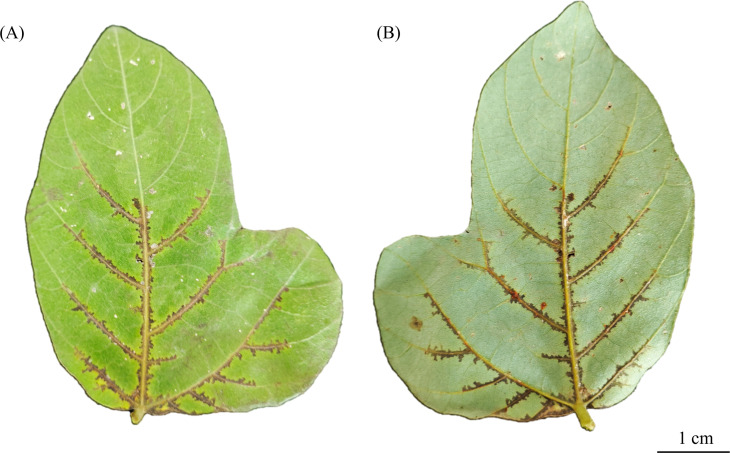 Fig 1
Fig 1Peer Reviews
No public reviews on file for this paper yet. If you reviewed it on a platform where reviews are public (OpenReview, ICLR, NeurIPS, ICML), you can paste yours below so the community can read it here.
Videos
No videos yet. Explain this paper in a talk, walkthrough, or lecture? Add one.
Taxonomy
TopicsPlant Pathogenic Bacteria Studies · Legume Nitrogen Fixing Symbiosis · Genomics and Phylogenetic Studies
ANNOUNCEMENT
Robbsia andropogonis is a gram-negative plant pathogen causing bacterial leaf spot disease (1). In China, R. andropogonis has recently caused significant economic losses to Pueraria montana var. thomsonii (Pmt) cultivation in Guangdong Province (2). This study reports the complete genome sequence of R. andropogonis strain FG-1 from Pmt, facilitating deeper insights into the pathogen’s virulence mechanisms and informing future disease control strategies. Strain FG-1 was isolated in August 2024 from a Pmt leaf showing characteristic bacterial leaf spot symptoms, collected from Gaoming District, Guangdong Province, China (22.53N, 112.53E). Following surface sterilization with 75% ethanol and triple rinsing with sterile water, tissues from the disease-health junction were macerated in sterile water. The resulting suspension was streaked onto LB culture medium and incubated at 30°C in darkness for 3–5 days. Pure cultures were obtained through at least three successive rounds of subculturing individual colonies exhibiting characteristic morphology: gray-white to dull white, mucoid, convex, circular, and smooth (2). Pathogenicity was confirmed by spray-inoculating young leaves of a 3-month-old Pmt plant with bacterial suspension (10⁸ CFU/mL). Leaves were individually bagged with fresh-keeping bags for 24 h at 100% RH under 30°C/16 h light and 22°C/8 h dark cycles. Characteristic water-soaked lesions with yellow haloes developed interveinally within 7 days, matching field symptoms (Fig. 1). Koch’s postulates were fulfilled through pathogen reisolation from lesions. A single colony was inoculated into 50 mL of LB broth and incubated at 30°C for 12 h. Genomic DNA was extracted from the bacterial culture using E.Z.N.A. Bacterial DNA Kit, DNA from a single extraction was used for both libraries. The identity of the isolate was confirmed as R. andropogonis by Conventional PCR amplification of the full-length 16S rRNA gene using universal bacterial primers 27F/1492R and by amplifying the expected 704 bp product using species-specific primers LJ23f/LJ24R (3, 4). Sequencing was performed using a combination of long-read and short-read technologies. Long-read data was generated using the Oxford Nanopore Technology PromethION platform with the SQK-RBK110.96 kit on a FLO-PRO114M flow cell, yielding raw sequencing data. After quality control, this resulted in 688,274,112 bp of Nanopore data from 395,669 reads, with a mean read length of 1,739.5 bp, an N50 of 3,224 bp, and a maximum read length of 163,189 bp. Short-read data were generated using the Illumina HiSeq platform (SBS technology), with libraries prepared using the Nextera XT kit for 2×150 bp paired-end sequencing. Following quality control, 13,397,406 clean reads (2,004,581,918 bp) were obtained, providing 333× coverage. Default parameters were used for all software unless otherwise specified. A hybrid assembly was generated using Unicycler v0.4.9 with Illumina reads for contigs and Nanopore reads for scaffolding (5). The assembly underwent two rounds of error correction with Pilon v1.23 (6), correcting 37 insertions and 75 deletions in Round 1, and 38 SNPs in Round 2. The final assembly comprised eight contigs with an overall GC content of 59.00% and a total size of 6,011,680 bp, consisting of three circular chromosomes (3,612,886 bp, 1,112,911 bp, and 557,219 bp) and five circular plasmids (178,005 bp, 153,059 bp, 138,375 bp, 130,044 bp, and 129,181 bp). Genome completeness and quality were assessed using CheckM v1.2.3, BUSCO v6.0.0 (lineage data set: burkholderiaceae_odb12, mode: prok_genome_prod), and through annotation by the NCBI Prokaryotic Genome Annotation Pipeline (PGAP), revealing a completeness of 92.02% (CheckM) and 97.00% (BUSCO), contamination of 0.82%, and an Average Nucleotide Identity of 99.32% against R. andropogonis type strain BLB1 (GenBank GCA_034047095.1) (7–9). PGAP annotation predicted 5,652 genes in total, comprising 5,033 protein-coding genes, 548 pseudogenes, 55 tRNA genes, 12 rRNA genes, and 4 ncRNA genes.
Symptoms induced by R. andropogonis strain FG-1 on Pmt leaves 7 days post-inoculation. (A) Adaxial leaf surface showing radiating water-soaked lesions with chlorotic haloes (scale bar = 1 cm). (B) Corresponding abaxial surface exhibiting necrotic centers and translucent margins.
The reference list from the paper itself. Each links out to its DOI / PubMed record.
- 1Sun J, Li Y, Zheng L, Chen D, Zhou X, Li P. 2024. The first complete genome of Robbsia andropogonis reveals its arsenal of virulence system causing leaf spot disease of areca palm. Phytopathol Res 6:51. doi:10.1186/s 42483-024-00269-2 · doi ↗
- 2Cui X, Cai Y, Chen R, Liu Q. 2022. First report of bacterial leaf spot disease on Pueraria montana var. thomsonii caused by Robbsia andropogonis in China. Plant Dis 106:2985. doi:10.1094/PDIS-12-21-2848-PDN · doi ↗
- 3Frank JA, Reich CI, Sharma S, Weisbaum JS, Wilson BA, Olsen GJ. 2008. Critical evaluation of two primers commonly used for amplification of bacterial 16S r RNA genes. Appl Environ Microbiol 74:2461–2470. doi:10.1128/AEM.02272-0718296538 PMC 2293150 · doi ↗ · pubmed ↗
- 4Duan YP, Sun X, Zhou LJ, Gabriel DW, Benyon LS, Gottwald T. 2009. Bacterial brown leaf spot of citrus, a new disease caused by Burkholderia andropogonis. Plant Dis 93:607–614. doi:10.1094/PDIS-93-6-060730764396 · doi ↗ · pubmed ↗
- 5Wick RR, Judd LM, Gorrie CL, Holt KE. 2017. Unicycler: resolving bacterial genome assemblies from short and long sequencing reads. P Lo S Comput Biol 13:e 1005595. doi:10.1371/journal.pcbi.100559528594827 PMC 5481147 · doi ↗ · pubmed ↗
- 6Bankevich A, Nurk S, Antipov D, Gurevich AA, Dvorkin M, Kulikov AS, Lesin VM, Nikolenko SI, Pham S, Prjibelski AD, Pyshkin AV, Sirotkin AV, Vyahhi N, Tesler G, Alekseyev MA, Pevzner PA. 2012. SP Ades: a new genome assembly algorithm and its applications to single-cell sequencing. J Comput Biol 19:455–477. doi:10.1089/cmb.2012.002122506599 PMC 3342519 · doi ↗ · pubmed ↗
- 7Parks DH, Imelfort M, Skennerton CT, Hugenholtz P, Tyson GW. 2015. Check M: assessing the quality of microbial genomes recovered from isolates, single cells, and metagenomes. Genome Res 25:1043–1055. doi:10.1101/gr.186072.11425977477 PMC 4484387 · doi ↗ · pubmed ↗
- 8Manni M, Berkeley MR, Seppey M, Simão FA, Zdobnov EM. 2021. BUSCO update: novel and streamlined workflows along with broader and deeper phylogenetic coverage for scoring of eukaryotic, prokaryotic, and viral genomes. Mol Biol Evol 38:4647–4654. doi:10.1093/molbev/msab 19934320186 PMC 8476166 · doi ↗ · pubmed ↗