Complete genome sequence of Thermodesulfovibrio sp. strain TK500a, isolated from Nakabusa Hot Springs, Japan
Toko Hisano, Shin Haruta

TL;DR
The complete genome of a new sulfate-reducing bacterium, Thermodesulfovibrio sp. strain TK500a, isolated from a Japanese hot spring, is reported.
Contribution
The paper provides the first complete genome sequence of Thermodesulfovibrio sp. strain TK500a, a newly isolated bacterium from Japan.
Findings
The genome is 2,018,434 bp in size with a GC content of 36.9%.
It contains 2,038 protein-coding sequences.
Abstract
Here we present the complete genome sequence of a sulfate-reducing bacterium in the phylum Nitrospirota, Thermodesulfovibrio sp. strain TK500a, newly isolated from Nakabusa Hot Springs, Nagano prefecture, Japan. The genome comprises a 2,018,434 bp chromosome with a guanine-cytosine content of 36.9% and 2,038 protein-coding sequences.
Genes, proteins, chemicals, diseases, species, mutations and cell lines named across the full text — each resolved to its canonical identifier and authoritative record.
Click any figure to enlarge with its caption.
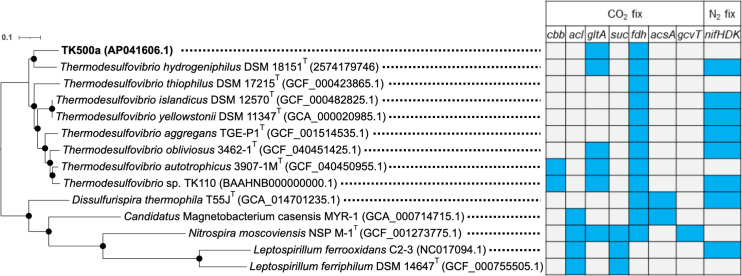 Fig 1
Fig 1| Features | Strain TK500a |
|---|---|
| Genome size (bp) | 2,018,434 |
| High-fidelity reads | 37,522 |
| Raw read N50 (bp) | 7,251 |
| Genome coverage | 123 |
| Number of contigs | 1 |
| Completeness (%) | 100 |
| Contamination (%) | 0 |
| GC content (%) | 36.9 |
| Coding sequence | 2,038 |
| rRNAs | 3 |
| tRNAs | 47 |
- —Japan Society for the Promotion of Sciencehttp://dx.doi.org/10.13039/501100001691
Peer Reviews
No public reviews on file for this paper yet. If you reviewed it on a platform where reviews are public (OpenReview, ICLR, NeurIPS, ICML), you can paste yours below so the community can read it here.
Videos
No videos yet. Explain this paper in a talk, walkthrough, or lecture? Add one.
Taxonomy
TopicsGenomics and Phylogenetic Studies · Microbial Community Ecology and Physiology · Plant Disease Resistance and Genetics
ANNOUNCEMENT
Bacteria in the phylum Nitrospirota appear to have ecologically important roles in carbon, nitrogen, and sulfur cycling in terrestrial aquifers (1–3). It is of great interest to discuss the evolutionary traits of metabolic capabilities and ecological niches of this lineage (1, 4). Among them, the genus Thermodesulfovibrio, known as a thermophilic sulfate-reducing bacterium (5), is phylogenetically diverse, and elucidation of their physiological and genetic differentiation should provide important clues for understanding metabolic evolution (6–8).
A piece of microbial mats was collected at Nakabusa Hot Springs (36°23′20″N, 137°44′52″E, Nagano, Japan) as described previously (9), and was anaerobically cultivated. A pure culture of strain TK500a was obtained by three rounds of roll-tube method and dilution-to-extinction method, as reported previously (3), and grown at 70°C (see below). Here we report the whole genome sequence of strain TK500a to contribute to the evolutionary and physiological studies on Nitrospirota.
Strain TK500a was anaerobically grown at 70°C for 2 weeks in JCM479 medium (https://jcm.brc.riken.jp/) (pH 6.5) under N_2_:H_2_:CO_2_ (2:2:1, vol:vol:vol) atmosphere. Genomic DNA was extracted and purified using the Genomic Tip Kit (Qiagen) and sheared with Megaruptor 3 (Diagenode) to approximately 10–25 kb. A sequencing library was prepared using the SMRTbell Prep Kit 3.0 and the SMRTbell gDNA Sample Amplification Kit (PacBio). The library was sequenced with the Revio (PacBio). High-fidelity reads were obtained through adapter removal and Q ≥ 20 filtering using SMRT Link (v.13.1.0.221970, PacBio). Reads were trimmed using lima (v.2.9.0) (https://github.com/pacificbiosciences/barcoding), and PCR duplicates were removed using pbmarkdup (v.1.0.3) (https://github.com/PacificBiosciences/pbmarkdup). High-quality reads filtered using Filtlong (v.0.2.1) (https://github.com/rrwick/Filtlong) to remove reads of <1,000 bases were assembled using Flye (v.2.9.3) (10). A circularized assembly was confirmed with Bandage (v.0.8.1) (11), and assembly quality was assessed with CheckM2 (v.1.0.1) (12). Genome annotation was performed using the DFAST pipeline (13). Default parameters were used for all software analyses.
The assembled genome of strain TK500a contained a single contig of 2.0 Mb with 36.9% guanine-cytosine (GC) content (Table 1). A molecular phylogenetic tree supported that strain TK500a was classified into the genus Thermodesulfovibrio (Fig. 1). The 16S rRNA gene sequence showed 96.9%, 96.7%, and 96.3% identity with those from Thermodesulfovibrio obliviosus (CP144374.1), Thermodesulfovibrio autotrophicus (CP144373.1), and Thermodesulfovibrio hydrogeniphilus (2574179745), respectively, determined through the local alignment (https://www.ebi.ac.uk/jdispatcher/psa/emboss_water). Average nucleotide identity using BLAST (https://github.com/widdowquinn/pyani) of strain TK500a was 74%–77% with Thermodesulfovibrio sp. shown in the tree in Fig. 1.
Phylogenetic classification of strain TK500a. Maximum likelihood phylogenetic tree was generated by ezTree (14) using 212 single-copy marker proteins. The scale bar represents the number of substitutions per site. Bootstrap values (1,000 replicates) were 100% for all nodes. The presence or absence of each homologous gene for CO2 fixation and N2 fixation is shown using color coding: blue for presence and white for absence. cbb, ribulose-1,5-bisphosphate carboxylase (Calvin-Benson-Bassham cycle); acl, ATP-citrate lyase (reductive tricarboxylic acid [TCA] cycle); gltA, Si-/Re-citrate synthase; suc, succinyl-CoA synthetase (oxidative TCA cycle/reversed oxidative TCA cycle); fdh, formate dehydrogenase (Wood-Ljungdahl pathway and reductive glycine pathway); acsA, CO dehydrogenase (Wood-Ljungdahl pathway); gcvT, glycine synthase (reductive glycine pathway); nifHDK, molybdenum-iron nitrogenase (N2 fixation).
Carbon and nitrogen fixation-related genes were explored (Fig. 1). Strain TK500a does not possess any key genes for the Calvin-Benson-Bassham cycle and the reductive tricarboxylic acid (TCA) cycle. No homologous genes encoding CO dehydrogenase and glycine synthase were found in the genome of strain TK500a, as reported for other Thermodesulfovibrio sp. (2, 3). Some of the genes for the oxidative/reversed oxidative TCA cycle (15, 16) were missing in Thermodesulfovibrio. N_2_-fixation genes were not detected from strain TK500a.
The reference list from the paper itself. Each links out to its DOI / PubMed record.
- 1Mosley OE, Gios E, Handley KM. 2024. Implications for nitrogen and sulphur cycles: phylogeny and niche-range of Nitrospirota in terrestrial aquifers. ISME Commun 4:ycae 047. doi:10.1093/ismeco/ycae 04738650708 PMC 11033732 · doi ↗ · pubmed ↗
- 2Maltseva AI, Elcheninov AG, Klyukina AA, Pimenov NV, Novikov AA, Lebedinsky AV, Frolov EN. 2024. Thermodesulfovibrio autotrophicus sp. nov., the first autotrophic representative of the widespread sulfate-reducing genus Thermodesulfovibrio, and Thermodesulfovibrio obliviosus sp. nov. that has lost this ability. Syst Appl Microbiol 47:126561. doi:10.1016/j.syapm.2024.12656139551005 · doi ↗ · pubmed ↗
- 3Hisano T, Nishihara A, Haruta S. 2025. Nitrogen-fixing ability of a thermophilic sulfate-reducing bacterium in the genus Thermodesulfovibrio isolated from a terrestrial hot spring in Japan. Microbes Environ 40:ME 25030. doi:10.1264/jsme 2.ME 2503040967806 PMC 12501866 · doi ↗ · pubmed ↗
- 4Elling FJ, Pierrel F, Chobert S-C, Abby SS, Evans TW, Reveillard A, Pelosi L, Schnoebelen J, Hemingway JD, Boumendjel A, Becker KW, Blom P, et al.. 2025. A novel quinone biosynthetic pathway illuminates the evolution of aerobic metabolism. Proc Natl Acad Sci USA 122:e 2421994122. doi:10.1073/pnas.242199412239977315 PMC 11874023 · doi ↗ · pubmed ↗
- 5Maki JS. 2015. Thermodesulfovibrio. In Bergey’s manual of systematics of archaea and bacteria. John Wiley & Sons, Inc., in association with Bergey’s Manual Trust.
- 6Frank YA, Kadnikov VV, Lukina AP, Banks D, Beletsky AV, Mardanov AV, Sen’kina EI, Avakyan MR, Karnachuk OV, Ravin NV. 2016. Characterization and genome analysis of the first facultatively alkaliphilic Thermodesulfovibrio isolated from the deep terrestrial subsurface. Front Microbiol 7:2000. doi:10.3389/fmicb.2016.0200028066337 PMC 5165239 · doi ↗ · pubmed ↗
- 7Matsuura N, Ohashi A, Tourlousse DM, Sekiguchi Y. 2016. Draft genome sequence of Thermodesulfovibrio aggregans TGE-P 1T, an obligately anaerobic, thermophilic, sulfate-reducing bacterium in the phylum Nitrospirae. Genome Announc 4:10. doi:10.1128/genome A.00089-16PMC 478665626966200 · doi ↗ · pubmed ↗
- 8Yamada T, Harada J, Kurobe M, Giri S, Konishi Nobu M, Narihiro T, Tsuji H, Daimon H. 2019. Draft genome sequence of Thermodesulfovibrio sp. strain Kuro-1, a thermophilic, lactate-degrading anaerobe isolated from a thermophilic anaerobic digestion reactor. Microbiol Resour Announc 8. doi:10.1128/MRA.00709-19PMC 663962731320437 · doi ↗ · pubmed ↗