Complete genome sequence of Bacillus cereus phage vB_BceH_LBC2, a lytic member of the genus Bequatrovirus
Eo-Jin Kim, Jeong-A Lim

TL;DR
This paper reports the full genome sequence of a lytic bacteriophage that infects Bacillus cereus.
Contribution
The study provides the complete genome sequence and gene prediction of a new lytic phage in the Bequatrovirus genus.
Findings
The phage genome is 157,419 base pairs with 232 predicted genes.
The genome has a GC content of 35.63 percent.
No virulence or antibiotic resistance genes were found in the genome.
Abstract
Phage vB_BceH_LBC2 is a lytic bacteriophage infecting Bacillus cereus, classified as a member of the genus Bequatrovirus (family Herelleviridae). Its genome is 157,419 base pairs, with 232 predicted genes and a GC content of 35.63 percent. No virulence, antibiotic resistance, or lysogeny-related genes were identified.
Genes, proteins, chemicals, diseases, species, mutations and cell lines named across the full text — each resolved to its canonical identifier and authoritative record.
Click any figure to enlarge with its caption.
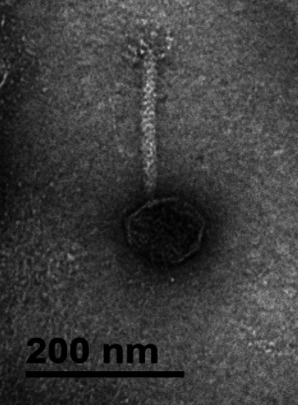 Fig 1
Fig 1- —Ministry of Science and ICT, South Koreahttp://dx.doi.org/10.13039/501100014188
Peer Reviews
No public reviews on file for this paper yet. If you reviewed it on a platform where reviews are public (OpenReview, ICLR, NeurIPS, ICML), you can paste yours below so the community can read it here.
Videos
No videos yet. Explain this paper in a talk, walkthrough, or lecture? Add one.
Taxonomy
TopicsBacteriophages and microbial interactions · Plant Virus Research Studies · Microbial infections and disease research
ANNOUNCEMENT
Bacillus cereus is a gram-positive, spore-forming bacterium linked to food spoilage and gastrointestinal illness (1). Its ubiquity and resistance make it a frequent target for phage-based control (2). Lytic phages offer host-specific antibacterial potential (3). Here, we report the isolation, morphology, and genome sequence of lytic phage vB_BceH_LBC2, a member of the genus Bequatrovirus.
Phage vB_BceH_LBC2 was isolated from sewage samples from wastewater treatment plants in Iksan, South Korea (35.988558°N, 126.935605°E), using B cereus NCCP 14796, obtained from the National Culture Collection for Pathogens (NCCP), as the host strain. Filtered samples were mixed with 2× TSB containing 2 mM MgCl_2_ and CaCl_2_, incubated with the host at 37°C for 24 h, re-filtered, and spotted onto B. cereus lawns via double-layer agar (4). Plaques were picked and purified through three reinfection rounds. Phages were propagated in exponential-phase cultures, lysate dialyzed with SM buffer, and stored at 4°C (5).
Phage morphology was confirmed by transmission electron microscopy (TEM) after negative staining with 2% (wt/vol) uranyl acetate (pH 4.0) (6). TEM showed LBC2 possesses an icosahedral capsid (length: 86.3 ± 1.2 nm; width: 90.9 ± 6.0 nm) and a long, flexible tail (205.7 ± 5.8 nm), typical of siphovirus-like morphology (Fig. 1).
Transmission electron micrograph of B. cereus phage vB_BceH_LBC2. Phage particles were negatively stained with 2% (wt/vol) uranyl acetate (pH 4.0) and imaged using a Hitachi H-7650 transmission electron microscope (Hitachi, Tokyo, Japan) at Jeonbuk National University (Jeonju, Republic of Korea), operated at 80 kV accelerating voltage and ×100,000 magnification. Particle dimensions were analyzed using ImageJ v1.52 (NIH, Bethesda, MD, USA). Scale bar = 200 nm.
Genomic DNA was extracted from a high-titer phage stock using the Phage DNA Isolation Kit (Norgen Biotek, Ontario, Canada) (7). Paired-end libraries (2 × 300 bp) were prepared using the TruSeq Nano DNA Library Prep Kit (Illumina) and sequenced on the Illumina MiSeq platform by Sanigen Co., Ltd. (South Korea). Adapter trimming and quality filtering were performed using Trimmomatic v0.39 (8), and read quality was assessed with FastQC v0.11.9. A total of 852,458 reads were generated, yielding approximately 242 Mb of sequence data, with an average genome coverage of ~1,537× . To assess the genome termini and packaging strategy, we analyzed the raw sequencing reads using PhageTerm (9). De novo genome assembly was performed using SPAdes v3.15.2 with default parameters (10). All other software was run with default parameters unless otherwise specified. Open reading frames (ORFs) were predicted using GeneMarkS (11), and annotated using RAST (12) and BLASTp searches against the NCBI non-redundant protein database (13). In addition, tRNA and tmRNA genes were searched using ARAGORN v1.2.41 (14).
The complete genome of phage LBC2 is 157,419 bp in length and has a GC content of 35.63%. The genome comprises 232 predicted protein-coding sequences, of which 99 were assigned putative functions. PhageTerm analysis suggested that the phage genome is circularly permuted with multiple preferred termini, consistent with a headful packaging mechanism. No tRNA genes or other non-coding RNA elements were identified in the genome. No virulence or lysogeny-associated genes, including integrases or repressors, were detected. Based on sequence similarity and current ICTV taxonomy (15), phage LBC2 is classified within the genus Bequatrovirus, subfamily Bastillevirinae, family Herelleviridae, and class Caudoviricetes. The closest known relative to phage LBC2 is Bacillus phage vB_BceH_LY2 (GenBank accession no. ON366411.1), with 97.68% nucleotide identity over 82% of the genome, supporting its classification within the genus Bequatrovirus.
The reference list from the paper itself. Each links out to its DOI / PubMed record.
- 1Haque MA, Quan H, Zuo Z, Khan A, Siddique N, He C. 2021. Pathogenicity of feed-borne Bacillus cereus and its implication on food safety. Agrobiol Records 3:1–16. doi:10.47278/journal.abr/2020.015 · doi ↗
- 2Garvey M. 2022. Bacteriophages and food production: biocontrol and bio-preservation options for food safety. Antibiotics (Basel) 11:1324. doi:10.3390/antibiotics 1110132436289982 PMC 9598955 · doi ↗ · pubmed ↗
- 3Li Y, Li Y, Ma Y, Wang J. 2024. Isolation and characteristic of Bacillus cereus phage Z 3 and its application in rice and milk. LWT 198:116022. doi:10.1016/j.lwt.2024.116022 · doi ↗
- 4Li C, Yuan X, Li N, Wang J, Yu S, Zeng H, Zhang J, Wu Q, Ding Y. 2020. Isolation and characterization of Bacillus cereus phage v B_Bce P-D Lc 1 reveals the largest member of the Φ29-like phages. Microorganisms 8:1750. doi:10.3390/microorganisms 811175033171789 PMC 7695010 · doi ↗ · pubmed ↗
- 5Peters DL, Harris G, Davis CM, Dennis JJ, Chen W. 2022. Bacteriophage isolation, purification, and characterization techniques against ubiquitous opportunistic pathogens. Curr Protoc 2:e 594. doi:10.1002/cpz 1.59436383057 · doi ↗ · pubmed ↗
- 6Meidaninikjeh S, Mohammadi P, Elikaei A. 2024. A simplified method of bacteriophage preparation for transmission electron microscope. J Virol Methods 328:114951. doi:10.1016/j.jviromet.2024.11495138750823 · doi ↗ · pubmed ↗
- 7Maffei E, Manner C, Jenal U, Harms A. 2024. Complete genome sequence of Pseudomonas aeruginosa phage Knedl. Microbiol Resour Announc 13:e 0117423. doi:10.1128/mra.01174-2338393330 PMC 11008142 · doi ↗ · pubmed ↗
- 8Bolger AM, Lohse M, Usadel B. 2014. Trimmomatic: a flexible trimmer for Illumina sequence data. Bioinformatics 30:2114–2120. doi:10.1093/bioinformatics/btu 17024695404 PMC 4103590 · doi ↗ · pubmed ↗