Complete genome sequences of two strains of Pseudomonas fragi, isolated from feces of a domestic rabbit (Oryctolagus cuniculus)
L. K. Y. Chow, S. H. N. Pang, K. M. Leung, G. K. K. Lai, S. D. J. Griffin

TL;DR
This paper reports the full genome sequences of two Pseudomonas fragi strains isolated from a rabbit's feces.
Contribution
The study provides newly sequenced and assembled genomes of two Pseudomonas fragi strains using hybrid assembly.
Findings
Each strain has a single circular chromosome and plasmid.
The genomes total 5,036,311 bp and 5,249,147 bp with G+C content of 59.06% and 59.31%, respectively.
Abstract
The complete genomes of Pseudomonas fragi strains LKYC.ZH and LKYC.Zb1, recovered from rabbit feces, were established by hybrid assembly: each comprises a single circular chromosome and circular plasmid, totaling 5,036,311 bp (59.06% G+C) and 5,249,147 bp (59.31% G+C), respectively.
Genes, proteins, chemicals, diseases, species, mutations and cell lines named across the full text — each resolved to its canonical identifier and authoritative record.
Click any figure to enlarge with its caption.
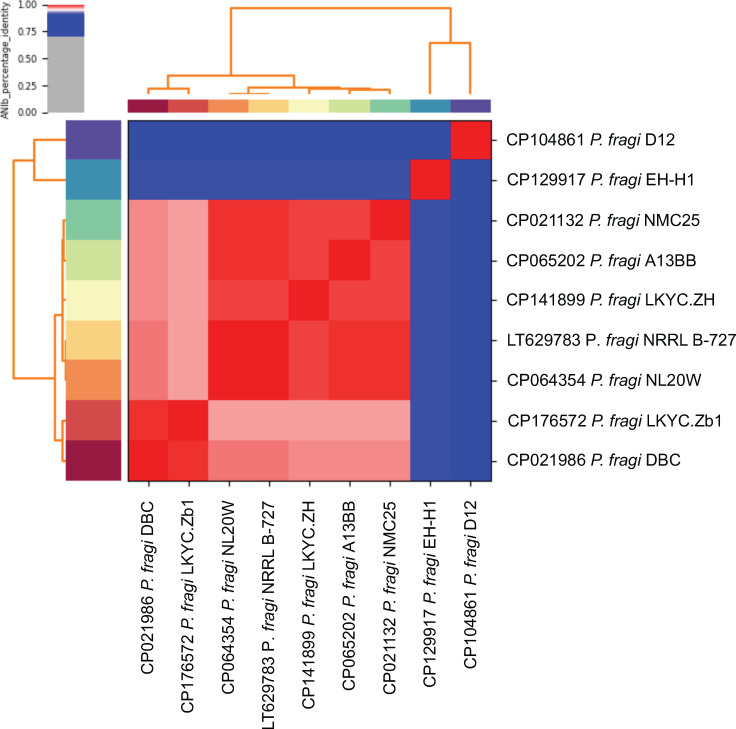 Fig 1
Fig 1| LKYC.Zb1 | LKYC.ZH | |||
|---|---|---|---|---|
| Sequencing | ||||
| Sequencing method | Illumina NovaSeq | Nanopore MinION | Illumina NovaSeq | Nanopore MinION |
| SRA (raw) |
|
|
|
|
| Filtered reads | 1,009,277 (pairs) | 108,418 | 1,648,692 | 137,383 |
| Mean length | 245.9 | 9,621.9 | 247.9 | 9,078.2 |
| N50 | 250 | 10,207 | 250 | 9,343 |
| Total Mbp | 248.2 | 1,043 | 408.7 | 1,247 |
| Assembly | ||||
| Assembler used |
|
| ||
| Replicon | Chromosome | Plasmid pLKYC.Zb1 | Chromosome | Plasmid pLKYC.ZH |
| GenBank accession |
|
|
|
|
| Topology | Circular | Circular | Circular | Circular |
| Size | 5,205,602 bp | 43,545 bp | 5,027,131 bp | 9,180 bp |
| G+C % | 59.39% | 55.4% | 59.06% | 55.56% |
| Coverage | 293× | 248× | ||
| CDs | 4,716 | 48 | 4,515 | 13 |
| Pseudogenes | 73 | 0 | 64 | 0 |
| rRNA (5S, 16S, 23S) | 9, 8, 8 | 0 | 9, 8, 8 | 0 |
| tRNA | 73 | 0 | 60 | 0 |
| NCBI loci of genes linked to dye degradation (if present) | ||||
| Azoreductase | ACKZH3_15960, ACKZH3_12490 | VK847_08680, VK847_12160 | ||
| Dyp-type peroxidase | ACKZH3_19820 | VK847_04785 | ||
| Multi-copper polyphenol oxidoreductase (laccase) | Not present | VK847_07340 | ||
| SDR family oxidoreductase (E-value) | ACKZH3_15785 (2e-49) | Not present | ||
| ACKZH3_0478 (1e-16) | VK847_19410 (1e-16) | |||
Peer Reviews
No public reviews on file for this paper yet. If you reviewed it on a platform where reviews are public (OpenReview, ICLR, NeurIPS, ICML), you can paste yours below so the community can read it here.
Videos
No videos yet. Explain this paper in a talk, walkthrough, or lecture? Add one.
Taxonomy
TopicsPlant Pathogenic Bacteria Studies · Genomics and Phylogenetic Studies · Aquaculture disease management and microbiota
ANNOUNCEMENT
As a psychrotrophic member of the Pseudomonas fluorescens group, Pseudomonas fragi is commonly known for the aerobic spoilage of chilled foods, such as milk and meat (1–4). However, strains may also be plant growth-promoting (5–8), antifungal (9), nematicidal (7), and algicidal (10). Its versatile biochemistry has been examined for the synthesis of feedstocks and nanomaterials (8, 11), and the species shows potential for bioremediation, with whole cells and enzymes showing useful activity even at low temperatures (11–14). Here, P. fragi strains LKYC.ZH and LKYC.Zb1, recovered from feces of a domestic rabbit (Oryctolagus cuniculus), were found to degrade the triarylmethane dye malachite green over a broad temperature range.
A sample of rabbit feces (1 g; from 22.3759876° N, 114.1058617° E) was vortexed in 19-mL saline (0.9% wt/vol) and, following a further 10,000-fold dilution, a 100-µL aliquot was spread onto Luria agar (15). Following 24 h of incubation, colonies were transferred to Luria agar containing 0.1 g/L malachite green. Colonies decolorizing the dye were streaked >5 times on Luria agar to generate pure isolates and their decolorizing activity confirmed at temperatures between 4°C and 37°C by inoculating Luria broth containing 20 mg/L malachite green and following a decrease in absorbance due to the dye at 619 nm. For subsequent DNA extraction, a single colony of each pure isolate was streaked onto Luria agar to harvest overnight growth from the plate for processing using the Qiagen DNeasy PowerSoil Pro Kit following the manufacturer’s protocol. All agar incubations were at 27°C.
UV absorbance (BioDrop µLITE; Biochrom Ltd., UK) and PicoGreen assays (16) were used for DNA quality/quantity evaluations before preparing paired-end short-read sequencing libraries (NEBNext Ultra DNA Library Prep Kit) for sequencing via the NovaSeq 6000 platform using an SP PE250 flow cell and v1.5 Reagent Kit. Raw read pairs were quality-filtered and trimmed using TrimGalore! v0.6.7 (stringency:3; -e:0.2). Long-read libraries, prepared from the same extracted DNA using the Rapid Barcoding Kit SQK-RBK004 (without size selection), were sequenced with a Spot-ON Flow Cell (vR9), MinION sequencer, and MinKNOW v3.1.8 software, with base-calling by a Guppy v2.1.3 high-accuracy mode (all by Oxford Nanopore Technologies plc). Final long-read data sets were trimmed by Filtlong v0.2.1 to select high-quality reads to scaffold the assembly. Default parameters were used for all software unless otherwise specified.
Hybrid assembly, via Trycycler v0.5.5 (LKYC.Zb1) and Unicycler v0.5.0 (LKYC.ZH) (17, 18), yielded a circular chromosome and a single circular plasmid for both isolates, which were submitted to NCBI PGAP v6.9 for annotation (19) (sequencing and assembly data are given in Table 1). pLKYC.Zb1 is a 43,545 bp plasmid encoding a MobF relaxase (20), while the 9,180 bp cryptic plasmid pLKYC.ZH was classified by MobSuite v3.1.9 (21) as a non-mobilizable rep_cluster_1967 replicon. Average nucleotide identities (ANIs) between the LKYC.Zb1 and LKYC.ZH chromosomes and seven complete P. fragi chromosomes were calculated by a BLAST-based method in pyani v0.2.12 (22), with the computed relationships displayed in Fig. 1. LKYC.Zb1 and LKYC.ZH were found closest to strains DBC (CP021986) and NMC25 (CP021132), respectively (ANIs > 98.6%).
ANI analysis of the LKYC.Zb1 and LKYC.ZH chromosomes and seven complete P. fragi chromosomes, as calculated by a BLAST-based method in pyani v0.2.12 (22).
Both genomes are predicted to encode dye-degrading proteins, including azoreductases (25), a Dyp-type peroxidase (26), and laccase (24). NCBI BLASTp (23) found SDR family oxidoreductases that may be homologs of triphenylmethane reductase (Tmr2) (27). NCBI loci are given in Table 1.
The reference list from the paper itself. Each links out to its DOI / PubMed record.
- 1Gruber T. 1905. Ein weiterer Beiträg zür Aromabildung, speziell zür Bildung des Erdbeergeruches in der Gruppe “Pseudomonas”, Pseudomonas fragariae II. Zentralblatt für Bakteriologie, Parasitenkunde, Infektionskrankheiten und Hygiene, Abteilung II 14:122–123.
- 2Ercolini D., Russo F, Blaiotta G, Pepe O, Mauriello G, Villani F. 2007. Simultaneous detection of Pseudomonas fragi, P. lundensis, and P. putida from meat by use of a multiplex pcr assay targeting the car A gene. Appl Environ Microbiol 73:2354–2359. doi:10.1128/AEM.02603-0617293505 PMC 1855653 · doi ↗ · pubmed ↗
- 3Ercolini Danilo, Casaburi A, Nasi A, Ferrocino I, Di Monaco R, Ferranti P, Mauriello G, Villani F. 2010. Different molecular types of Pseudomonas fragi have the same overall behaviour as meat spoilers. Int J Food Microbiol 142:120–131. doi:10.1016/j.ijfoodmicro.2010.06.01220627208 · doi ↗ · pubmed ↗
- 4Marchand S, Vandriesche G, Coorevits A, Coudijzer K, De Jonghe V, Dewettinck K, De Vos P, Devreese B, Heyndrickx M, De Block J. 2009. Heterogeneity of heat-resistant proteases from milk Pseudomonas species. Int J Food Microbiol 133:68–77. doi:10.1016/j.ijfoodmicro.2009.04.02719481283 · doi ↗ · pubmed ↗
- 5Asghar I, Ahmed M, Farooq MA, Ishtiaq M, Arshad M, Akram M, Umair A, Alrefaei AF, Jat Baloch MY, Naeem A. 2023. Characterizing indigenous plant growth promoting bacteria and their synergistic effects with organic and chemical fertilizers on wheat (Triticum aestivum). Front Plant Sci 14:1232271. doi:10.3389/fpls.2023.123227137727857 PMC 10505817 · doi ↗ · pubmed ↗
- 6Gupta S, Pandey S, Kotra V, Kumar A. 2023. Assessing the role of ACC deaminase-producing bacteria in alleviating salinity stress and enhancing zinc uptake in plants by altering the root architecture of French bean (Phaseolus vulgaris) plants. Planta 258:3. doi:10.1007/s 00425-023-04159-337212904 · doi ↗ · pubmed ↗
- 7Wang S, Fan H, Zhao D, Zhu X, Wang Y, Liu X, Liu D, Duan Y, Chen L. 2021. Multifunctional efficacy of the nodule endophyte Pseudomonas fragi in stimulating tomato immune response against Meloidogyne incognita. Biol Control 164:104773. doi:10.1016/j.biocontrol.2021.104773 · doi ↗
- 8Wu J, Liu P, Zheng Z, Ouyang J. 2022. Valorization of cheese whey to lactobionic acid by a novel strain Pseudomonas fragi and identification of enzyme involved in lactose oxidation. Microb Cell Fact 21:184. doi:10.1186/s 12934-022-01907-036076243 PMC 9461264 · doi ↗ · pubmed ↗