Draft genome sequence of Bradyrhizobium sp. 33ap4 associated with effective root nodulation in pigeon pea (Cajanus cajan)
Francina Lebogang Bopape, Ahmed Idris Hassen, Eastonce Tendayi Gwata

TL;DR
This paper presents the draft genome of a soil bacterium that helps pigeon peas form root nodules, which is important for nitrogen fixation.
Contribution
The paper provides a new draft genome sequence of Bradyrhizobium sp. 33ap4 with insights into its nodulation and stress response capabilities.
Findings
The genome of Bradyrhizobium sp. 33ap4 is a single chromosome of 9.37 Mbp.
The genome contains genes related to nodulation, nitrogen fixation, and stress response.
This strain was isolated from pigeon pea root nodules and is associated with effective nodulation.
Abstract
Bradyrhizobium sp. 33ap4 is a free-living soil bacterium that was isolated from nodules on pigeon pea roots. This draft genome sequence revealed that the Bradyrhizobium strain consists of a 9.37-Mbp single chromosome with predicted nodulation and nitrogen fixation genes, DNA metabolism, and other stress response features.
Genes, proteins, chemicals, diseases, species, mutations and cell lines named across the full text — each resolved to its canonical identifier and authoritative record.
Click any figure to enlarge with its caption.
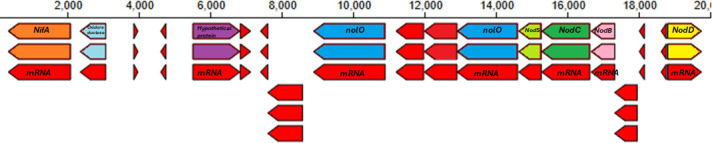 Fig 1
Fig 1- —University of Vendahttp://dx.doi.org/10.13039/501100008976
Peer Reviews
No public reviews on file for this paper yet. If you reviewed it on a platform where reviews are public (OpenReview, ICLR, NeurIPS, ICML), you can paste yours below so the community can read it here.
Videos
No videos yet. Explain this paper in a talk, walkthrough, or lecture? Add one.
Taxonomy
TopicsLegume Nitrogen Fixing Symbiosis · Plant-Microbe Interactions and Immunity · Plant responses to water stress
ANNOUNCEMENT
Bradyrhizobium bacteria establish effective symbiotic associations with grain legumes by forming root nodules, thus providing fixed nitrogen and an alternative source of nitrogen to chemical fertilizers for farmers (1, 2). Here, we report the draft genome of a free-living Bradyrhizobium sp. strain 33ap4 that existed in virgin soil originating from South Africa (Fig. 1). The study also investigated the genes likely responsible for nodulation and nitrogen fixation. The soil, sampled from Thohoyandou Town (S22°57 E30°29), was used in a soil trap pot trial with the host plant pigeon pea. Nodules from pigeon pea roots were surface sterilized with 3.5% bleach and rinsed with sterile water five times. Nodules were squeezed with sterilized forceps and cultured on Yeast Mannitol Congo Red (YM-CR) agar that consists of mannitol 10 g, K_2_HPO_4_ 0.5 g, MgSO_4_.7H_2_O 0.2 g, NaCl 0.1 g, yeast extract 0.5 g, agar 15 g, Congo red 10 mL, and distilled water 1 L (3). The plates were incubated for 5–9 days at 28°C. Single colonies were selected and purified by re-streaking on YM-CR and incubated with the same conditions as described above. For DNA extraction, the cultures were transferred to Tryptone Yeast broth and incubated for 3 days on a shaker (150 rpm) at 28°C. The broth culture (1.5 mL) was used to extract DNA with the Wizard Genomic DNA Extraction Kit (Promega, Madison, USA). For the taxonomic identification using the 16S ribosomal RNA sequencing, we used the 16S primers: 27F (5′ AGA GTT TGA TCC TGG CTC AG 3′) and 1485R (5′ TAC CTT GTT ACG ACT TCA CCC CA 3′) (4). The rhizobium strain 33ap4, isolated from nodules on pigeon pea roots, showed a 99.76% 16S rRNA sequence similarity to Bradyrhizobium sp. with the accession number: MF140379.1. The BLASTn similarity search tool used on the NCBI Standard database nr/Core nucleotide database was accessed on 23 May 2025. For the draft genome sequencing, the extracted DNA was fragmented using a Covaris E220 Focused-Ultrasonicator (Thermo Fisher Scientific), followed by DNA library preparation using the MGIEasy Universal DNA Library Prep Kit (MGI Tech Co), and sequencing with the MGI DNBSEQ G400 platform using a PE150 sequencing cartridge at the Biotechnology Platform, ARC-Onderstepoort, South Africa. The number of read pairs obtained is 2,206,680 with a 200-bp read length. A total of 4.4 M spots were obtained, after which adapter sequences and low-quality bases were trimmed with Trimmomatic v.0.36 (5). The resulting raw reads were used for a de novo assembly with SPAdes v.3.15.3 (4) on KBase (6), which resulted in a draft genome with a total size of 9.4 Mb with 309 contigs, N50 of 109.4 kb, and L50 of 28 with a GC content of 63.5%. Scaffold was created with genome assembly software SSPACE v3.15.3 (7). The gene annotations were performed with the NCBI Prokaryotic Genome Annotation Pipeline (PGAP v6.9) (8, 9) that resulted in a total of 8,475 protein coding sequences, and 54 RNAs dispersed throughout the genome. The genome coverage was 100×, with a final scaffold number of 304, a total of 8,830 genes, and an assembly completeness of 98.57% (CheckM analysis v1.2.3) (10).
The chromosomal regions of annotated predicted genes for nodulation (nodBCD), nitrogen fixation (NifA), and the Nod factor regulating genes (nolO) of Bradyrhizobium sp. 33ap4 located on contig 28 and generated on the KBase platform.
The reference list from the paper itself. Each links out to its DOI / PubMed record.
- 1Bopape FL, Gwata ET, Hassen AI, Zhou MM. 2021. Symbiotic efficiency of pigeonpea ( Cajanus cajan (L.) Huth) with different sources of nitrogen. Plant Genet Resour 19:312–315. doi:10.1017/S 1479262121000356 · doi ↗
- 2Lengwati DM, Mathews C, Dakora FD. 2020. Rotation benefits from N 2-fixing grain legumes to cereals: from increases in seed yield and quality to greater household cash-income by a following maize crop. Front Sustain Food Syst 4:94. doi:10.3389/fsufs.2020.00094 · doi ↗
- 3Vincent JM. 1970. A manual for the practical study of root-nodule bacteria, IBP handbook No.15, International Biological Programme. In . Blackwell, Oxford.
- 4Lane DJ. 1991. 16S/23S r RNA sequencing, p 115–175. In Stackebrandt E, Goodfellow M (ed), Nucleic acid techniques in bacterial systematics. John Wiley and Sons, New York, NY.
- 5Bolger AM, Lohse M, Usadel B. 2014. Trimmomatic: a flexible trimmer for Illumina sequence data. Bioinformatics 30:2114–2120. doi:10.1093/bioinformatics/btu 17024695404 PMC 4103590 · doi ↗ · pubmed ↗
- 6Arkin AP, Cottingham RW, Henry CS, Harris NL, Stevens RL, Maslov S, Dehal P, Ware D, Perez F, Canon S, et al.. 2018. K Base: The United States Department of Energy Systems Biology Knowledgebase. Nat Biotechnol 36:566–569. doi:10.1038/nbt.416329979655 PMC 6870991 · doi ↗ · pubmed ↗
- 7Boetzer M, Henkel CV, Jansen HJ, Butler D, Pirovano W. 2011. Scaffolding pre-assembled contigs using SSPACE. Bioinformatics 27:578–579. doi:10.1093/bioinformatics/btq 68321149342 · doi ↗ · pubmed ↗
- 8Bopape FL, Hassen AI, Swanevelder ZH, Gwata ET. 2020. Draft genome sequence of Rhizobium tropici SARCC-755, a free-living rhizobium that nodulated and promoted growth in pigeonpea [Cajanus cajan (L.) Millsp.]. Microbiol Resour Announc 9:10–128. doi:10.1128/MRA.01122-19PMC 695264631919160 · doi ↗ · pubmed ↗