Draft genome sequence of Methylobacterium aquaticum LEGMi-203a, isolated from root nodules of Pithecellobium hymenaeifolium
Valeria Castro-Camacho, Rubí Robles-Azor, Luciana Rodríguez-Burdock, Keilor Rojas-Jimenez, Bradd Mendoza-Guido

TL;DR
This paper presents the draft genome of a Methylobacterium aquaticum strain found in plant root nodules, suggesting it may help tropical plants through nitrogen fixation.
Contribution
The study provides a new draft genome sequence and identifies potential symbiotic functions in a Methylobacterium strain.
Findings
The draft genome of Methylobacterium aquaticum LEGMi-203a was successfully sequenced.
Genomic analysis confirms its classification and reveals genes related to nitrogen fixation and nodulation.
Abstract
We report the draft genome of Methylobacterium aquaticum LEGMi-203a, a root nodule isolated from Pithecellobium hymenaeifolium. Genomic analysis supports its classification as M. aquaticum, and annotated nitrogen fixation and nodulation genes underscore its possible functional capabilities as a symbiont in tropical plants.
Genes, proteins, chemicals, diseases, species, mutations and cell lines named across the full text — each resolved to its canonical identifier and authoritative record.
Click any figure to enlarge with its caption.
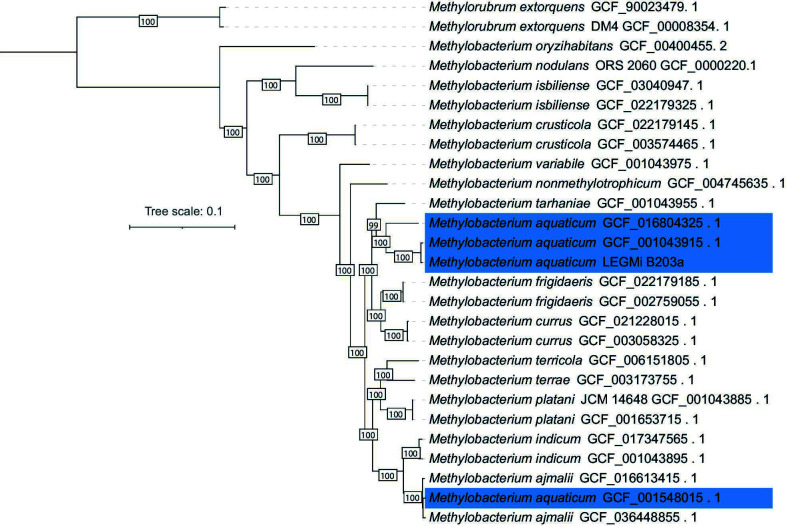 Fig 1
Fig 1Peer Reviews
No public reviews on file for this paper yet. If you reviewed it on a platform where reviews are public (OpenReview, ICLR, NeurIPS, ICML), you can paste yours below so the community can read it here.
Videos
No videos yet. Explain this paper in a talk, walkthrough, or lecture? Add one.
Taxonomy
TopicsLegume Nitrogen Fixing Symbiosis · Microbial metabolism and enzyme function
ANNOUNCEMENT
The genus Methylobacterium includes species known for plant growth promotion and facilitation of symbiosis within root nodules (1). M. aquaticum has shown the ability to utilize methanol, a by-product of plant metabolism, as a carbon source, emphasizing its relevance in symbiotic interactions (2). Genomic analysis has revealed the evolutionary and functional diversity of Methylobacterium, highlighting their plant-associated traits (3).
We obtained the isolate in August 2021 from root nodules of the native legume P. hymenaeifolium (Michiguiste) in Costa Rica (10°00′50″N 84°07′53″W). We sampled four plant nodules, surface-sterilized, macerated, and serially diluted them (10⁻¹–10⁻²) in Peptone Yeast Extract (PY) broth. Aliquots (50 µL) were plated on PY agar supplemented with cycloheximide (40 mg/L) and incubated at 28°C for up to 3 weeks. Colonies were repeatedly streaked on PY agar and preserved in PY broth with 20% glycerol at −80°C. A loopful of the bacterial strain was then collected from the solid culture, resuspended in 250 µL PBS, and genomic DNA was extracted using the DNEasy PowerSoil Kit (Qiagen, USA) according to the manufacturer’s protocol.
Libraries were prepared using the Illumina DNA Prep kit, following the manufacturer’s protocol. Genomic DNA was randomly sheared, end repaired, A-tailed, and ligated with Illumina adapters. Adapter-ligated fragments were PCR-amplified, size-selected, purified, and assessed using Qubit, real-time PCR, and Bioanalyzer. Quantified libraries were pooled, and paired-end whole-genome sequencing (150 bp reads) was performed on the Illumina NovaSeq 6000 platform at Novogene Co. (CA, USA).
Sequencing produced 13,714,316 raw reads that were assessed for quality using fastp v0.20.1 (4), with average quality threshold of 30 and assembled using SPAdes v3.15.4 (5) with k-mer values of 21, 33, 55, and 77. Functional annotation was performed using PGAP v6.10 (6). Default parameters were used for all software except where otherwise noted.
We performed phylogenomic analysis employing two strains from each species in Methylobacterium clade C1 (7) as reference, and three M. aquaticum genomes available in the NCBI database (Fig. 1) to confirm taxonomy. We used an in-house pipeline that selects all the single-copy core genes (SCCGs) in the pangenome of the data set applying a MCL inflation value of 2 (8). The SCCGs were aligned with MAFFT v7.397 (9) and used to generate a phylogenomic tree with FastTree v2.1.10 employing the General Time Reversible model and 1,000 bootstrap resamplings (10). Average nucleotide identity (ANI) was evaluated with pyANI (11) and digital DNA-DNA hybridization (dDDH) with the TYGS web server (12).
Phylogenomic tree of 27 genomes closely related to M. aquaticum, based on clade C1. The tree was constructed with FastTree v2.1.11 (10) using amino acid sequences and 891 single-copy core genes. Visualization and edition were conducted in iTOL v6 (13). Bootstrap values are shown in the nodes.
The M. aquaticum LEGMi-203a strain genome is 7,778,826 bp long with 7,913 putative coding sequences. The assembly resulted in 151 contigs, an N50 value of 150114, L50 of 17, a GC content of 69.8%, and an average coverage of 237.511. PGAP identified genes linked to nitrogen fixation and nodulation, including nifU-like domains, the transcriptional regulator FixJ, and the N-related dehydratase MaoC. Our isolate appeared related to the M. aquaticum type strain (DSM16371^t^) (ANI 98.9%, dDDH 83.3%) (Fig. 1).
The reference list from the paper itself. Each links out to its DOI / PubMed record.
- 1Gallego V, García MT, Ventosa A. 2005. Methylobacterium hispanicum sp. nov. and Methylobacterium aquaticum sp. nov., isolated from drinking water. Int J Syst Evol Microbiol 55:281–287. doi:10.1099/ijs.0.63319-015653888 · doi ↗ · pubmed ↗
- 2Sy A, Giraud E, Jourand P, Garcia N, Willems A, de Lajudie P, Prin Y, Neyra M, Gillis M, Boivin-Masson C, Dreyfus B. 2001. Methylotrophic Methylobacterium bacteria nodulate and fix nitrogen in symbiosis with legumes. J Bacteriol 183:214–220. doi:10.1128/JB.183.1.214-220.200111114919 PMC 94868 · doi ↗ · pubmed ↗
- 3Jourand P, Renier A, Rapior S, Miana de Faria S, Prin Y, Galiana A, Giraud E, Dreyfus B. 2005. Role of methylotrophy during symbiosis between Methylobacterium nodulans and Crotalaria podocarpa. Mol Plant Microbe Interact 18:1061–1068. doi:10.1094/MPMI-18-106116255245 · doi ↗ · pubmed ↗
- 4Chen S, Zhou Y, Chen Y, Gu J. 2018. Fastp: an ultra-fast all-in-one FASTQ preprocessor. Bioinformatics 34:i 884–i 890. doi:10.1093/bioinformatics/bty 56030423086 PMC 6129281 · doi ↗ · pubmed ↗
- 5Bankevich A, Nurk S, Antipov D, Gurevich AA, Dvorkin M, Kulikov AS, Lesin VM, Nikolenko SI, Pham S, Prjibelski AD, Pyshkin AV, Sirotkin AV, Vyahhi N, Tesler G, Alekseyev MA, Pevzner PA. 2012. SP Ades: a new genome assembly algorithm and its applications to single-cell sequencing. J Comput Biol 19:455–477. doi:10.1089/cmb.2012.002122506599 PMC 3342519 · doi ↗ · pubmed ↗
- 6Tatusova T, Di Cuccio M, Badretdin A, Chetvernin V, Nawrocki EP, Zaslavsky L, Lomsadze A, Pruitt KD, Borodovsky M, Ostell J. 2016. NCBI prokaryotic genome annotation pipeline. Nucleic Acids Res 44:6614–6624. doi:10.1093/nar/gkw 56927342282 PMC 5001611 · doi ↗ · pubmed ↗
- 7Alessa O, Ogura Y, Fujitani Y, Takami H, Hayashi T, Sahin N, Tani A. 2021. Comprehensive comparative genomics and phenotyping of Methylobacterium species. Front Microbiol 12:740610. doi:10.3389/fmicb.2021.74061034737731 PMC 8561711 · doi ↗ · pubmed ↗
- 8Mendoza-Guido B, Rivera-Montero L, Barrantes K, Chacon L. 2025. Plasmid and integron-associated antibiotic resistance in Escherichia coli isolated from domestic wastewater treatment plants. FEMS Microbiol Lett 372:fnaf 041. doi:10.1093/femsle/fnaf 04140246693 · doi ↗ · pubmed ↗