Draft genome of a multi-drug, metal and biocide-resistant strain of Klebsiella variicola isolated from the Yaque del Sur River in the Dominican Republic
David Tavares Martins, Oscar Victor Cardenas Alegria, Thais Azevedo Cardoso, Antônio Márcio Gomes Martins-Júnior, Luiz Orlando Maroto-Martin, Edian Franco Franklin de Los Santos, Rommel Thiago Jucá Ramos

TL;DR
Scientists sequenced the genome of a drug-resistant Klebsiella variicola strain from a Dominican Republic river, finding genes linked to resistance and plant colonization.
Contribution
The study provides a new genome sequence of a multi-resistant Klebsiella variicola strain with insights into its resistance and colonization mechanisms.
Findings
The genome contains genes associated with plant colonization.
It includes a wide range of multi-drug, biocide, and metal resistance genes.
Abstract
Klebsiella variicola strain YSP4_INTEC was isolated from a Dominican Republic River and had its genome sequenced (size: 5,611,899 bp and GC content: 57.19%). The genomic analysis identified various genes involved in plant colonization mechanisms, plus a wide array of multi-drug, biocide, and multi-metal resistance genes.
Genes, proteins, chemicals, diseases, species, mutations and cell lines named across the full text — each resolved to its canonical identifier and authoritative record.
Click any figure to enlarge with its caption.
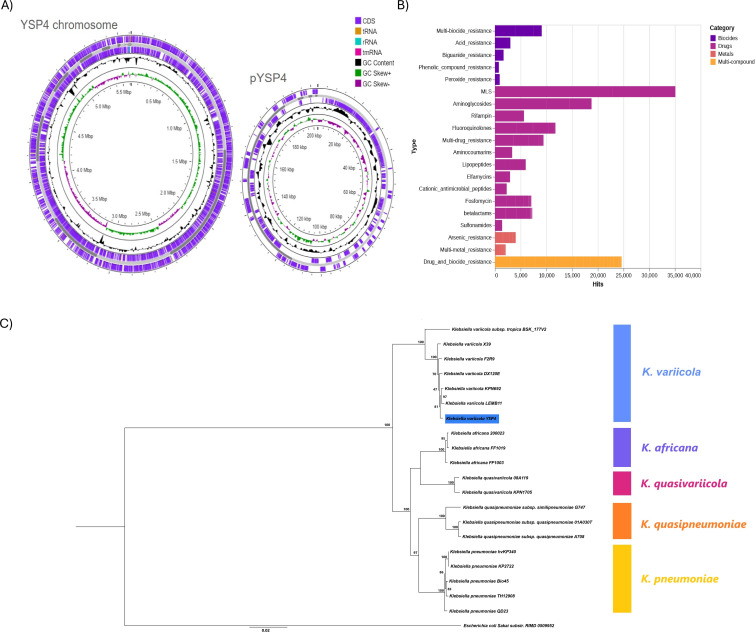 Fig 1
Fig 1Peer Reviews
No public reviews on file for this paper yet. If you reviewed it on a platform where reviews are public (OpenReview, ICLR, NeurIPS, ICML), you can paste yours below so the community can read it here.
Videos
No videos yet. Explain this paper in a talk, walkthrough, or lecture? Add one.
Taxonomy
TopicsGenomics and Phylogenetic Studies · Plant Pathogenic Bacteria Studies · Antibiotic Resistance in Bacteria
ANNOUNCEMENT
Klebsiella variicola is a highly adaptable bacterial species found in diverse environments and maintains complex mutualistic or parasitic relationships with plants, fungi, or animals (1). It exhibits plant growth-promoting genes and can remove heavy metals and phenolic compounds from the environment (2–5). However, some strains are highly virulent and resistant to antibiotics, causing severe infections in humans (6–8). Due to limitations in automated microbiology equipment, differentiating Klebsiella pneumoniae from K. variicola remains challenging (2). This difficulty highlights the need for genomic studies, especially in places like the Dominican Republic, where data on related infections are scarce.
River water samples were collected from Tamayo, Bahoruco (18°23.962′N, 71°11.165′W). The water was serially diluted (10^−1^ to 10^−4^) and plated on MacConkey Agar, incubated at 37°C for 24 h. Colonies were isolated on the same medium and cultured on CHROMagar Orientation. The COL-APSE and SuperCARB culture media were employed to identify colistin-resistant and carbapenem-resistant colonies, respectively. The DNA was extracted from a single colony with the DNeasy Blood and Tissue (QIAGEN) Kit and quantified with a Qubit fluorometer. Sequencing was performed by the NovoGene company and conducted in the Illumina NovaSeq6000 platform with a microbial whole genome library (2 × 150 bp paired-end) without customizations. Quality control was conducted using AdapterRemoval (3.0.0) (9), KmerStream (1.1) (10), and FastQC (0.12.1) (11). Genome assembly utilized Edena (3.131028) (12), SPAdes (4.2.0) (13), and Unicycler (0.5.1) (14), with the best assembly selected based on QUAST (5.3.0) (15) results. Annotation was performed using Prokka (1.14.6) (16), and MOB-recon (3.1.9) (17) was used for plasmid annotation and extraction. These steps were performed via the Assembly Hi-Seq pipeline (18). Taxonomic classification was followed using GTDB-Tk v2 (v1.6.0) (19). Annotation was performed using PATRIC (https://www.bv-brc.org/) (20), and AMR identification was performed with AMR++ (v2.0.2) (21) and CARD (v6.0.6) (22). VFAnalyzer (https://www.mgc.ac.cn/VFs/main.htm) (23) was used for virulence gene identification. CheckM (v1.0.18) (24) was used for completeness evaluation. Phylogenetic trees were reconstructed using a maximum likelihood criterion in RaxML-NG, comparing (25) the isolate to 19 Klebsiella species genomes from NCBI. All the tools were used with default parameters.
The analysis revealed a 5,611,899 bp chromosome assembled in 60 contigs (N50 = 715,876 bp, L50 = 3, and GC content = 57.19%) with 228× coverage, 99.61% completeness, and 9,690,956 total reads. The genome harbored 5,796 coding sequences (CDSs), 76 tRNAs, and 5 rRNAs. A total of 4,835 CDSs were annotated with known functions, and 961 were hypothetical proteins. The plasmid was assembled in 8 contigs displaying 202,973 bp (N50 = 113,706 bp) and harbored 120 protein-coding genes and 154 hypothetical proteins. Phylogenetic analysis placed the isolate within the K. variicola clade with 100% bootstrap support (Fig. 1).
(A) Circular map of chromosome and plasmid from K. variicola strain YSP4_INTEC’s annotated. From outside to the center: genes on forward strand, genes on reverse strand, GC content, and GC skew. Circular map was generated by Proksee. (B) Reads of YSP4_INTEC’s sequencing distribution over four different categories of bacterial resistance genes in the MEGARES database analyzed by AMR plus plus. (C) Phylogenetic tree of the Klebsiella group genome sequences showing the position of K. variicola strain YSP4_INTEC. Escherichia coli Sakai substr. RIMD 0509952 is used as an outgroup. The values located in front or behind the tree nodes represent the bootstrap support value.
The bacterium harbors 27 putative antibiotic and biocide resistance genes, including multi-drug efflux pumps, as well as arsenic and multi-metal resistance genes. It contains 63 putative virulence genes distributed in adherence, iron uptake, secretion systems, and proteases, including a protease involved in the pathogenesis of Yersinia pestis (26). The strain also carries genes involved in nitrogen fixation, phosphate solubilization, and phytohormone production typical in plant-interacting bacteria. The presence of genes associated with plant colonization and biocide resistance substantiates the possibility of pathogen transmission through plants to animals and humans.
The reference list from the paper itself. Each links out to its DOI / PubMed record.
- 1Yang L, Yang K. 2020. Biological function of Klebsiella variicola and its effect on the rhizosphere soil of maize seedlings. Peer J 8:e 9894. doi:10.7717/peerj.989432995084 PMC 7501803 · doi ↗ · pubmed ↗
- 2Rodríguez-Medina N, Barrios-Camacho H, Duran-Bedolla J, Garza-Ramos U. 2019. Klebsiella variicola: an emerging pathogen in humans. Emerg Microbes Infect 8:973–988. doi:10.1080/22221751.2019.163498131259664 PMC 6609320 · doi ↗ · pubmed ↗
- 3Afzal AM, Rasool MH, Waseem M, Aslam B. 2017. Assessment of heavy metal tolerance and biosorptive potential of Klebsiella variicola isolated from industrial effluents. AMB Express 7:184. doi:10.1186/s 13568-017-0482-228963704 PMC 5622018 · doi ↗ · pubmed ↗
- 4Mahgoub SA, Qattan SYA, Salem SS, Abdelbasit HM, Raafat M, Ashkan MF, Al-Quwaie DA, Motwali EA, Alqahtani FS, Abd El-Fattah HI. 2023. Characterization and biodegradation of phenol by Pseudomonas aeruginosa and Klebsiella variicola strains isolated from sewage sludge and their effect on soybean seeds germination. Molecules 28:1203. doi:10.3390/molecules 2803120336770871 PMC 9921572 · doi ↗ · pubmed ↗
- 5Zhang J, Liang S, Wang X, Lu Z, Sun P, Zhang H, Sun F. 2019. Biodegradation of Atrazine by the Novel Klebsiella variicola Strain FH-1. Biomed Res Int 2019:1–12. doi:10.1155/2019/4756579 PMC 669935231467894 · doi ↗ · pubmed ↗
- 6de Campos TA, de Almeida FM, de Almeida APC, Nakamura-Silva R, Oliveira-Silva M, de Sousa IFA, Cerdeira L, Lincopan N, Pappas GJ Jr, Pitondo-Silva A. 2021. Multidrug-resistant (MDR) Klebsiella variicola strains isolated in a Brazilian Hospital belong to new clones. Front Microbiol 12:604031. doi:10.3389/fmicb.2021.60403133935984 PMC 8085564 · doi ↗ · pubmed ↗
- 7Potter RF, Lainhart W, Twentyman J, Wallace MA, Wang B, Burnham CAD, Rosen DA, Dantas G. 2018. Population structure, antibiotic resistance, and uropathogenicity of Klebsiella variicola. m Bio 9:e 02481-18. doi:10.1128/m Bio.02481-1830563902 PMC 6299229 · doi ↗ · pubmed ↗
- 8Huang L, Fu L, Hu X, Liang X, Gong G, Xie C, Zhang F, Wang Y, Zhou Y. 2021. Co-occurrence of Klebsiella variicola and Klebsiella pneumoniae both carrying bla KPC from a respiratory intensive care unit patient. Infect Drug Resist 14:4503–4510. doi:10.2147/IDR.S 33097734744441 PMC 8565889 · doi ↗ · pubmed ↗