Draft genomes of multidrug-resistant Acinetobacter baumannii isolates from an agriculturally-dominated watershed and dairy cattle feces
Cecilio Valadez-Cano, Izhar U. H. Khan, Jiacheng Chuan, Xiang (Sean) Li, David R. Lapen, Suzanne Gerdis, Jeremy Dettman, Wen Chen

TL;DR
This paper presents draft genomes of six Acinetobacter baumannii strains from agricultural sources, revealing antibiotic resistance and virulence genes.
Contribution
The study provides new genomic insights into A. baumannii strains from non-clinical agricultural environments.
Findings
The genomes contain diverse antibiotic resistance genes.
Virulence-associated genes were identified in the isolates.
Strains were isolated from dairy cattle feces and agricultural surface waters.
Abstract
Acinetobacter baumannii is an opportunistic human pathogen that primarily affects individuals with compromised immune systems. Here, we report the draft genomes of six A. baumannii strains isolated from animal fecal sources and mixed-use but primarily agricultural surface waters. These genomes contain a diverse array of antibiotic resistance and virulence-associated genes.
Genes, proteins, chemicals, diseases, species, mutations and cell lines named across the full text — each resolved to its canonical identifier and authoritative record.
Click any figure to enlarge with its caption.
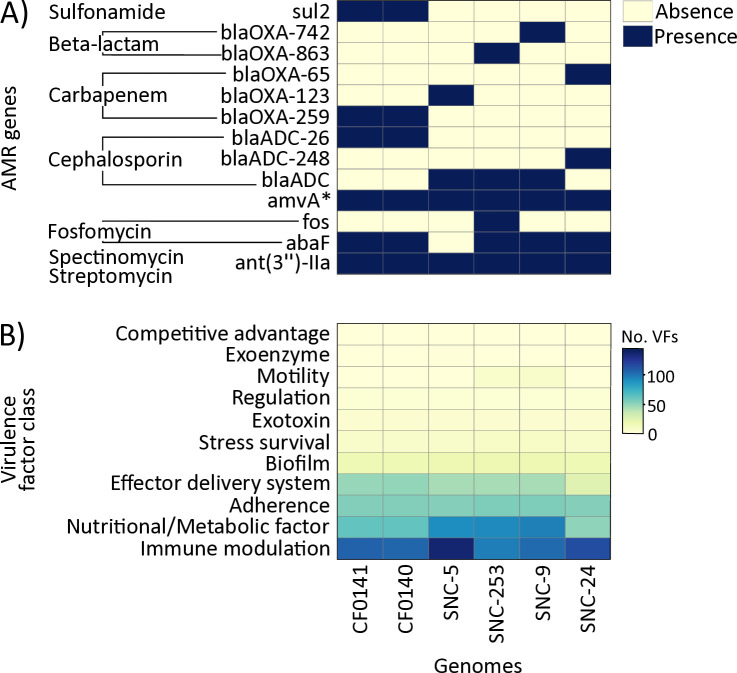 Fig 1
Fig 1| SNC-24 | SNC-253 | SNC-5 | SNC-9 | CF0141 | CF0140 | |
|---|---|---|---|---|---|---|
| WGS Accession |
|
|
|
|
|
|
| SRA Accession |
|
|
|
|
|
|
| Total Read Pairs | 1,617,312 | 1,617,336 | 1,015,731 | 2,009,428 | 1,516,751 | 1,629,001 |
| Coverage | 108.7 | 109 | 72.7 | 139.2 | 105 | 108.9 |
| Length (bp) | 3,965,885 | 3,944,394 | 3,712,131 | 3,737,889 | 3,859,206 | 3,984,304 |
| Number scaffolds | 9 | 9 | 9 | 4 | 7 | 15 |
| N50 scaffolds (Mbp) | 3.92 | 3.92 | 3.68 | 3.73 | 3.81 | 3.79 |
| Completeness (%) | 99.8 | 99.8 | 99.8 | 99.8 | 98.2 | 98.6 |
| Contamination (%) | 0.7 | 1.2 | 0.5 | 0.8 | 0.6 | 0.7 |
| CDS | 3,726 | 3,655 | 3,437 | 3,384 | 3,609 | 3,732 |
Peer Reviews
No public reviews on file for this paper yet. If you reviewed it on a platform where reviews are public (OpenReview, ICLR, NeurIPS, ICML), you can paste yours below so the community can read it here.
Videos
No videos yet. Explain this paper in a talk, walkthrough, or lecture? Add one.
Taxonomy
TopicsAntibiotic Resistance in Bacteria · Vibrio bacteria research studies · Mycobacterium research and diagnosis
ANNOUNCEMENT
Acinetobacter baumannii is a major opportunistic pathogen associated with severe (co)infections in immunocompromised individuals. The ability to acquire and express diverse antimicrobial resistance (AMR) determinants has driven the rise of multidrug-resistant and extensively drug-resistant strains (1–3). Its resilience in diverse environments supports persistence and facilitates dissemination into healthcare settings (4, 5). Particularly concerning are carbapenem-resistant (CRAB) strains, which the World Health Organization designates as ‘critical’ priority pathogens due to limited treatment options and high clinical burden (6).
Strains SNC-24, SNC-253, SNC-5, and SNC-9 were isolated from surface waters in an agriculturally dominated but mixed-use watershed, whereas CF0141 and CF0140 were recovered from dairy cattle feces in the South Nation River basin (45.170, -75.079), eastern Ontario, Canada. Collected samples were suspended in 1× phosphate-buffered saline and serially diluted 10-fold. Bacteria were cultured on Karmali agar (Thermo Fisher Scientific, KS, USA) supplemented with amphotericin B, cefoperazone, sodium pyruvate, and vancomycin, and plates incubated at 42°C under microaerophilic conditions (5% O_2_, 85% N_2_, and 10% CO_2_) for 48 h. Single colonies were subcultured to ensure purity and stored at −20°C for further analysis. Genomic DNA was extracted with the DNeasy UltraClean microbial kit (Qiagen, MD, USA). Identification was performed by 16S rRNA sequencing with primers pA-F (5’ – AGA GTT TGA TCC TGG CTC AG- 3’) and pH-R (5’ – AAG GAG GTG ATC CAG CCG C - 3’). Sequencing was performed on an ABI PRISM 3130XL Genetic Analyzer (Applied Biosystems) and BLAST analysis confirmed 100% identity to A. baumannii 16S rRNA.
Whole-genome sequencing was performed using the Illumina NextSeq 500 platform (2×150 bp) using the Nextera DNA Flex Library Prep kit following manufacturer’s instructions. Reads were trimmed with Atria v3.1.2 (first 10 bp removed) (7), quality-checked with FastQC v0.12.1 (8) and MultiQC v1.19 (9), and assembled de novo with MEGAHIT v1.2.9 (10), discarding contigs <500 bp. Assembly quality was evaluated with CheckM v1.2.2 (11), and taxonomy confirmed with GTDB-Tk v2.3.2 (12). Scaffolding was performed using RagTag v2.1.0 (13) with A. baumannii K09-14 (GCA_008632635.1) as reference. Gene annotation was conducted with Prokka v1.14.6 (14). Virulence factors were identified via BLASTp v2.12.0 (15) against the Virulence Factor Database (16), and AMR genes were detected using AMRFinderPlus v3.11 (17). Default parameters were applied unless stated otherwise.
High-quality draft genomes (3.71–3.98 Mbp; N50: 3.68–3.92 Mbp) were recovered from all isolates, each with >98% completeness, <1.3% contamination, and 72–140× coverage (Table 1). Isolates were predicted to be resistant to spectinomycin/streptomycin and cephalosporins, with variable resistance to other antibiotics (Fig. 1A). SNC-5, SNC-24, CF0141, and CF0140 were identified as potential CRAB strains, based on the presence of carbapenem resistance genes (Fig. 1A). Virulence factors were predominantly associated with immune modulation (VFC0258), nutritional/metabolic factors (VFC0272), adherence (VFC0001), effector delivery systems (VFC0086), and biofilm formation (VFC0271) (Fig. 1B).
*Genome-based assessment of antibiotic resistance and virulence factors in A. baumannii strains. (A) AMR genes identified in six A. baumannii genomes and their associated antibiotic resistance profiles. amvA confers resistance to disinfecting agents, antiseptics, and macrolide antibiotics. (B) Number of virulence factor genes categorized by functional class.
The reference list from the paper itself. Each links out to its DOI / PubMed record.
- 1Ayoub Moubareck C, Hammoudi Halat D. 2020. Insights into Acinetobacter baumannii: a review of microbiological, virulence, and resistance traits in a threatening nosocomial pathogen. Antibiotics (Basel) 9:119. doi:10.3390/antibiotics 903011932178356 PMC 7148516 · doi ↗ · pubmed ↗
- 2Muntean D, Licker M, Horhat F, Dumitrașcu V, Săndesc D, Bedreag O, Dugăeșescu D, Coșniță DA, Krasta A, Bădițoiu L. 2018. Extensively drug-resistant Acinetobacter baumannii and Proteeae association in a Romanian intensive care unit: risk factors for acquisition. Infect Drug Resist 11:2187–2197. doi:10.2147/IDR.S 17128830519056 PMC 6233948 · doi ↗ · pubmed ↗
- 3Mirzaei B, Bazgir ZN, Goli HR, Iranpour F, Mohammadi F, Babaei R. 2020. Prevalence of multi-drug resistant (MDR) and extensively drug-resistant (XDR) phenotypes of Pseudomonas aeruginosa and Acinetobacter baumannii isolated in clinical samples from Northeast of Iran. BMC Res Notes 13:380. doi:10.1186/s 13104-020-05224-w 32778154 PMC 7418330 · doi ↗ · pubmed ↗
- 4Clark NM, Zhanel GG, Lynch JP. 2016. Emergence of antimicrobial resistance among Acinetobacter species: a global threat. Curr Opin Crit Care 22:491–499. doi:10.1097/MCC.000000000000033727552304 · doi ↗ · pubmed ↗
- 5Hamidian M, Maharjan RP, Farrugia DN, Delgado NN, Dinh H, Short FL, Kostoulias X, Peleg AY, Paulsen IT, Cain AK. 2022. Genomic and phenotypic analyses of diverse non-clinical Acinetobacter baumannii strains reveals strain-specific virulence and resistance capacity. Microb Genom 8:000765. doi:10.1099/mgen.0.00076535166651 PMC 8942024 · doi ↗ · pubmed ↗
- 6Geneva: World Health Organization. 2024. WHO Bacterial Priority Pathogens List, 2024: bacterial pathogens of public health importance to guide research, development and strategies to prevent and control antimicrobial resistance
- 7Chuan J, Zhou A, Hale LR, He M, Li X. 2021. Atria: an ultra-fast and accurate trimmer for adapter and quality trimming. Giga Byte 2021:gigabyte 31. doi:10.46471/gigabyte.3136967729 PMC 10038132 · doi ↗ · pubmed ↗
- 8Andrews S. 2010. Fast QC: a quality control tool for high throughput sequence data