Bridging the Gap: A Pre- and Post-evaluation of an Online Skin of Colour Dermatology Lecture Series for Medical Students
Vaseharan Suntharan, Charlotte Wilson, Emma Amoafo, Dominique Dao, Ezigbo Iyamah, Marisa Taylor

TL;DR
A student-led online lecture series improved medical students' confidence in diagnosing skin conditions in darker skin tones, narrowing the gap compared to fairer skin tones.
Contribution
A student-led online lecture series effectively increased confidence in dermatology for skin of colour among medical students.
Findings
Student confidence in diagnosing dermatological conditions in darker skin tones improved significantly after the lecture series.
The gap in confidence between diagnosing in fairer and darker skin tones narrowed following the series.
Almost all students supported including skin of colour teaching in the undergraduate curriculum.
Abstract
Background Medical students often report limited teaching on dermatology in skin of colour (SoC), which may contribute to lower confidence and risk of health inequalities. Objective The objective of this study is to evaluate a pilot student-led lecture series designed to bridge the gap in confidence between recognising dermatological conditions in fairer skin tones (Fitzpatrick I-III) and darker skin tones (Fitzpatrick IV-VI). Methods A nine-lecture online series was delivered to medical students. Students completed pre- and post-series surveys measuring self-reported confidence in diagnosing general dermatological (GenDerm) and SoC dermatological conditions on a five-point Likert scale. Changes in confidence scores were assessed with the Wilcoxon signed-rank test, and effect sizes were calculated. For dichotomised outcomes (high confidence ≥ quite confident), McNemar’s test with…
Genes, proteins, chemicals, diseases, species, mutations and cell lines named across the full text — each resolved to its canonical identifier and authoritative record.
Click any figure to enlarge with its caption.
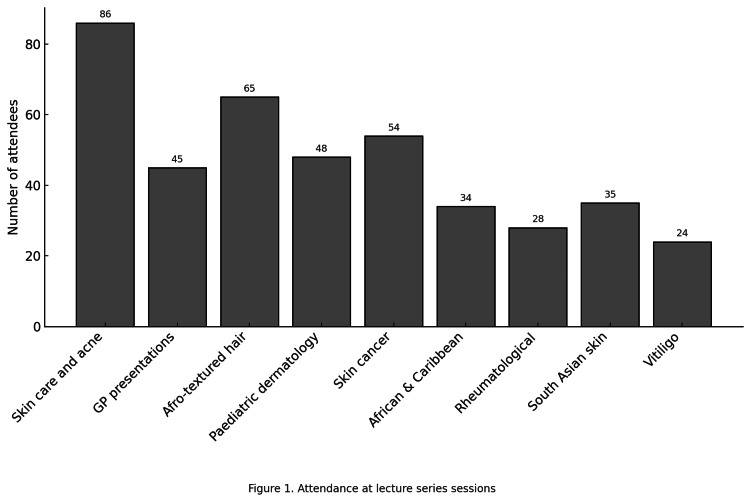 Figure 1
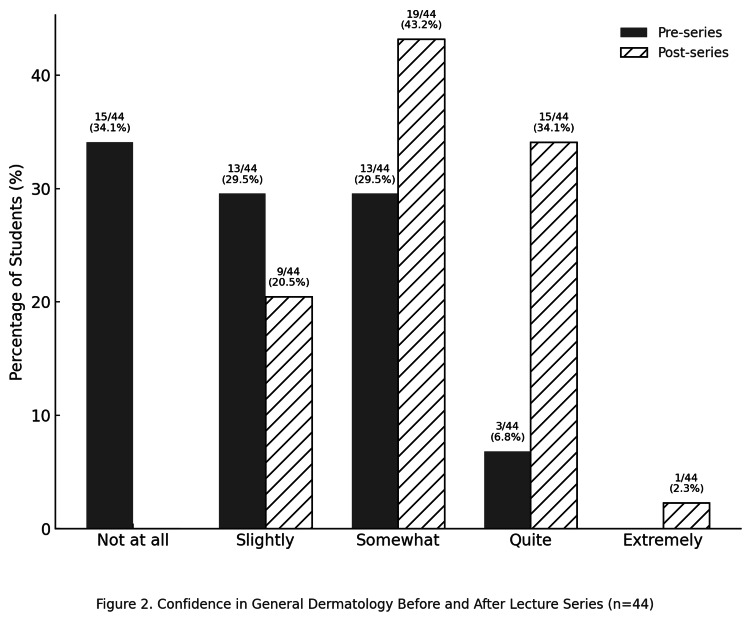 Figure 2
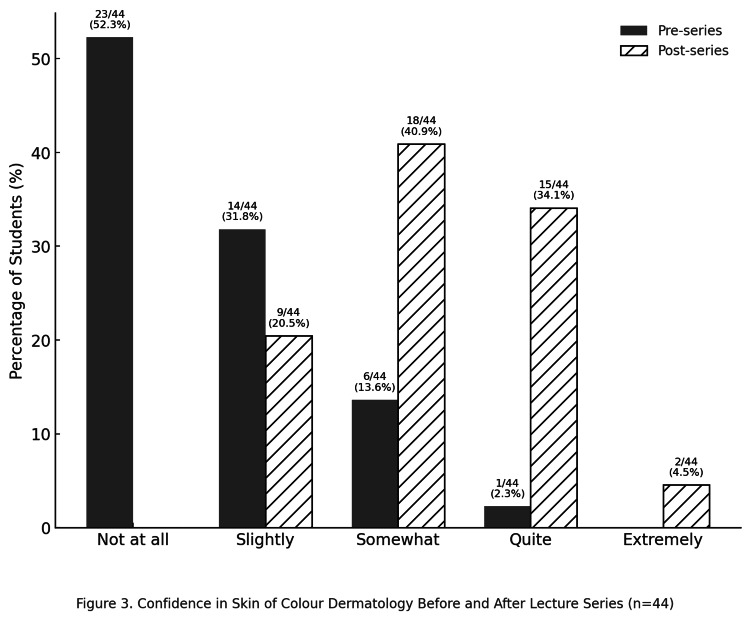 Figure 3
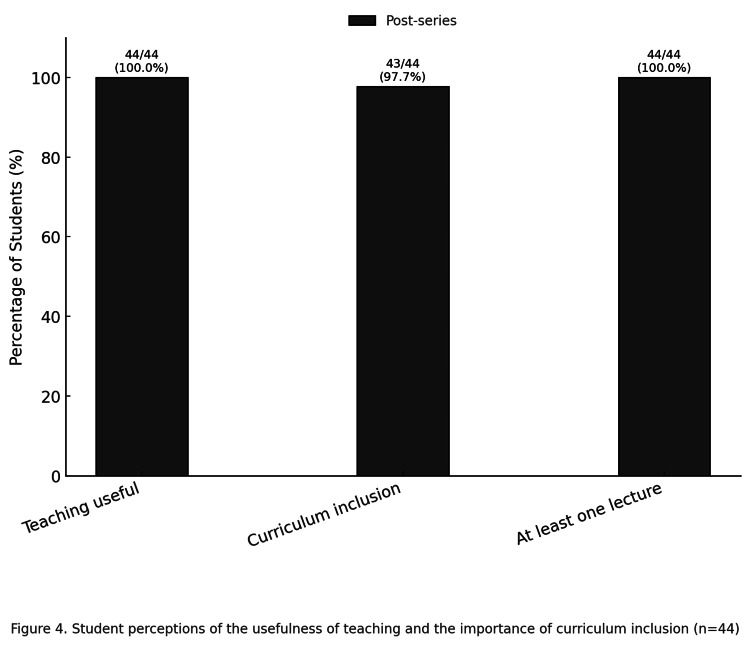 Figure 4
| Confidence level | GenDerm n (%) | SoC n (%) |
| Not at all confident | 34% (n = 15) | 52% (n = 23) |
| Slightly confident | 30% (n = 13) | 32% (n = 14) |
| Somewhat confident | 30% (n = 13) | 14% (n = 6) |
| Quite confident | 7% (n = 3) | 2% (n = 1) |
| Extremely confident | 0% | 0% |
| Confidence level | GenDerm n (%) | SoC n (%) |
| Not at all confident | 0 (0%) | 0 (0%) |
| Slightly confident | 9 (21%) | 9 (21%) |
| Somewhat confident | 19 (43%) | 18 (41%) |
| Quite confident | 15 (34%) | 15 (34%) |
| Extremely confident | 1 (2%) | 2 (4%) |
| Survey item | Agree/yes n (%) | Disagree/no n (%) |
| Previously received formal skin of colour dermatology teaching | 5 (11%) | 39 (88%) |
| Believe skin of colour dermatology is important for future practice | 43 (98%) | 1 (2%) |
| Support inclusion of skin of colour dermatology in medical school curricula | 43 (98%) | 1 (2%) |
Peer Reviews
No public reviews on file for this paper yet. If you reviewed it on a platform where reviews are public (OpenReview, ICLR, NeurIPS, ICML), you can paste yours below so the community can read it here.
Videos
No videos yet. Explain this paper in a talk, walkthrough, or lecture? Add one.
Taxonomy
TopicsCutaneous Melanoma Detection and Management · Dermatological diseases and infestations · Skin Protection and Aging
Introduction
Racial and ethnic disparities in healthcare are well documented, with bias shown to affect clinical decision-making and patient outcomes [1-4]. Within dermatology, these disparities are compounded by inadequate training on conditions presenting in darker skin types. A survey reported that nearly half of U.S. dermatologists felt undertrained in diagnosing conditions in Black patients [5]. Although skin cancer is less common in individuals with darker skin tones, mortality rates are higher due to diagnostic delays [6].
Confidence among clinicians and students in diagnosing dermatological conditions also varies by skin tone. In one large-scale U.S. study, diagnostic accuracy for darker skin was significantly lower compared with lighter skin [7]. Smaller single-centre studies corroborate this, showing reduced diagnostic ability and confidence among medical students when presented with darker skin phototypes [8,9].
Educational resources have historically underrepresented SoC, with textbooks and training models predominantly depicting lighter skin [10-12]. This perpetuates uncertainty in practice and risks poorer outcomes for patients of colour. In the UK, dermatology teaching is often limited to short modules with minimal clinical exposure, exacerbating disparities [13].
To address this gap, we developed Bridging the Gap, a nine-lecture online series on SoC dermatology, with the aim of improving medical student confidence in recognising presentations in Fitzpatrick phototypes IV and above. For the purposes of this study, we refer to these as SoC presentations, whilst acknowledging that in practice such cases are part of GenDerm. The findings were initially presented as a poster at the British Association of Dermatologists Annual Meeting 2024, where feedback was received regarding the inclusion of statistical analysis, which has since been incorporated.
Materials and methods
Study design and setting
This educational intervention was organised by St George’s University Dermatology Society in collaboration with dermatology societies from Imperial College London, University College London, Queen Mary University of London, and King’s College London. The series was supported by Skin of Colour Training UK, the St George’s University Equity Champions programme, and the British Skin Foundation. The project was conceived and coordinated by the lead author (VS), then a fourth-year medical student at St George’s University, who led the design of the teaching programme, organisation across institutions, and delivery of the intervention in collaboration with faculty and student dermatology societies.
Ethics
This project was conducted in accordance with the St George’s Research Ethics Committee (SGREC) Standard Operating Procedure (JRESGOVSOP0054, Version 4.0, 20/05/2021). Under this SOP, studies that constitute educational interventions that do not involve patient participants, clinical data, or identifiable personal information are classified as exempt from requiring full SGREC review. As this study evaluated the impact of a dermatology lecture series on medical student confidence, it fell into the category of an educational intervention and was therefore exempt from formal ethics review. No SGREC application or approval number was required. Participation was voluntary, and completion of the surveys was taken as implied informed consent.
Intervention
Nine online lectures were delivered weekly between November 2023 and February 2024 (excluding the Christmas break) via Microsoft Teams (Microsoft Corporation, Redmond, WA). Sessions were delivered by consultant dermatologists, registrars and medical students. The titles of the lectures were as follows: skin care and acne in diverse skin types, common community (GP) presentations in diverse skin types, Afro-textured hair and colourism, paediatric dermatology in diverse skin types, skin cancer in diverse skin types, what to know about dermatology in African and Caribbean patients, rheumatological skin presentations in diverse skin types, South Asian skin presentations and vitiligo.
A small attendance fee (three pounds per student) was donated in full to the British Skin Foundation. Lecture notes and supplementary materials were hosted on a dedicated website (www.diversedermatology.co.uk) to enhance accessibility and sustainability of the teaching.
Participants
Only medical students were included. For analysis, only those who attended four or more lectures and completed both pre- and post-series surveys were included (n = 44). The threshold of four sessions was chosen as it represented just under half of the lecture series, ensuring participants had sufficient exposure to the teaching to allow a meaningful evaluation of changes in confidence.
Data collection
Pre- and post-lecture surveys were administered via Microsoft Forms (Microsoft Corporation, Redmond, WA) (Appendices). Surveys included questions on confidence in GenDerm and SoC, as well as perceptions of the importance of SoC teaching. Confidence was measured on a five-point Likert scale (1 = not at all confident, 2 = slightly confident, 3 = somewhat confident, 4 = quite confident, 5 = extremely confident), with ‘high confidence’ defined as ≥ four.
For the survey, SoC dermatology was defined as conditions presenting in Fitzpatrick skin phototype IV or higher. We acknowledge that in practice, these conditions are part of GenDerm, but this separation was made to evaluate confidence specifically in darker skin types. The survey instrument was developed through a systematic process. Content validity was established through expert review by two consultant dermatologists, including one with formal qualifications in medical education (PGCert), who assessed the clinical relevance and educational appropriateness. Following expert review, the survey was piloted with 10 medical students to assess clarity and comprehensibility before final implementation.
Statistical analysis
Survey responses were summarised descriptively. Pre- and post-series confidence scores were compared using the Wilcoxon signed-rank test. For ease of interpretation, confidence ratings were also collapsed into two outcomes of ‘high confidence’ (≥‘quite confident’) versus all other responses. These two categories were assessed using McNemar’s test, with odds ratios (ORs) and 95% confidence intervals (CIs) calculated. Perceptions of the teaching, such as usefulness and the value of including skin of colour (SoC) in the curriculum, were reported as proportions with Wilson 95% CIs, which remain reliable even when responses were unanimous. Computational tools were used to generate the statistical calculations.
Post-hoc power calculations were undertaken using paired t-test approximations. The study was highly powered to detect the observed changes, with power exceeding 99% for both general dermatology (Cohen’s d = 0.81) and SoC (Cohen’s d = 1.34).
Results
Baseline dermatology teaching
Attendance data for each lecture are shown in Figure 1. The mean attendance across the nine lectures was 46.5 students. In total, 108 unique email addresses were recorded across the series, representing both undergraduate and postgraduate attendees. Attendance decreased as the series progressed, more so after the Christmas break.
Attendance at lecture series sessions
Baseline confidence was low across both domains. In GenDerm, only 7% (3/44) of students reported high confidence (≥quite confident), whilst in SoC this was even lower at 2% (1/44). In addition, 68% (30/44) reported greater confidence in diagnosing conditions in lighter compared with darker skin.
Perceptions of the importance of SoC teaching were high even before the series. All students (100%, 44/44) agreed that at least one lecture on diverse skin presentations should be included in every medical school curriculum, and almost all agreed that learning about dermatology in patients of colour is important. Table 1 and Table 2 provide numerical data for both pre- and post-lecture series.
Confidence in GenDerm
Before the series, most students described themselves as not at all or slightly confident, and only 7% (3/44) reported high confidence (≥quite confident). After the series, this increased to 36% (16/44). Median confidence rose from slightly confident to somewhat confident. This improvement was significant (Wilcoxon z = 4.13, p < 0.001, r = 0.69). Overall confidence improved across the scale, but only a few students moved into the highest confidence group. The data are illustrated in Figure 2.
Comparison of student confidence in GenDerm before and after the lecture series (n = 44)
Confidence in SoC
At baseline, most students (52%, 23/44) described themselves as not at all confident, and only 2% (1/44) reported high confidence (≥quite confident). After the series, this rose to 39% (17/44). Median confidence increased from not at all confident to somewhat confident, a highly significant improvement (Wilcoxon z = 5.11, p < 0.001, r = 0.84). McNemar’s test showed a significant increase in the proportion of participants reporting high confidence (GenDerm: b = 15, c = 2, p = 0.002; SoC: b = 16, c = 0, p < 0.001). The data are illustrated in Figure 3.
Comparison of student confidence in skin of colour (SoC) before and after the lecture series (n = 44)
Perceptions of the teaching
All students rated the teaching as useful (100%, 95% CI 92.0-100.0). Almost all (98%, 43/44) agreed that SoC should be included in the undergraduate curriculum (95% CI 88.2-99.6). In addition, every student (100%, 44/44) agreed that at least one lecture on diverse skin presentations should form part of medical training (95% CI 92.0-100.0). The data are presented in Table 3 and illustrated in Figure 4.
Change in student perception of the importance of skin of colour (SoC) for clinical practice (n = 44)
Discussion
This study shows that a structured, student-led online teaching series can improve medical students' perceived confidence when faced with dermatological conditions in SoC. Before the intervention, students reported limited exposure and lower confidence compared with GenDerm. After the lectures, confidence levels shifted significantly in both areas, with no students remaining in the not at all confident categories. Wilcoxon signed-rank tests confirmed these changes were significant, with large effect sizes for GenDerm and very large effect sizes for SoC. To reiterate, the goal of the study was to bring confidence with SoC more in line with confidence in GenDerm and, hence, to bridge the gap.
Figure 2 and Figure 3 demonstrate similar distributions, with upward shifts in confidence scores that mirror one another. These visual patterns are consistent with the statistical analysis, supporting our hypothesis that the gap between GenDerm and SoC confidence can be bridged. This finding is consistent with recent reports highlighting both the scarcity of formal SoC teaching in medical curricula [5,7-9] and the value of focused interventions in improving student confidence [10-12]. The consensus among our participants in favour of integrating SoC into the undergraduate curriculum further emphasises the need for systemic change. Addressing these gaps is important not only for enhancing student confidence but also for supporting the development of equitable patient care in the longer term [1-4]. The online delivery format offers the additional advantages of being cost-effective, scalable and easily replicable.
Strengths and limitations
The study has several strengths. It represents a multi-institutional collaboration, was designed and led by medical students with expert input. The combination of quantitative data on confidence levels and qualitative feedback on perceptions provides both statistical and contextual evidence of educational value.
Our study did have limitations to note. The survey instrument, whilst not formally psychometrically validated, underwent rigorous content validation by clinical experts with educational expertise. Likert scales are often used in medical education analysis with good effect [14]. The outcomes, therefore, reflect Kirkpatrick levels 1 and 2 (reaction and self-perceived learning) [15], rather than demonstrating changes in behaviour (level 3) or patient outcomes (level 4). The sample size was modest, and voluntary participation introduces the possibility of selection bias.
Whilst self-reported confidence improved, this does not necessarily reflect objective diagnostic skill. Future work should include validated knowledge tests or Objective Structured Clinical Examination (OSCE)-style assessments, as these are needed to validate these findings and explore the potential impact on clinical performance.
Conclusions
Medical students reported lower confidence in diagnosing SoC compared with GenDerm. Our nine-lecture series improved self-reported confidence and received near-universal support for curricular inclusion. Incorporating structured SoC teaching into undergraduate education may help to reduce inequalities in dermatological care, although further studies using validated assessments are needed to confirm the impact on clinical practice.
The reference list from the paper itself. Each links out to its DOI / PubMed record.
- 1A systematic review of the impact of physician implicit racial bias on clinical decision making Acad Emerg Med Dehon E Weiss N Jones J Faulconer W Hinton E Sterling S 8959042420172847253310.1111/acem.13214 · doi ↗ · pubmed ↗
- 2Disparities in the emergency department evaluation of chest pain patients Acad Emerg Med Pezzin LE Keyl PM Green GB 1491561420071726753110.1197/j.aem.2006.08.020 · doi ↗ · pubmed ↗
- 3The effects of patient sex and race on medical students’ ratings of quality of life Am J Med Rathore SS Lenert LA Weinfurt KP 56156610820001080628510.1016/s 0002-9343(00)00352-1 · doi ↗ · pubmed ↗
- 4The effect of patient race and socio-economic status on physicians’ perceptions of patients Soc Sci Med Van Ryn M Burke J 8138285020001069597910.1016/s 0277-9536(99)00338-x · doi ↗ · pubmed ↗
- 5Dermatologic health disparities Dermatol Clin Buster KJ Stevens EI Elmets CA 53593020122211786710.1016/j.det.2011.08.002PMC 3742002 · doi ↗ · pubmed ↗
- 6Skin cancer concerns in people of color: risk factors and prevention Asian Pac J Cancer Prev Gupta AK Bharadwaj M Mehrotra R 525752641720162812587110.22034/APJCP.2016.17.12.5257 PMC 5454668 · doi ↗ · pubmed ↗
- 7Representation and misdiagnosis of dark skin in a large-scale visual diagnostic challenge J Am Acad Dermatol Diao JA Adamson AS 9509518620223381295410.1016/j.jaad.2021.03.088 · doi ↗ · pubmed ↗
- 8The impact of patient skin colour on diagnostic ability and confidence of medical students Adv Health Sci Educ Theory Pract Dodd RV Rafi D Stackhouse AA 117111892820233685973110.1007/s 10459-022-10196-6PMC 9977083 · doi ↗ · pubmed ↗