The European Union summary report on surveillance for the presence of transmissible spongiform encephalopathies (TSE) in 2024
Romolo Nonno, Giuseppe Ru, Roxani Aminalragia‐Giamini, Catalin Iancu, Angel Ortiz‐Pelaez, Kamela Kryemadhi, Francesca Baldinelli

TL;DR
This report summarizes the 2024 EU surveillance for transmissible spongiform encephalopathies in various animal species and genotyping results.
Contribution
The report provides updated surveillance data and genotyping results for TSE in multiple species across EU and non-EU countries in 2024.
Findings
3 atypical BSE cases were reported in EU27 and XI, with no BSE cases in non-EU reporting countries.
458 scrapie cases were reported in sheep, including 380 classical and 78 atypical cases.
71 scrapie cases were reported in goats, with no polymorphisms at codon 146 and 222 in genotyped cases.
Abstract
This report presents results of surveillance on transmissible spongiform encephalopathies in bovines, sheep, goats, cervids and other species, and genotyping in sheep and goats, carried out in 2024 by 27 EU Member States (EU27, MS), the UK (in respect of Northern Ireland, (XI)) and 8 non‐EU reporting countries: Bosnia and Herzegovina, Iceland, Montenegro, North Macedonia, Norway, Serbia, Switzerland and Türkiye. In total, 980,624 bovines were tested by EU27 and XI (+3.4% compared to 2023), with 3 atypical bovine spongiform encephalopathy (BSE) cases reported (2 H‐type: 1 in France, 1 in Ireland; 1 L‐type in Poland); and 41,397 bovines by 8 non‐EU reporting countries with no BSE cases reported. Four additional BSE cases were reported by the UK (1 classical and 1 H‐type), the USA (1 L‐type), Brazil (1 H‐type). In total, 277,064 sheep were tested in EU27 and XI (−2.7% compared to 2023). In…
Genes, proteins, chemicals, diseases, species, mutations and cell lines named across the full text — each resolved to its canonical identifier and authoritative record.
Click any figure to enlarge with its caption.
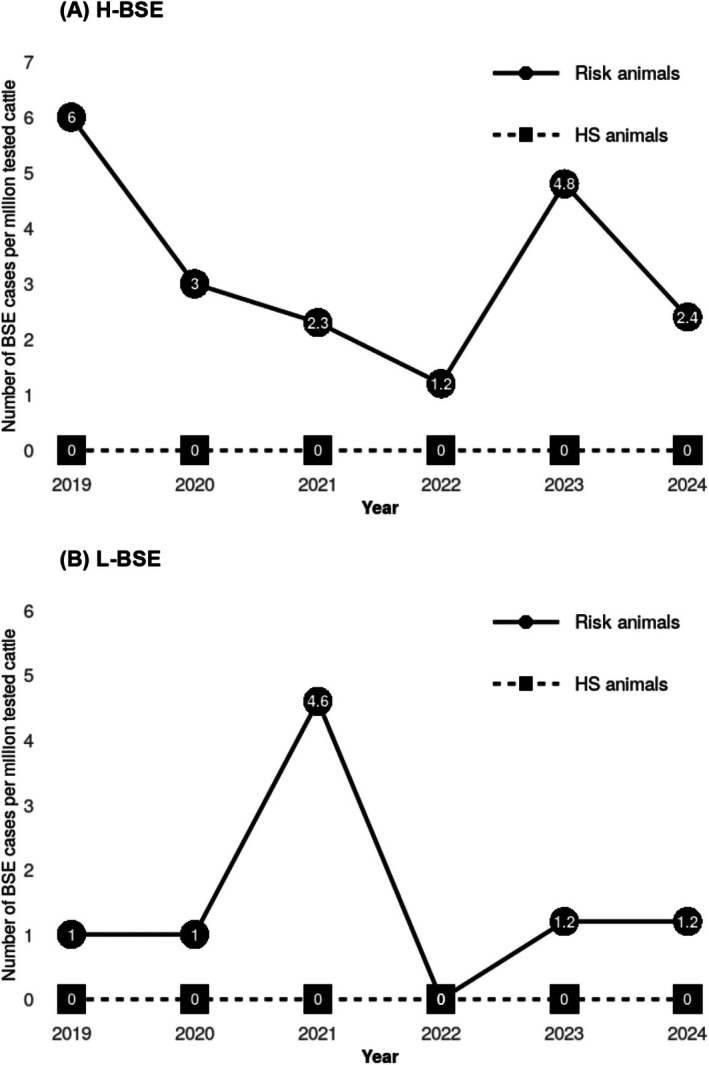 FIGURE 1
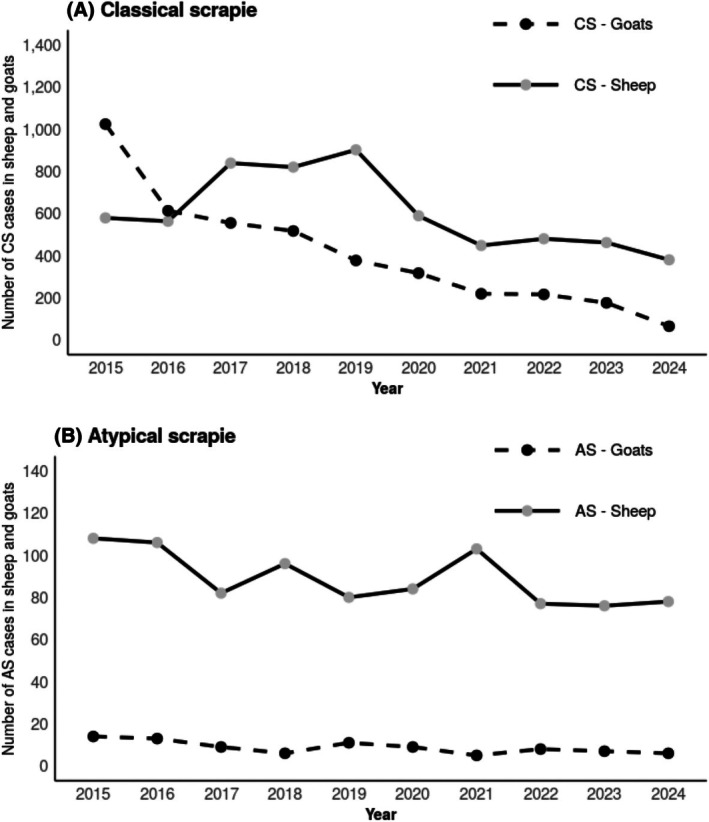 FIGURE 2
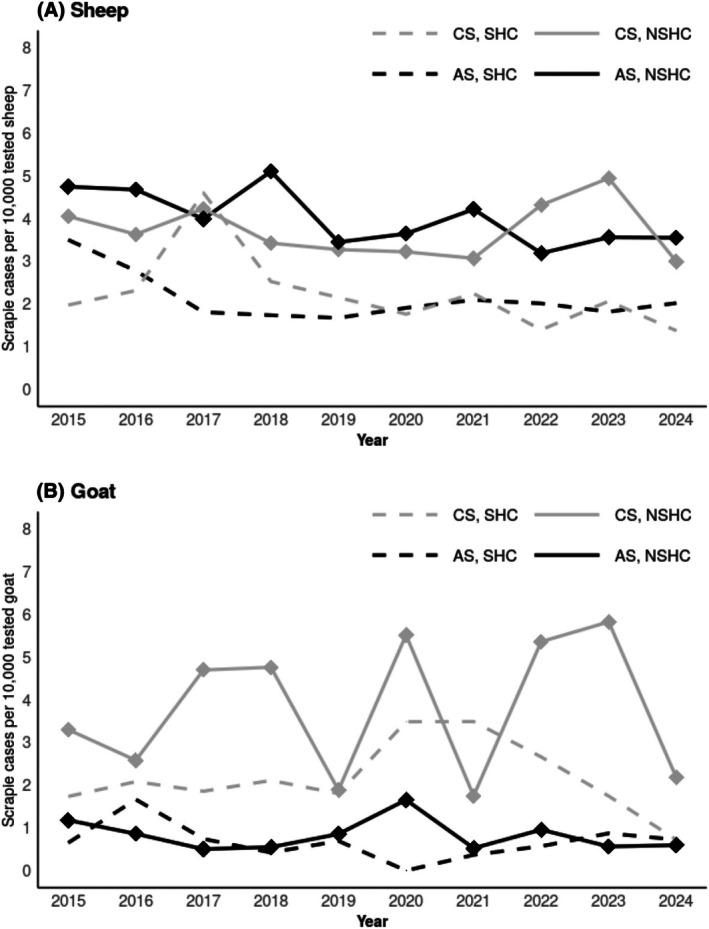 FIGURE 3
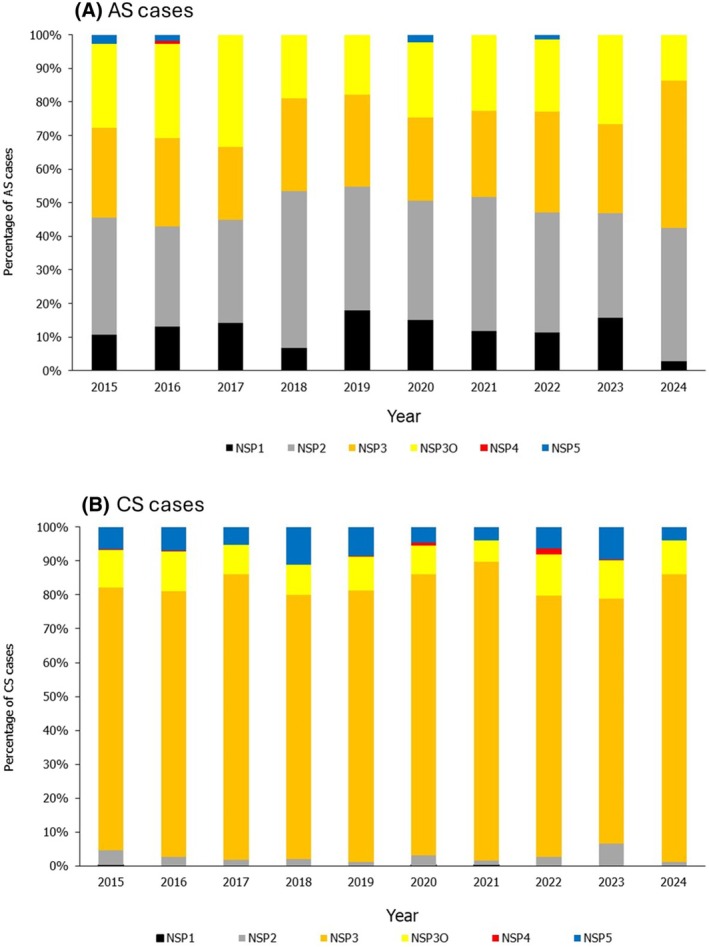 FIGURE 4
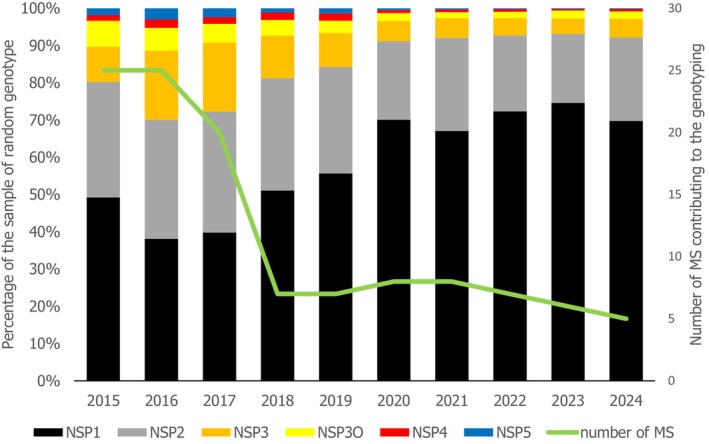 FIGURE 5
| Surveillance target group | EU 25 + XI | Romania, Bulgaria |
|---|---|---|
| Emergency slaughtered animals (ES) | > 48 months | > 24 months |
| Animals with clinical signs at ante‐mortem (AM) | ||
| Fallen stock (FS) | ||
| Healthy slaughtered animals (HS) | No mandatory testing required | > 30 months |
| BSE suspects (SU) | All | All |
| Animals culled under BSE eradication measures (EM) |
| Country | Surveillance target group | |||||
|---|---|---|---|---|---|---|
| ES | AM | FS | HS | SU | EM | |
|
| > 24 | > 24 | > 48 | No testing | No age limit | No age limit |
|
| > 48 | > 48 | > 48 | No testing | No age limit | > 24 |
|
| > 24 | > 24 | > 24 | > 30 | No age limit | No age limit |
|
| > 48 | > 48 | > 48 | No testing | No age limit | > 48 |
|
| > 48 | > 48 | > 48 | No testing | No age limit | No age limit |
|
| > 48 | > 24 | > 48 | No testing | No age limit | No age limit |
|
| > 48 | > 48 | > 48 | No testing | No age limit | > 48 |
|
| > 48 | > 48 | > 48 | No testing | No age limit | No age limit |
|
| > 48 | > 48 | > 48 | No testing | No age limit | No age limit |
|
| > 48 | > 48 | > 48 | Born before 2001 and coming from herds with BSE positive cases | No age limit | No age limit |
|
| > 48 | > 48 | > 48 | No testing | No age limit | No age limit |
|
| > 48 | > 48 | > 48 | Born before 1/1/2002 | No age limit | > 48 |
|
| > 48 | > 48 | > 48 | No testing | No age limit | No age limit |
|
| > 24 | > 24 | > 24 | No testing | No age limit | No age limit |
|
| > 48 | > 48 | > 48 | No testing | No age limit | > 48 |
|
| > 48 | > 48 | > 48 | No testing | No age limit | No age limit |
|
| > 48 | > 48 | > 48 | No testing | No age limit | No age limit |
|
| > 48 | > 48 | > 48 | No testing | No age limit | > 48 |
|
| > 48 | > 48 | > 48 | No testing | No age limit | No age limit |
|
| > 48 | > 48 | > 48 | No testing | No age limit | No age limit |
|
| > 48 | > 48 | > 48 | No testing | No age limit | No age limit |
|
| > 48 | > 48 | > 48 | No testing | No age limit | No age limit |
|
| > 48 | > 48 | > 48 | No testing | No age limit | No age limit |
|
| > 24 | > 24 | > 24 | > 30 | No age limit | No age limit |
|
| > 48 | > 48 | > 48 | No testing | No age limit | No age limit |
|
| > 48 | > 48 | > 48 | No testing | No age limit | No age limit |
|
| > 48 | > 48 | > 48 | No testing | No age limit | No age limit |
|
| > 48 | > 48 | > 48 | No testing | No age limit | No age limit |
|
| n/a | n/a | n/a | n/a | n/a | n/a |
|
| > 48 | > 48 | > 48 | No testing | No age limit | > 48 |
|
| > 48 | > 48 | > 48 | No testing | No age limit | No age limit |
|
| > 24 | > 24 | > 24 | > 30 | No age limit | No age limit |
|
| > 24 | > 24 | > 24 | > 30 | No age limit | No age limit |
|
| > 48 | > 48 | > 48 | No testing | No age limit | No age limit |
|
| > 24 | > 24 | > 24 |
> 72 for domestic animals > 30 for imported animals | No age limit | No age limit |
|
| > 30 | > 30 | > 30 | > 36 | > 30 | No age limit |
| Reported flock/herd status | Index case | Case type | Control measures taken | Sampled population | Surveillance target group to be reported |
|---|---|---|---|---|---|
|
| Yes | CS or AS | n/a | Slaughtered for human consumption. Annex III, Chapter A, Part II, point 2 |
|
| Not slaughtered for human consumption. Annex III, Chapter A, Part II, point 3 |
| ||||
| TSE suspects |
| ||||
|
| No | CS | Killing and complete destruction of all animals (option 1), TSE Regulation, Annex VII, Chapter B, point 2.2.2 (b) or killing and complete destruction of the susceptible animals only (option 2 | Culled and destroyed under options 1 or 2 |
|
| Slaughtered for human consumption after application of option 1 or option 2 |
| ||||
| TSE clinical suspects Chapter 4, Article 12, points 1 and 2 |
| ||||
|
| No | CS | Follow‐up after implementation of control measures according to Annex VII, point 2. Intensified TSE monitoring protocol (Annex VII, point 3) after option 1 or option 2, or if derogation of option 2 was established, after complete destruction or slaughtering for human consumption of identified animals. | Slaughtered for human consumption point 3.1. (a) |
|
| Not slaughtered for human consumption point 3.1. (b) |
| ||||
| TSE clinical suspects Chapter 4, Article 12, points 1 and 2 |
| ||||
|
| No | CS | Follow‐up after implementation of control measures according to Annex VII, point 2. | Slaughtered for human consumption point 4.1. (a) |
|
| Intensified TSE monitoring protocol (Annex VII, point 4) after option 3. | Not slaughtered for human consumption point 4.1. (b) |
| |||
| TSE clinical suspects Chapter 4, Article 12, points 1 and 2 |
| ||||
|
| No | CS | Intensified TSE monitoring protocol pending the implementation of control measures according to the derogation in point 2.2.2. (c)(iii) and after the implementation of the control measures | Slaughtered for human consumption. Points 4.1. (a) and 3.1. (a) |
|
| Not Slaughtered for human consumption. Points 4.1. (b) and 3.1. (b) |
| ||||
| TSE clinical suspects Chapter 4, Article 12, points 1 and 2 |
| ||||
|
| No | AS | Until July 2021, intensified TSE monitoring protocol after the detection of an Atypical Scrapie case (Annex VII point 2.2.3); the active monitoring (i.e. targeting SHC and NSHC) has been lifted on the basis of Commission Regulation (EU) 2021/1176) | Slaughtered for human consumption point 2.2.3 (discontinued from July 2021) |
|
| Not slaughtered for human consumption point 2.2.3 (discontinued from July 2021) |
| ||||
| TSE clinical suspects Chapter 4, Article 12, points 1 and 2 |
|
| Country | Sheep | Goats | ||||
|---|---|---|---|---|---|---|
| Population size | Surveillance target group | Population size | Surveillance target group | |||
| SHC | NSHC | SHC | NSHC | |||
|
| 100–750 | 0 | 1500 | 40–250 | 0 | 100% up to 500 |
|
| 100–750 | 0 | 1500 | 40–250 | 0 | 100% up to 500 |
|
| > 750 | 10,000 | 10,000 | 40–250 | 0 | 100% up to 500 |
|
| 100–750 | 0 | 1500 | 40–250 | 0 | 100% up to 500 |
|
| 100–750 | 0 | 1500 | < 40 | 0 | 100% up to 100 |
|
| > 750 | 10,000 | 10,000 | 40–250 | 0 | 100% up to 500 |
|
| 40–100 | 0 | 100% up to 500 | < 40 | 0 | 100% up to 100 |
|
| 40–100 | 0 | 100% up to 500 | < 40 | 0 | 100% up to 100 |
|
| > 750 | 10,000 | 10,000 | > 750 | 10,000 | 10,000 |
|
| > 750 | 10,000 | 10,000 | > 750 | 10,000 | 10,000 |
|
| 40–100 | 0 | 100% up to 500 | < 40 | 0 | 100% up to 100 |
|
| > 750 | 10,000 | 10,000 | > 750 | 10,000 | 10,000 |
|
| 100–750 | 0 | 1500 | 40–250 | 0 | 100% up to 500 |
|
| > 750 | 10,000 | 10,000 | < 40 | 0 | 100% up to 100 |
|
| > 750 | 10,000 | 10,000 | < 40 | 0 | 100% up to 100 |
|
| > 750 | 10,000 | 10,000 | > 750 | 10,000 | 10,000 |
|
| 100–750 | 0 | 1500 | < 40 | 0 | 100% up to 100 |
|
| < 40 | 0 | 100% up to 100 | < 40 | 0 | 100% up to 100 |
|
| 40–100 | 0 | 100% up to 500 | < 40 | 0 | 100% up to 100 |
|
| < 40 | 0 | 100% up to 100 | < 40 | 0 | 100% up to 100 |
|
| 100–750 | 0 | 1500 | 250–750 | 0 | 1500 |
|
| 100–750 | 0 | 1500 | 40–250 | 0 | 100% up to 500 |
|
| > 750 | 10,000 | 10,000 | 250–750 | 0 | 1500 |
|
| > 750 | 10,000 | 10,000 | > 750 | 10,000 | 10,000 |
|
| 100–750 | 0 | 1500 | < 40 | 0 | 100% up to 100 |
|
| 40–100 | 0 | 100% up to 500 | < 40 | 0 | 100% up to 100 |
|
| 100–750 | 0 | 1500 | < 40 | 0 | 100% up to 100 |
|
| > 750 | 10,000 | 10,000 | 40–250 | 0 | 100% up to 500 |
|
| > 750 | 40–250 | ||||
|
| – | – | ||||
|
| 100–750 | < 40 | ||||
|
| 100–750 | < 40 | ||||
|
| 100–750 | 40–250 | ||||
|
| >750 | 40–250 | ||||
|
| > 750 | 1000 | 1000 | 40–250 | 1000 | 1000 |
|
| > 750 | > 750 | ||||
| Country | Surveillance target group | ||||||||
|---|---|---|---|---|---|---|---|---|---|
| Risk animals | Other target group | Total | |||||||
| FS | AM | ES | Subtotal | HS | SUS | EM | Subtotal | ||
|
| 16,126 | 13 | 3617 | 19,756 | 45 | 4 | 49 |
| |
|
| 27,493 | 4 | 1295 | 28,792 | 6 | 23 | 29 |
| |
|
| 874 | 322 | 1196 | 23,421 | 9 | 23,430 |
| ||
|
| 1633 | 76 | 1709 | 79 | 79 |
| |||
|
| 14,007 | 5685 | 19,692 | 17 | 2 | 19 |
| ||
|
| 174,347 | 11,533 | 185,880 | 116 | 1 | 117 |
| ||
|
| 24,073 | 2205 | 26,278 | 0 |
| ||||
|
| 3078 | 36 | 112 | 3226 | 0 |
| |||
|
| 1882 | 1882 | 34 | 9 | 43 |
| |||
|
| 56,133 | 4 | 2150 | 58,287 | 271 | 9 | 280 |
| |
|
| 9469 | 9469 | 1 | 1 |
| ||||
|
| 176,097 | 1496 | 177,593 | 1026 | 1026 |
| |||
|
| 4563 | 14 | 4577 | 91 | 91 |
| |||
|
| 8381 | 131 | 47 | 8559 | 34 | 17 | 51 |
| |
|
| 62,683 | 146 | 62,829 | 287 | 6 | 293 |
| ||
|
| 32,126 | 78 | 9894 | 42,098 | 191 | 191 |
| ||
|
| 3856 | 1 | 2 | 3859 | 0 |
| |||
|
| 2774 | 1 | 4 | 2779 | 0 |
| |||
|
| 3199 | 28 | 47 | 3274 | 5 | 5 |
| ||
|
| 105 | 110 | 215 | 0 |
| ||||
|
| 60,497 | 7396 | 67,893 | 10 | 10 |
| |||
|
| 35,081 | 1714 | 6542 | 43,337 | 0 |
| |||
|
| 12,508 | 657 | 1665 | 14,830 | 1 | 1 |
| ||
|
| 5006 | 5777 | 5528 | 16,311 | 106,812 | 40 | 106,852 |
| |
|
| 7534 | 5 | 52 | 7591 | 13 | 13 |
| ||
|
| 5186 | 26 | 600 | 5812 | 2 | 3 | 5 |
| |
|
| 6113 | 6113 | 0 |
| |||||
|
| 754,824 | 8621 | 60,392 | 823,837 | 132,443 | 133 | 9 | 132,585 |
|
|
| 23,817 | 258 | 127 | 24,202 | 0 |
| |||
|
|
|
|
|
|
|
|
|
|
|
|
| 19 | 19 | 3559 | 3559 |
| ||||
|
| 6883 | 4465 | 11,348 | 19 | 19 |
| |||
|
| 0 | 306 | 306 |
| |||||
|
| 1 | 1 | 2911 | 2911 |
| ||||
|
| 16 | 16 | 927 | 927 |
| ||||
|
| 1792 | 27 | 4072 | 5891 | 0 |
| |||
|
| 4030 | 1 | 4031 | 10,344 | 1 | 10,345 |
| ||
|
| 5 | 5 | 2019 | 2019 |
| ||||
|
| 12,746 | 27 | 8538 | 21,311 | 20,066 | 20 | 20,086 |
| |
|
|
|
|
|
|
|
|
|
|
|
| Country | FR – atypical | IE – atypical | PL – atypical |
|---|---|---|---|
|
| FS (fallen stock) | FS (fallen stock) | FS (fallen stock) |
|
| H‐type BSE | H‐type BSE | L‐type BSE |
|
| 11/2006 | 03/2009 | 07/2018 |
|
| 207 | 186 | 69 |
|
| Yes | Yes | Yes |
|
| None | Lateral recumbency | One case of fallen stock was noted, with no other clinical signs observed |
|
| Dairy | Beef | Dairy |
|
| Montbéliard | Highland | Holstein‐Friesian |
|
| Yes | No (UK Import) | No |
|
| FR | Kildare, Ireland | Stanin municipality, łukowski district, Poland |
|
| 125 | 87 | 42 |
|
| Dairy | Suckler | Mix |
|
| Bovine milk, cereals barley corn | Imported as a calf heifer in 2012 and no feeding records prior to arrival in Ireland | On the farm feed was prepared on‐site, including hay, grass silage, maize silage and a mixture of ground grain with a complementary feed mix for dairy cattle. Calves were fed with milk replacers. Meat‐and‐bone meal was not used in feeding the animals. |
|
| 0 | No feed cohorts were tested but the index cow was imported into Ireland as part of a consignment of 10 animals in 2012. Five of these were alive in Ireland and tested negative. The sixth animal had been moved to N Ireland and N Ireland authorities were notified. | None of the animals in this group were alive. |
|
| 190 | No, as animal was born in the UK and spent first 3 years there. | Of the 45 animals, only 4 were alive and remained under continuous supervision. |
|
| 11 | Two offspring were alive and tested negative. | The cow gave birth to three calves, none of them were alive. |
|
| No | No | No |
|
| No | No | No |
| Country | Year | Total | |||||
|---|---|---|---|---|---|---|---|
| Up to 2019 | 2020 | 2021 | 2022 | 2023 | 2024 | ||
|
| 8 |
| |||||
|
| 133 |
| |||||
|
| 30 |
| |||||
|
| 421 | 1 |
| ||||
|
| 16 |
| |||||
|
| 1 |
| |||||
|
| 819 | 1 | 2 | 2 |
| ||
|
| 1 |
| |||||
|
| 1013 | 2 | 3 | 1 | 1 | 1 |
|
|
| 1661 | 1 | 1 | 1 |
| ||
|
| 147 |
| |||||
|
| 3 |
| |||||
|
| 88 | 1 |
| ||||
|
| 75 | 1 |
| ||||
|
| 1086 |
| |||||
|
| 2 |
| |||||
|
| 1 |
| |||||
|
| 9 |
| |||||
|
| 27 |
| |||||
|
|
|
|
|
|
|
|
|
|
| 3 | 2 | 1 | 1 |
| ||
|
| 20 | 1 |
| ||||
|
| 465 | 1 | 2 |
| |||
|
| 1 |
| |||||
|
| 36 |
| |||||
|
| 2 |
| |||||
|
| 1 |
| |||||
|
| 184,595 |
| |||||
|
| 1 | 1 | 2 |
| |||
|
| 6 | 1 | 1 |
| |||
|
|
|
|
|
|
|
|
|
|
|
|
|
|
|
|
|
|
| Country | Year | Total | |||||
|---|---|---|---|---|---|---|---|
| Up to 2019 | 2020 | 2021 | 2022 | 2023 | 2024 | ||
|
| 5 |
| |||||
|
| 133 |
| |||||
|
| 29 |
| |||||
|
| 416 |
| |||||
|
| 15 |
| |||||
|
| 1 |
| |||||
|
| 798 |
| |||||
|
| 1 |
| |||||
|
| 969 |
| |||||
|
| 1656 |
| |||||
|
| 142 |
| |||||
|
| 3 |
| |||||
|
| 84 |
| |||||
|
| 60 |
| |||||
|
| 1079 |
| |||||
|
| 8 |
| |||||
|
| 27 |
| |||||
|
|
|
|
|
|
|
|
|
|
| 464 |
| |||||
|
| 184,579 |
| |||||
|
| 1 | 1 |
| ||||
|
|
|
|
|
|
|
|
|
|
|
|
|
|
|
|
|
|
| Country | Year | Total | ||||||||||||
|---|---|---|---|---|---|---|---|---|---|---|---|---|---|---|
| Up to 2019 | 2020 | 2021 | 2022 | 2023 | 2024 | |||||||||
| H | L | H | L | H | L | H | L | H | L | H | L | H | L | |
|
| 1 | 2 |
|
| ||||||||||
|
| 1 |
| ||||||||||||
|
| 2 | 3 | 1 |
|
| |||||||||
|
| 1 |
| ||||||||||||
|
| 11 | 10 | 1 | 1 | 1 | 2 |
|
| ||||||
|
| 24 | 20 | 1 | 1 | 1 | 2 | 1 | 1 | 1 |
|
| |||
|
| 4 | 1 | 1 | 1 | 1 |
|
| |||||||
|
| 5 |
| ||||||||||||
|
| 1 | 3 | 1 |
|
| |||||||||
|
| 2 | 13 | 1 |
|
| |||||||||
|
| 7 |
| ||||||||||||
|
| 2 |
| ||||||||||||
|
| 1 |
| ||||||||||||
|
| 1 |
| ||||||||||||
|
|
|
|
|
|
|
|
|
|
|
|
|
|
|
|
|
| 2 | 2 | 1 | 1 |
| |||||||||
|
| 1 | 1 | 1 |
|
| |||||||||
|
| 1 | 0 | 1 | 2 |
|
| ||||||||
|
| 1 |
| ||||||||||||
|
| 7 | 9 |
|
| ||||||||||
|
| 1 | 1 | 2 | 0 | ||||||||||
|
| 1 | 1 | 1 | 1 |
|
| ||||||||
|
|
|
|
|
|
|
|
|
|
|
|
|
|
|
|
|
|
|
|
|
|
|
|
|
|
|
|
|
|
|
|
| Flock status | Infected | Non‐infected | Total | |||||||
|---|---|---|---|---|---|---|---|---|---|---|
| Surveillance target group | EM | NSHC | SHC | SU | Subtotal infected flock | NSHC | SHC | SU | Subtotal non‐infected flock | |
| Country | ||||||||||
|
| 2367 | 114 | 1 | 2482 |
| |||||
|
| 1514 | 1514 |
| |||||||
|
| 599 | 4007 | 14 | 4620 |
| |||||
|
| 279 | 140 | 419 | 1721 | 18 | 1739 |
| |||
|
| 3050 | 3050 |
| |||||||
|
| 10,799 | 9065 | 19,864 |
| ||||||
|
| 436 | 436 |
| |||||||
|
| 102 | 102 |
| |||||||
|
| 299 | 26 | 53 | 378 | 483 | 2941 | 4 | 3428 |
| |
|
| 3758 | 17 | 5 | 3780 | 10,524 | 8328 | 1 | 18,853 |
| |
|
| 1586 | 1 | 1587 |
| ||||||
|
| 46 | 46 | 14,017 | 4618 | 18,635 |
| ||||
|
| 1519 | 1 | 1520 |
| ||||||
|
| 10,039 | 11,135 | 21,174 |
| ||||||
|
| 99 | 2 | 7 | 108 | 10,195 | 11,853 | 22,048 |
| ||
|
| 2759 | 203 | 2962 | 11,414 | 11,017 | 5 | 22,436 |
| ||
|
| 503 | 503 |
| |||||||
|
| 88 | 88 |
| |||||||
|
| 187 | 2 | 189 |
| ||||||
|
| 87 | 1 | 88 |
| ||||||
|
| 1569 | 1569 |
| |||||||
|
| 8659 | 28,571 | 37,230 |
| ||||||
|
| 1 | 1 | 14,365 | 4614 | 18,979 |
| ||||
|
| 94 | 1696 | 1790 | 16,003 | 27,372 | 2 | 43,377 |
| ||
|
| 1703 | 1703 |
| |||||||
|
| 2153 | 174 | 7 | 2334 |
| |||||
|
| 14,167 | 14,167 |
| |||||||
|
|
|
|
|
|
|
|
|
|
|
|
|
| 3865 | 3865 |
| |||||||
|
|
|
|
|
|
|
|
|
|
|
|
|
| ||||||||||
|
| ||||||||||
|
| 611 | 6 | 617 | 21 | 6131 | 1 | 6153 |
| ||
|
| ||||||||||
|
| 36 | 36 |
| |||||||
|
| 10,120 | 8193 | 5 | 18,318 |
| |||||
|
| 173 | 38 | 211 |
| ||||||
|
| 2 | 2 |
| |||||||
|
|
|
|
|
|
|
|
|
|
|
|
|
|
|
|
|
|
|
|
|
|
|
|
| Flock status | Infected | Non‐infected | Total | |||||||
|---|---|---|---|---|---|---|---|---|---|---|
| Surveillance target group | EM | NSHC | SHC | SU | Subtotal infected herd | NSHC | SHC | SU | Subtotal non‐infected herd | |
| Country | ||||||||||
|
| 690 | 30 | 720 | 720 | ||||||
|
| 669 | 669 | 669 | |||||||
|
| 95 | 765 | 12 | 872 | 872 | |||||
|
| 519 | 263 | 782 | 556 | 28 | 584 | 1366 | |||
|
| 595 | 595 | 595 | |||||||
|
| 1887 | 107 | 1994 | 1994 | ||||||
|
| 107 | 107 | 107 | |||||||
|
| 1 | 1 | 1 | |||||||
|
| 305 | 4 | 6 | 315 | 109 | 540 | 1 | 650 | 965 | |
|
| 262 | 2 | 264 | 9356 | 8044 | 17,400 | 17,664 | |||
|
| 190 | 190 | 190 | |||||||
|
| 2 | 2 | 11,904 | 5373 | 17,277 | 17,279 | ||||
|
| 399 | 399 | 399 | |||||||
|
| 97 | 89 | 186 | 186 | ||||||
|
| 130 | 130 | 130 | |||||||
|
| 570 | 37 | 607 | 7051 | 11,489 | 18,540 | 19,147 | |||
|
| 76 | 76 | 76 | |||||||
|
| 102 | 102 | 102 | |||||||
|
| 16 | 16 | 16 | |||||||
|
| 84 | 84 | 84 | |||||||
|
| 1638 | 1638 | 1638 | |||||||
|
| 3350 | 3176 | 6526 | 6526 | ||||||
|
| 1475 | 1475 | 1475 | |||||||
|
| 6 | 31 | 37 | 8563 | 11,769 | 2 | 20,334 | 20,371 | ||
|
| 164 | 164 | 164 | |||||||
|
| 772 | 59 | 831 | 831 | ||||||
|
| 379 | 379 | 379 | |||||||
|
|
|
|
|
|
|
|
|
|
|
|
|
| 14 | 14 | 14 | |||||||
|
|
|
|
|
|
|
|
|
|
|
|
|
| ||||||||||
|
| ||||||||||
|
| ||||||||||
|
| ||||||||||
|
| ||||||||||
|
| 614 | 15 | 629 | 629 | ||||||
|
| 8 | 8 | 8 | |||||||
|
| ||||||||||
|
|
|
|
|
|
|
|
|
|
|
|
|
|
|
|
|
|
|
|
|
|
|
|
| Case type | Atypical scrapie (AS) | Classical scrapie (CS) | Total | ||||||||||||||||||||
|---|---|---|---|---|---|---|---|---|---|---|---|---|---|---|---|---|---|---|---|---|---|---|---|
| Index case | No | Yes | No | Yes | |||||||||||||||||||
| Surveillance target group | EM | NSHC | SHC | SU | Sub‐ total | EM | NSHC | SHC | SU | Sub‐ total | Total AS | EM | NSHC | SHC | SU | Sub‐ total | EM | NSHC | SHC | SU | Sub‐ total | Total CS | |
| Country | |||||||||||||||||||||||
|
| 9 | 2 | 11 |
|
| ||||||||||||||||||
|
| 7 | 26 | 53 | 86 | 20 | 2 | 1 | 23 |
|
| |||||||||||||
|
| 6 | 8 | 14 |
| 131 | 13 | 5 | 149 | 2 | 2 |
|
| |||||||||||
|
| 3 | 3 |
|
| |||||||||||||||||||
|
| 3 | 3 |
|
| |||||||||||||||||||
|
| 1 | 1 |
|
| |||||||||||||||||||
|
| 7 | 6 | 13 |
|
| ||||||||||||||||||
|
| 1 | 1 | 2 |
| 5 | 1 | 6 | 1 | 1 |
|
| ||||||||||||
|
| 2 | 2 | 4 |
| 44 | 3 | 47 | 11 | 4 | 15 |
|
| |||||||||||
|
| 1 | 3 | 4 |
|
| ||||||||||||||||||
|
| 15 | 5 | 20 |
| 1 | 1 |
|
| |||||||||||||||
|
| 7 | 24 | 31 | 8 | 11 | 19 |
|
| |||||||||||||||
|
| 1 | 1 |
|
| |||||||||||||||||||
|
| 1 | 1 |
|
| |||||||||||||||||||
|
|
|
|
|
|
|
|
|
|
|
|
|
|
|
|
|
|
|
|
|
|
|
|
|
|
| 1 | 1 |
|
| |||||||||||||||||||
|
|
|
|
|
|
|
|
|
|
|
|
|
|
|
|
|
|
|
|
|
|
|
|
|
|
| 2 | 2 |
| 57 | 4 | 61 |
|
| |||||||||||||||
|
| 4 | 5 | 9 |
|
| ||||||||||||||||||
|
|
|
|
|
|
|
|
|
|
|
|
|
|
|
|
|
|
|
|
|
|
|
|
|
|
|
|
|
|
|
|
|
|
|
|
|
|
|
|
|
|
|
|
|
|
|
|
|
|
| Case type | Atypical scrapie (AS) | Classical scrapie (CS) | Total | ||||||||||||||||||||
|---|---|---|---|---|---|---|---|---|---|---|---|---|---|---|---|---|---|---|---|---|---|---|---|
| Index case | No | Yes | No | Yes | |||||||||||||||||||
| Surveillance target group | EM | NSHC | SHC | SU | Sub‐ total | EM | NSHC | SHC | SU | Sub‐ total | Total AS | EM | NSHC | SHC | SU | Sub‐ total | EM | NSHC | SHC | SU | Sub‐ total | Total CS | |
| Country | |||||||||||||||||||||||
|
| 3 | 5 | 8 | 2 | 2 | 10 |
| ||||||||||||||||
|
| 16 | 4 | 6 | 26 | 3 | 3 | 29 |
| |||||||||||||||
|
| 2 | 2 | 4 |
| 7 | 2 | 9 | 3 | 2 | 5 | 14 |
| |||||||||||
|
| 1 | 1 |
|
| |||||||||||||||||||
|
| 3 | 3 | 2 | 2 | 5 |
| |||||||||||||||||
|
| 1 | 1 |
|
| |||||||||||||||||||
|
| 5 | 5 | 1 | 1 | 2 | 7 |
| ||||||||||||||||
|
|
|
|
|
|
|
|
|
|
|
|
|
|
|
|
|
|
|
|
|
|
|
|
|
|
| |||||||||||||||||||||||
|
|
|
|
|
|
|
|
|
|
|
|
|
|
|
|
|
|
|
|
|
|
|
|
|
|
|
|
|
|
|
|
|
|
|
|
|
|
|
|
|
|
|
|
|
|
|
|
|
|
| Country | Up to 2019 | 2020 | 2021 | 2022 | 2023 | 2024 | Total |
|---|---|---|---|---|---|---|---|
|
| 38 |
| |||||
|
| 17 | 8 | 6 |
| |||
|
| 3211 | 2 | 2 | 2 |
| ||
|
| 56 |
| |||||
|
| 116 |
| |||||
|
| 6445 | 176 | 74 | 145 | 188 | 109 |
|
|
| 1977 | 244 | 184 | 117 | 138 | 151 |
|
|
| 1534 |
| |||||
|
| 10 |
| |||||
|
| 587 | 7 |
| ||||
|
| 3220 | 102 | 148 | 170 | 45 | 62 |
|
|
| 401 |
| |||||
|
| 34 | 5 | 1 |
| |||
|
| 1153 | 52 | 34 | 46 | 91 | 50 |
|
|
| 174 |
| |||||
|
| 132 |
| |||||
|
| 19,105 | 589 | 448 | 480 | 462 | 380 |
|
|
|
|
|
|
|
|
|
|
|
| 249 | 53 | 55 | 70 | 61 |
| |
|
| 16 |
| |||||
|
| 2004 |
| |||||
|
| 2269 | 53 | 55 | 0 | 70 | 61 |
|
|
|
|
|
|
|
|
|
|
| Country | Up to 2019 | 2020 | 2021 | 2022 | 2023 | 2024 | Total |
|---|---|---|---|---|---|---|---|
|
| 15 | 1 | 1 |
| |||
|
| 8 | 2 | 1 |
| |||
|
| 6 |
| |||||
|
| 8 |
| |||||
|
| 132 | 14 | 5 | 1 | 5 | 11 |
|
|
| 14 | 1 |
| ||||
|
| 2 |
| |||||
|
| 32 | 1 |
| ||||
|
| 239 | 12 | 6 | 10 | 11 | 14 |
|
|
| 18 | 1 | 1 | 5 | 3 |
| |
|
| 571 | 3 | 7 | 7 | 7 | 3 |
|
|
| 2 | 2 | 2 | 1 |
| ||
|
| 173 | 14 | 16 | 19 | 12 | 13 |
|
|
| 50 | 1 | 1 | 1 | 2 |
| |
|
| 109 | 6 | 6 | 3 | 5 | 4 |
|
|
| 18 |
| |||||
|
| 64 | 5 | 11 | 4 | 3 | 4 |
|
|
| 696 | 18 | 32 | 23 | 21 | 20 |
|
|
| 0 | 1 |
| ||||
|
| 49 | 1 | 1 | 2 | 3 |
| |
|
| 10 | 2 | 1 | 1 | 1 |
| |
|
| 42 | 5 | 12 | 1 | 1 |
| |
|
| 2258 | 84 | 102 | 76 | 75 | 77 | 2672 |
|
| 0 | 1 | 1 | 1 | 1 |
| |
|
|
|
|
|
|
|
|
|
|
| 8 | 1 | 2 |
| |||
|
| 169 | 12 | 8 | 16 | 7 | 9 |
|
|
| 368 | 14 |
| ||||
|
|
|
|
|
|
|
|
|
|
|
|
|
|
|
|
|
|
| Country | Up to 2019 | 2020 | 2021 | 2022 | 2023 | 2024 | Total |
|---|---|---|---|---|---|---|---|
|
| 14 | 7 | 4 | 9 | 8 | 42 | |
|
| 11,459 | 236 | 135 | 134 | 64 | 10 | 12,038 |
|
| 601 | 27 | 11 | 43 | 58 | 29 | 769 |
|
| 264 | 29 | 43 | 20 | 29 | 14 | 399 |
|
| 8 | 8 | |||||
|
| 173 | 173 | |||||
|
| 1 | 1 | |||||
|
| 150 | 13 | 23 | 8 | 9 | 5 | 208 |
|
| 0 | 1 | 1 | ||||
|
| 16 | 5 | 3 | 2 | 7 | 7 | 40 |
|
| 4 | 4 | |||||
|
| 12,690 | 317 | 219 | 216 | 176 | 65 | 13,683 |
|
| |||||||
|
|
|
|
|
|
|
|
|
|
| 231 | 2 | 233 | ||||
|
|
|
|
|
|
|
|
|
|
|
|
|
|
|
|
|
|
| Country | Up to 2019 | 2020 | 2021 | 2022 | 2023 | 2024 | Total |
|---|---|---|---|---|---|---|---|
|
| 1 | 1 | |||||
|
| 4 | 4 | |||||
|
| 2 | 1 | 1 | 4 | |||
|
| 0 | 1 | 1 | ||||
|
| 5 | 5 | |||||
|
| 55 | 3 | 2 | 2 | 2 | 4 | 68 |
|
| 1 | 1 | |||||
|
| 61 | 1 | 1 | 2 | 2 | 1 | 68 |
|
| 29 | 3 | 2 | 3 | 1 | 38 | |
|
| 1 | 1 | 2 | ||||
|
| 14 | 1 | 1 | 16 | |||
|
| 1 | 1 | |||||
|
|
|
|
|
|
|
|
|
|
| |||||||
|
|
|
|
|
|
|
|
|
|
| 1 | 1 | |||||
|
|
|
|
|
|
|
|
|
|
|
|
|
|
|
|
|
|
| Country | No. of classical scrapie, CH1641‐like and inconclusive cases | Cases submitted for discriminatory testing | |||
|---|---|---|---|---|---|
| BSE‐not‐excluded | BSE‐excluded | Total | % of total classical scrapie and inconclusive case | ||
|
| 109 | 0 | 109 | 109 |
|
|
| 151 | 0 | 151 | 151 |
|
|
| 7 | 0 | 7 | 7 |
|
|
| 62 | 0 | 62 | 62 |
|
|
| 1 | 0 | 1 | 1 |
|
|
| 50 | 0 | 50 | 50 |
|
|
| 380 | 0 | 380 | 380 |
|
|
| |||||
|
|
|
|
|
|
|
|
| 61 | 0 | 61 | 61 |
|
|
| 61 | 0 | 61 | 61 |
|
|
|
|
|
|
|
|
| Country | No. of classical scrapie, CH1641‐like and inconclusive cases | Cases submitted for discriminatory testing | |||
|---|---|---|---|---|---|
| BSE‐not‐excluded | BSE‐excluded | Total | % of total classical scrapie and inconclusive cases | ||
|
| 10 | 0 | 10 | 10 | 100% |
|
| 29 | 0 | 29 | 29 | 100% |
|
| 14 | 0 | 14 | 14 | 100% |
|
| 5 | 0 | 5 | 5 | 100% |
|
| 7 | 0 | 7 | 7 | 100% |
|
|
|
|
|
|
|
|
|
|
|
|
|
|
| NSP group | Genotype | Risk of classical scrapie (Hunter, |
|---|---|---|
|
| ARR/ARR | Most resistant to scrapie |
|
| ARR/ARQ; ARR/ARH; ARR/AHQ | Resistant to scrapie but offspring may be susceptible depending on genotype of the other parent |
|
| ARQ/ARQ | Higher risk of scrapie in these sheep and in offspring |
|
| AHQ/AHQ; ARH/ARH; ARH/ARQ; AHQ/ARH; AHQ/ARQ | Higher risk of scrapie in these sheep and in offspring |
|
| ARR/VRQ | Susceptible to scrapie but could be used as a breeding source of the ARR allele associated with resistance |
|
| ARQ/VRQ; ARH/VRQ; AHQ/VRQ; VRQ/VRQ | Sheep of highest susceptibility to scrapie in self and offspring |
| Atypical scrapie | Classical scrapie | Total | |||||||||||||||
|---|---|---|---|---|---|---|---|---|---|---|---|---|---|---|---|---|---|
| NSP1 | NSP2 | NSP3 | NSP3O | NSP4 | NSP5 | Other | Total AS | NSP1 | NSP2 | NSP3 | NSP3O | NSP4 | NSP5 | Other | Total CS | ||
|
NSP types Country | |||||||||||||||||
|
| 2 | 7 | 1 | 1 |
|
| |||||||||||
|
|
| 3 | 81 | 18 | 4 | 3 |
|
| |||||||||
|
| 5 | 6 | 2 | 1 |
| 129 | 6 | 16 |
|
| |||||||
|
| 3 |
|
| ||||||||||||||
|
| 1 | 2 |
|
| |||||||||||||
|
| 1 |
|
| ||||||||||||||
|
| 7 | 4 | 2 |
|
| ||||||||||||
|
| 1 | 1 |
| 4 | 3 |
|
| ||||||||||
|
| 1 | 3 |
| 50 | 11 | 1 |
|
| |||||||||
|
| 4 |
|
| ||||||||||||||
|
| 1 | 8 | 7 | 3 | 1 |
| 1 |
|
| ||||||||
|
|
| 1 | 37 | 1 | 7 | 4 |
|
| |||||||||
|
| 1 |
|
| ||||||||||||||
|
| 1 |
|
| ||||||||||||||
|
|
|
|
|
|
|
|
|
|
|
|
|
|
|
|
| ||
|
| 1 |
|
| ||||||||||||||
|
|
|
|
|
|
|
|
|
|
|
|
|
|
|
|
|
|
|
|
| 2 |
| 5 | 56 |
|
| |||||||||||
|
| 1 | 4 | 1 | 3 |
|
| |||||||||||
|
|
|
|
|
|
|
|
|
|
|
|
|
|
|
|
|
|
|
|
|
|
|
|
|
|
|
|
|
|
|
|
|
|
|
| ||
| Number of genotyped animals (%) | ||||||||
|---|---|---|---|---|---|---|---|---|
| NSP1 | NSP2 | NSP3 | NSP3O | NSP4 | NSP5 | Other | Total | |
|
NSP types Country | ||||||||
|
| 1787 (76.8%) | 404 (17.4%) | 82 (3.5%) | 36 (1.5%) | 4 (0.2%) | 0 (0%) | 15 (0.6%) |
|
|
| 161 (57.5%) | 42 (15%) | 7 (2.5%) | 2 (0.7%) | 6 (2.1%) | 0 (0%) | 62 (22.1%) |
|
|
| 232 (35.6%) | 293 (45%) | 87 (13.4%) | 28 (4.3%) | 7 (1.1%) | 2 (0.3%) | 2 (0.3%) |
|
|
| 860 (71.7%) | 228 (19%) | 44 (3.7%) | 22 (1.8%) | 10 (0.8%) | 6 (0.5%) | 30 (2.5%) |
|
|
| 64 (64%) | 32 (32%) | 1 (1%) | 2 (2%) | 1 (1%) | 0 (0%) | 0 (0%) |
|
|
|
|
|
|
|
|
|
|
|
| Number of genotyped animals (%) | ||||||||
|---|---|---|---|---|---|---|---|---|
| NSP1 | NSP2 | NSP3 | NSP3O | NSP4 | NSP5 | Other | Total | |
|
NSP types Country | ||||||||
|
| 55,717 (93.8%) | 3089 (5.2%) | 69 (0.1%) | 44 (0.1%) | 73 (0.1%) | 9 (0%) | 374 (0.6%) |
|
|
| 208 (0.3%) | 17,363 (23.7%) | 38,992 (53.2%) | 13,469 (18.4%) | 524 (0.7%) | 2678 (3.7%) | 0 (0%) |
|
|
|
|
|
|
|
|
|
|
|
| Case type | Atypical scrapie | Classical scrapie | Total | ||||
|---|---|---|---|---|---|---|---|
| Country | NQ/NQ | ZZ/ZZ | Total AS | NQ/NQ | ZZ/ZZ | Total CS | |
|
| 0 | 6 | 4 | 10 |
| ||
|
| 0 | 29 | 29 |
| |||
|
| 2 | 2 | 4 | 5 | 9 | 14 |
|
|
| 1 | 1 | 0 |
| |||
|
| 0 | 5 | 5 |
| |||
|
| 1 | 1 | 0 |
| |||
|
| 0 | 2 | 5 | 7 |
| ||
|
| 3 | 3 | 6 | 47 | 18 | 65 |
|
|
| |||||||
|
|
|
|
|
|
|
|
|
|
| 0 | 0 | 0 | 0 | 0 | 0 |
|
|
|
|
|
|
|
|
|
|
| Management system | Semi‐domesticated/farmed deer species | Wild deer species | Total | |||||||||||||||||
|---|---|---|---|---|---|---|---|---|---|---|---|---|---|---|---|---|---|---|---|---|
| Country |
Species Target group | Deer | European moose | Fallow deer | Red Deer | Reindeer | Roe deer | White‐tailed deer | Wild forest reindeer | Sub‐Total | Deer | European moose | Fallow deer | Red Deer | Reindeer | Roe deer | White‐tailed deer | Wild forest reindeer | Sub‐Total | |
|
| FC | 0 | 3 | 5 | 13 | 21 |
| |||||||||||||
| HSHC | 0 | 62 | 14 | 175 | 44 | 295 |
| |||||||||||||
| HSNHC | 0 | 20 | 20 |
| ||||||||||||||||
|
|
|
|
|
|
|
|
|
|
|
|
|
|
|
|
|
|
|
|
| |
|
| FC | 1 | 11 | 5 | 2 | 2 | 21 | 43 | 10 | 7 | 3 | 63 |
| |||||||
| HSHC | 0 | 1 | 1 |
| ||||||||||||||||
| HSNHC | 0 | 1 | 1 |
| ||||||||||||||||
| RK | 1 | 1 | 5 | 2 | 7 |
| ||||||||||||||
|
|
|
|
|
|
|
|
|
|
|
|
|
|
|
|
|
|
|
|
| |
|
| FC | 0 | 3 | 2 | 5 |
| ||||||||||||||
|
|
|
|
|
|
|
|
|
|
|
|
|
|
|
|
|
|
|
|
| |
|
| FC | 0 | 1 | 3 | 11 | 15 |
| |||||||||||||
| SUS | 1 | 1 | 1 | 2 | 6 | 9 |
| |||||||||||||
|
|
|
|
|
|
|
|
|
|
|
|
|
|
|
|
|
|
|
|
| |
|
| FC | 0 | 0 | 13 | 13 |
| ||||||||||||||
| SUS | 0 | 5 | 5 |
| ||||||||||||||||
|
|
|
|
|
|
|
|
|
|
|
|
|
|
|
|
|
|
|
|
| |
|
| SUS | 1 | 1 | 1 | 1 |
| ||||||||||||||
|
|
|
|
|
|
|
|
|
|
|
|
|
|
|
|
|
|
|
|
| |
|
| HSHC | 8 | 8 | 0 |
| |||||||||||||||
|
|
|
|
|
|
|
|
|
|
|
|
|
|
|
|
|
|
|
|
| |
|
| FC | 0 | 1 | 4 | 25 | 30 |
| |||||||||||||
| HSHC | 0 | 36 | 160 | 1007 | 1203 |
| ||||||||||||||
| HSNHC | 0 | 1 | 1 |
| ||||||||||||||||
|
|
|
|
|
|
|
|
|
|
|
|
|
|
|
|
|
|
|
|
| |
|
| FC | 1 | 1 | 2 | 1 | 1 |
| |||||||||||||
| SUS | 1 | 2 | 3 | 32 | 1 | 33 |
| |||||||||||||
|
|
|
|
|
|
|
|
|
|
|
|
|
|
|
|
|
|
|
|
| |
|
|
|
|
|
|
|
|
|
|
|
|
|
|
|
|
|
|
|
|
| |
|
| HSHC | 0 | 88 | 88 |
| |||||||||||||||
| RK | 0 | 8 | 8 |
| ||||||||||||||||
|
|
|
|
|
|
|
|
|
|
|
|
|
|
|
|
|
|
|
|
| |
|
| FC | 3 | 1 | 6 | 63 | 73 | 15 | 330 | 162 | 37 | 435 | 979 |
| |||||||
| HSHC | 0 | 26 | 216 | 3396 | 3638 | 34 | 1054 | 1330 | 1966 | 79 | 4463 |
| ||||||||
| RK | 43 | 43 | 2 | 343 | 203 | 1188 | 1736 |
| ||||||||||||
|
|
|
|
|
|
|
|
|
|
|
|
|
|
|
|
|
|
|
|
| |
|
| FC | 0 | 18 | 44 | 62 |
| ||||||||||||||
| HSHC | 0 | 2 | 55 | 60 | 117 |
| ||||||||||||||
| RK | 0 | 7 | 7 |
| ||||||||||||||||
|
|
|
|
|
|
|
|
|
|
|
|
|
|
|
|
|
|
|
|
| |
|
|
|
|
|
|
|
|
|
|
|
|
|
|
|
|
|
|
|
|
| |
|
|
|
|
|
|
|
|
|
|
|
|
|
|
|
|
|
|
|
|
| |
| Country | National case ID | Management system | Species | Sex | Age group | Target group | Part sampled | Analytical method type | Analytical method | Result |
|---|---|---|---|---|---|---|---|---|---|---|
|
| E‐13 | Wild or gathered or hunted | European moose (as animal) | Female | ≥ 12 months | FC | Obex | Screening | IDEXX | POS |
| Obex | Confirmation | Western blot | POS | |||||||
| Retropharyngeal lymph node | Screening | IDEXX | NEG | |||||||
| E‐14 | Wild or gathered or hunted | European moose (as animal) | Female | ≥ 12 months | FC | Obex | Screening | IDEXX | POS | |
| Obex | Confirmation | Western blot | POS | |||||||
| Retropharyngeal lymph node | Screening | IDEXX | NEG |
Peer Reviews
No public reviews on file for this paper yet. If you reviewed it on a platform where reviews are public (OpenReview, ICLR, NeurIPS, ICML), you can paste yours below so the community can read it here.
Videos
No videos yet. Explain this paper in a talk, walkthrough, or lecture? Add one.
Taxonomy
TopicsPrion Diseases and Protein Misfolding · Neurological diseases and metabolism · Peripheral Neuropathies and Disorders
SUMMARY
This report of the European Food Safety Authority (EFSA) presents the detailed results of surveillance activities on animal transmissible spongiform encephalopathies (TSE) carried out during 2024 in the European Union (EU) Member States (MS), in the UK (in respect of Northern Ireland, hereafter: ‘XI’)1 and in eight non‐EU reporting countries: Bosnia and Herzegovina, Iceland, Montenegro, North Macedonia, Norway, Serbia, Switzerland (the data reported by Switzerland include those of Liechtenstein) and Türkiye, as well as genotyping data in sheep and goats. Albania and Kosovo2 confirmed no TSE surveillance was conducted in 2024.
TSE monitoring data for bovines, sheep, goats, cervids and species other than domestic ruminants are reported by country according to Regulation (EC) 999/20013 (the TSE Regulation) and consist of testing and case data. Twenty‐eight reporting countries submitted the surveillance data through the EFSA TSE data reporting tool, and eight submitted data directly as extensible markup language (XML) files by using their own system for the automatic upload of data into the EFSA Data Collection Framework (DCF). The data submitted to EFSA were further processed, validated and extracted to draft the summary tables presented in the current EU summary report (EUSR).
As in 2023, the 2024 data for EU and XI have been compared with those from the previous years for the EU and the UK. That might introduce some bias, mainly in the 10‐year trend analysis. In this report, the 2024 EU27 data (i.e. data from the current 27 EU MS, referred to as ‘EU27’) have been summed up with those provided by XI. However, all tables present separately the EU27 totals and those including EU27 data plus XI. Totals obtained from the three European Free Trade Association (EFTA) countries (Iceland, Norway and Switzerland) and the five non‐EFTA IPA (Instrument for Pre‐Accession Countries) countries (Bosnia and Herzegovina, Montenegro, North Macedonia, Serbia and Türkiye) are referred to as ‘non‐EU reporting countries’ in the text, and shortened to ‘non‐EU’ in the tables for brevity.
Bovines
In total, 980,624 bovines were tested in 2024 in the EU27 and XI, with an increase of 3.4% compared to the previous year. This increase was driven by higher testing numbers in Germany, Romania, Bulgaria and Denmark, partially compensated by decreases observed mainly in France, Spain, Poland and Ireland. The 86.5% of all bovines tested in the EU27 and XI was reported to the group of risk animals (emergency slaughtered animals (ES), animals with clinical signs at ante‐mortem inspection (AM) and fallen stock (FS)), with FS being the largest contributor in 2024 (91.8% of all cattle in the risk group), 2.4% more than in 2023. An additional 41,397 bovines were tested by the 8 non‐EU reporting countries. Serbia (the main contributor with 14,376 bovines tested) reported mostly bovines from the healthy slaughtered (HS) target group while Switzerland with 11,367, reported mostly bovines from animals in the risk group.
In the EU27 and XI, three atypical bovine spongiform encephalopathy (BSE) cases were reported in 2024. There were 2 H‐type (1 in France and 1 in Ireland) and 1 L‐type (in Poland) BSE cases, all submitted as FS. The reporting of these atypical BSE cases was consistent with previous years, showing the normal variability of a very rare event, with cases ranging between 1 and 6 per million tested in both H and L types over the years.
In addition, 4 BSE cases were reported in the rest of the world in 2024: 3 atypical – 1 L‐type (in the USA) and 2 H‐type (1 in the UK and 1 in Brazil) – and 1 case of classical BSE in the UK, in a 7.5‐year‐old cow on a beef suckler farm in Ayrshire, Scotland. The classical BSE cases identified in the UK in 2018, 2021 and 2024, even when considering the disease's long incubation time, provide evidence that bovine animals have been exposed to the C‐BSE agent after the reinforcement of the feed ban.4
Small ruminants
In total, 371,024 small ruminants were tested in 2024 in the EU27 and XI: 277,064 sheep (a 2.7% decrease compared to 2023) and 93,960 goats (an 8.5% decrease), with some countries not achieving the expected testing quota. In addition, 25,337 sheep were tested by 5 of the 8 non‐EU countries – Iceland, North Macedonia, Norway, Serbia and Türkiye – and 637 goats were tested by Norway and Serbia.
In sheep, 380 scrapie cases in the EU27 and XI were classical scrapie (CS) (83.0%) which represent 17.7% less than those detected in 2023, and 78 cases were atypical scrapie (AS) (17.0%), 2 cases more than in 2023.
Among the 5 non‐EU reporting countries that tested sheep, 61 CS cases were reported by Iceland – with cases from two previously detected infected flocks – and 11 AS cases were reported by Iceland (2) and Norway (9).
CS in sheep remains a concern in 4 EU27 – Greece, Italy, Romania and Spain – which accounted for 97.8% of all cases reported in 2024. The remaining cases included 7 cases from the same flock in Ireland (first outbreak since 2018) and 1 case in Portugal (first outbreak since 2020). Overall, 16.1% of CS cases (61/380) were reported as index cases (IC), which is a lower percentage than the 22.5% observed in 2023. This observed decline in IC of CS cases in sheep in 2024 – consistent with a similar trend in 2023 – suggests a continuing decrease in disease incidence, even if the reduction is borderline non‐statistically significant.
In total, 98.9% of the CS cases in sheep reported in 2024 with known genotypes belonged to animals holding genotypes of the susceptible groups (NSP3, NSP3O, NSP4 or NSP5), confirming the association between the occurrence of the disease in animals with those susceptible genotypes.
AS cases were reported by 13 EU27 and XI countries: Croatia, Finland, France, Germany, Hungary, Ireland, Italy, Northern Ireland, Poland, Portugal, Slovakia, Slovenia and Spain; and 2 non‐EU reporting countries: Iceland and Norway. The pattern of atypical scrapie cases in sheep remained unchanged in 2024 – more countries reported cases compared to CS and all were IC. In addition, a statistically significant trend of AS cases was observed in sheep, with detectable annual decrease of 3.99% over the last 10 years.
In 2024, the random genotyping of the national EU sheep populations was carried out by five EU27: France, Germany, Italy, the Netherlands and Poland. Of the sheep randomly genotyped, 7.8% still carried genotypes in the susceptible groups, higher than 6.9% in 2023.
In goats, in total 71 scrapie cases were reported in the EU27 and XI: 65 CS (91.5% of total scrapie cases,) and 6 AS cases (8.5%).
Similar to the situation in sheep, CS cases were reported in Italy, Greece, Romania and Spain with the addition of Cyprus. In 2024, Greece was the largest contributor to the CS caseload (29; 44.6%), replacing Cyprus which had been the largest contributor in the previous year. This shift reflects the continuous decline of CS cases in Cyprus, dropping from 1678 cases in 2013 to 10 in 2024. In 2024, IC accounted for 21.5% (14/65) of CS cases, which is a lower percentage than the 26.7% observed in 2023.
AS cases in goats were reported by three MS – France, Poland and Spain – indicating a largely stable situation compared to the previous year, with a similar caseload and all cases being index cases.
Genotype data for goat cases at either codon 146 or 222 were reported in 50 scrapie cases (3 AS, 47 CS) by Cyprus, Greece, Italy, Poland, Romania and Spain without indicating any polymorphism, though the genotype could not be determined for the rest of the cases (18 CS, 3 AS).
With regard to long‐term trends (cases per 10,000 tests), the analysis up to 2024 confirmed that no detectable trend was observed for CS and AS in goats over the last 10 years.
From the non‐EU reporting countries, none reported scrapie cases in goats.
Cervids
Chronic wasting disease (CWD) surveillance in 2024 saw reduced testing across EU MS and Norway, with a continued focus on lower‐risk categories, potentially impacting disease detection ability. In 2024, 1761 cervids were tested for CWD by 9 MS and no cases were detected. The hunted/slaughtered fit for human consumption (HSHC) target group was the most tested group, accounting for 85.6% of all tested cervids tested in EU27 and XI. Among the non‐EU reporting countries, Norway tested 10,932 animals, Serbia tested 186 animals and Iceland tested 96 animals. Two fallen/culled (FC) female European moose tested positive for CWD in Norway.
Other species
Two MS reported results of samples tested for TSE in species other than bovines, sheep, goats and cervids. In Estonia, one sample was collected from musk ox and tested negative; in Finland, a total of 185 samples were collected from cat (107), American mink (48), fox (20) and raccoon dog (10), none of them tested positive. From the non‐EU reporting countries, in Norway, a total of 6 samples were collected from musk ox, none of them tested positive.
Two interactive communication tools on TSE – a story map click_this_link, providing general information on TSEs, and a dashboard click_this_link to search and visualise the surveillance data from EU Member States and other reporting countries, have been updated with the data of the 2024 reporting year.
INTRODUCTION
1
Background and Terms of Reference
1.1
According to Part I.A, Chapter B, Annex III of Regulation (EC) 999/20015 (here referred to as the transmissible spongiform encephalopathy (TSE) Regulation), the information to be presented by MS in their annual report, as provided for in Article 6(4), includes:
- The number of suspected cases placed under official movement restrictions in accordance with Article 12(1), per animal species.
- The number of suspected cases subject to laboratory examination in accordance with Article 12(2), per animal species, including the results of the rapid and confirmatory tests (number of positives and negatives) and, with regard to bovine animals, the age distribution of all tested animals. The age distribution should be grouped as follows: ‘below 24 months’, distribution per 12 months between 24 and 155 months, and ‘above 155 months’ of age.
- The number of flocks where suspected cases in ovine and caprine animals have been reported and investigated pursuant to Article 12(1) and (2).
- The number of bovine animals tested within each subpopulation referred to in Chapter A, Part I, points 2.1, 2.2, 3.1 and 5. The method of the sample selection, the results of the rapid and confirmatory tests and the age distribution of the tested animals grouped as set out in point 2 should be provided.
- The number of ovine and caprine animals and flocks tested within each subpopulation referred to in Chapter A, Part II, points 2, 3, 5 and 6 together with the method for sample selection and the results of the rapid and confirmatory tests.
- The geographical distribution, including the country of origin if not the same as the reporting country, of positive cases of BSE and scrapie. The year, and where possible the month of birth should be given for each TSE case in bovine, ovine and caprine animals. TSE cases that have been considered atypical shall be indicated. For scrapie cases, the results of the primary and secondary molecular testing, referred to in Annex X, Chapter C, point 3.2(c), shall be reported, when appropriate.
- In animals other than bovine, ovine and caprine animals, the number of samples and confirmed TSE cases per species.
- The genotype, and, where possible, the breed, of each ovine and caprine animal found positive to TSE and sampled in accordance with Chapter A, Part II, point 8.
According to Part I.B, Chapter B of the same Annex III: ‘The compilation of reports containing the information referred to in Section A and submitted to the Commission (which shall send it to the European Food Safety Authority) on a monthly basis in the electronic format agreed between the Member States, the Commission and the European Food Safety Authority or, with regard to the information referred to in point 8 on a quarterly basis, may constitute the annual report as required by Article 6(4), provided that the information is updated whenever additional information becomes available.’6
According to Part II of Chapter B, ‘the Union summary shall be presented in a tabled format covering at least the information referred to in Part I.A for each Member State. From 1 January 2016, the European Food Safety Authority shall analyse the information referred to in Part I and publish by the end of November a summary report on the trends and sources of TSE in the Union’.
Surveillance of TSE in the European Union
1.2
Legal basis
1.2.1
Animals suspected of a TSE should be examined in accordance with Article 12.2 of the TSE Regulation. The legal framework for the active surveillance (i.e. the testing of animals not reported as suspected of being infected by a TSE) of ruminants for the presence of TSE is laid down in Article 6 of the TSE Regulation, and specified in its Annex III, Chapter A.
Commission Decision 2009/719/EC7 allowed MS to apply a revised BSE monitoring programme. Commission Implementing Decision 2013/76/EU8 of 4 February 2013, amending Commission Decision 2009/719/EC, authorised 25 MS to decide to stop testing slaughtered bovine animals for human consumption. Following the EFSA scientific report on the evaluation of the revision of the BSE monitoring regime in Croatia (EFSA, 2016a) and the Commission Implementing Decision (EU) 2016/851,9 Croatia was allowed to discontinue the testing of slaughtered bovine animals for human consumption that is still required for Bulgaria and Romania.
With regard to the UK, the transition period agreed as part of the Agreement on the Withdrawal of the UK from the EU ended on 31 December 2020 and the UK is considered a third country. However, the Article 5(4) and Section 24 of Annex 2 of the Protocol on Ireland/Northern Ireland contemplates the EU requirements on data sampling are also applicable to Northern Ireland; so, for the purpose of this report, references to Member States are read as including the UK in respect of Northern Ireland.
The legal basis for the sample collection and for the test methods is laid down in Chapter C of Annex X of the TSE regulation. From 2005, Annex X [as amended by Commission Regulation (EC) No. 36/200510] also provides for mandatory discriminatory testing for BSE of TSE cases detected in small ruminants.
BSE surveillance of bovine animals
1.2.2
As described in the 2016 European Union Summary Report (EUSR) (EFSA, 2017) on TSE, the BSE surveillance of bovine animals is based on the testing of samples from the following target groups: emergency slaughtered animals (ES); animals with clinical signs at ante‐mortem (AM); fallen stock (FS); healthy slaughtered animals (HS); animals clinically suspected of being infected by BSE (SU); and animals culled under BSE eradication measures (EM).
The categories of bovine animals to be submitted for BSE testing are defined in the TSE Regulation and are based on a combination of age (age limits have been changed over time) and surveillance target groups. The general rules for BSE surveillance in EU, applied in 2024, are summarised in Table 1. A table summarising the evolution of the changes (age limits for different target groups) was published in the 2015 EU summary report on TSE (EFSA, 2016b).
However, there are still some differences in the application of these general rules due to specific national provisions that provide some residual testing of HS or the testing of at‐risk animals (AM, ES and FS) at younger age. The age limits (in months) of bovine animals tested for BSE surveillance applied in 2024 by Member States (MS) and the UK (in respect of Northern Ireland) or the other non‐EU reporting countries (Bosnia and Herzegovina, Iceland, Montenegro, North Macedonia, Norway, Serbia, Switzerland and Türkiye) are shown in Table 2.
TSE surveillance of small ruminants
1.2.3
As described in the 2016 EUSR on TSE (EFSA, 2017), the surveillance of ovine and caprine animals for the presence of TSE11 is performed based on testing samples obtained from the following surveillance target groups: animals culled under TSE eradication measures (EM); animals not slaughtered for human consumption (NSHC); healthy animals slaughtered for human consumption (SHC) and animals clinically suspected of being infected by TSE (SU).
Target surveillance groups in small ruminants to be reported for surveillance for TSE in 2024 based on the infection status of flock/herd/holding, the case type detected and the control measures taken according to the TSE Regulation, have been summarised in Table 3.
The minimal sample sizes for NSHC and SHC are set out in Tables A and B of Annex III, Chapter A, Section II, point 3 and point 2(a) and (b), respectively, of the TSE Regulation. The application of the quotas according to sheep and goat populations in each MS is displayed in Table 4. MS may choose to replace up to a maximum of 50% of their SHC ovine and caprine animals by animals obtained from NSHC, e.g. dead ovine and caprine animals over the age of 18 months and up to a maximum of 10% of their ovine and caprine animals tested in SHC and NSHC by animals (> 18 months of age) killed as part of disease eradication campaign(s) at a ratio of 1:1.
According to Commission Regulation (EU) 2021/1176,12 point 4.6, Chapter B, Annex VII is replaced by the following: ‘the restrictions set out in points 4.1 to 4.5 shall apply for a period of two years following the detection of the last TSE case, other than atypical scrapie, on the holdings where option 3 laid down in point 2.2.2(d) has been implemented’. This means, among other things, intensive surveillance no longer needs to be conducted for a period of 2 years on holdings where an atypical scrapie case has been confirmed.
As a result of the changes made by the implementing regulation (EU) 2024/877 to the Annex VIII of the Regulation (EC) No 999/2001, Chapter A, Section A, point 2.3, the Member States or zone of the Member State with a negligible risk for classical scrapie are now as follows: Austria, the Czechia,13 Finland, Sweden and Slovenia.14
The Commission Regulation (EU) 2024/887 aligned the conditions applicable to genetically resistant goats with the ones applicable to genetically resistant sheep, particularly as regards the provisions for a holding to be recognised as having a negligible risk or a controlled risk of classical scrapie and the requirements for intra‐Union trade of caprine semen and embryos set out in Annex VIII to Regulation (EC) No 999/2001, and the requirements for importation into the Union of milk and milk products of caprine animals, caprine animals intended for breeding, as well as of caprine semen and embryos set out in Annex IX to that Regulation.
Genotyping in sheep
1.2.3.1
The prion protein genotype for the codons 136, 154 and 171 should be determined for each positive TSE case in sheep. Where the positive TSE case is an atypical scrapie case, the prion protein genotype for the codon 141 shall also be determined.
As described in the 2018 EUSR on TSE (EFSA, 2019), the Commission Regulation (EC) 2017/89415 amended Annex VII to Regulation (EC) No 999/2001 with regards to representative genotyping activities in the ovine populations (Part 1 Chapter C). The changes in the TSE Regulation no longer require genotyping a minimum sample of at least 600 animals per MS with an adult sheep population of > 750,000 animals, and for other MS, to genotype a minimum sample of at least 100 animals. The new requirements establish that MS where a breeding programme is in place and decide to allow sampling and genotyping of breeding rams only in flocks not participating in the breeding programme, shall determine the prion protein genotype at codons 136, 141, 154 and 171 for a minimum sample representative of the entire ovine population of the Member State, either once every 3 years with a minimum sample of at least 1560 ovine or at a frequency and with a sample size based on compliance with a set of criteria.
According to the Commission Regulation (EU) 2024/91816 entered into force on 25 March 2024, Member States implementing national breeding programmes to select for resistance to TSE in their ovine populations shall notify to the Commission the requirements for such programmes and submit a report only in case of changes to the same. The amendment, which moved from a systematic annual reporting to a reporting when there is a clear need, does not impact the main policy objective which is to ensure that Member States continue to monitor and report on their epidemiological situation as regards TSE.
Genotyping in goats
1.2.3.2
Point 8.2 Part II Chapter A of Annex III of Commission Regulation (EU) 2021/1176, amending the TSE Regulation, established that ‘the prion protein genotype for the codons 146 and 222 shall be determined for each positive TSE case in goats. TSE cases found in goats with genotypes which encode serine (S) or aspartic acid (D) on at least one allele at codon 146 and/or lysine (K) on at least one allele at codon 222, shall immediately be reported to the Commission’.
TSE surveillance in cervids and other species
1.2.4
Since 2021 MS and non‐EU reporting countries may carry out active monitoring for CWD in cervids only on a voluntary basis.
Testing protocols
1.3
The testing protocol for BSE surveillance in bovine animals and for TSE surveillance in small ruminants are described in pages 8 and 9, and in pages 13 and 14, respectively, of the 2016 EUSR on TSE (EFSA, 2017). The testing protocols were updated in 2020 and came into force in 2021; a reference to the updated protocols is included in the Guidance for reporting 2021 surveillance data on TSE (EFSA, 2021). According to this amendment, ‘samples that, following the examinations referred to in points (a) or (b), are regarded as positive TSE cases, but which are not considered atypical cases, shall be examined to exclude the presence of BSE only when they come from an index case. Other cases, which display characteristics that, according to the testing laboratory, merit investigation, shall also be examined to exclude the presence of BSE’.
DATA AND METHODS
2
Origin of the data
2.1
Raw data are electronically submitted by EU MS and non‐EU reporting countries to EFSA. The data to be submitted consist of testing data and case‐based data for bovine animals, small ruminants, cervids and other species, according to the reporting periods (monthly basis) as described in Chapter B.I of Annex III of the TSE Regulation.
Surveillance data on TSE were submitted to EFSA as required by the TSE Regulation. The EFSA data reporting tool (https://github.com/openefsa/tse‐reporting‐tool/wiki) allows reporting countries to edit and automatically upload the data to the EFSA Data Collection Framework (DCF) for inclusion in the EFSA Scientific Data Warehouse (DWH). The tool has been used for the first time during the 2018 TSE data collection period. Eight reporting countries (CZ, ES, FI, FR, IT, NL, SK and SE) transmitted data directly as eXtensible Markup Language (XML) files in 2024 by using their own system for the XML file generation and the upload of data into the DCF, whereas the rest of the reporting countries transmitted XML files to the DCF by the EFSA TSE data reporting tool. All data were then submitted to the EFSA DWH and confirmed by the reporting countries. The electronically submitted data were extracted from the EFSA DWH and further processed and validated by EFSA to summarise the information and to draft the summary tables presented in the current EUSR. The validation dashboard, available to all reporting countries to visualise the data since 2018, has been updated for 2024 data visualisation.
Finally, information on the population of bovine animals in 2024 were obtained from Eurostat annual data17 (Bovine animals, 2 years or over), while information on the population of small ruminants in 2024 as presented in Table 4 were obtained from the 2024 or latest available Eurostat annual data.18 The number of BSE cases worldwide (Table 12) was obtained from the last available report on the monitoring and testing of ruminants for the presence of TSE in the EU (European Commission, 2016), the World Animal Health Information System (WOAH‐WAHIS; https://wahis.woah.org/#/home) and grey literature. A final check regarding the number of BSE cases outside Europe was made conducting searches in grey literature and press releases. During validation of the data, the following additional information was asked to the reporting countries:
- the number of suspected cases placed under official movement restrictions in accordance with Article 12(1), per animal species (according to (i) Annex III, Chapter B, Section 1.A, point 1 of the TSE Regulation);
- the number of flocks for which suspected cases in ovine and caprine animals have been reported and investigated pursuant to Article 12(1) and (2) according to (ii) Annex III, Chapter B, Section 1.A, point 3 of the TSE Regulation; and
- the number of ovine and caprine flocks tested within each subpopulation referred to in Annex III, Chapter A, Part II, points 2, 3, 5 and 6.
The results of this questionnaire are summarised in Appendix D.
In accordance with the Agreement on the Withdrawal of the UK from the EU, and in particular with the Protocol on Ireland/Northern Ireland, the EU requirements on data sampling are also applicable to Northern Ireland. Therefore, pursuant to Article 5(4) and Section 24 of Annex 2 of the Protocol on Ireland/Northern Ireland, which is an integral part of the Agreement on the withdrawal of the UK of Great Britain and Northern Ireland from the European Union and the European Atomic Energy Community, for the purpose of this report, references to Member States are read as including the UK in respect of Northern Ireland.
The data in this report refer only to the samples collected between 1 January 2024 and 31 December 2024 in the EU (27 Member States and the UK in respect of Northern Ireland, referred to in the report as ‘EU27 + XI’) and 8 additional non‐EU reporting countries: Bosnia and Herzegovina, Iceland, Montenegro, North Macedonia, Norway, Serbia, Switzerland (the data reported by Switzerland include those of Liechtenstein) and Türkiye. Upon request, Albania and Kosovo19 informed that they did not conduct TSE surveillance in 2024.
EFSA validated the 2024 data by checking for inconsistencies in the electronically extracted data, and by comparing the reported data with previous years. Members of the TSE subgroup of the Scientific Network for Zoonoses Monitoring Data in the reporting countries were consulted during this validation. The data validation started on 9 April 2025 and was finalised on 06 June 2025. Two consultations with reporting countries were conducted between 4 July and 5 September 2025, and between 30 September and 08 October 2025. The results and tables presented in the current EUSR are based on the data retrieved from the EFSA Scientific Data Warehouse on 26 September 2025. Data submitted from 2018 onwards can be corrected in the EFSA DWH. However, if data were corrected by the reporting countries in the report but not updated in the EFSA Scientific Data Warehouse, the corrections will only be mentioned by means of footnotes in the current or future EUSR.
Data between 2001 and 2024 with focus on the last 5 years in cattle and sheep are presented in tables and figures. As certain MS and non‐EU reporting countries may calculate their annual statistics using different reporting criteria (e.g. based on the date of final test results rather than the date of sampling), the data summarised in this report may differ slightly from the national figures published by single reporting countries for 2024. In addition, subsequent submissions of updated/amended historical data by reporting countries may have resulted in differences in the figures included in this report when compared with the same data presented in previous EUSR.
Presentation of the data
2.2
The current report should be considered the EU summary report (EUSR) for 2024 in compliance with Section II, Chapter B, Annex III of the TSE Regulation.
The reporting countries in this report are the 27 EU MS or EU27, the UK in respect of Northern Ireland (XI), 3 EFTA members (Iceland, Norway and Switzerland) and 5 non‐EFTA IPA (Instrument for Pre‐Accession Countries) countries (Bosnia and Herzegovina, Montenegro, North Macedonia, Serbia and Türkiye). The data reported by Switzerland include those of Lichtenstein. The countries are quoted in this report by using the country codes from the Nomenclature of Units for Territorial Statistics (NUTS) or the English name according to Regulation (EC) No 1059/200320 (see section Country codes).
Since 1 January 2021, complete UK data are no longer submitted to EFSA. Instead, data from XI are submitted and included in this report. In the tables of the report, EU27 data are shown individually and summed to those provided by the XI (EU27 + XI). Totals obtained from the three EFTA countries and the five non‐EFTA IPA are referred as to ‘non‐EU’. Tables 12–18, 23–30 include historical data in which full data from the UK are displayed until 2020 and XI for 2021–2024.
For some tables and figures, the surveillance target groups were combined: FS, ES and AM in bovine animals have been included in the group ‘risk animals’. The group ‘risk animals’ is used here to indicate those animals in which the probability of detecting the disease is higher than in the surveillance target group of HS animals. However, this does not imply that the risk animals experienced a higher level of exposure than normal (Doherr et al., 2001). The same holds for small ruminants from the NSHC target group (Bird, 2003) when tested from non‐infected flocks/herds.
Two interactive communication tools on TSE – a storymap (click_this_link), providing general information on TSE, and a dashboard (click this link), to search and visualise the surveillance data from EU Member States and other reporting countries, have been updated with the data of the reporting year.
Methods
2.3
Descriptive methods
2.3.1
To describe the results of the TSE surveillance programme in the EU in 2024, figures and tables have been produced along with a short narrative text to describe the main findings. The first draft of the report has been created using the R package 'bseReporting' as described in Bossier et al., 2025, and complemented, finalised, reviewed by EFSA experts. The report is split into four sections: bovine animals, small ruminants (sheep and goats), cervids and species other than bovine, ovine and caprine animals and cervids. Both EU aggregated data and data at the national level are presented. When it was considered relevant, multi‐year and historical data are shown. Surveillance data covered the period 2001–2024 for bovine animals and the period 2002–2024 for small ruminants.
Despite the new provisions for the data from the UK, the 2024 EU27 and XI data have been compared with data for the EU27 and the UK until 2021, hence some caution must be applied when interpreting the results.
For bovine animals, summary statistics were obtained based on the total number of tests performed in 2024 by reporting country and surveillance target group. In addition, historical data on confirmed cases between 2020 and 2024 (a 5‐year period) are presented in detail whereas those on the 2001–2019 period have been summed up. Over this period, data of reporting countries are comparable: as of 2017 in the EU as a whole, the surveillance system has been harmonised with active surveillance limiting monitoring to at‐risk animals older than 48 months; exceptions are still in place in some countries, as shown in Table 2.
Additional epidemiological parameters have been presented: number of cases by case type (i.e. C‐BSE, H‐BSE, L‐BSE), target group and proportions (cases per million tests) by case type and year. These have been used to describe the development of the BSE epidemic and to put into context the findings of the reporting year.
To obtain relevant epidemiological information about the BSE cases detected in 2024, EFSA asked for additional information from the individual concerned reporting countries by a small questionnaire.
For small ruminants, summary statistics are presented in this report, and when possible, stratified according to the relevant variables in the database such as surveillance target group (SHC, NSHC, SU, EM), flock/herd status (infected, non‐infected, unknown/not available), surveillance type (passive surveillance restricted to SU vs active surveillance restricted to SHC and NSHC in non‐infected flocks/herds), country, year (since 2002), case type (CS or AS), index case (yes/no). In particular, when historical data have been considered for trend analysis, the last 10‐year period (2015–2024) has been included in the analysis.
Based on the minimum testing requirements for TSE surveillance in small ruminants (Table 4), a check has been carried out of the compliance of each MS. For assessing compliance, the following criteria have been applied:
- For testing in the NSHC surveillance target group: if the difference between observed testing and expected testing (minimum requirements) was positive, then the MS is compliant with the testing requirements.
- For testing in the SHC surveillance target group: if the difference between observed testing and expected testing (minimum requirements) was positive, the MS is compliant. When the difference was negative, a further calculation was performed to check if the MS compliance had been achieved by applying the derogation provided by the TSE Regulation (according to point II.2(c), Chapter A, Annex III of the TSE Regulation), i.e. replacing up to 50% of its minimum SHC sample size by testing dead ovine or caprine animals over the age of 18 months at the ratio of 1:1 and in addition to the minimum sample size for NSHC.
- If the MS is required to test 100% up to 500 of the NSHC in sheep, and the reported number of tested sheep was, e.g. 350, the MS was categorised as undetermined as the total subpopulation of NSHC in the country is not known.
A MS has been considered to meet the minimum requirements when the above criteria have been met in both target groups.
The reporting system of TSE surveillance data does not allow the collation of the number of newly infected flocks and herds during the reporting year but only the number of index cases (IC), considered to be a proxy for the number of incident scrapie cases.
Finally, the classification originally developed by the Great Britain's National Scrapie Plan (NSP) was used to summarise and describe the data on sheep genotyping, while allele nomenclature was used to summarise and describe the data on goats’ genotyping.
To describe and plot the data, some assumptions were made to report the results of bovine animals and small ruminants (sheep and goats):
- To present the number of BSE cases (C‐BSE, L‐BSE and H‐BSE) in tables or graphs, cases for which the type was reported as ‘unknown’ or was missing were considered for reporting purposes as C‐BSE. This could have resulted in a overreporting of C‐BSE cases and underreporting of H‐BSE and L‐BSE cases before 2005.
- To plot the reported scrapie cases according to the flock/herd status, it was assumed that flocks/herds with status reported as ‘unknown’, ‘other’ or blank were ‘non‐infected flocks/herds’.
- To describe the change in evolution of the total number of scrapie IC, it was assumed that all IC were confirmed in non‐infected flocks/herds. If a case was reported as non‐index or unknown index status, it was considered for reporting purposes as ‘infected flocks/herds’.
- To describe the results of the discriminatory TSE testing, it was assumed that all scrapie cases with ‘BSE‐like’, ‘non‐BSE‐like’ or ‘inconclusive’ results in the primary or secondary molecular tests have been submitted for discriminatory testing.
For cervids, summary statistics were extracted and presented in tabular format as follows:
- For all reporting countries, number of tested cervids in 2024 by target group, reporting country, species and management system (wild and semi‐domesticated/farmed).
- For all reporting countries, the number of cases in cervids in 2024.
Number of tested animals in species other than bovines, sheep, goats and cervids tested for TSE in reporting countries in 2024 are presented in tabular format by species and reporting country.
Data analysis methods
2.3.2
With regard to surveillance in bovines, the average number of cases detected per million tests at the EU level in both the risk animals and HS target groups (period 2015–2024) has been used to check if any significant temporal trend was detectable. For this purpose, a Poisson regression model has been fitted for each BSE case type (C‐BSE, H‐BSE and L‐BSE) separately, using the number of cases as dependent variable and the year as a continuous independent variable. The number of tests was taken into account in the model (offset). The target group (risk animals vs. HS), potentially affecting the probability of detecting the disease, was added to the model as covariate to adjust for any confounding effect.
TSE data of small ruminants from the last 10 years (period 2015–2024) have been used to check if any significant temporal trend was detectable. As per BSE, a Poisson regression model has been fitted for each case type (CS and AS) and for each species (ovine and caprine) separately, using the number of cases as dependent variable and the year as a continuous independent variable. The number of tests was taken into account in the model (offset). The target group (NSHC vs SHC), potentially affecting the probability of detecting the disease, was added to the model as covariate to adjust for any confounding effect.
For both species, the relative risk (RR) obtained by exponentiating the beta coefficient associated with the ‘year’ variable was used as a measurement of the annual variation in the probability of detection, i.e. the temporal trend for the entire period. In the model, the RR indicates the average annual change in the proportion of cases per animals tested corresponding with the annual probability of detecting the disease: an RR > 1 indicates an average annual increase in the number of cases per million whereas an RR < 1 indicates an average annual decrease.
Over the same 10‐year period, and considering cases from all reporting countries, the mean age of the AS cases has been compared with that of CS cases in sheep and goats by applying a two‐sample t‐test with unequal variances. A p‐value < 0.05 was considered statistically significant for all the above‐described statistical analyses.
ASSESSMENT
3
BSE surveillance in bovine animals
3.1
Testing in bovine animals
3.1.1
Since 2001 approximately 123.8 million bovine animals have been tested for BSE in the EU, including the UK until 2020 and XI instead since 2021. In 2024, there was a 3.4% increase in the number of tested bovine animals in the EU27 and XI, from 948,165 in 2023 to 980,624 in 2024. The highest increase in the number of cattle tested was observed in Germany (+15,830, +9.3%), Romania (+14,794, +13.7%), Bulgaria (+5207, +26.8%) and Denmark (+4917, +23%), while the highest decrease was observed in France (−6153, −3.3%), Spain (−5453, −8.5%), Poland (−2803, −6.1%) and Ireland (−2021, −3.1%).21 The top two contributors to the HS testing group were Bulgaria and Romania with 130,233 HS (97.9% of all HS) tested bovines in the EU27 and XI.
The eight non‐EU reporting countries (Bosnia and Herzegovina, Iceland, Montenegro, North Macedonia, Norway, Serbia, Switzerland and Türkiye) tested 41,397 bovines in 2024. Serbia was the main contributor with 14,376 bovines tested (showing a decrease of 2.5% compared to 2023), followed by Switzerland that tested 11,367 animals. The non‐EU countries tested bovines mainly in the HS (48.5%) target group, followed by FS (30.7%) and ES (20.6%). All the non‐EFTA IPA countries reported mostly bovines tested in the HS target group (80%).
The number of animals tested in the risk group (ES + AM + FS) increased from 828,030 in 2023 in EU27 and XI to 848,039 in 2024 (+2.4%). This increase was mainly due to enhanced testing of risk animals in Germany (+16,230, +9.6%), Denmark (+4918, +23%) and Belgium (+4147, +16.8%). Similar to the previous year, bovines in the risk group accounted for 86.5% of all tested animals in the EU27 and XI, with those in the FS target group accounting for 91.8% of all risk bovines tested. The number of bovines tested for BSE per reporting country and surveillance target group in 2024 is shown in Table 5.
The distribution of the number of bovine animals tested for BSE by age group, surveillance target group and reporting country in 2024 can be found in the following link https://doi.org/10.5281/zenodo.17378970 distributed as follows:
- Table 6: Number of bovine animals by age group, tested in EU27 and XI and non‐EU reporting countries in 2024.
- Table 7: Number of bovine animals in the risk group (animals with clinical signs at ante‐mortem, emergency slaughtered and fallen stock), by age group, tested in EU27 and XI and non‐EU reporting countries in 2024.
- Table 8: Number of healthy slaughtered bovine animals by age group, tested in EU27 and XI and non‐EU reporting countries in 2024.
- Table 9: Number of BSE suspected bovine animals by age group, tested in EU27 and XI and non‐EU‐reporting countries in 2024.
- Table 10: Number of bovine animals culled under BSE eradication measures, by age group, tested in EU27 and XI and non‐EU reporting countries in 2024.
BSE cases in bovine animals
3.1.2
In the EU27 and XI, three atypical BSE cases were reported in 2024. There were 2 H‐type cases, 1 in Ireland and 1 in France, both detected in the FS target group, and aged 186 and 207 months at detection, respectively. Additionally, 1 L‐type case was reported in Poland, found in FS, and was 69 months of age at detection.
Four additional cases were reported in the rest of the world in 2024: 3 atypical, 1 L‐type (in the USA), 2 H‐type (1 in the UK and 1 in Brazil) and 1 C‐BSE in the UK, in a 7.5‐year‐old cow on a beef suckler farm in Ayrshire, Scotland (Gov UK, online). The last three cases of C‐BSE reported in Europe were detected in the UK in 2018, 2021 and 2024. In the EU27 + XI, the last C‐BSE case was reported by France in 2016.
Table 11 reports the main clinical and epidemiological data of the 2024 cases in the EU27 and XI plus Switzerland. Figure 1 shows the proportion of cases per million tests from 2019 to 2024.
Based on 134 atypical BSE cases with known age since 2001, the average age at detection was 12.2 years (range: 5.5–22.2 years). The FS target group accounts, as mentioned above, for most of the tested animals and hence the cases.
The number of BSE cases by reporting country, type and year (up to 2024, with a focus on the last 5 years) is shown in Tables 12, 13, 14 for total cases, classical BSE and atypical BSE, respectively.
The results of the Poisson regression model carried out over the last 10‐year period (period 2015–2024) shows a non‐significant trend in the occurrence of C‐BSE (RR = 0.50, i.e. an apparent annual decrease of 50.13% in the proportion of cases per tested animals; p = 0.06), of H‐BSE (RR = 1.00; p = 0.99) and of L‐BSE (RR = 1.06; p = 0.49).
Maps showing the geographical distribution of the cumulative number of cases and the cumulative proportion of cases per million tests of C‐BSE cases born after the total (reinforced) feed ban (BARB), H‐BSE and L‐BSE for the period 2001–2024 are shown in Appendix B.
The number of historical reported BSE cases can be found in the following link https://doi.org/10.5281/zenodo.17378970, as follows:
- Table 15: Number of BSE cases per country and year until 2000 (included) in the EU and non‐EU reporting countries.
- Table 16: Number of classical BSE cases per country and year from 2001 in the EU and non‐EU reporting countries.
- Table 17: Number of atypical H‐BSE cases per country and year from 2001 in the EU and non‐EU reporting countries.
- Table 18: Number of atypical L‐BSE cases per country and year from 2001 in the EU and non‐EU reporting countries.
Cases per million tested bovine animals by surveillance target group and case type for the period 2019–2024 in the EU and the UK (until 2020) and in the EU and XI from 2021 to 2024. BSE, bovine spongiform encephalopathy; H‐type BSE (A); L‐type BSE (B).
TSE surveillance in small ruminants
3.2
Testing in small ruminants
3.2.1
Since 2002, more than 11.6 million small ruminants have been tested as part of the official TSE surveillance in the EU, including the UK until 2020 and XI instead since 2021. In 2024, 371,024 small ruminants were tested by the EU27 and XI: 277,064 sheep (74.7%) and 93,960 goats (25.3%), which represents an overall 4.2% decrease (−16,308) in the number of tested small ruminants, compared to 2023.
In 5 of the 8 non‐EU reporting countries (Iceland, North Macedonia, Norway, Serbia and Türkiye), a total of 25,974 small ruminants were tested: 25,337 sheep (97.5%) and 637 goats (2.5%), a decrease of 662 (−2.5%) compared with 2023, mostly due to a 3.5% decrease in testing by Norway compared to the previous year (−684). Bosnia and Herzegovina, Montenegro and Switzerland did not report data on small ruminants.
In sheep, the decrease in the animals tested in the EU27 and XI was 2.7% (−7622, from 284,686 tested in 2023 to 277,064 in 2024), mostly due to a decrease of 5322 in the testing in the non‐TSE‐infected flocks (−2%, from 272,900 in 2023 to 267,578 in 2024) and of −2300 in the TSE‐infected flocks (−19.5%, from 11,786 to 9486.)
In goats, there was a 8.5% decrease in the animals tested in the EU27 and XI (−8688, from 102,646 tested in 2023 to 93,960 in 2024), mostly due to a decrease of 7206 in the testing in non‐TSE‐infected herds (−7.3%, from 99,159 in 2023 to 91,953 in 2024). In addition, the testing decreased by 1480 also in TSE‐infected herds (−42.4%, from 3487 to 2007).
The numbers of sheep and goats tested for TSE by reporting country, surveillance target group and flock/herd status in 2024 are summarised in Tables 19 and 20, respectively. Taking into account the number of samples tested in the SHC and NSHC target groups and those required according to the TSE Regulation (Table 4) and the criteria described in Section 2.3.1, 17 countries in the group EU27 and XI fulfilled the requirements for sheep testing, 6 did not meet requirements. For 5 countries, it was not possible to determine whether the country met the requirements given the unknown number of total sheep NSHC in the countries. In goat surveillance, 14 countries in the group EU27 and XI fulfilled the requirements for goat testing, 6 did not fulfil requirements and for 8 countries it was not possible to determine it.
The pattern of ovine testing by country and flock status observed in previous years was consolidated in 2024. For each sheep tested in a TSE‐infected flock in the EU27 and XI, there were about 28.2 sheep tested in non‐TSE‐infected flocks, larger than in 2023 (23.2) and in 2022 (18.5). This change means that the number of flocks under restriction is decreasing hence the number of animals tested during the 2‐year enhanced monitoring. The decrease in the overall testing of sheep is due to the balance between the lower level of testing mainly in Romania (−4860; −9.7%), Spain (−4321; −16%), Greece (−4228; −52.6%), Portugal (−1438; −7.0%) and France (−1365; −6.8%), compensated partially by an increase in testing by Italy (+2227; +9.6%), Bulgaria (+1571; +51.5%), Northern Ireland (+1308; +51.2%), Poland (+1264; +3.5%), Slovakia (+1,34; +8.7%).
Similarly, in goats the pattern of testing by country and flock status observed in previous years was consolidated in 2024. In 2024, for each goat tested in a TSE‐infected herd in the EU27 and the XI, there were 45.8 goats tested in non‐TSE‐infected herds, higher than that in 2023 (28.4) and in 2022 (25.3). The decrease of 8686 (−8.5%), in the total number of tested goats is primarily attributed to Italy (−3301; −14.7%), Greece (−1898; −66.3%), Cyprus (−949; −41%), Spain (−818; −4.4%) Poland (−440; −6.3%) and France (−345; −1.9) and has not been offset by the increase in the number of goats tested mainly by Bulgaria (+625; +253%), Belgium (+84; +14.4%), Lithuania (+58; +322.2%), Sweden (+56; +51.9%),
TSE cases in small ruminants
3.2.2
In total, 458 scrapie cases in sheep were reported in the EU27 and XI in 2024, 80 (−14.9%) less than in 2023. They were reported by 14 MS and XI, as in the previous year. Except for Austria, Belgium and Sweden, all countries that had reported cases in 2023 did so again in 2024 with the addition of Croatia, Ireland and Slovakia. In the non‐EU reporting countries, 72 scrapie cases in sheep were reported by Iceland (63) and Norway (9), 5 (−6.5%) less than in 2023.
Out of the 458 sheep scrapie cases reported in the EU27 and XI in 2024, 380 were CS cases (83% of all cases), 82 (−17.7%) less compared to 2023, and 78 were AS cases (17% of all cases), two cases more than in 2023.
CS was reported by six MS: Greece, Ireland, Italy, Portugal, Romania and Spain and one non‐EU country: Iceland. Greece and Spain accounted together for 68.4% of CS cases reported overall.
The decrease in CS cases reported in 2024 compared to 2023 was due to reductions in Greece (−79, −42%) and Romania (−41, −45.1%). This decline was partially offset by an increase in reported cases from Italy (+17, +37.8%) and Spain (+13, +9.4%), as well as new reports from Ireland (7 cases, all from the same affected flock) and Portugal (1 case). Notably, 2024 marked Ireland's first CS cases since 2018 and Portugal's first since 2020.
AS was reported by 13 EU27 and XI: Croatia, Finland, France, Germany, Hungary, Ireland, Italy, Poland, Portugal, Slovakia, Slovenia, Spain, and XI, and 2 non‐EU reporting countries: Iceland and Norway. Overall, the number of AS cases remained similar in 2024 compared to 2023. However, some countries reported an increase, like Germany (+6, +120%) and Spain (+3, +27.3%), while some like France (−4), Sweden (−3) and Italy (−1) reported fewer cases. Additionally, Croatia (1), Ireland (2) and Slovakia (1) reported AS cases this year, having not done so previously.
Among the non‐EU reporting countries, 61 CS cases were reported by Iceland and 11 AS cases were reported by Iceland (2) and Norway (9).
Table 21 shows the number of scrapie cases in sheep by reporting country, case type, index case status and surveillance target group. The geographical distribution of AS and CS in 2024 in sheep is shown in Appendix C.
In the EU27 and XI, 139 (30.3%) of all reported sheep scrapie cases in 2024 were index cases (IC): 78 AS and 61 CS. This percentage is lower than the 33.5% observed in 2023, and the absolute number of IC cases also decreased by 22.8% from 180 in 2023. A higher proportion of IC was found in AS cases (78/78; 100%) compared to CS cases (61/380; 16.1%), with a large proportion of non‐IC among CS cases reflecting the within‐flock spread. Using the absolute number of IC as a proxy for the flock‐level incidence in sheep and comparing 2023 with 2024, there was a 41.3% decrease in CS IC (from 104 in 2023 to 61 in 2024) and no changes in the proportion of AS IC.
For non‐EU reporting countries, all 61 CS cases reported by IS were non‐IC and detected in two infected flocks (27 and 34, respectively). All AS cases (11) detected in Iceland and Norway, were IC.
In total, 71 scrapie cases in goats were reported in the EU27 and XI in 2024, 112 (−61.2%) less than in 2023 due to the decrease in the number of cases mainly in Cyprus (−54, −84.4%), Greece (−29, −50%) and Spain (−13, −41.9%). These scrapie cases were reported by 7 countries (Cyprus, Greece, France, Italy, Poland, Romania and Spain), overall, two less than in 2023 but with Bulgaria, Germany and Portugal reporting cases in 2023 and none in 2024, and Poland reporting in 2024 only.
In total, 65 caprine cases in the EU27 and XI in 2024 were CS cases (91.5%) and 6 were AS (8.5%), while in 2023 there were 176 CS (96.2%) and 7 AS (3.8%) cases. Spain reported both CS and AS (14 and 4 cases, respectively). Cyprus (10), Greece (29), Italy (5) and Romania (7) reported only CS cases, and France (1) and Poland (1) reported only AS cases. Greece was the largest contributor to the CS cases reported in 2024 (29; 44.6%) while Cyprus had been the main contributor in 2023 (64; 36.4%). Among the non‐EU reporting countries, none reported scrapie cases in goats.
Table 22 shows the number of scrapie cases in goats by reporting country, case type, index case status and surveillance target group in 2024. The geographical distribution of AS and CS in 2024 in goats is shown in Appendix C.
In goats, 28.2% (20) of all cases reported in the EU27 and XI in 2024 were IC: 6 AS and 14 CS. This percentage is slightly lower than the 29.5% (54) observed in 2023, despite the lower number of caprine cases reported in 2024 (71) compared to 2023 (183). As occurred in sheep, the proportion of IC was higher in AS (6/6; 100%) than in CS (14/65; 21.5%). Spain accounted for 45% (9/20) of all IC in goats. Using the absolute number of IC in goats as a proxy for the herd‐level incidence in goats and comparing 2024 with 2023, there was a decrease in the number of CS IC (from 47 to 14, −70.2%) and there was a decrease of AS IC (from 7 to 6, −14.3%).
Focusing on the last 10 years (2015–2024), the evolution in the number of scrapie cases detected at EU27 and the UK level for the period 2015–2020 and at EU27 and XI level for the period 2021–2024 is shown for each species and by case type in Figure 2. The 2015–2024 trends indicate a decrease in the annual caseload for both the species and scrapie type. However, as these trends do not account for the relevant denominators and potential confounding factors (e.g. the surveillance stream), an epidemiological interpretation should refer to the multivariate analysis applied to the prevalence data presented below.
In goats, the decreasing trend in the absolute number of CS cases (from 176 to 65) continued in 2024. This long‐term evolution is mainly associated to one single MS (Cyprus), where the number of detected cases has consistently declined since the peak in 2013. In 2024, Cyprus experienced a 84.4% reduction in the number of cases, decreasing from 64 in 2023 to 10 in 2024, following a stable period in 2021 and 2022.
Number of reported scrapie cases in sheep and goats in the EU and the UK by case type in the period 2015–2024 in (A) CS and (B) AS.
Focusing on the last 10 years, based on the cases of scrapie with known type and age in sheep (7380 cases), the average age of AS cases (92.4 months) is significantly higher (p < 0.001) than that of CS cases (55.2 months). Similarly, in goats (4081 cases), the average age of AS cases (93.1 months) is significantly higher (p < 0.001) than that of CS cases (57.1 months). Comparing sheep and goats, no significant difference in mean age was found for AS (p = 0.89) and a significant difference was observed for CS (p < 0.01).
Tables 23 and 24 show the cases of CS and AS, respectively, in sheep for the period 2002–2024, with a focus on the last 5 years. Tables 25 and 26 show the cases of CS and AS, respectively, in goats for the period 2002–2024, with a focus on the last 5 years.
The number of historical reported scrapie cases can be found in the following https://doi.org/10.5281/zenodo.17378970, as follows:
- Table 27: Number of classical scrapie cases in sheep per country and year from 2002 in EU and non‐EU reporting countries.
- Table 28: Number of atypical scrapie cases in sheep per country and year from 2002 in EU and non‐EU reporting countries.
- Table 29: Number of classical scrapie cases in goats per country and year from 2002 in EU and non‐EU reporting countries.
- Table 30: Number of atypical scrapie cases in goats per country and year from 2002 in EU and non‐EU reporting countries.
In sheep, in 2024, the number of IC of CS and AS per 10,000 tests carried out by target group at EU27 and XI level was: (i) for CS: 3 in NSHC and 1.4 in SHC; (ii) for AS: 3.5 in NSHC and 2.2 in SHC. In goats, in 2024, the number of IC of CS and AS per 10,000 tests carried out by target group at EU27 and XI level was: (i) for CS: 2.2 in NSHC and 0.7 in SHC; (ii) for AS: 0.6 in NSHC and 0.7 in SHC.
Figure 3 shows, by surveillance target group, the 10‐year trend (2015–2024) of the number of scrapie cases per 10,000 tests of sheep and goats in TSE non‐infected flocks/herds and separately per case type. The data consist of those for EU27 and the UK for the period 2013–2020, and EU27 and XI for the period 2021–2024. In sheep, the results of the Poisson regression model showed a statistically non‐significant, although borderline, decreasing trend for CS of about 2.29% per year (annual RR = 0.98, p = 0.05), and a statistically significant decreasing trend of about 3.99% per year for AS (annual RR = 0.96, p < 0.001). In goats, the model showed a statistically non‐significant trends for both CS (annual RR = 1.01, p = 0.45, with an annual change of 1.45%) and AS (annual RR = 0.95, p = 0.22, with an annual change of 4.69%).
Number of scrapie (index) cases per 10,000 tests in the EU27 and the UK until 2020 and the EU27 and XI for the period 2021–2024 in (A) sheep and (B) goats in non‐TSE infected flocks/herds, reported by case type and target group in the period 2015–2024. This figure is restricted to active surveillance data, i.e. testing performed in NSHC and SHC target groups from non‐infected flocks/herds or not previously known as infected. AS, atypical scrapie; CS, classical scrapie; NSHC, animals not slaughtered for human consumption; SHC, animals slaughtered for human consumption.
Tables 31 and 32 summarise the number and results of discriminatory tests performed by country in 2024 for CS in sheep and goats. In sheep, 380 (100%) of the CS reported in the EU27 and XI were submitted for discriminatory testing. The 61 CS cases of Iceland were also submitted to discriminatory testing. In goats, 65 (100%) of the CS reported in the EU and XI were submitted for discriminatory testing.
As in previous years, discriminatory testing did not find any evidence of BSE infections in small ruminants, as BSE could be excluded in 100% of CS cases detected in 2024 in sheep and goats.
Although not mandatory, Spain, Hungary, Italy and XI performed discriminatory testing on 100% of AS cases in sheep. Spain conducted the discriminatory test also on all goat AS cases. In all cases, BSE was excluded.
Genotyping
3.2.3
The classification of genotypes of the sheep prion protein PRNP gene used in this report, based on the Great Britain's National Scrapie Plan (NSP), is summarised in Table 33 (the risk is relative to classical scrapie only).
Genotyping in scrapie cases in sheep
3.2.3.1
Table 34 shows the genotypes of sheep scrapie cases in 2024 in the EU and other reporting countries.
Genotype data of NSP type were available for 356 (93.7%) out of 380 CS sheep cases in the EU27 and XI in 2024. Of those, 352 cases (98.9%) were from the susceptible genotype groups (NSP3, NSP3O, NSP4 or NSP5). This is in line with the very high proportion of CS cases with known genotype from the susceptible groups generally observed in previous years (ranging from 93.4% to 98.7% in the period 2015–2023). In the current year, no country has reported cases of CS in a sheep with the ARR/ARR genotype (NSP1). This is a very rare occurrence which has been reported in the past (e.g. by Spain in 2019 and by Romania in 2020).
Genotype data were available for 73 (93.6%) out of 78 AS sheep cases in the EU27 and XI in 2024. When known, among ovine AS cases, 42 (57.5%) were from the genotype groups NSP3, NSP3O NSP4 or NSP5. In 2023, this was 53.1%. The additional 31 AS cases had genotypes in the NSP1 or NSP2.
Figure 4 shows the frequency distribution of genotypes of sheep scrapie cases by case type, year and NSP group in the period 2015–2024 in the reporting countries.
Frequency distribution of genotypes of sheep scrapie cases by case type (A) AS cases (B) CS cases, year and National Scrapie Plan (NSP) group in the period 2015–2024 in the reporting countries. AS, atypical scrapie; CS, classical scrapie; NSP1, resistant (black); NSP2, semi‐resistant (grey); NSP3 (orange) + NSP3O (yellow) + NSP4 (red) + NSP5 (blue): classical scrapie susceptible genotypes.
Genotyping in the general sheep population
3.2.3.2
Tables 35 and 36 show the results of the genotyping conducted in 2024 from the general sheep population in the reporting countries. In the EU27 and XI, following the changes in the legislation that entered into force in 2018, five MS conducted the genotyping of a random sample of sheep: France, Germany, Italy, the Netherlands and Poland (Table 35). Note that genotyping conducted in Cyprus and Iceland is reported separately in Table 36 as, in Cyprus, it was conducted systematically in the breeding sheep population, and Iceland obtained data from scrapie outbreaks rather than from a random sample of the sheep population. The subset of EU27 and XI (excluding data from Cyprus) that carried out the activity in 2024 reported a total of 4559 genotypes: 7.8% (347) of the sheep population (with known genotype) were susceptible to CS (NSP3, NSP3O, NSP4 and NSP5), higher than the 6.9% in 2023. This percentage stands at 19.1% in Italy (it was 18.3% in 2023), one of the countries with high case load in 2024, whereas it was 4% in Poland, 5.3% in Belgium, 6.9% in France and 7% in the Netherlands.
After excluding Cyprus, the proportion of sheep in the resistant genotype group (NSP1; black colour in the bars of Figure 5) shifted from 28.6% of the total number of genotyped sheep in 2011 (in which 23 MS contributed) to 68.1% in 2024 (to which 5 MS contributed) and 5.6% lower than the 73.7% of 2023, to which 6 MS contributed.
Frequency distribution of the six genotype National Scrapie Plan (NSP) groups in sheep randomly sampled for genotyping in the EU and XI in the period 2015–2024 according to Regulation (EC) 999/2001, Annex III, Chapter A, Part II, point 8 until end of 2017 and Annex VII, in Chapter C, in Part 1, point 8 from 2018. Number of MS contributing to the genotyping activities is reported in the secondary axes (green). NSP1, resistant (black); NSP2, semi‐resistant (grey); NSP3 (orange) + NSP3O (yellow) + NSP4 (red) + NSP5 (blue): classical scrapie susceptible genotypes.
Genotyping in goats
3.2.3.3
In 2024, Cyprus, Greece, Italy, Poland, Romania and Spain – six of the seven EU27 and XI countries that reported cases in goat – indicated no polymorphisms at either codon 146 or 222 in the 50 scrapie cases (3 AS (50%), 47 CS (72.3%)) with known genotypes (Table 37). However, in a proportion of CS cases (18/45) and AS (3/6) it was not possible to determine the genotype.
TSE surveillance in cervids
3.3
In 2024, 1761 cervids were tested for TSE in the EU27 and XI (Table 38), 335 less (−16%) than in the previous year. The 9 MS that contributed to the monitoring were Finland, France, Hungary, Italy, Latvia, Malta, Romania, Spain and Sweden. Romania contributed to the 70% of the total number of tested cervids in the EU and XI. Out of the 1761 cervids tested by the MS, 37 (2.1%) were captive or farmed or semi‐domesticated animals, and most of them were reindeer (14; 37.8%) and fallow deer (8; 21.6%). Among the 1724 (97.9%) wild cervids tested by MS, the most tested species were roe deer (1118, 63.5%) and red deer (373, 21.6%).
When considering the target groups, the most tested group by the MS was the hunted/slaughtered fit for HC (HSHC) with 1507 animals (85.6%); Romania and Spain contributed particularly to this group. A total of 254 cervids were tested in the risk groups: 171 (9.7%) fallen/culled (FC), 53 (3%) clinical suspect animals (SUS), 22 (1.2%) hunted/slaughtered not fit for HC (HSNHC) and 8 (0.5%) road/predator killed (RK). The numbers of tested cervids by reporting country, management system and target group in 2024 are displayed in Table 38.
Norway tested 10,932 animals, 23.1% less (−3292) than in the previous year. The majority of these were HSHC (74.1%) with semi‐domesticated reindeer (32.0%), wild reindeer (18.3%) and European moose (15.8%) being the most frequently sampled species. In Serbia 186 animals were tested, primarily HSHC (62.9%) including wild roe deer (59.7%), red deer (39.2%) and fallow deer (1.1%). Iceland tested 96 animals, all wild reindeer, most of them were HSHC (91.7%). Norway reported two CWD cases, both in female European moose, one aged 14 years old (NVI, online). The description of the CWD cases detected in 2024 is shown in Table 39.
TSE surveillance in other species
3.4
Three reporting countries reported results of samples tested for TSE in species other than bovines, domestic sheep and goats and cervids. In Estonia, a total of one sample was collected from Musk ox. In Finland, a total of 185 samples were collected from cats (107), American mink (48), fox (20) and raccoon dog (10). In Norway, a total of six samples were collected from musk ox (6). None of them tested positive.
CONCLUSIONS
4
Bovines
4.1
In 2024, a total of 980,624 bovines were tested in the EU27 and XI, representing a 3.4% increase compared to the previous year. This increase was driven by higher testing numbers in Germany, Romania, Bulgaria and Denmark, partially compensated by decreases observed mainly in France, Spain, Poland and Ireland. These are absolute changes in the number of animals tested, not relative to changes in the bovine population of the reporting countries from the previous year.
The increase (+2.4%) in testing of risk animals (which comprised 86.5% of all tests) contributed to maintain a high sensitivity for the BSE surveillance system, considering the EU27 and XI as a single epidemiological unit.
In the EU27 and XI, the reporting of atypical BSE cases was consistent with previous years, showing the normal variability of a very rare event, with cases ranging between 1 and 6 per million tested in both H and L types over the years. Important to note there were no C‐BSE cases among the reporting countries in 2024. However, one case of classical BSE was identified in the UK in 2024. The classical BSE cases identified in the UK in 2018, 2021 and 2024, even when considering the disease's long incubation time, provide evidence that bovine animals have been exposed to the C‐BSE agent after the reinforcement of the feed ban.22
Small ruminants
4.2
Sheep
4.2.1
In 2024, there was a 2.7% decrease in the number of tested sheep – with some countries not achieving the required quota – and a 17.7% decrease in the number of reported cases. However, classical scrapie in sheep remains a concern in four EU MS – Greece, Italy, Romania and Spain – which accounted for 97.8% of all cases reported in 2024. The remaining cases included 1 IC and 6 secondary cases from the same flock in Ireland (first outbreak since 2018) and 1 IC in Portugal (first outbreak since 2020). For the second consecutive year, Cyprus did not report any CS cases in sheep. This decline in cases in Cyprus, after a high number prior to 2015, coincides with a high proportion of resistant genotypes (99%) in the breeding sheep population.
Among non‐EU reporting countries, CS continued to be detected in Iceland (61 cases in 2024, 70 in 2023, 55 in 2021 and 53 in 2020) with multiple cases from two previously detected infected flocks.
The pattern of atypical scrapie cases in sheep remained unchanged in 2024 – more countries reported cases compared to CS and all were IC.
The genotyping data from ovine CS cases consistently confirmed the association between the occurrence of the disease in animals with susceptible genotypes (NSP3, NSP3O, NSP4 or NSP5) – 98.9% of the cases with known NSP genotype.
The observed decline in IC of CS cases in sheep in 2024 – consistent with a similar trend in 2023 – suggests a continuing decrease in disease incidence, even if the reduction is borderline non‐statistically significant. Nonetheless, a 10‐year analysis based on the Poisson model, which accounts for the number of tests conducted annually, indicated that the only statistically significant trend observed in sheep concerns AS, with a detectable annual decrease of 3.99%.
Goats
4.2.2
In the EU27 and XI, 8.5% fewer goats were tested in 2024 compared to 2023. Similar to the situation in sheep, CS in goats remains a concern in Greece, Italy, Romania and Spain but with the addition of Cyprus, which together accounted for all CS cases in 2024. In 2024, Greece was the largest contributor to the CS caseload (29; 44.6%), replacing Cyprus which had been the largest contributor in the previous year. This shift reflects the continuous decline of CS cases in Cyprus, dropping from the peak of 1678 cases in 2013 to 10 in 2024.
The AS situation in goats remained largely stable compared to the previous year, with a similar caseload and all cases being index cases.
The 10‐year trend analysis does not indicate any statistically significant trend, unlike the significant increasing trend of AS observed in 2023.
In 50 goat scrapie cases (3 AS, 47 CS), reported by six of the seven reporting MS, no polymorphisms were detected at codon 146 or 222, though the genotype could not be determined for the rest of the cases (18 CS, 3 AS).
Cervids
4.3
In 2024, no CWD cases were detected in the EU27 and XI. Caution is needed when interpreting the CWD surveillance data as testing continued to decrease in both the EU27 and XI, with fewer MS than in previous years contributing to surveillance. In addition, monitoring efforts primarily focused on the ‘hunted/slaughtered fit for human consumption’ (HSHC) category, a target group with a low probability of detecting CWD (EFSA BIOHAZ Panel et al., 2023). Norway's surveillance programme also continued its decline in the number of tested cervids, focusing on semi‐domesticated and wild reindeer. Despite the overall reduction in testing, Norway reported two CWD cases in European moose.ABBREVIATIONSAMante mortemASatypical scrapieBARBborn after the revised feed banBSEbovine spongiform encephalopathyCBSEclassical bovine spongiform encephalopathyCSclassical scrapieCWDchronic wasting diseaseDCFdata collection frameworkDWHdata warehouseEFTAEuropean Free Trade AssociationEMeradication measuresESemergency slaughteredEUSREuropean Union summary reportFCfallen/culledFSfallen stockH‐BSEH=type bovine spongiform encephalopathyHShealthy slaughteredHSHChunted/slaughtered fit for human consumptionHSNHChunted/slaughtered not fit for human consumptionICIndex case/sIPAInstrument for Pre‐Accession CountriesL‐BSEL‐type bovine spongiform encephalopathyMSMember State(s)NSHCnot slaughtered for human consumptionNSPNational Scrapie PlanNUTSNomenclature of Units for Territorial StatisticsRKroad/predator killedRRrelative riskSHCslaughtered for human consumptionSUClinical suspectSUSClinical suspect (cervids)TSEtransmissible spongiform encephalopathies COUNTRY CODESATAustriaBEBelgiumBABosnia and HerzegovinaBRABrazilBGBulgariaCANCanadaHRCroatiaCYCyprusCZCzechiaDKDenmarkEEEstoniaFIFinlandFRFranceDEGermanyELGreeceHUHungaryISIcelandIEIrelandISRIsraelITItalyJPNJapanLVLatviaLILiechtensteinLTLithuaniaLULuxembourgMTMaltaMEMontenegroNLNetherlandsMKNorth MacedoniaXINorthern IrelandNONorwayPLPolandPTPortugalXURest of the UKRORomaniaRSSerbiaSKSlovakiaSISloveniaESSpainSESwedenCHSwitzerland (the data reported by Switzerland include those of Liechtenstein)TRTürkiyeUKUnited KingdomUSAUnited States of America
EU27 MS countries and United Kingdom (in respect of Northern Ireland) AT; BE; BG; HR; CY; CZ; DK; EE; FI; FR; DE; EL; HU; IE; IT; LV; LT; LU; MT; NL; PL; PT; RO; SK; SI; ES; SE, XI.
Non‐EU reporting countries BA, CH; IS; ME; MK; NO; RS; TR; XU.
REQUESTOR
European Commission
QUESTION NUMBER
EFSA‐Q‐2025‐00546
COPYRIGHT FOR NON‐EFSA CONTENT
EFSA may include images or other content for which it does not hold copyright. In such cases, EFSA indicates the copyright holder and users should seek permission to reproduce the content from the original source.
GENERIC MAP DISCLAIMER
The designations employed and the presentation of material on any maps included in this scientific output do not imply the expression of any opinion whatsoever on the part of the European Food Safety Authority concerning the legal status of any country, territory, city or area or of its authorities, or concerning the delimitation of its frontiers or boundaries.
SPECIFIC MAP DISCLAIMER
Any designation of Kosovo is without prejudice to positions on status and is in line with United Nations Security Council Resolution 1244 and the International Court of Justice Opinion on the Kosovo Declaration of Independence.
The reference list from the paper itself. Each links out to its DOI / PubMed record.
- 1Bird, S. M. (2003). European Union's rapid TSE testing in adult cattle and sheep: implementation and results in 2001 and 2002. Statistical Methods in Medical Research, 12, 261–278.12828246 10.1191/0962280203 sm 331ra · doi ↗ · pubmed ↗
- 2Bossier, H. , Varewyck, M. , & Verbeke, T. (2025). Software for TSE Surveillance Report. EFSA supporting publication 2025:EN‐9429. 14 pp. 10.2903/sp.efsa.2025.EN-9429. · doi ↗
- 3Doherr, M. G. , Heim, D. , Fatzer, R. , Cohen, C. H. , Vandevelde, M. , & Zurbriggen, A. (2001). Targeted screening of high‐risk cattle populations for BSE to augment mandatory reporting of clinical suspects. Preventive Veterinary Medicine, 51, 3–16. 10.1016/s 0167-5877(01)00203-3 11530191 · doi ↗ · pubmed ↗
- 4EFSA (European Food Safety Authority) . (2016 a). Scientific report on the evaluation of the revision of the BSE monitoring regime in Croatia. EFSA Journal, 14(2), 4399. 10.2903/j.efsa.2016.4399 · doi ↗
- 5EFSA (European Food Safety Authority) . (2016 b). The European Union summary report on data of the surveillance of ruminants for the presence of transmissible spongiform encephalopathies (TS Es) in 2015. EFSA Journal, 14(12), 4643. 10.2903/j.efsa.2016.4643 · doi ↗
- 6EFSA (European Food Safety Authority) . (2017). Scientific report on the European Union summary report on surveillance for the presence of transmissible spongiform encephalopathies (TSE) in 2016. EFSA Journal, 15(11), 5069. 10.2903/j.efsa.2017.5069 PMC 700982532625357 · doi ↗ · pubmed ↗
- 7EFSA (European Food Safety Authority) . (2019). The European Union summary report on surveillance for the presence of transmissible spongiform encephalopathies (TSE) in 2018. EFSA Journal, 17(12), 5925. 10.2903/j.efsa.2019.5925 PMC 700882832626210 · doi ↗ · pubmed ↗
- 8EFSA (European Food Safety Authority) , Ortiz Pelaez, A. , Papanikolaou, A. , & Stoicescu, A.‐V. (2021). Guidance for reporting 20 surveillance data on transmissible spongiform encephalopathies (TSE). EFSA Supporting Publications, 18(2), 6441. 10.2903/sp.efsa.2021.EN-6441 · doi ↗