The Effectiveness of the Safety and Home Injury Prevention for Seniors: A Study Protocol for a Randomized Controlled Trial
Ok-Hee Cho, Hyekyung Kim, Kyung-Hye Hwang

TL;DR
This study aims to test a program designed to prevent home injuries in older adults by improving their safety awareness and behaviors.
Contribution
The novel contribution is a health belief model-based intervention protocol for preventing unintentional home injuries in older adults.
Findings
The SHIPs program is expected to reduce home injuries among older adults.
The program may improve participants' awareness and preventive behaviors regarding safety.
It could enhance physical and psychological health and overall quality of life.
Abstract
Background: The majority of injuries among older adults occur due to unexpected and sudden incidents in the home environment. This study aimed to develop a protocol for the design of the health belief model-based program for preventing unintentional home injuries in older adults and to evaluate the effectiveness of the program. Methods: The study proposed in this protocol, Safety and Home Injury Prevention for Seniors (SHIPs), is a single-blind, parallel-group, randomized controlled trial. A total of 54 Korean older adults (≥65 years) will be randomly assigned to either (1) the intervention group (n = 27), which will receive the SHIPs program, or (2) the control group (n = 27), which will attend four lecture-only sessions. The efficacy of the program will be assessed via tests performed at baseline, 1 week after program completion, and 1 month after program completion, and analyses of…
Genes, proteins, chemicals, diseases, species, mutations and cell lines named across the full text — each resolved to its canonical identifier and authoritative record.
Click any figure to enlarge with its caption.
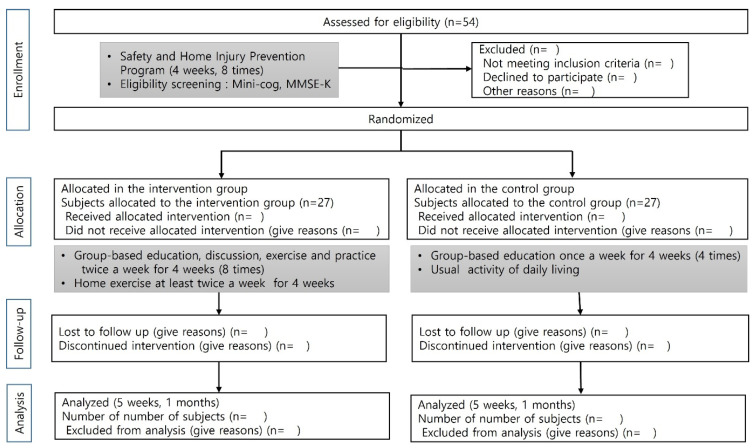 Figure 1
Peer Reviews
No public reviews on file for this paper yet. If you reviewed it on a platform where reviews are public (OpenReview, ICLR, NeurIPS, ICML), you can paste yours below so the community can read it here.
Videos
No videos yet. Explain this paper in a talk, walkthrough, or lecture? Add one.
Taxonomy
TopicsHealth and Wellbeing Research