Spatial and Functional Roles of Syndecans in Skin Wound Healing
Eunhye Park, Han-gyeol Kim, Yowon Un, Eok-Soo Oh

TL;DR
This paper reviews how Syndecans help coordinate skin wound healing by regulating cell functions and signaling.
Contribution
The paper highlights the spatial regulation and functional roles of Syndecans in skin wound healing.
Findings
Syndecans coordinate regenerative responses through distinct spatial and temporal expression.
SDC-1 and SDC-4 are key regulators of epidermal and dermal repair.
Syndecans modulate signaling and the wound microenvironment during healing.
Abstract
Wound healing is a complex, multi-phase process involving hemostasis, inflammation, proliferation, and tissue remodeling. Syndecans (SDCs), a family of transmembrane heparan sulfate proteoglycans, serve as co-receptors for growth factors, cytokines, and ECM components, playing critical roles in cell adhesion, migration, proliferation, and angiogenesis. Among them, SDC-1 and SDC-4 are key regulators of skin wound healing. Due to their distinct spatial and temporal expression across various cell types—such as epithelial cells, fibroblasts, and immune cells—SDCs are well-positioned to coordinate regenerative responses. This review focuses on the spatial regulation of SDCs during skin wound healing, highlighting their roles in epidermal and dermal repair, modulation of intracellular signaling, and remodeling of the wound microenvironment. Overall, SDCs are emerging as central modulators of…
Genes, proteins, chemicals, diseases, species, mutations and cell lines named across the full text — each resolved to its canonical identifier and authoritative record.
Click any figure to enlarge with its caption.
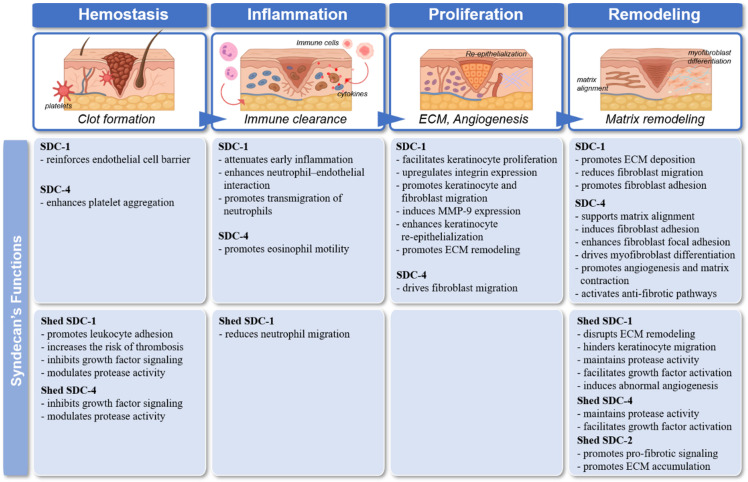 Figure 1
Peer Reviews
No public reviews on file for this paper yet. If you reviewed it on a platform where reviews are public (OpenReview, ICLR, NeurIPS, ICML), you can paste yours below so the community can read it here.
Videos
No videos yet. Explain this paper in a talk, walkthrough, or lecture? Add one.
Taxonomy
TopicsProteoglycans and glycosaminoglycans research · Wound Healing and Treatments · Pressure Ulcer Prevention and Management