Artificial Intelligence in Thyroid Cytopathology: Diagnostic and Technical Insights
Mariachiara Negrelli, Chiara Frascarelli, Fausto Maffini, Elisa Mangione, Clementina Di Tonno, Mariano Lombardi, Francesca Maria Porta, Mario Urso, Vincenzo L’Imperio, Fabio Pagni, Claudio Bellevicine, Mariantonia Nacchio, Umberto Malapelle, Giancarlo Troncone, Antonio Marra

TL;DR
This paper explores how artificial intelligence, specifically deep learning, can improve the accuracy and consistency of thyroid cancer diagnosis by analyzing cytology slides.
Contribution
The paper provides a technical overview of deep learning applications in thyroid cytopathology and highlights challenges and requirements for clinical deployment.
Findings
Deep learning can assist in Bethesda category classification and reduce diagnostic uncertainty in thyroid cytology.
Preanalytical variability and annotation bias limit the generalizability of deep learning models across institutions.
Multicenter trials and standardized datasets are needed for safe clinical adoption of these technologies.
Abstract
Thyroid nodules are very common, and fine-needle aspiration cytology is the main test used to decide whether a nodule is benign or not. While this test is reliable in most cases, many samples fall into an “indeterminate” category, often leading to unnecessary operations or delays in treatment. New computer-based methods, known as deep learning, can analyze digital images of thyroid cytology slides and may help reduce this uncertainty. By learning patterns that even experienced specialists may overlook, these systems could support pathologists in making faster and more accurate decisions, especially in difficult cases. In this article, we discuss how deep learning has been applied to thyroid cytology, the technical and practical challenges it faces, and how it could eventually help make thyroid cancer diagnosis more precise, consistent, and accessible worldwide. Fine-needle aspiration…
Genes, proteins, chemicals, diseases, species, mutations and cell lines named across the full text — each resolved to its canonical identifier and authoritative record.
Click any figure to enlarge with its caption.
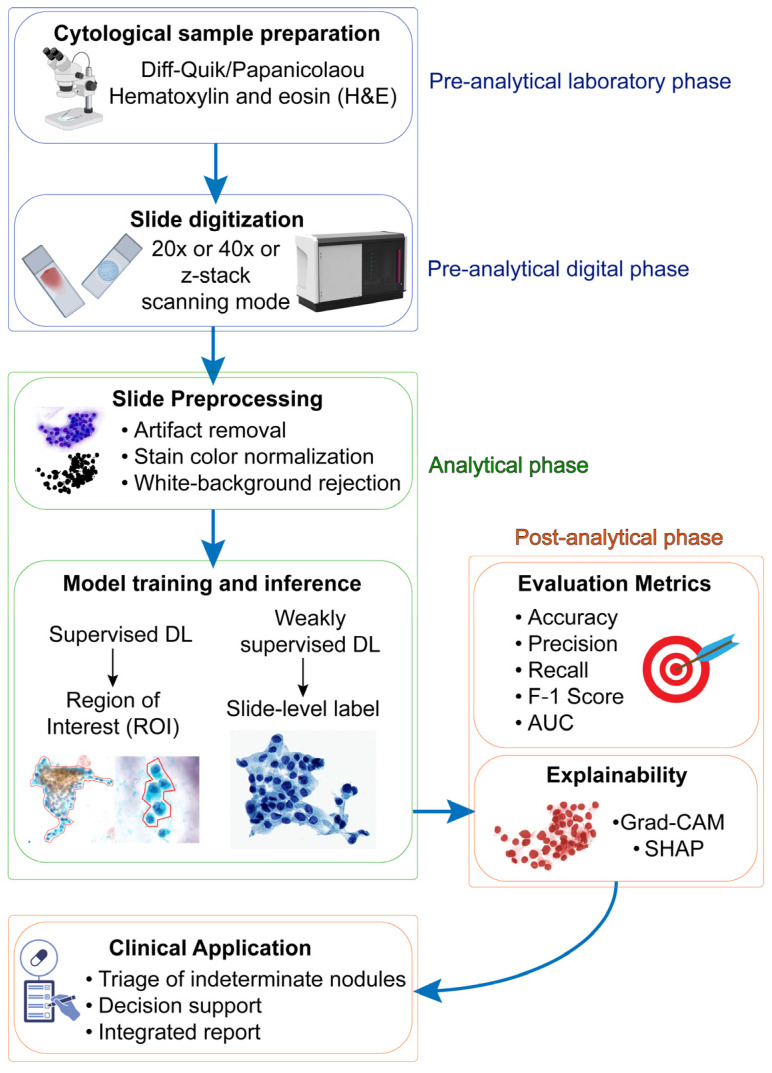 Figure 1
Peer Reviews
No public reviews on file for this paper yet. If you reviewed it on a platform where reviews are public (OpenReview, ICLR, NeurIPS, ICML), you can paste yours below so the community can read it here.
Videos
No videos yet. Explain this paper in a talk, walkthrough, or lecture? Add one.
Taxonomy
TopicsAI in cancer detection · Thyroid Cancer Diagnosis and Treatment · Artificial Intelligence in Healthcare and Education