Factor VII-Activating Protease (FSAP) and Its Importance in Hemostasis—Part II: A Link Between FSAP, Blood Coagulation, and Fibrinolysis: A Narrative Review
Iga Schachta, Ewa Żekanowska, Jan Styczyński, Joanna Murawska, Simona Lattanzi, Andrea M. Alexandre, Artur Słomka

TL;DR
This review explores how factor VII-activating protease (FSAP) influences blood clotting and clot breakdown, highlighting its role in modulating coagulation and fibrinolysis.
Contribution
The paper provides a narrative synthesis of FSAP's dual roles in coagulation and fibrinolysis, emphasizing its context-dependent effects and key research gaps.
Findings
FSAP enhances thrombin generation mainly by inactivating TFPI, with limited direct activation of FVII.
FSAP indirectly accelerates clot lysis by converting scuPA to tcuPA and modifying fibrinogen chains.
FSAP modulates clot architecture, increasing susceptibility to proteolysis through altered fiber structure.
Abstract
As a continuation of Part I on the structure and regulation of factor VII-activating protease (FSAP), this narrative review synthesizes mechanistic, translational, and limited clinical evidence to delineate FSAP’s roles at the interface of coagulation and fibrinolysis. Current evidence indicates that FSAP enhances thrombin generation primarily via proteolytic inactivation of tissue factor pathway inhibitor (TFPI), whereas direct activation of factor VII (FVII) by FSAP appears weak or context-restricted. Beyond plasma proteins, FSAP can upregulate tissue factor (TF) in human macrophages, while platelet-related effects remain insufficiently substantiated. On the fibrinolytic axis, FSAP indirectly accelerates clot lysis by converting single-chain urokinase (scuPA) to its active two-chain form (tcuPA) and, less efficiently, by processing tissue-type plasminogen activator (tPA); in addition,…
Genes, proteins, chemicals, diseases, species, mutations and cell lines named across the full text — each resolved to its canonical identifier and authoritative record.
Click any figure to enlarge with its caption.
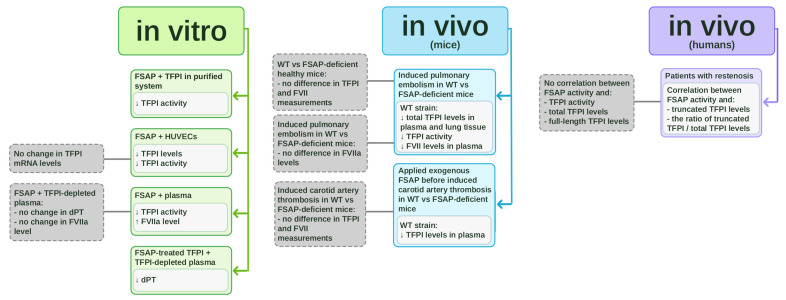 Figure 1
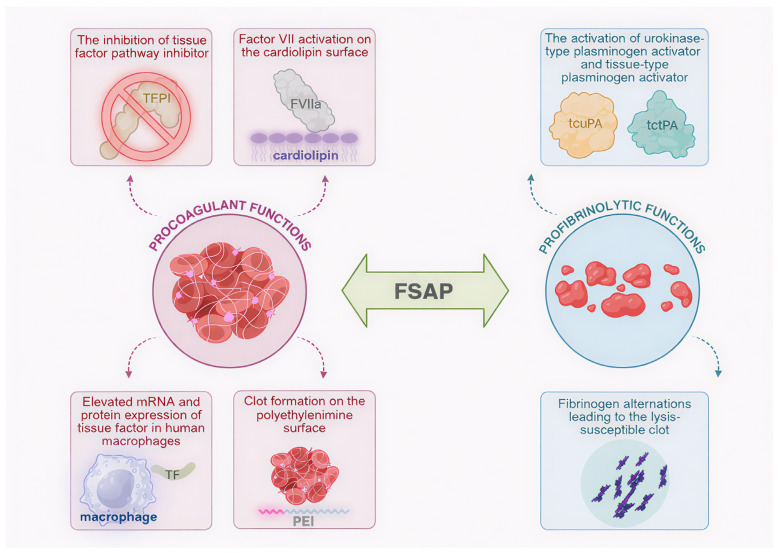 Figure 2
Peer Reviews
No public reviews on file for this paper yet. If you reviewed it on a platform where reviews are public (OpenReview, ICLR, NeurIPS, ICML), you can paste yours below so the community can read it here.
Videos
No videos yet. Explain this paper in a talk, walkthrough, or lecture? Add one.
Taxonomy
TopicsBlood Coagulation and Thrombosis Mechanisms · Hemophilia Treatment and Research · Blood properties and coagulation