CDK4/6 Inhibitors in Breast Cancer—Who Should Receive Them?
Anran Chen, Ze-Yi Zheng, Meenakshi Anurag, Ahmed Elkhanany, Natalie C. Chen, Eric C. Chang

TL;DR
This paper explores how CDK4/6 inhibitors can be better targeted in breast cancer treatment, especially for patients with specific genetic changes.
Contribution
The study identifies that loss of the NF1 tumor suppressor increases sensitivity to CDK4/6 inhibitors in breast cancer.
Findings
NF1 loss makes tumors more reliant on CDK4/6 activity for survival.
CDK4/6 inhibition is more effective in tumors with NF1 loss when combined with endocrine therapy.
Abstract
More than 70% of breast cancers are estrogen receptor-positive (ER+). Endocrine therapy that blocks estrogen signaling remains the cornerstone of treatment, yet relapses continue to affect many patients. Cyclin-dependent kinases 4 and 6 (CDK4/6) regulate the G1-S phase transition in the cell cycle, and pharmacological inhibition of this pathway has been successfully leveraged to reduce recurrence. CDK4/6 inhibitors combined with endocrine therapy are now the standard of care, although determining the optimal patient population for treatment remains a key challenge. A newly published study provides important insight, showing that loss of the NF1/neurofibromin tumor suppressor confers greater sensitivity to CDK4/6 inhibition, as these tumors rely heavily on CDK4/6 activity for survival under endocrine therapy.
Genes, proteins, chemicals, diseases, species, mutations and cell lines named across the full text — each resolved to its canonical identifier and authoritative record.
Click any figure to enlarge with its caption.
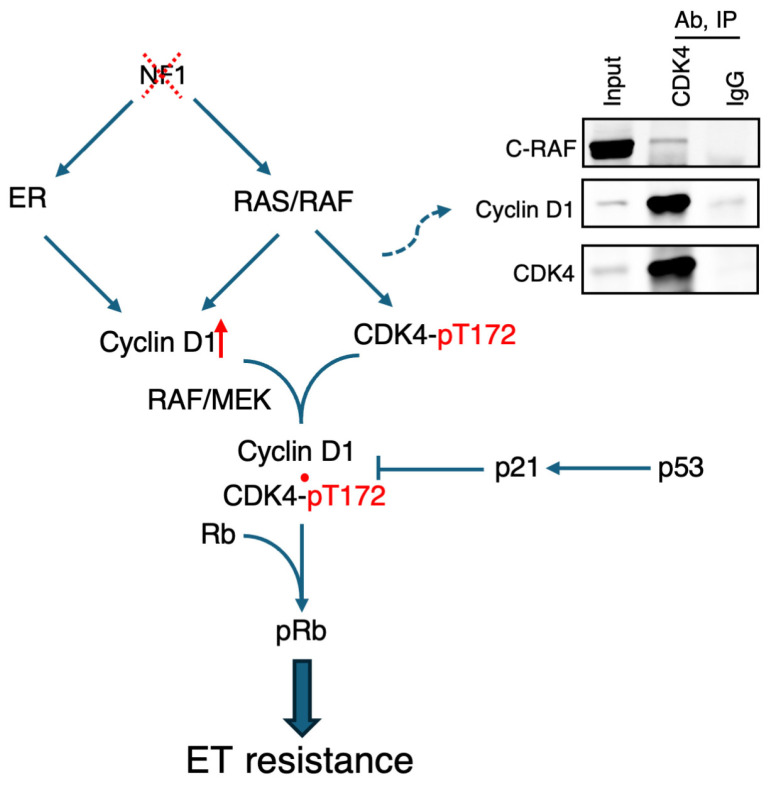 Figure 1
Peer Reviews
No public reviews on file for this paper yet. If you reviewed it on a platform where reviews are public (OpenReview, ICLR, NeurIPS, ICML), you can paste yours below so the community can read it here.
Videos
No videos yet. Explain this paper in a talk, walkthrough, or lecture? Add one.
Taxonomy
TopicsAdvanced Breast Cancer Therapies · Breast Cancer Treatment Studies · HER2/EGFR in Cancer Research