Comparative Effectiveness of Origami-Box-Folding and Outside-the-Box Knot-Tying Exercises in Laparoscopic Surgical Training: A Prospective Cohort Study
Cristian-Valentin Toma, Adrian-Iustin Georgevici, Didina-Catalina Barbalata, George-Sabin Popescu, Ioana Gabriela Visan, George E. D. Petrescu, Cătălin Ovidiu Nechita, Daniel Liviu Bădescu, Cristian George Tieranu, Alexandru Ciudin, Viorel Jinga

TL;DR
This study compares two training methods for laparoscopic surgery, finding both improve skills, but one is better for square knots and knowledge confidence.
Contribution
The study introduces a novel comparison of OBFE and OBTKE training methods for laparoscopic surgery skill development.
Findings
Both OBFE and OBTKE significantly improved surgical knot-tying performance in residents.
OBFE showed greater improvement in square knot efficiency and self-rated knowledge compared to OBTKE.
Technical errors decreased similarly in both training groups.
Abstract
Background/Objectives: Minimally invasive surgical techniques require precise psychomotor skills distinct from those used in traditional surgery. Simulation-based training is essential for skill acquisition without patient risk. This study compared two prevalent training methodologies: the Origami-Box-Folding Exercise (OBFE) and Outside-the-Box Knot-Tying Exercise (OBTKE). Methods: In this prospective cohort study, 84 surgical residents (34 OBFE, 50 OBTKE) from General Surgery, Obstetrics–Gynecology, and Urology underwent pre- and post-intervention assessments. Performance metrics included completion times for surgical and square knots, out-of-visual-field instrument instances, needle drops, tissue lesions, and self-assessment via 5-point Likert scales. Behavioral Observation Research Interactive Software quantified performance objectively. Data were analyzed using paired Wilcoxon…
Genes, proteins, chemicals, diseases, species, mutations and cell lines named across the full text — each resolved to its canonical identifier and authoritative record.
Click any figure to enlarge with its caption.
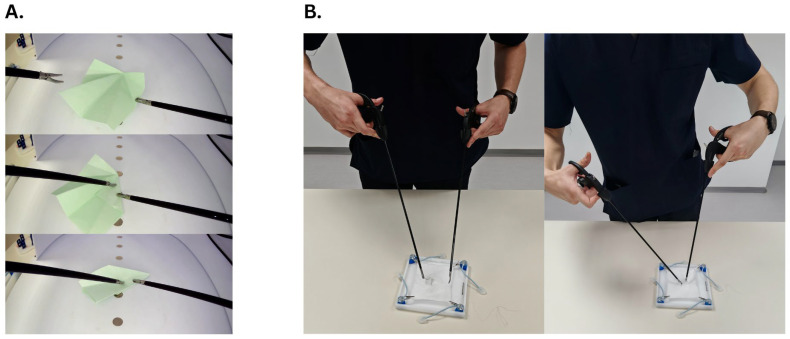 Figure 1
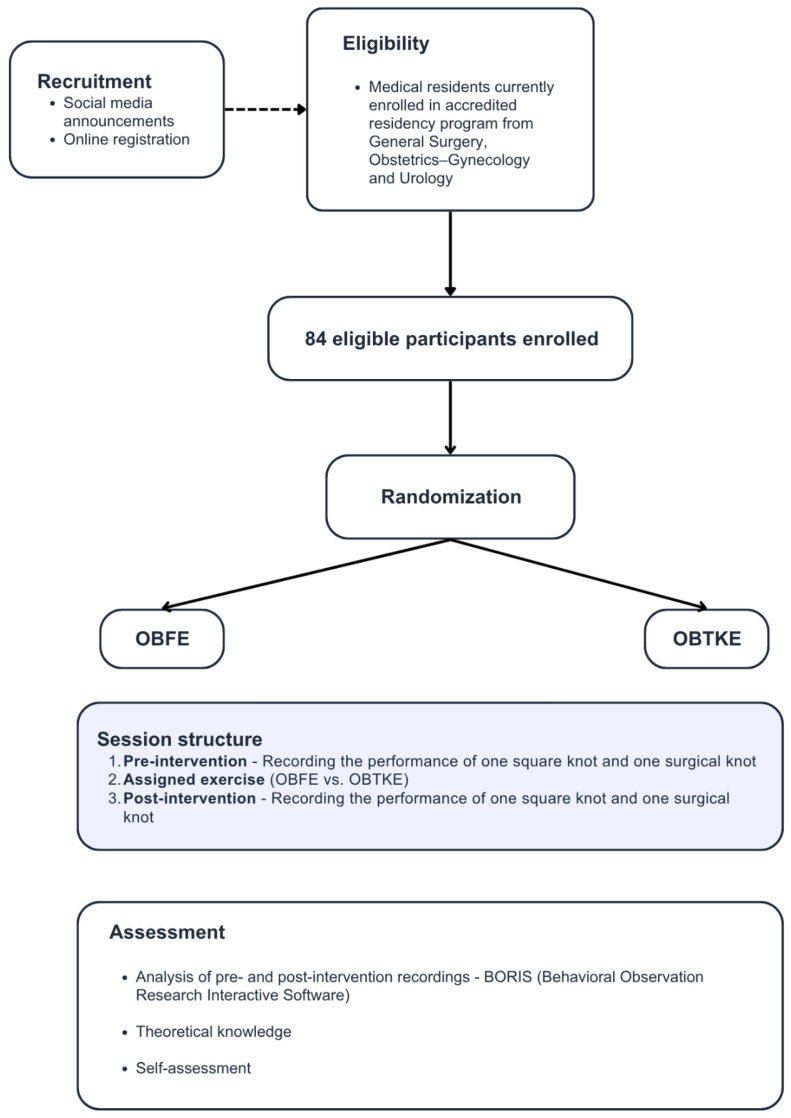 Figure 2
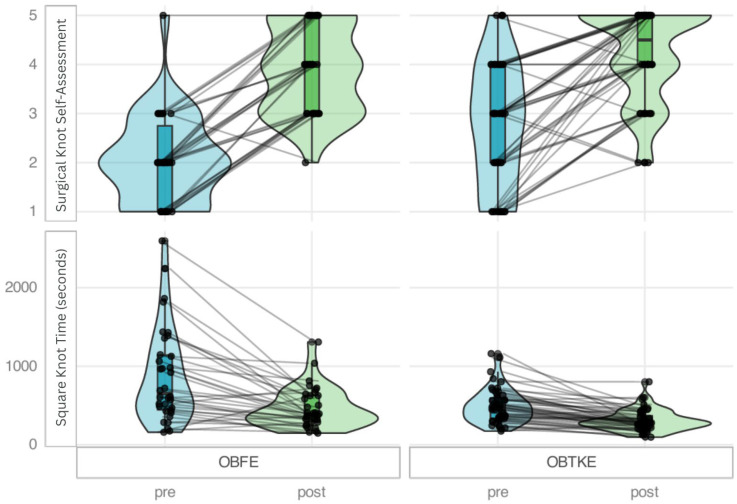 Figure 3
Peer Reviews
No public reviews on file for this paper yet. If you reviewed it on a platform where reviews are public (OpenReview, ICLR, NeurIPS, ICML), you can paste yours below so the community can read it here.
Videos
No videos yet. Explain this paper in a talk, walkthrough, or lecture? Add one.
Taxonomy
TopicsSurgical Simulation and Training · Minimally Invasive Surgical Techniques · Simulation-Based Education in Healthcare