Clitoria ternatea: Perspectives on Its Application in Foods and Potential Health Benefits
Nicole Marina Almeida Maia, Irene Andressa, Jeferson Silva Cunha, Nataly de Almeida Costa, Eduardo Basílio de Oliveira, Bruno Ricardo de Castro Leite Júnior, Érica Nascif Rufino Vieira

TL;DR
Clitoria ternatea, known for its blue color and bioactive compounds, is a promising natural ingredient for functional foods and cosmetics.
Contribution
This review highlights the plant's potential in food applications and health benefits, emphasizing its bioactive properties and natural colorant use.
Findings
Clitoria ternatea has antioxidant, antidiabetic, and anti-obesity properties.
It serves as a natural colorant and functional ingredient in food and cosmetics.
Most evidence is from preclinical studies, requiring further human trials for validation.
Abstract
In recent years, edible flowers have gained increasing attention as unconventional foods, primarily due to their richness in bioactive compounds. Within this context, Clitoria ternatea L. (Fabaceae), commonly known as butterfly pea, stands out not only for its remarkable biological properties but also for its intense blue pigmentation. This review aims to provide a comprehensive overview of the plant’s potential in the food industry, highlighting its bioactive compounds, technological applications, and associated health benefits. Recent studies have demonstrated its antioxidant, antidiabetic, anti-obesity, hepatoprotective, and anticancer activities, as well as its use as a natural colorant, functional ingredient, active packaging component, and in nutraceutical and cosmetic formulations. Despite these promising findings, most available evidence comes from preclinical studies, with…
Genes, proteins, chemicals, diseases, species, mutations and cell lines named across the full text — each resolved to its canonical identifier and authoritative record.
Click any figure to enlarge with its caption.
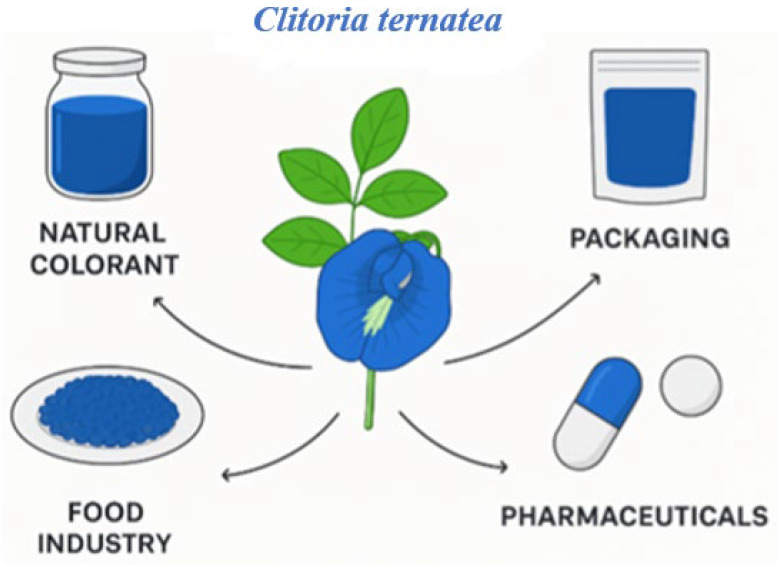 Figure 1
Peer Reviews
No public reviews on file for this paper yet. If you reviewed it on a platform where reviews are public (OpenReview, ICLR, NeurIPS, ICML), you can paste yours below so the community can read it here.
Videos
No videos yet. Explain this paper in a talk, walkthrough, or lecture? Add one.
Taxonomy
TopicsMedicinal Plants and Neuroprotection · Medicinal Plant Research · Biochemical and Structural Characterization