Chemical Structure of a Branched α-d-Glucan from the Eggs of Sea Urchin Tripneustes gratilla
Maria I. Bilan, Dmitry A. Argunov, Vladimir I. Torgov, Andrey S. Dmitrenok, Dinh Thanh Trung, Thinh Duc Pham, Hang Thi Thuy Cao, Anatolii I. Usov, Nikolay E. Nifantiev

TL;DR
This paper identifies a highly branched glucose-based polysaccharide in sea urchin eggs, resembling glycogen but with more branching.
Contribution
The discovery of a glycogen-like α-d-glucan with oligosaccharide branches in sea urchin eggs, differing from previously known structures.
Findings
The polysaccharide NP is composed of glucose residues in a 1:8:1 ratio of terminal, 4-linked, and 4,6-disubstituted units.
NP has an average linear chain length of five glucose residues and a high degree of branching.
Unlike other sea urchin glucans, NP contains oligosaccharide branches at position 6, confirmed by NMR data.
Abstract
A water-soluble high-molecular neutral polysaccharide (NP) was isolated from the eggs of the sea urchin Tripneustes gratilla. The formation of glucose only upon the treatment of NP by amyloglucosidase and the value of its optical rotation [α]D +233.5 (c 0.2, water) confirmed its belonging to the family of α-d-glucans. According to the results of NMR spectroscopy and methylation analysis, the chains of NP are built up of non-reducing terminal, 4-linked and 4,6-disubstituted glucose residues at a ratio of 1:8:1. A branched structure with an average linear chain length of about five glucose residues was calculated from the spectrum of iodine complex. Contrary to the previously published structure of branched α-d-glucan from the sea urchin Strongylocentrotus nudus bearing single glucose units as branches, the polysaccharide NP contains oligosaccharide branches at position 6, which was…
Genes, proteins, chemicals, diseases, species, mutations and cell lines named across the full text — each resolved to its canonical identifier and authoritative record.
Click any figure to enlarge with its caption.
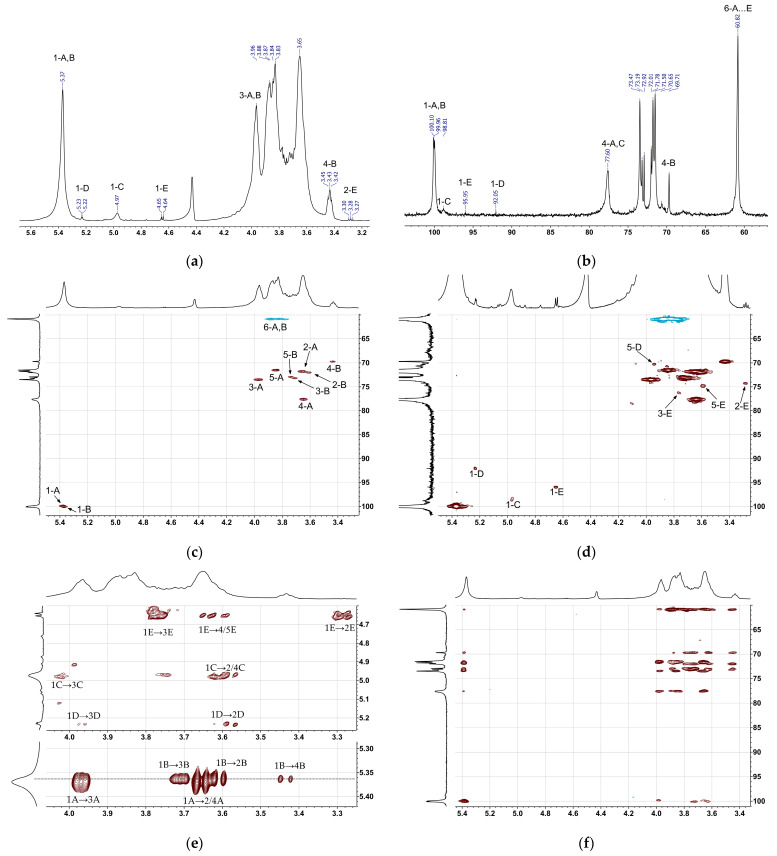 Figure 1
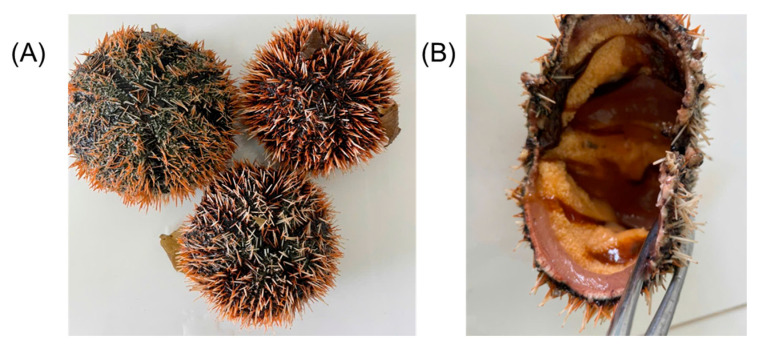 Figure 2
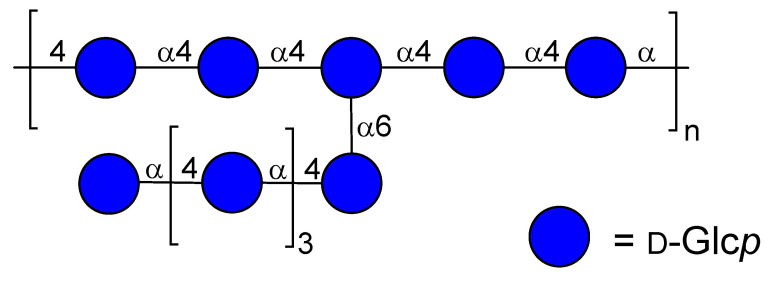 Figure 3
Peer Reviews
No public reviews on file for this paper yet. If you reviewed it on a platform where reviews are public (OpenReview, ICLR, NeurIPS, ICML), you can paste yours below so the community can read it here.
Videos
No videos yet. Explain this paper in a talk, walkthrough, or lecture? Add one.
Taxonomy
TopicsSeaweed-derived Bioactive Compounds · Echinoderm biology and ecology · Marine and coastal plant biology