Can We Improve Pregnancy Rates in Hormone Receptor-Positive Breast Cancer After Endocrine Therapy? The Role of Fertility Preservation Beyond Gonadotoxic Therapy
Maria Vittoria Luciani, Giorgia Mangili, Enrico Papaleo, Rossella Biancardi, Valeria Stella Vanni, Rossella Masciangelo, Valentina Elisabetta Di Mattei, Massimo Candiani, Raffaella Cioffi

TL;DR
This study explores fertility preservation in hormone receptor-positive breast cancer patients treated with hormonal therapy alone, showing that it can help improve pregnancy rates and treatment adherence.
Contribution
The study is the first to assess fertility preservation in hormone receptor-positive breast cancer patients not undergoing gonadotoxic therapies.
Findings
36.3% of patients who sought pregnancy after fertility preservation successfully conceived.
Fertility preservation was effective even after discontinuation of hormonal therapy, with some achieving live births.
Counseling on fertility preservation improved treatment adherence in hormone receptor-positive breast cancer patients.
Abstract
Fertility preservation is safe and effective in breast cancer patients; however, there is a lack of data regarding fertility preservation in hormone receptor-positive breast cancer patients treated exclusively with hormonal therapy. This study aims to assess the feasibility and reproductive outcomes of fertility preservation in this group of patients often excluded from standard oncofertility pathways. We want to emphasize the importance of considering fertility preservation not only to mitigate the gonadotoxic effects of chemotherapy but also to counteract age-related fertility decline during prolonged endocrine therapy. This study may encourage the use of fertility-sparing treatments in patients who are not referred for gonadotoxic therapies, promoting patient adherence to treatment. Background/Objectives: Young patients with hormone receptor-positive breast cancer (HR+BC) face an…
Genes, proteins, chemicals, diseases, species, mutations and cell lines named across the full text — each resolved to its canonical identifier and authoritative record.
Click any figure to enlarge with its caption.
 Figure 1
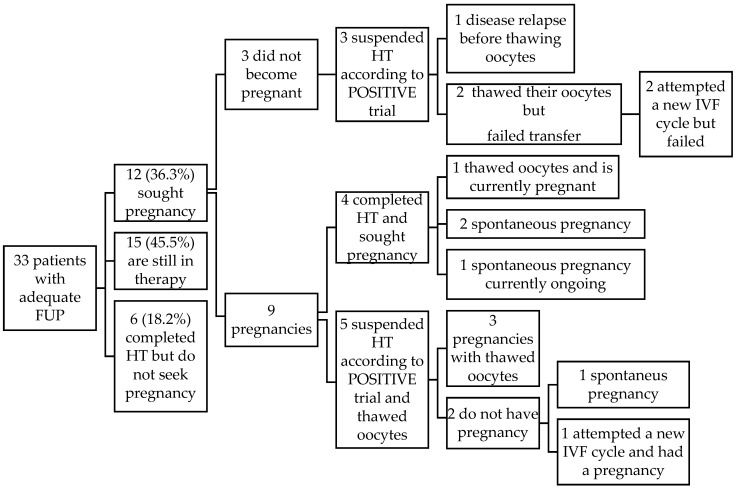 Figure 2
Peer Reviews
No public reviews on file for this paper yet. If you reviewed it on a platform where reviews are public (OpenReview, ICLR, NeurIPS, ICML), you can paste yours below so the community can read it here.
Videos
No videos yet. Explain this paper in a talk, walkthrough, or lecture? Add one.
Taxonomy
TopicsReproductive Biology and Fertility · Cancer Risks and Factors · Ovarian function and disorders