Capillary Electrophoresis as a Useful Tool to Separate Isomeric Opioid–Neurotensin Hybrid Peptides
Joanna Zdunek, Patrycja Kleczkowska, Łukasz Szeleszczuk, Wojciech Kamysz, Karol Sikora, Błażej Grodner

TL;DR
This paper describes a capillary electrophoresis method to separate two opioid-neurotensin hybrid peptides that differ by a single amino acid.
Contribution
A validated CE method is introduced for resolving isomeric opioid–neurotensin hybrids with high precision and speed.
Findings
The CE method achieved baseline resolution (Rs = 1.4) for the two isomeric peptides.
The method demonstrated excellent linearity (R² 0.9991–0.9999) and recovery rates (94.8–100%).
The analysis time was only 6 minutes, and the method works in both aqueous and serum samples.
Abstract
We developed and validated a capillary electrophoresis (CE) method for the separation of two opioid–neurotensin hybrid peptides, recently presented as potent analgesics being decapeptides with a hybridic nature (i.e., H-Dmt-D-Lys-Phe-Phe-Lys-Lys-Pro-Phe-Tle-Leu-OH; PK20 and its structural analogue H-Dmt-D-Lys-Phe-Phe-Lys-Lys-Pro-Phe-Ile-Leu-OH; [Ile9]PK20). As these two chimeras differ by only one amino acid, Tle→Ile, and are characterized by possessing the same molecular weight while having different spatial conformations, the aim of the study was to determine their potential separation in terms of the presence of any differences resulting from this structural modification. The separation process was performed using an eCAP fused silica capillary at a detection wavelength of 200 nm in 25 mM phosphate buffer at pH 2.5. The analysis was performed at 25 °C and 10 kV. The developed method…
Genes, proteins, chemicals, diseases, species, mutations and cell lines named across the full text — each resolved to its canonical identifier and authoritative record.
Click any figure to enlarge with its caption.
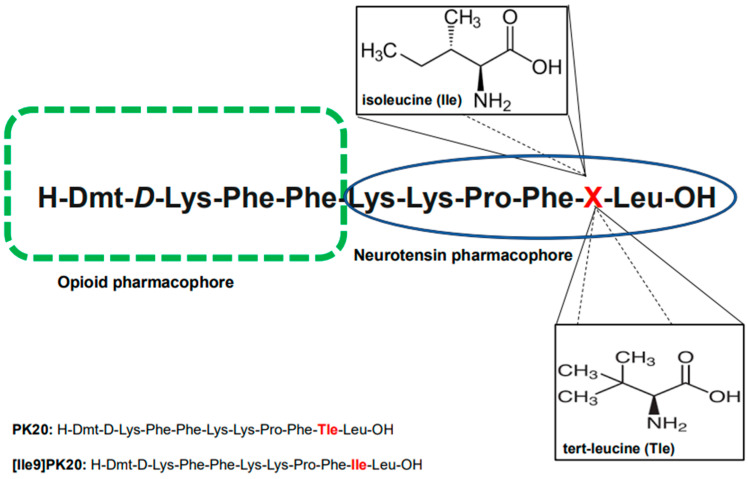 Figure 1
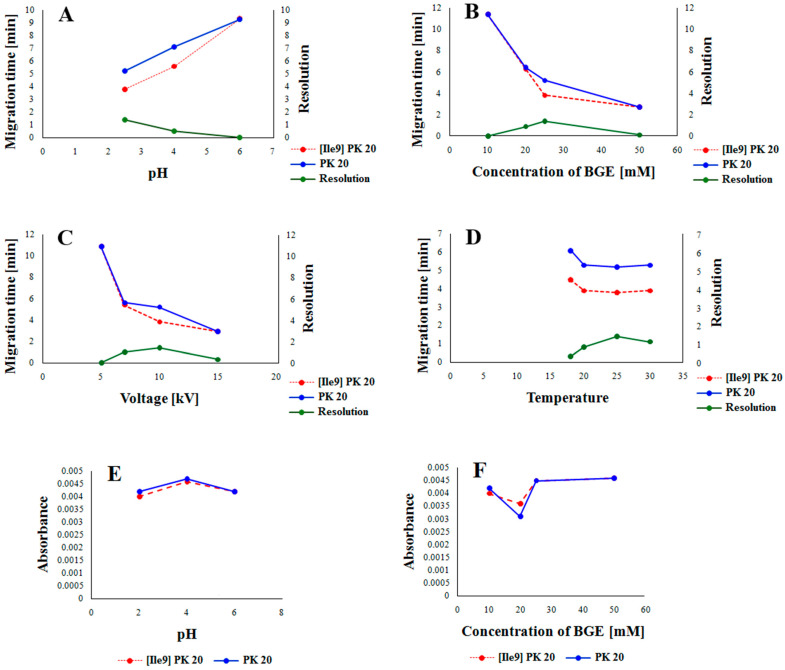 Figure 2
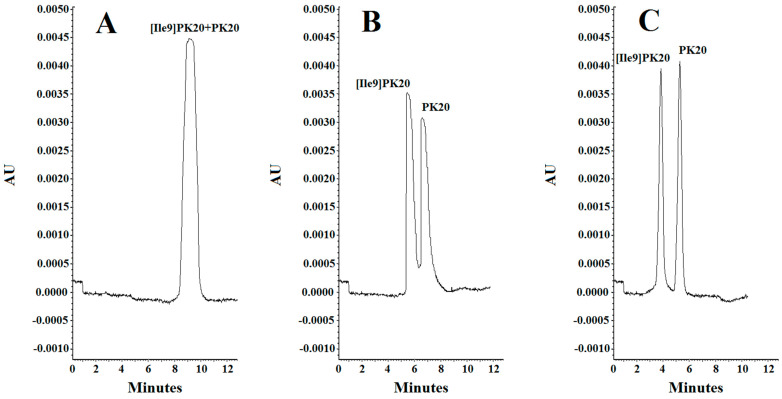 Figure 3
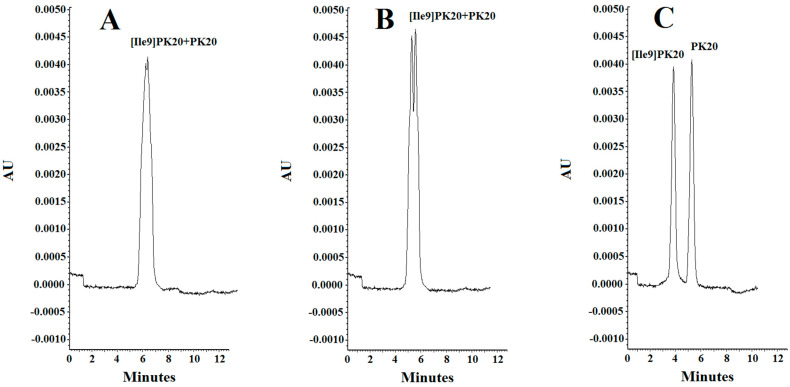 Figure 4
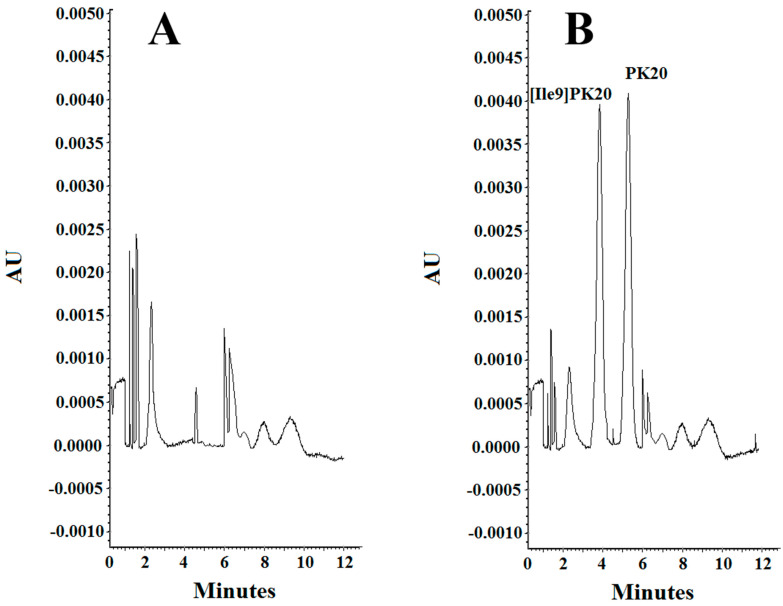 Figure 5
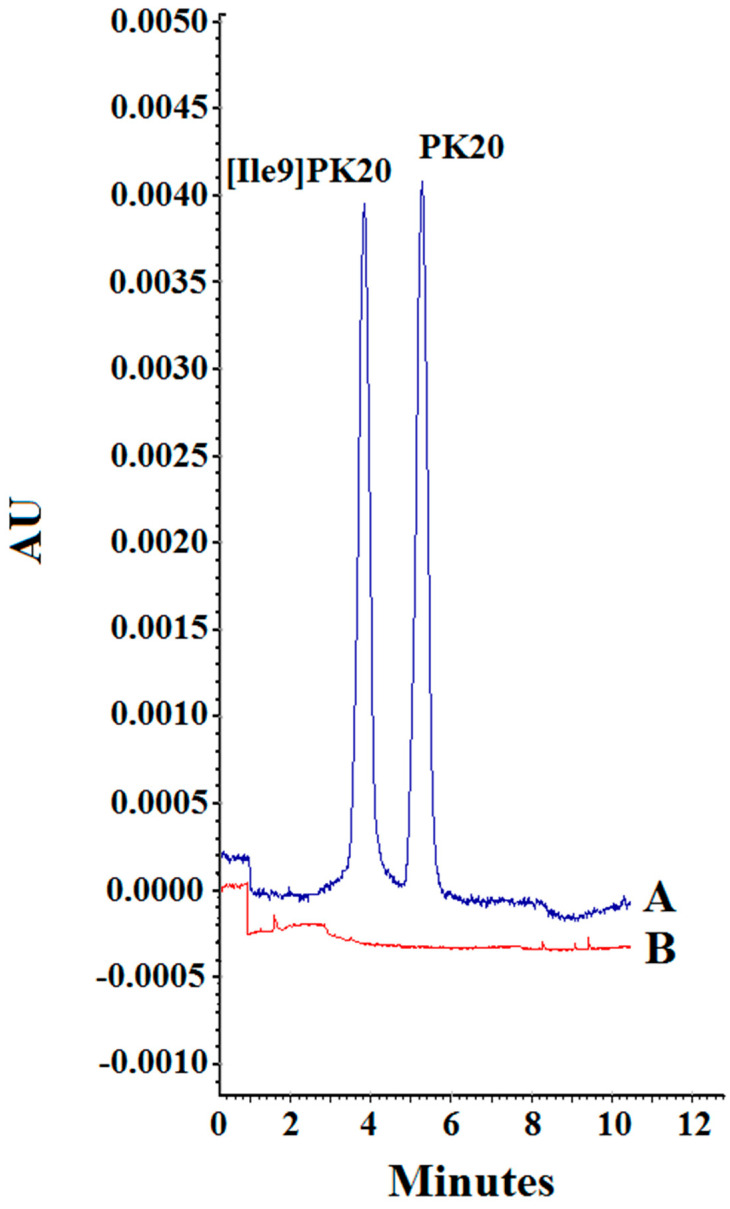 Figure 6
Peer Reviews
No public reviews on file for this paper yet. If you reviewed it on a platform where reviews are public (OpenReview, ICLR, NeurIPS, ICML), you can paste yours below so the community can read it here.
Videos
No videos yet. Explain this paper in a talk, walkthrough, or lecture? Add one.
Taxonomy
TopicsNeuropeptides and Animal Physiology · Protein Hydrolysis and Bioactive Peptides · Antimicrobial Peptides and Activities