Optimizing Client Participation in Communication-Constrained Federated LLM Adaptation with LoRA
Faranaksadat Solat, Joohyung Lee

TL;DR
This paper introduces a framework to optimize client participation in federated learning for large language models, reducing communication costs while maintaining accuracy.
Contribution
The novel contribution is a communication-aware framework, LoRaC-GA, using a genetic algorithm to dynamically select clients under bandwidth constraints.
Findings
LoRaC-GA adaptively selects the optimal number of clients per round under fixed bandwidth constraints.
The framework achieves competitive accuracy while significantly reducing communication costs.
A structured peer-to-peer protocol enables scalable communication with log2K complexity.
Abstract
Federated learning (FL) enables privacy-preserving adaptation of large language models (LLMs) across distributed clients. However, deploying FL in edge environments remains challenging because of the high communication overhead of full-model updates. Recent advances in parameter-efficient fine-tuning (PEFT), particularly low-rank adaptation (LoRA), have substantially reduced update sizes by injecting lightweight trainable matrices into pretrained transformers, thereby making FL with LLMs more feasible. In this paper, we propose LoRaC-GA, a communication-aware optimization framework that dynamically determines the optimal number of clients to participate in each round under a fixed bandwidth constraint. We formulated a max-min objective to jointly maximize the model accuracy and communication efficiency and solved the resulting non-convex problem using a genetic algorithm (GA). To…
Genes, proteins, chemicals, diseases, species, mutations and cell lines named across the full text — each resolved to its canonical identifier and authoritative record.
Click any figure to enlarge with its caption.
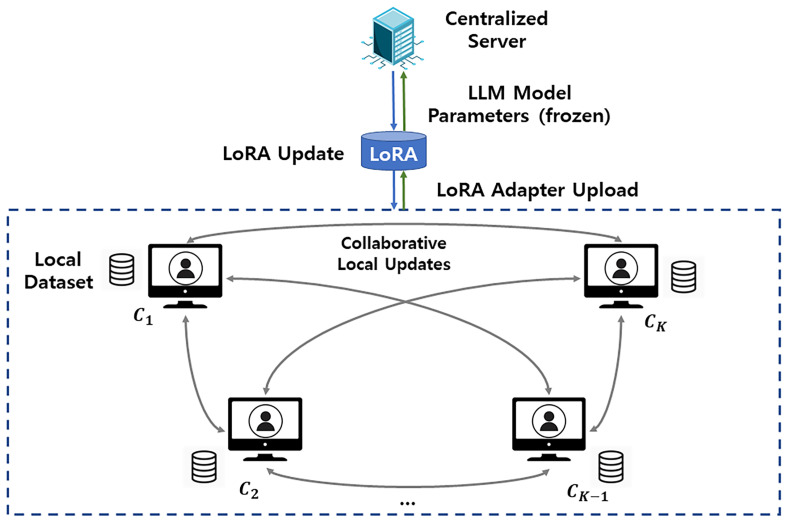 Figure 1
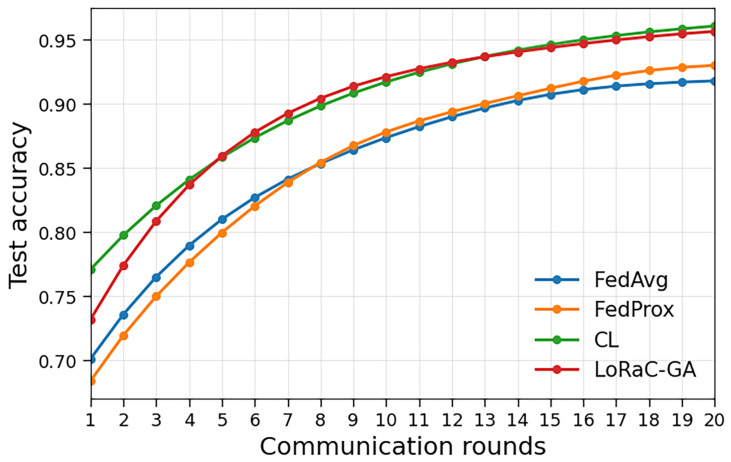 Figure 2
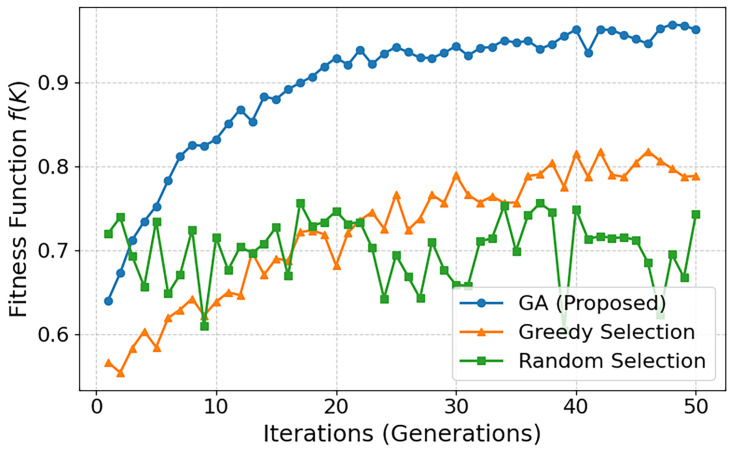 Figure 3
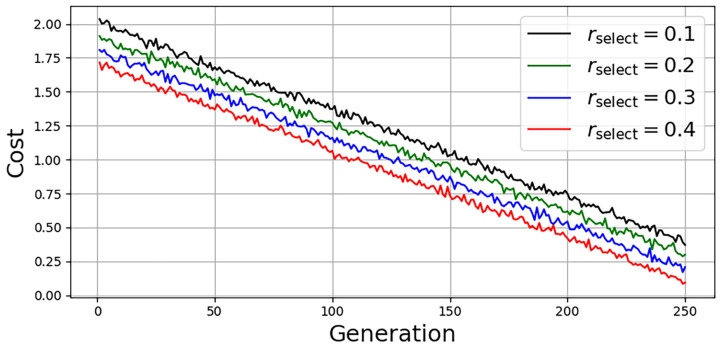 Figure 4
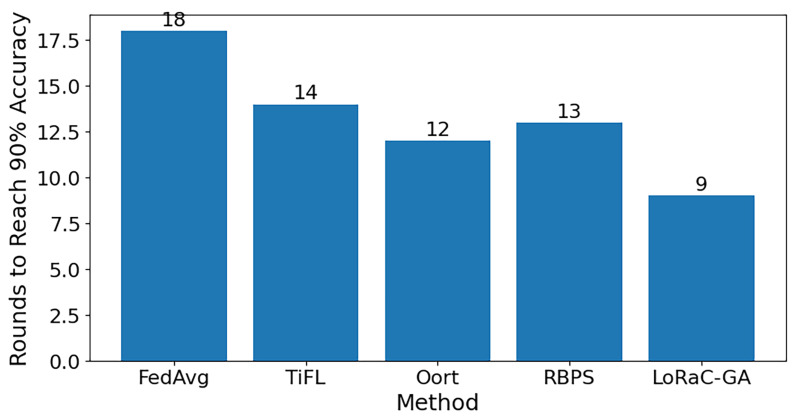 Figure 5
Peer Reviews
No public reviews on file for this paper yet. If you reviewed it on a platform where reviews are public (OpenReview, ICLR, NeurIPS, ICML), you can paste yours below so the community can read it here.
Videos
No videos yet. Explain this paper in a talk, walkthrough, or lecture? Add one.
Taxonomy
TopicsIoT and Edge/Fog Computing · Distributed and Parallel Computing Systems