Iron-Based Metal–Organic Frameworks for the Removal of Different Organic and Inorganic Arsenic Species from Water: Kinetic and Adsorption Studies
Afef Azri, Khaled Walha, Claudia Fontàs, José-Elias Conde-González, Eladia M. Peña-Méndez, Andreas Seubert, Victoria Salvadó

TL;DR
Iron-based metal-organic frameworks effectively remove various arsenic species from water across a wide pH range and can be reused multiple times.
Contribution
The study introduces Fe-MOFs as efficient and reusable adsorbents for diverse arsenic species with insights into adsorption mechanisms and regeneration.
Findings
Fe-MOFs show broad pH adsorption for MMA, DMAA, ASA, and arsenate, with higher effectiveness for Basolite® F300.
Adsorption kinetics follow pseudo-second-order models, indicating chemisorption with pore diffusion as the rate-limiting step.
Fe-MOFs can be regenerated for four cycles using acidic methanol, maintaining adsorption efficiency.
Abstract
Basolite® F300 and synthetic nano-{Fe-BTC} MOFs, two iron-trimesate MOFs, have been investigated, demonstrating broad pH range adsorption for monomethylarsenate (MMA), cacodylic acid (DMAA), 4-aminophenylarsonate (ASA), and arsenate, while arsenite adsorption was notable at pH > 9.5. A similar uptake trend was found for both MOFs, with Basolite® F300 being the more effective given its higher porosity and greater surface area. Pseudo-second-order kinetic models were followed by MMA, DMAA, ASA, and As(V), suggesting a chemisorption mechanism with arsenic species diffusion into MOF pores as the controlling step. Equilibrium data for DMAA and ASA fit the Langmuir model whereas MMA adsorption fits the Redlich–Peterson model. The uptake of MMA, DMAA, and ASA by both Fe-MOFs is mainly attributed to their coordination with Fe(III). Aromatic units in ASA enhance adsorption through П-П stacking…
Genes, proteins, chemicals, diseases, species, mutations and cell lines named across the full text — each resolved to its canonical identifier and authoritative record.
Click any figure to enlarge with its caption.
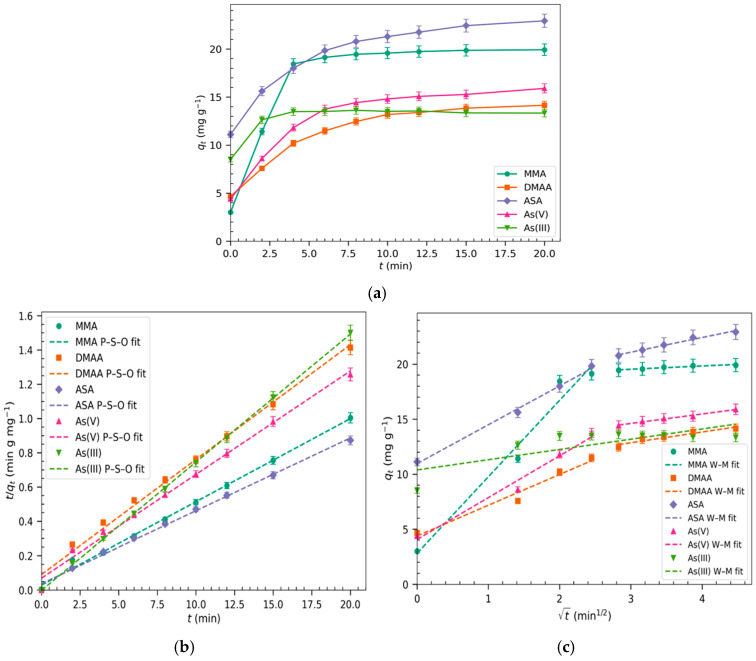 Figure 1
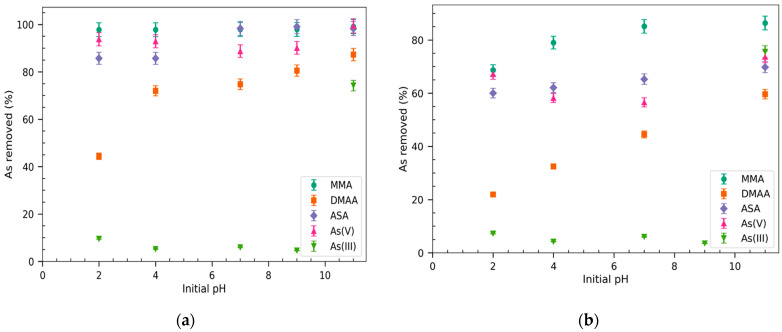 Figure 2
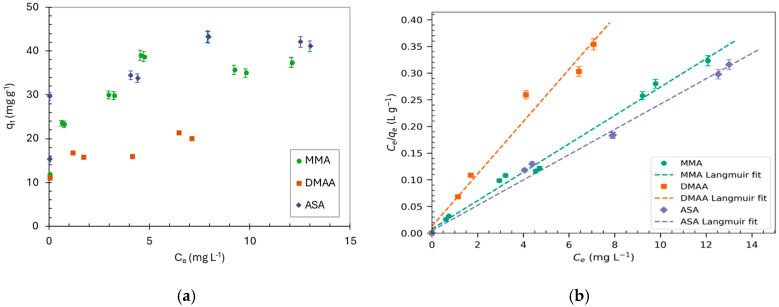 Figure 3
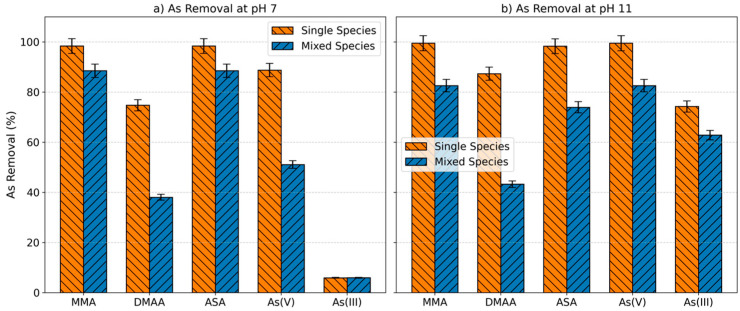 Figure 4
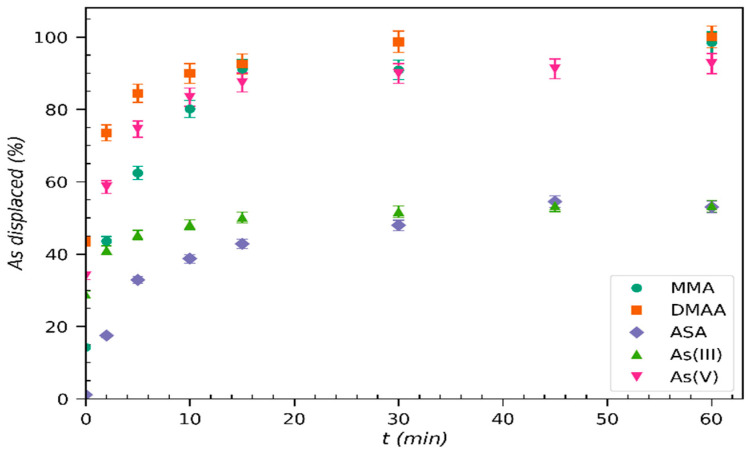 Figure 5
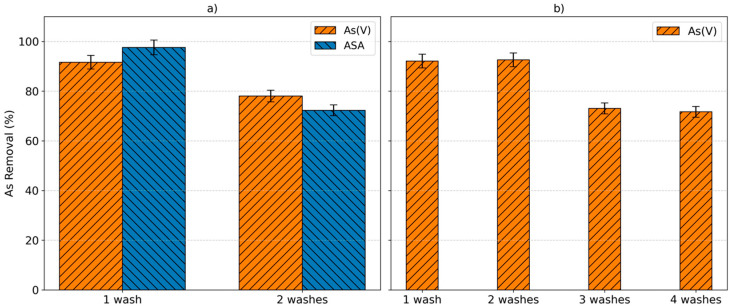 Figure 6
Peer Reviews
No public reviews on file for this paper yet. If you reviewed it on a platform where reviews are public (OpenReview, ICLR, NeurIPS, ICML), you can paste yours below so the community can read it here.
Videos
No videos yet. Explain this paper in a talk, walkthrough, or lecture? Add one.
Taxonomy
TopicsArsenic contamination and mitigation · Metal-Organic Frameworks: Synthesis and Applications · Advanced oxidation water treatment