Urea Detection in Phosphate Buffer and Artificial Urine: A Simplified Kinetic Model of a pH-Sensitive EISCAP Urea Biosensor
Karen Simonyan, Astghik Tsokolakyan, Vahe Buniatyan, Artem Badasyan, Mkrtich Yeranosyan

TL;DR
This paper presents a simplified model for a urea biosensor that works in both buffer and artificial urine, showing how biological fluids affect sensor performance.
Contribution
A simplified kinetic model for a pH-sensitive EISCAP urea biosensor is introduced for quantitative analysis in complex fluids.
Findings
The model yielded comparable KM values of 10.9 mM in PBS and 32.4 mM in artificial urine.
The k¯V values were significantly lower in artificial urine due to inhibitory effects of complex biological fluids.
The model enables accurate characterization of enzyme layers for real-world applications.
Abstract
A simplified kinetic model for the quantitative analysis of a potentiometric, pH-based urea biosensor is presented. The device was an electrolyte–insulator–semiconductor capacitor (EISCAP) with a pH-sensitive Ta2O5 gate functionalized by a polyallylamine hydrochloride (PAH)/urease bilayer. Within the steady-state approximation, the kinetic equations yielded an implicit algebraic relation linking the bulk urea concentration to the local pH at the sensor surface. Numerical solution of this equation, combined with a fitting routine, provides the apparent Michaelis–Menten constant (KM) and the normalized maximum reaction rate (k¯V). Validation against the literature data confirmed the reliability of the approach. Experimental results were then analyzed in both phosphate buffer (PBS) and artificial urine (AU), covering urea concentrations of 0.1–50 mM. The fitted parameters showed comparable…
Genes, proteins, chemicals, diseases, species, mutations and cell lines named across the full text — each resolved to its canonical identifier and authoritative record.
Click any figure to enlarge with its caption.
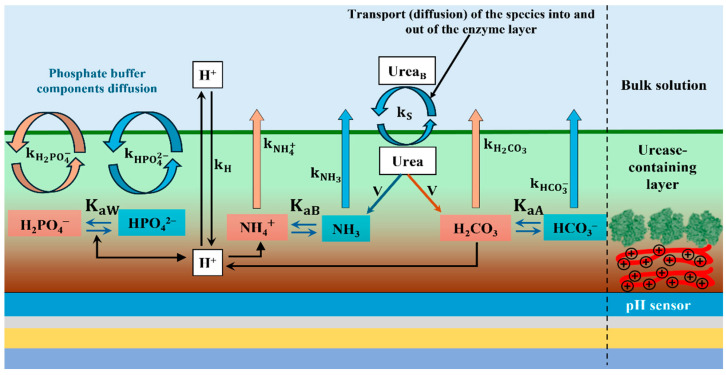 Figure 1
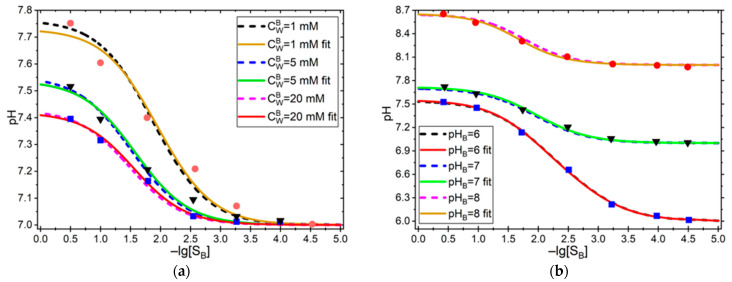 Figure 2
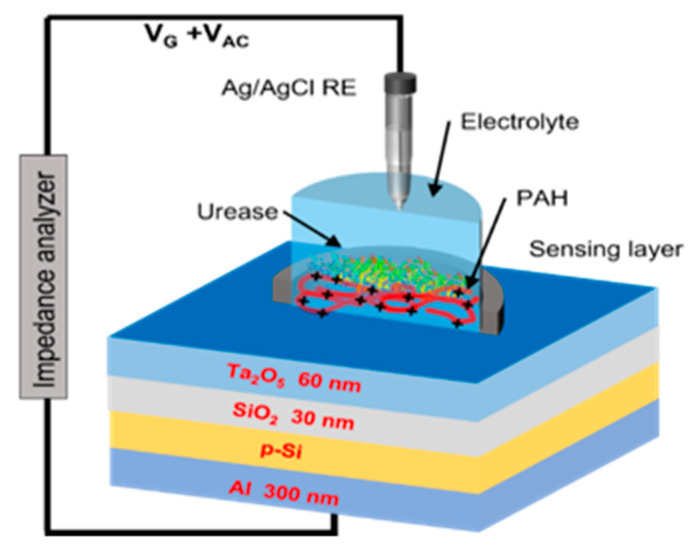 Figure 3
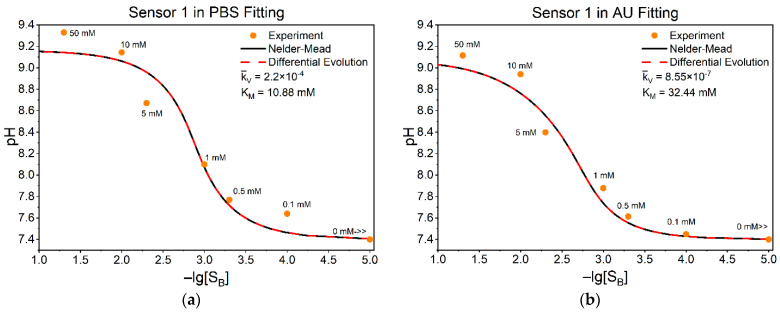 Figure 4
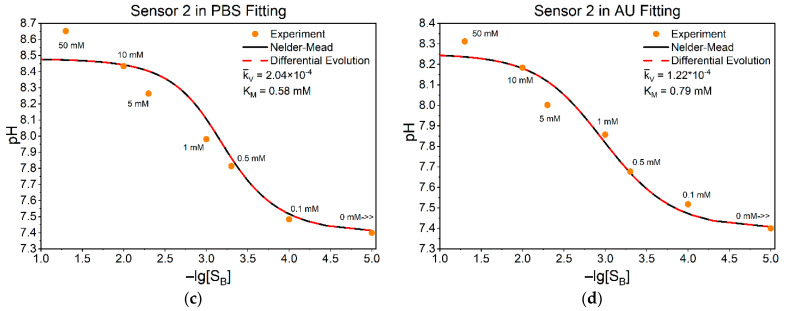 Figure 5
Peer Reviews
No public reviews on file for this paper yet. If you reviewed it on a platform where reviews are public (OpenReview, ICLR, NeurIPS, ICML), you can paste yours below so the community can read it here.
Videos
No videos yet. Explain this paper in a talk, walkthrough, or lecture? Add one.
Taxonomy
TopicsAnalytical Chemistry and Sensors · Electrochemical sensors and biosensors · Gas Sensing Nanomaterials and Sensors