Skeletal Muscle Quality Evaluation for Prognostic Stratification in the Emergency Department of Patients ≥65 Years with Major Trauma
Marcello Covino, Luigi Carbone, Martina Petrucci, Gabriele Pulcini, Marco Cintoni, Luigi Larosa, Andrea Piccioni, Gianluca Tullo, Davide Antonio Della Polla, Benedetta Simeoni, Mariano Alberto Pennisi, Antonio Gasbarrini, Maria Cristina Mele, Francesco Franceschi

TL;DR
This study shows that measuring muscle quality via CT scans in elderly trauma patients can help predict their risk of death during hospitalization.
Contribution
The study introduces CT-based skeletal muscle density as a novel prognostic tool for elderly trauma patients in the emergency department.
Findings
Lower skeletal muscle area density (SMAd) was significantly associated with higher mortality in elderly trauma patients.
SMAd <38 HU at ED admission was an independent risk factor for in-hospital death.
Low SMAd also increased the risk of death after the first week of hospitalization among survivors.
Abstract
Background: In patients aged 65 years and older who experience severe trauma, their underlying health status significantly influences overall mortality. This study aimed to determine whether computed tomography (CT) evaluation of skeletal muscle quality could serve as an effective risk stratification tool in the emergency department (ED) for this population. Methods: Retrospective observational study conducted between January 2018 and September 2021, including consecutive patients ≥65 years admitted to the ED for a major trauma (defined as having an Injury Severity Score > 15). Muscle quality analysis was made by specific software (Slice-O-Matic v5.0, Tomovision®, Montreal, QC, Canada) on a CT-scan slice at the level of the third lumbar vertebra (L3). Results: A total of 263 patients were included (72.2% males, median age 76 (71–82)), of whom 88 (33.5%) died during hospitalization. The…
Genes, proteins, chemicals, diseases, species, mutations and cell lines named across the full text — each resolved to its canonical identifier and authoritative record.
Click any figure to enlarge with its caption.
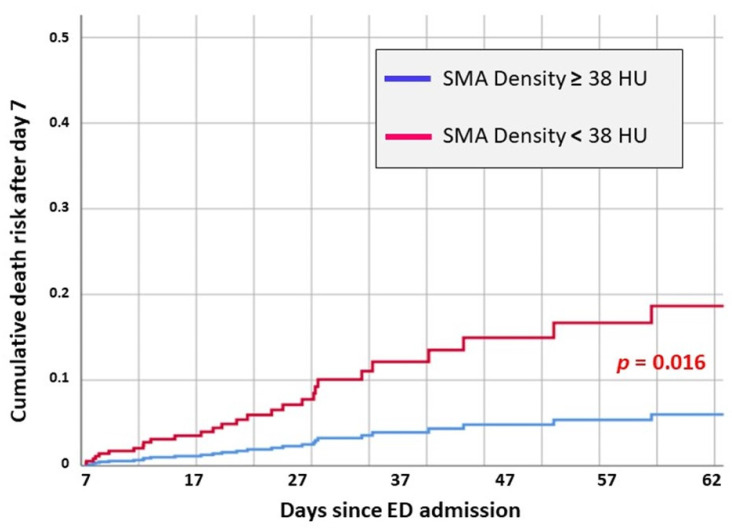 Figure 1
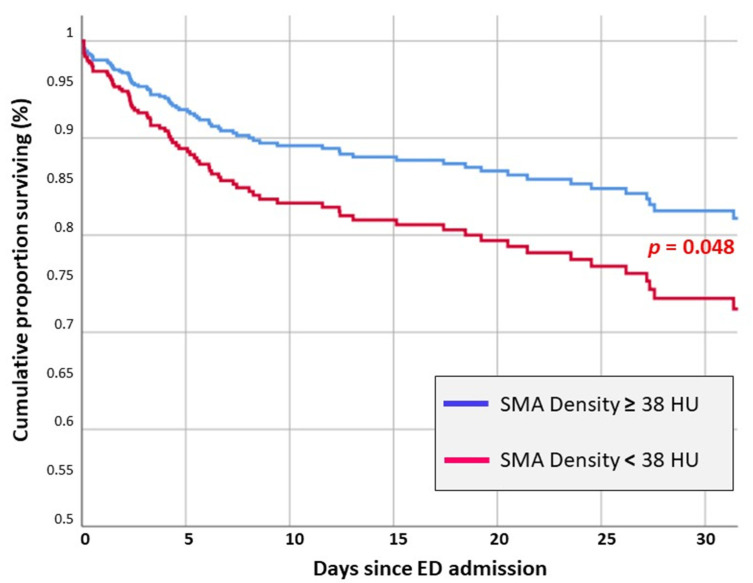 Figure 2
Peer Reviews
No public reviews on file for this paper yet. If you reviewed it on a platform where reviews are public (OpenReview, ICLR, NeurIPS, ICML), you can paste yours below so the community can read it here.
Videos
No videos yet. Explain this paper in a talk, walkthrough, or lecture? Add one.
Taxonomy
TopicsHip and Femur Fractures · Cardiac, Anesthesia and Surgical Outcomes · Pelvic and Acetabular Injuries