CO2-triggered reversible transformation of soft elastomers into rigid and highly fluorescent plastics
Yohei Miwa, Kazuma Okada, Takumi Hayashi, Kei Hashimoto, Hikaru Okubo, Hiroshi Takase, Katsuhiro Yamamoto, Ken Nakano, Shoichi Kutsumizu

TL;DR
This paper introduces a material that becomes rigid and fluorescent when exposed to CO2, offering potential for smart devices and CO2-based technologies.
Contribution
A CO2-responsive elastomer that reversibly changes stiffness, adhesion, friction, and fluorescence is developed.
Findings
The elastomer's Young’s modulus increases from ~1 MPa to >2 GPa in the presence of CO2.
The material exhibits amplified fluorescence and altered surface adhesion/friction when exposed to CO2.
The material is proposed for use in sensing, display, and data storage technologies.
Abstract
Polymers that alter their properties and functions in response to carbon dioxide (CO2) exposure offer significant potential for the development of smart technologies and innovative CO2 utilization approaches. Nonetheless, effectively regulating the behavior of solid-state polymers using CO2 remains a considerable challenge, highlighting the need for robust and reliable strategies to address this issue. This study presents elastomers that feature nanophase-separated morphologies composed of CO2-vitrifiable polyethyleneimine and CO2-permeable polydimethylsiloxane components. The elastomers (Young’s modulus (E) of approximately 1 MPa) reversibly transform into hard plastics (E > 2 GPa) in the presence of CO2. In addition to bulk stiffening, their surface adhesion and friction rapidly shift, and the material’s fluorescence is significantly amplified. Here, we show that these multifunctional…
Genes, proteins, chemicals, diseases, species, mutations and cell lines named across the full text — each resolved to its canonical identifier and authoritative record.
Click any figure to enlarge with its caption.
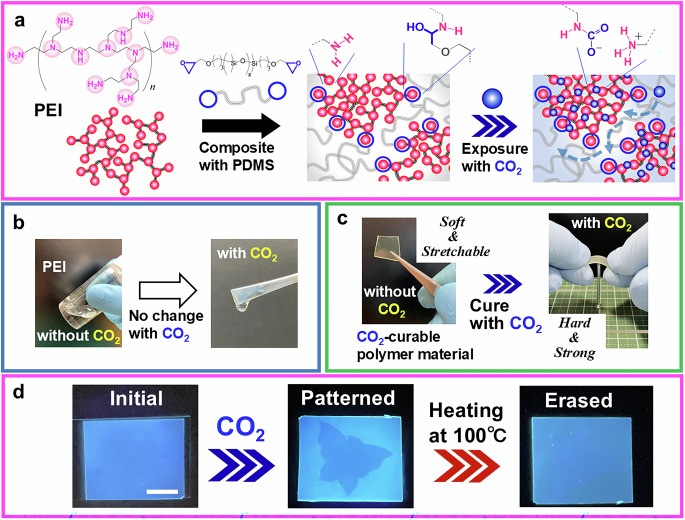 Figure 1
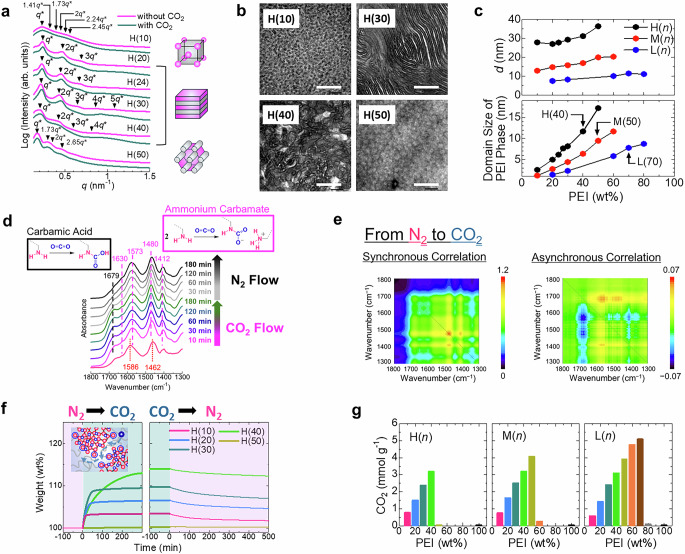 Figure 2
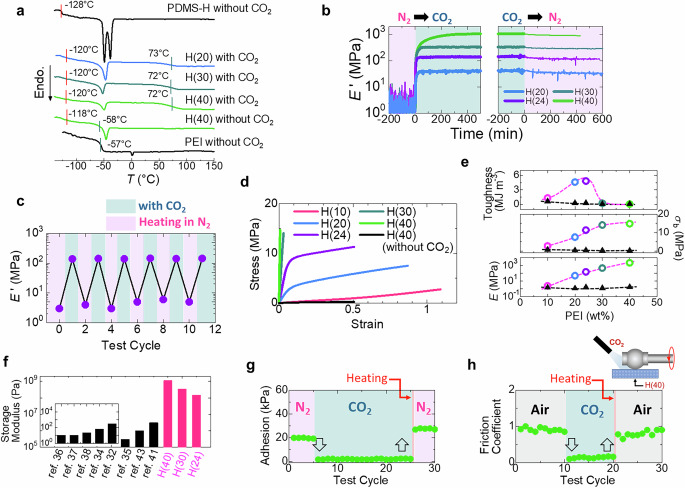 Figure 3
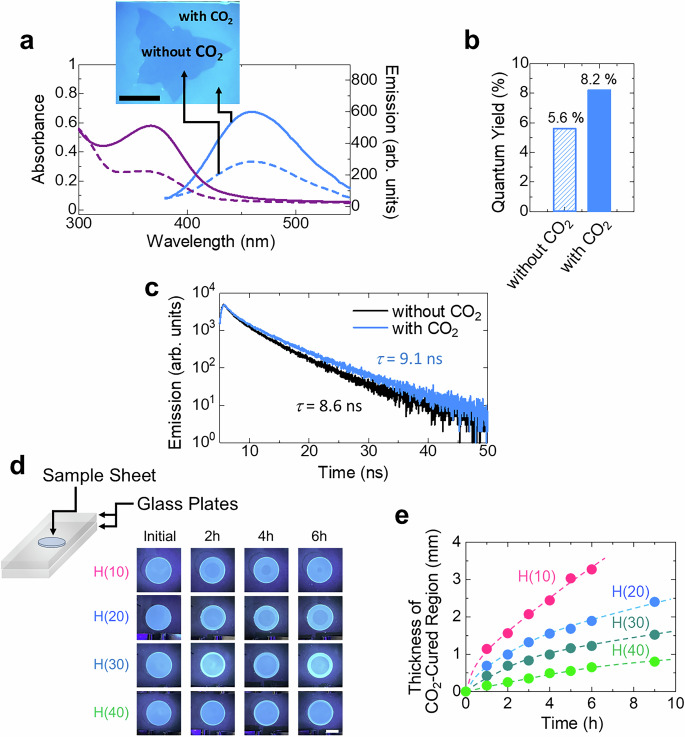 Figure 4
- —https://doi.org/10.13039/501100001691MEXT | Japan Society for the Promotion of Science (JSPS)
Peer Reviews
No public reviews on file for this paper yet. If you reviewed it on a platform where reviews are public (OpenReview, ICLR, NeurIPS, ICML), you can paste yours below so the community can read it here.
Videos
No videos yet. Explain this paper in a talk, walkthrough, or lecture? Add one.
Taxonomy
TopicsPolymer Foaming and Composites · Polymer composites and self-healing · Carbon dioxide utilization in catalysis
Introduction
Carbon dioxide (CO_2_) is a non-toxic, biocompatible, and non-flammable carbon resource that is both inexpensive and widely available. However, because CO_2_ is also a major greenhouse gas, its emissions require mitigation. The Intergovernmental Panel on Climate Change has acknowledged the severe impact of global warming, which is primarily driven by greenhouse gases, such as CO_2_ released through human activities^1^. In response, researchers have been working to establish a carbon-recycling society by developing technologies for the separation^2,3^, capture^4–7^, storage^8,9^, and utilization^10–22^ of CO_2_. Within the context of chemical CO_2_ utilization, researchers have specifically focused on synthesizing polymers^10–14,17,18^, methanol^15,16,20^, concrete^19,22^, and other materials^21^ using CO_2_ as a feedstock. Despite ongoing efforts, the practical utilization of CO_2_ remains markedly constrained, highlighting a critical need for the development of more diverse and efficient technologies to actively advance carbon-recycling and circular carbon-economy initiatives.
The use of CO_2_ to control material functions has recently garnered attention in materials science, leading to the development of advanced materials. For instance, Miyasaka et al. recently synthesized metal–organic frameworks capable of switching their magnetic properties in response to CO_2_ exposure^23–26^. Such CO_2_-responsive materials are anticipated to contribute to the effective utilization of CO_2_—a waste product—as a valuable resource. In the field of polymer chemistry, CO_2_-responsive polymers have predominantly been developed as solutions, liquids, or nanoparticles^27–29^. Since the first report by George and Weiss^30^, CO_2_-responsive gels^30–38^ and elastomers^39–44^ have been developed as solid-state materials. However, the elastic modulus of these CO_2_-responsive materials is limited to several megapascals. Consequently, developing solid-state materials whose mechanical properties can be broadly tuned on demand in response to CO_2_ exposure represents a primary challenge in this field. For instance, a soft elastomer that rapidly transforms into a hard plastic upon exposure to CO_2_ could serve not only as an advanced structural material but also as a tactile sensor for CO_2_ detection or a smart coating that forms wear-resistant, low-friction, and easy-to-clean surfaces. Such innovative materials hold considerable potential for creating advanced smart products that leverage CO_2_ to modulate their functions. However, the key ingredients enabling these materials to harden in response to CO_2_ exposure remain unknown.
In this report, we present the design of a CO_2_-curable polymer, wherein polyethyleneimine (PEI), serving as a CO_2_-vitrifiable building block, is linked with telechelic epoxy polydimethylsiloxane (PDMS), exhibiting CO_2_-permeable properties (Fig. 1a). Notably, PEI, a typical amine polymer, is unresponsive to CO_2_ in the bulk state (Fig. 1b). However, it vitrifies upon CO_2_ exposure when phase-separated at the nanoscale within a material. To control the size of this nanophase separation, herein, we used three telechelic epoxy PDMS variants (PDMS–H, PDMS–M, and PDMS–L) with different molecular weights. Among these, PDMS–H exhibits a number-average molecular weight (Mn) and polydispersity index (PDI) of 12,000 and 1.69, respectively (Supplementary Fig. 1). The corresponding values for PDMS–M and PDMS–L are 3800 and 1.75 and 1700 and 1.30, respectively. CO_2_-curable polymers containing PDMS–H are designated as H(n), where n represents the weight percentage of PEI in the material. Similarly, those containing PDMS–M and PDMS–L are labeled as M(n) and L(n), respectively. In these CO_2_-curable polymers, the continuous PDMS phase promotes CO_2_ diffusion into the material, enabling rapid curing upon CO_2_ exposure (Fig. 1a). Furthermore, this design allows on-demand tuning of mechanical properties—including Young’s modulus, strength, toughness, and stretchability—depending on the composition of the CO_2_-vitrifiable PEI component (Fig. 1c). For instance, the Young’s modulus of the CO_2_ curable polymers varies widely from approximately 2 MPa to approximately 2 GPa. Additionally, our findings indicate that these materials can function not only as mechanically responsive systems, but also as optical display and information recording frameworks utilizing CO_2_ (Fig. 1d). They can also serve as high-performance CO_2_ adsorbents, with capacities reaching approximately 5 mmol g^−1^. The synthesized materials exhibit the dual functionality of CO₂ capture and utilization, while additionally conferring value to CO₂ through its capacity to modulate the mechanical and optical properties of the material.Fig. 1. Design concept of CO_2_-curable polymers using PEI as the CO_2_-vitrifiable building block.a Schematic illustration of the preparation of CO_2_-curable polymers and their interaction with CO_2_ molecules. b Photographs of PEI, which remain unresponsive to CO_2_ in the bulk state. c Photographs of CO_2_-curable polymers with and without CO_2_ exposure, illustrating their transformation from elastic to plastic behavior upon CO_2_ exposure. d Photograph of an H(30) sheet under ultraviolet (UV) irradiation at 365 nm. Fluorescence intensity increases with CO_2_ exposure. A butterfly-shaped pattern is recorded onto the sheet using an aluminum mask. The scale bar is 10 mm.
Results
CO2-capture performance
The CO_2_-curable polymers synthesized in this study form transparent sheets regardless of the molecular weight of PDMS or the composition of PEI (Fig. 1c and Supplementary Fig. 2). Given the highly ordered nanophase separation between the PEI and PDMS phases, H(n) samples exhibit multiple scattering peaks in their small-angle X-ray scattering (SAXS) profiles (Fig. 2a). In particular, the profiles of H(20), H(24), H(30), and H(40) contain integral multiples of q*, indicative of a lamellar morphology. Here, q* denotes the scattering vector (q) of the primary scattering peak. Meanwhile, H(10) and H(50) exhibit spherical and cylindrical morphologies, respectively. The SAXS profiles of M(n) and L(n) samples are broad, which is attributed to the weak segregation of the low-molecular-weight PDMS used in these materials (Supplementary Fig. 3). The morphologies were further verified by transmission electron microscopy (TEM) (Fig. 2b and Supplementary Fig. 4). Overall, the SAXS analysis confirms that the morphology of the materials remains unchanged following CO_2_ exposure (Fig. 2a). The average domain size of the PEI phase, calculated from the average periodicity (d) and the volume fraction of PEI in each sample, decreases with the reduction in both the molecular weight of PDMS and PEI content (Fig. 2c). Here, the periodicity d is determined using the relation d = 2π q^−1^. In summary, the SAXS and TEM analyses reveal that the CO_2_-curable polymers comprise a continuous PDMS phase that facilitates CO_2_ diffusion alongside a nanoscale PEI phase, which collectively creates a large accessible interface between PEI and CO_2_ molecules.Fig. 2. Nanophase-separated morphology and CO_2_ capture performance of the synthesized CO_2_-curable polymers.a SAXS profiles of H(n) samples with and without CO_2_ exposure. b TEM images of selected samples. PEI component was stained with RuO_4_. The scale bar is 200 nm. c Average periodicity (d) and domain size of PEI phase as a function of PEI content. d Changes in the FTIR spectra of H(40) under CO_2_ and N_2_ flow. e Two-dimensional infrared correlation spectra recorded during the N_2_ → CO_2_ process. f Weight changes of selected samples during gas switching between N_2_ and CO_2_ at 25 °C. g CO_2_-capture capacity of the samples at 25 °C.
These polymers capture CO_2_ through the formation of ammonium carbamate and carbamic acid, as illustrated in Fig. 2d^45^. Under CO_2_ exposure, the bands at 1412, 1480, 1573, and 1630 cm^−1^— attributed to the symmetric stretching of COO^−^, symmetric deformation of NH_3_^+^, asymmetric stretching of COO^−^, and asymmetric deformation of NH_3_^+^ in ammonium carbamates, respectively—in the Fourier-transform infrared (FTIR) spectrum of H(40) intensify (Fig. 2d). Simultaneously, the band at 1679 cm^−1^, attributed to the C = O stretching of carbamic acid also becomes more prominent^45^. The change can be seen more clearly in the difference spectra (Supplementary Fig. 5). Conversely, the band at 1586 cm^−1^, assigned to the N–H bending of primary amine diminishes under CO_2_ flow. The spectrum also induces a band at 1462 cm^−1^, assigned to the C–H bending of methylene. Meanwhile, the synchronous correlation spectrum displays a positive cross peak between the bands at 1412 and 1480 cm^−1^ during both switching processes, suggesting that they share a common origin (Fig. 2e). In contrast, the asynchronous correlation spectrum reveals that the bands at 1412, 1480, 1573, and 1630 cm^−1^ exhibit negative cross peaks relative to the band at 1679 cm^−1^ during the N_2_ → CO_2_ process. However, during the reverse process (CO_2_ → N_2_), these bands exhibit positive cross peaks relative to the same band (Supplementary Fig. 6). Collectively, these results indicate that ammonium carbamate generates before carbamic acid during the N_2_ → CO_2_ process. In contrast, during the CO_2_ → N_2_ process, ammonium carbamate exhibits greater stability and decomposes more slowly than carbamic acid.
The CO_2_-capture performance of the materials was monitored by measuring weight changes during the N_2_ → CO_2_ process. Although PEI captures only a small amount of CO_2_ in its bulk state (Supplementary Fig. 7), the CO_2_-curable polymers synthesized herein exhibit rapid and substantial CO_2_ uptake owing to the combined effects of the continuous CO_2_-permeable PDMS phase and nanosized PEI phase, which together generate a large accessible interface between PEI and CO_2_ molecules (Fig. 2f and Supplementary Fig. 8). However, CO_2_ release under N_2_ flow at 25 °C proceeds slowly because the primary species formed during this reaction is stable ammonium carbamate (Fig. 2f). While this compound remains stable at room temperature, it decomposes upon heating (Supplementary Fig. 9). Furthermore, CO_2_ uptake by the synthesized polymers increases proportionally with PEI content, reaching a maximum of approximately 5 mmol g^−1^ for L(70) (Fig. 2g). Notably, this value is comparable to those of other high-performance amine-based CO_2_ adsorbents^7^. For L(70), heating accelerates CO_2_ uptake kinetics but reduces the overall uptake capacity (Supplementary Fig. 10). Moreover, the CO_2_-capture performance of H(30) is maintained even after 10 cycles of CO_2_ absorption and release by heating (Supplementary Fig. 11). Interestingly, CO_2_ uptake by the synthesized polymers decreases sharply once the PEI content exceeds a threshold, corresponding to H(40), M(50), and L(70) for each series. Notably, this threshold increases as the molecular weight of PDMS decreases. Although the precise cause of this behavior remains unclear, we speculate that it is associated with the domain size of the PEI phase. This is because a thicker PEI phase hinders the accessibility of CO_2_ molecules to the amine groups, as previously reported by Stafford et al.^46^. The measured domain sizes of PEI phase for H(40), M(50), and L(70) are 12 nm, 9.4 nm, and 7.8 nm, respectively (Fig. 2c). While these values are not identical owing to morphological heterogeneity, they are comparable.
CO2-curable polymers with tunable mechanical properties
The mechanical properties of CO_2_-curable polymer materials improve substantially with CO_2_ capture. For example, H(30) is soft and weak in the absence of CO_2_ (Supplementary Movie 1). However, it hardens and strengthens upon CO_2_ exposure (Supplementary Movie 2). This transformation is exemplified by the ability of a small CO_2_-cured H(30) sample to lift a 2 kg weight. Further insights are provided by temperature-modulated differential scanning calorimetry (MDSC) analysis. Specifically, the MDSC trace of H(40) without CO_2_ exposure reveals glass transition temperatures (Tg) of approximately −58 °C and −18 °C for PEI and PDMS components, respectively (Fig. 3a). The endothermic peak observed around −45 °C is attributed to the melting temperature of the PDMS component. Upon CO_2_ exposure, the Tg value of PEI component increases to approximately 72 °C, while that of PDMS component remains unchanged. The drastic increase in the Tg value of PEI component is attributed to the formations of ammonium carbamates and carbamic acids that densely crosslink the PEI component (Fig. 1a and Fig. 2d). Notably, the CO_2_-vitrified PEI component consistently exhibits a Tg value of approximately 72 °C regardless of the material’s composition (Fig. 3a). In contrast, bulk PEI does not vitrify upon CO_2_ exposure (Fig. 1b). In fact, the shear storage modulus of PEI increases only slightly under these conditions (Supplementary Fig. 12). PDMS is also unaffected by the presence of CO_2_ (Supplementary Fig. 13). Due to the presence of the CO_2_-vitrifiable PEI component, the H(n), M(n), and L(n) samples exhibit curability upon exposure to CO_2_. Notably, the tensile storage modulus (E’) of H(20), H(24), H(30), and H(40) increases substantially and rapidly during the N_2_ → CO_2_ process (Fig. 3b). Moreover, the CO_2_-curing of the materials can be observed even in ambient air (Supplementary Fig. 14). In contrast, the E’ values of the corresponding CO_2_-cured samples exhibit only a slight decrease when held at 25 °C in an N_2_ atmosphere. Following air exposure for one and two months, the Young’s modulus (E) of CO_2_-cured H(30) gradually declines from 470 MPa to 410 MPa and then to 250 MPa (Supplementary Fig. 15). This result indicates that the CO_2_-curable polymers have some stability at room temperature. Nevertheless, the mechanical properties of the materials change more drastically under thermal stimuli. For instance, upon heating, the CO_2_-cured samples soften rapidly owing to CO_2_ release (Supplementary Fig. 16). As depicted in Fig. 3c, H(24) retains excellent mechanical cyclability during repeated cycles of CO_2_ exposure and heating in N_2_. Collectively, these findings indicate that CO_2_-curable polymers are well suited for use as smart switching systems leveraging CO_2_ as a trigger.Fig. 3. Effect of CO_2_ exposure on the mechanical properties of the synthesized CO_2_-curable polymers.a MDSC thermograms of selected samples. b Changes in the tensile storage moduli (E’) of selected H(n) samples at 25 °C and 1 Hz during the N_2_ → CO_2_ and CO_2_ → N_2_ processes. c Cycling test results of H(24), involving CO_2_ exposure followed by heating to 100 °C under N_2_ flow. d Stress–strain curves obtained from uniaxial stretching tests of the selected samples. e Toughness, stress at break (σb), and Young’s modulus (E) of H(n) samples as functions of PEI content. Colored and black plots correspond to samples with and without CO_2_ exposure, respectively. f Comparison of the elastic moduli of H(24), H(30), and H(40) with those of conventional CO_2_-responsive polymers. g Reversible change in the adhesion of H(40) at 25 °C upon CO_2_ exposure followed by heating at 150 °C under N_2_ flow. h Effect of CO_2_ exposure on the surface friction of H(40).
The CO_2_-curable polymers synthesized herein transition from soft elastomers to hard, tough plastics in response to CO_2_ exposure. Moreover, the modulus, stretchability, and toughness of CO_2_-cured materials are broadly tunable through compositional adjustments (Fig. 3d and Supplementary Fig. 17). For instance, the E of the CO_2_-cured H(n) samples increases from 2.4 MPa to 2.2 GPa as the CO_2_-vitrifiable PEI content rises from 10 wt% to 40 wt% (Fig. 3e). In particular, the E value of H(40) increases by more than 1500-fold following CO_2_ exposure. Remarkably, the CO_2_-cured H(n) samples are approximately three orders of magnitude harder than previously reported CO_2_-responsive polymers (Fig. 3f)^32,34–38,41,43^. Beyond modulus enhancement, both the stress at break (σb), and toughness of H(n) samples also improve substantially upon CO_2_ exposure (Fig. 3e). In particular, L(60) recorded high σb value of 68 MPa (Supplementary Fig. 17). In this study, the toughness of the sample was characterized by the fracture energy, which was calculated by integrating the area under the stress-strain curve. In the CO_2_-curable polymers, the PEI component vitrifies upon CO_2_ exposure because of the formations of ammonium carbamates and carbamic acids that densely crosslink the PEI component. This is the mechanism for the drastic enhancement of mechanical properties of the materials. On the other hand, the CO_2_-cured materials that contain a large amount of vitrified PEI lose their stretchability and become brittle. The toughness of the materials reaches its maximum at a PEI content of approximately 20–30% (Supplementary Fig. 17).
In addition to tunable mechanical performance, the synthesized materials exhibit sensitive and reversible changes in surface properties upon CO_2_ exposure. For instance, an H(40) elastomer sheet displays some adhesion under ambient conditions; however, its surface hardens and loses its adhesive ability upon CO_2_ exposure (Fig. 3g, Supplementary Fig. 18, and Supplementary Movie 3). This change is reversible, as heating to remove CO_2_ quickly restores the adhesive property. A similar switching behavior is observed in surface friction (Fig. 3h). Specifically, the friction coefficient of an H(40) sheet varies markedly between approximately 0.9 and 0.1, in response to alternating CO_2_ exposure and heating. Notably, compared to the bulk properties, such as modulus, of the synthesized materials (Fig. 3b), their surface characteristics—namely adhesion and friction—are considerably more sensitive to CO_2_. Collectively, these results suggest that CO_2_-curable polymers are well suited for use as smart coatings or skin layers capable of rapidly and reversibly creating wear-resistant, low-friction, and easy-to-clean surfaces upon CO_2_ exposure.
CO2-switchable optical properties
The synthesized CO_2_-curable polymers exhibit fluorescent luminescence under UV-irradiation at 365 nm in their initial state (Fig. 1d), owning to PEI crosslinking, as previously reported by Yang et al.^47^. Interestingly, this luminescence intensifies upon CO_2_ exposure. As depicted in Fig. 4a, exposing H(40) to CO_2_ substantially increases its UV absorption at 364 nm and fluorescence emission intensity at 460 nm (excited at 360 nm). This CO_2_ exposure also results in slight increments in both quantum yield (Fig. 4b) and fluorescence lifetime (τ) (Fig. 4c). This enhanced fluorescence is mainly attributed to the formation of ammonium carbamate^48^. Importantly, this property enables direct visualization of CO_2_ diffusion into the material (Fig. 4d). Consistent with the results indicated by the gravimetric analysis (Fig. 2f), the rate of CO_2_ diffusion in CO_2_-curable polymers is visually observed to increase with increasing PDMS content (Fig. 4e). This is attributed to the CO_2_ diffusion pathways facilitated by the highly CO_2_-permeable PDMS component. The CO_2_-enhanced fluorescence also facilitates pattering on the material’s surface (Fig. 1d and Fig. 4a). Moreover, the pattern can be erased by releasing CO_2_ through heating (Fig. 1d). Thus, this system demonstrates immense potential for diverse applications, including CO_2_ detection, display technologies, and information recording systems.Fig. 4CO_2_-modulated fluorescence properties of H(40).a UV absorption (purple) and fluorescence emission (blue) spectra of H(40) at 25 °C. Solid and dashed lines indicate spectra with and without CO_2_ exposure, respectively. The excitation wavelength is 360 nm. The scale bar is 10 mm. b Impact of CO_2_ exposure on the quantum yield (excited at 360 nm). c Fluorescence decay curves of H(40) with and without CO_2_ exposure, measured under 360 nm excitation. The fluorescence lifetimes (τ) of H(40) with and without CO_2_ exposure are 8.6 and 9.1 ns, respectively. d Visualization of CO_2_ diffusion into selected H(n) sheets under UV irradiation. Here, circular sheets (8 mm in diameter) were sandwiched between glass plates and exposed to CO_2_. The scale bar is 4 mm. e Thickness of the CO_2_-cured region in the synthesized materials as a function of time.
Discussion
In this study, we present innovative CO_2_-curable polymers capable of dynamically adjusting their mechanical and optical properties in response to CO_2_ exposure. A key component of this material design is a nanophase-separated morphology composed of CO_2_-vitrifiable PEI and CO_2_-permeable flexible PDMS phases, which enable rapid and reversible transitions in mechanical behavior—ranging from soft and stretchable to tough and hard. In addition to serving as advanced structural materials, these systems are also effective as smart skin materials with switchable adhesion and friction. Furthermore, they exhibit optical responsiveness due to enhanced fluorescence upon CO_2_ exposure, making them capable of leveraging CO_2_ for information display and recording. Collectively, these findings illustrate that CO_2_-curable polymers hold promise not only as innovative structural platform but also as dynamic surface and optical systems, offering new directions for CO_2_ utilization.
Importantly, the use of PEI as a CO_2_-vitrifiable component is expected to broadly impart both mechanical and optical CO_2_-responsiveness to a wide range of polymers. Furthermore, the combination of PEI with other polymers may enable precise control over these mechanical and optical properties, paving the way for the development of innovative functional materials. Ongoing research related to this topic is currently being conducted in our laboratory.
Methods
Materials
Three kinds of telechelic epoxy polydimethylsiloxane (PDMS–H, PDMS–M, and PDMS–L) were obtained from Shin-Etsu Chemical Co., Ltd. and Fuzhou Topda New Material Co., Ltd (Supplementary Figs. 1, 19). Molecular sieves (3 A and 4 A, 1/16) and CDCl_3_ (99.8%) was purchased from Nacalai Tesque, Inc. Chloroform (>99.0%)was obtained from Kanto Chemical Co., Inc. Branched polyethyleneimine (PEI) (number-average molecular weight (Mn) ≈ 10,000) was purchased from Junsei Chemical Co., Ltd. The ratio of primary, secondary, and tertiary amines of PEI determined by ^13^C-NMR was 0.41, 0.32, and 0.27, respectively (Supplementary Fig. 20).
Synthesis of H(n), M(n), and L(n) samples
H(n) samples, comprising n wt% PEI linked with telechelic epoxy PDMS (PDMS–H, Mn = 12,000; PDI = 1.69), were synthesized as follows: Weighed amounts of PEI and PDMS–H were dissolved in dehydrated chloroform to yield a solution with total concentration of 8 wt%. The solution was maintained under an argon atmosphere and stirred at 60 °C for 5 days. It was then transferred into a Teflon petri dish and slowly dried at 50 °C for 24 h to form an approximately 1-mm thick sample sheet. This sample sheet was further dried at 120 °C for 18 h under vacuum. The chemical composition of the samples was checked by FTIR (Supplementary Fig. 21). M(n) and L(n) samples were prepared similarly using PDMS–M (Mn = 3800; PDI = 1.75) and PDMS–L (Mn = 1,700; PDI = 1.30), respectively. The resulting sheets were transparent (Supplementary Fig. 2).
Measurements
^1^H-NMR and ^13^C-NMR measurements of samples dissolved in CDCl_3_ containing tetramethylsilane were performed using a 400 MHz JEOL-ECS400 spectrometer.
An EXTREMA HPLC system (JASCO Co.), equipped with a polystyrene gel column (Shodex GPC LF-804), was employed for GPC measurements. THF was used as the eluent at 40 °C. PDMS standards (Scientific Polymer Products Inc.) were used for calibration.
An FT/IR-6600 spectrometer (JASCO Co.) was used for Fourier transform infrared (FTIR) measurements at a resolution of 4 cm^−1^. The transmittance mode was used for samples deposited on a KBr plate. A 2D correlation program (JASCO) was used to generate the 2D infrared correlation spectra.
Thermogravimetric (TG-DSC) measurements were performed on an STA200 (HITACHI) with a gas flow of 100 mL min^−1^.
Temperature-modulated differential scanning calorimetry (MDSC) was performed on an EXSTAR DSC6200 (Seiko Instruments Inc. [SII]). The samples were sealed in an aluminum pan and heated at a rate of 3 °C min^−1^ from −135 °C to 180 °C. A modulation amplitude of 1.5 °C and a period of 60 s were used. A reversing heat flow was applied for analysis.
For sheet samples, the MCR702e instrument (Anton Paar) was employed for monitoring of modulus during gas switching. Tensile measurements were conducted at 1 Hz with a tensile strain of 0.1% at a constant temperature of 25 °C. The typical sample dimensions were 20 × 5.0 × 1.0 mm. Dry N_2_ or CO_2_ gas was flowed into the sample chamber at 3.0 L min^−1^. For PEI, the MCR302 rheometer (Anton Paar) was employed. For the measurements, 1-mm-diameter parallel plates were used, and a shear strain of 0.03% was applied at 1 Hz. A Peltier cooling system was employed to maintain a constant temperature, and dry N_2_ or CO_2_ gas was flowed at 3.0 L min^−1^ inside the Peltier hood.
Synchrotron SAXS measurements were performed using the BL8S3 beamline at the Aichi Synchrotron Radiation Center in Aichi, Japan. X-ray wavelength of 0.092 nm was used at a constant distance of approximately 2.2 m between the specimen and the detector. PILATUS 2 M was used as the detector. Silver behenate was used as the calibration standard. Before the measurement, some samples were fully exposed to CO_2_ gas in an aluminum package. Each sample was then quickly installed into the beamline and measured in air.
The apparatus, a cryo unit (Leica FC7; Leica Microsystems) attached to an ultra-microtome (Leica UC7; Leica Microsystems), was used with liquid nitrogen. The sample pieces were frozen in the gas phase inside the cryo unit. A diamond knife (Syntek Co., Ltd.) was used to prepare ultrathin sections, with a thickness of approximately 100 nm. The sections were placed on copper grid with a carbon support film, for transmission electron microscope (TEM) observation. The sample grids were placed in a glass petri dish, and several drops of ruthenium tetroxide solution were added near the grids. The petri dish was covered, allowing the ruthenium to evaporate, and the specimens were stained. The stained ultrathin sections on the grid were observed using a TEM (JEM-1400Plus; JEOL Ltd.) at an acceleration voltage of 100 kV.
The Force Tester MCT-2150 (A&D Company, Ltd.) was used for the uniaxial tensile test. The test temperature was maintained at 26 °C ± 1 °C. JIS 7 dumbbell-shaped sample pieces were used for the tensile tests. Prior to the measurement, some specimens were fully exposed to CO_2_ gas in an aluminum package for more than 2 days. The sample pieces were stretched at a strain rate of 0.09 s^−1^. The toughness of the sample was characterized by the fracture energy, which was calculated by integrating the area under the stress-strain curve.
The Anton Paar MCR302 was used for the probe tack tests. A Peltier cooling system was employed to maintain a constant temperature, and dry N_2_ or CO_2_ gas was flowed at 3.0 L min^−1^ inside the Peltier hood. The test was performed at 25 °C. A stainless-steel parallel plate with a diameter of 4 mm was used as the probe. An H(40) sheet was bonded onto a copper plate. The probe was brought into contact with the sample sheet with a load of 0.5 N for 5 s. Then, the probe was removed from the sample sheet at a speed of 10 μm s^−1^. The measurements were repeated at 2 min intervals. After the measurements in CO_2_, the sample was heated at 150 °C for 5 min under N_2_ flow. After cooling, the measurement was performed again in N_2_ atmosphere at 25 °C.
A custom-built ball-on-disk friction tester was used to evaluate the frictional properties of the sample. The system allowed CO_2_ gas to be blown onto the sliding surface in air. Friction tests were conducted using a tribopair consisting of a square sample sheet and a stainless-steel ball (diameter: 19.05 mm). The sample sheet was mounted on a holder beneath the steel ball, which was rotated by a stepping motor, and the applied load was exerted by the steel ball onto the sample sheet. The sliding test conditions were as follows: an applied load of 1.0 N, a sliding speed of 1 mm s^−1^, and a temperature of 25 °C. CO_2_ gas was introduced at a flow rate of 1.0 L min^−1^ onto the sliding surface. After the measurements in CO_2_, the sample sheet was heated at 150 °C for 5 min in air using a rubber heater placed under the sample. After cooling, the measurement was performed again in air at 25 °C.
The UV absorption and fluorescent luminescence spectra were recorded using the UV-Vis spectrometer V-770 (JASCO Co.) and fluorescence spectrophotometer FP-8600 (JASCO Co.), respectively. H(40) was coated on a quartz glass plate to a thickness of ~0.1 mm and used for these measurements. The absolute PL quantum yield spectrometer C11347-01 (Hamamatsu Photonics) and fluorescence lifetime spectrometer Quantaurus-Qy C11367-01 (Hamamatsu Photonics) were used to obtain the quantum yield and the lifetime of fluorescent luminescence of H(40), respectively. The excitation wavelength was 360 nm.
Supplementary information
Supplementary Information Description of Additional Supplementary Files Supplementary Movie 1 Supplementary Movie 2 Supplementary Movie 3 Transparent Peer Review file
The reference list from the paper itself. Each links out to its DOI / PubMed record.
- 1Core Writing Team, Lee H. & Romero J. Eds. Climate Change 2023: Synthesis Report; Intergovernmental Panel on Climate Change (IPCC) 35–115 (IPCC, 2023).