Primula xinjingensis (Primulaceae), a new species from Guizhou, China

Abstract
Genes, proteins, chemicals, diseases, species, mutations and cell lines named across the full text — each resolved to its canonical identifier and authoritative record.
Click any figure to enlarge with its caption.
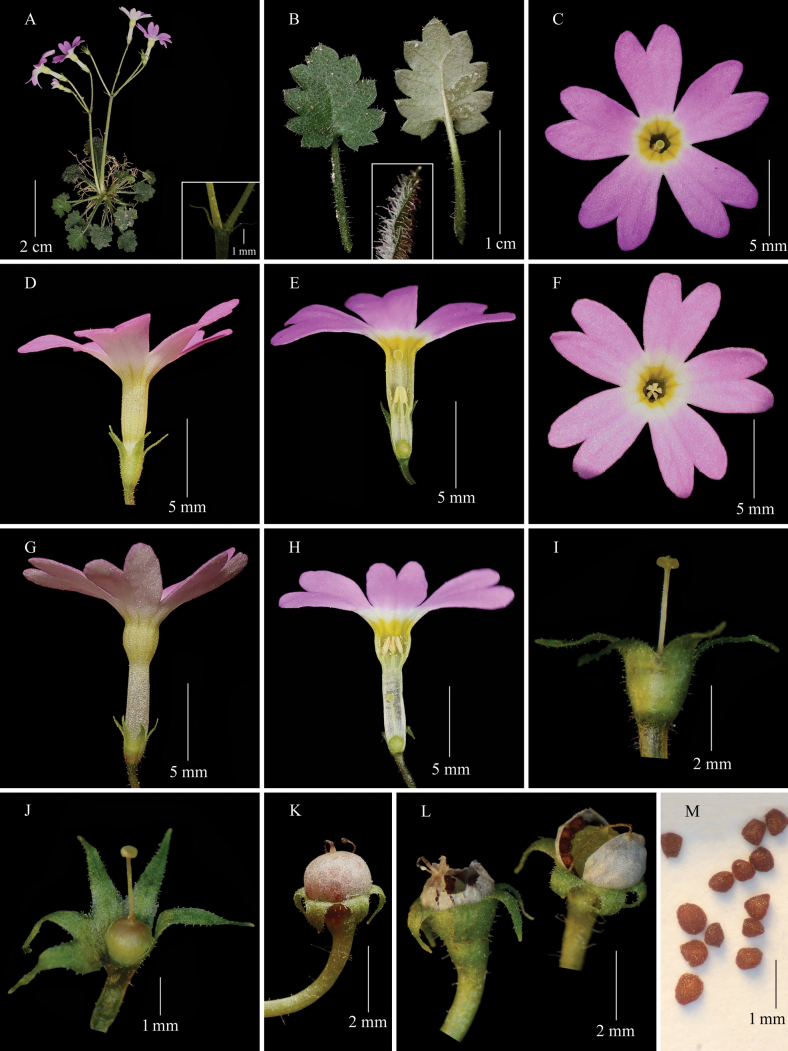 Figure 1
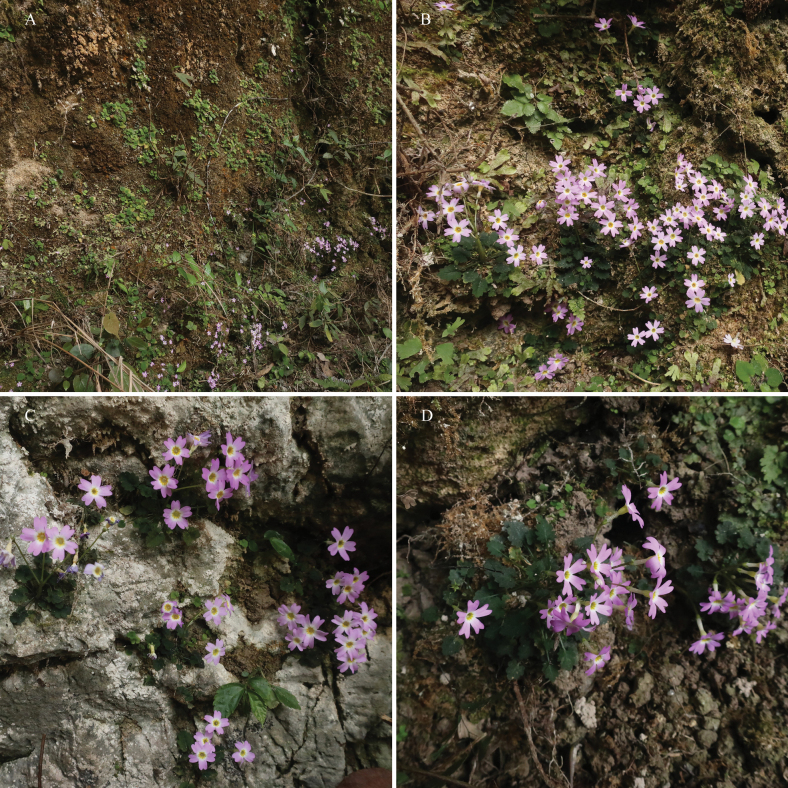 Figure 2
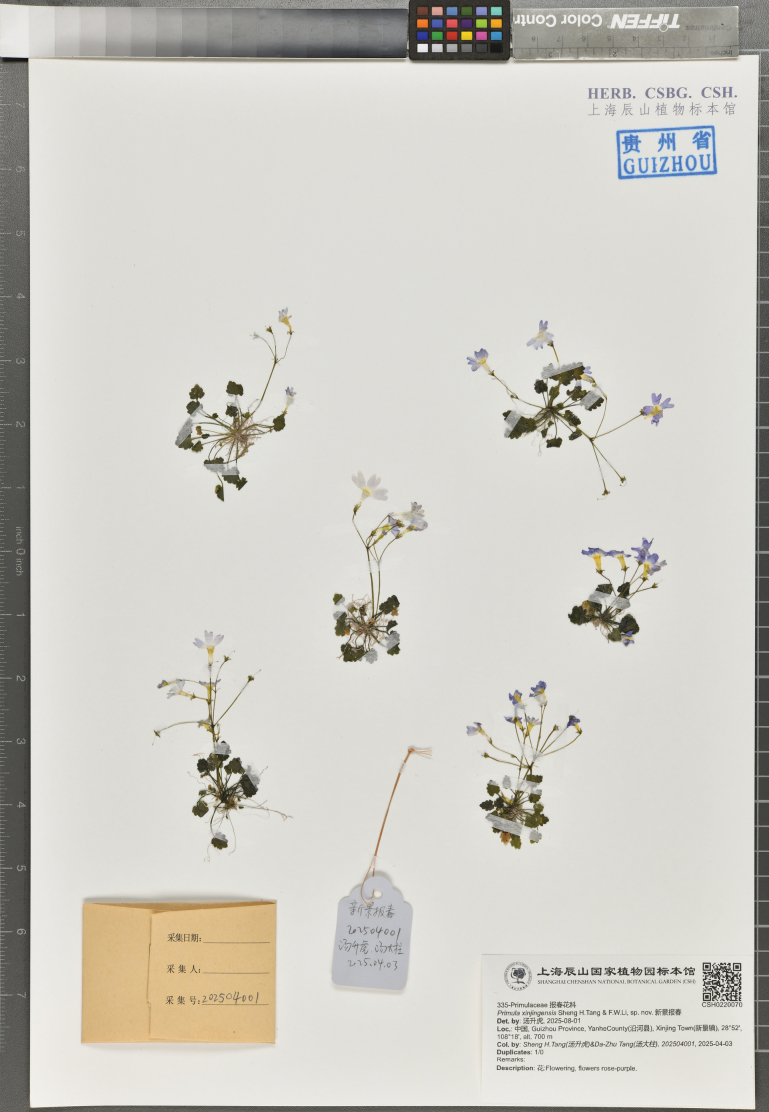 Figure 3
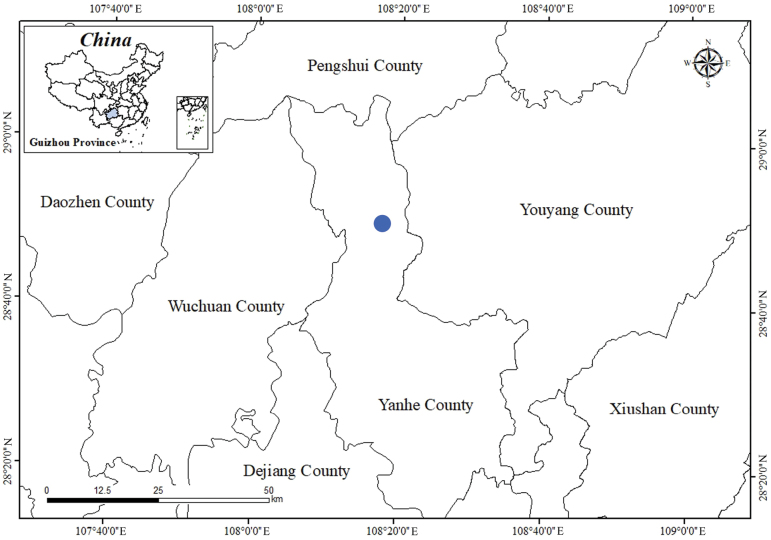 Figure 4
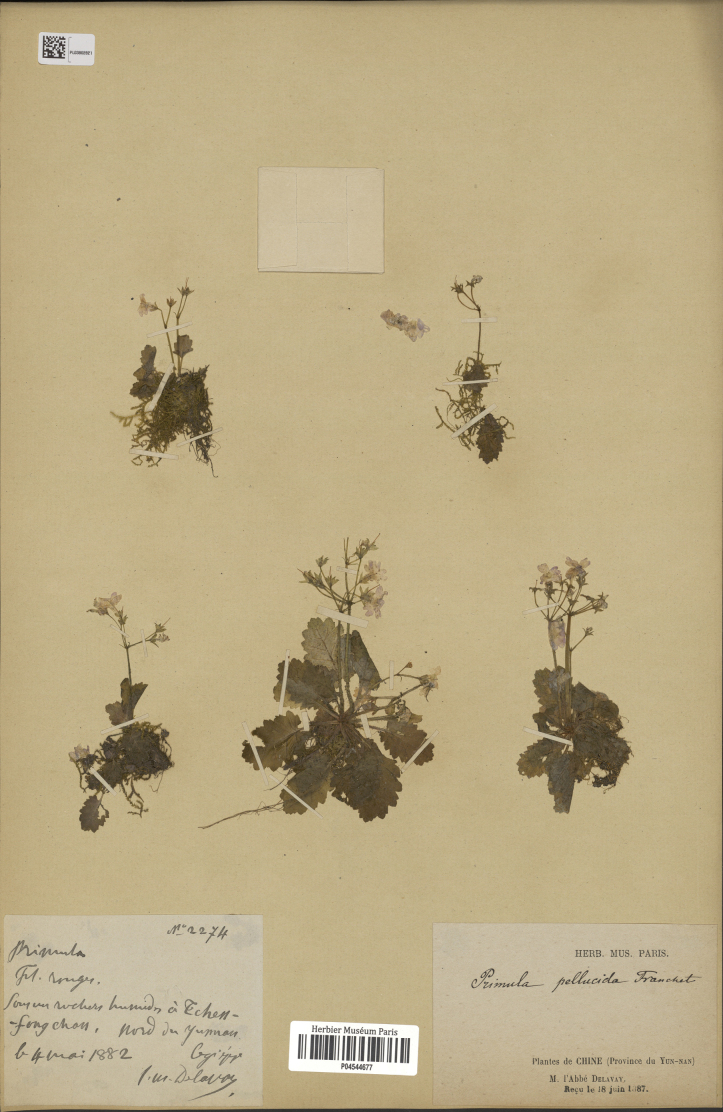 Figure 5
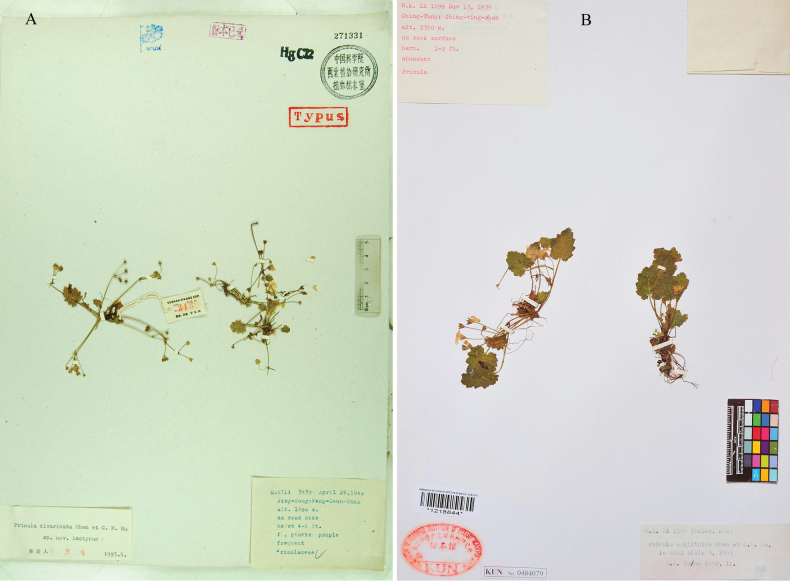 Figure 6
| Characters |
|
|
|
|
|---|---|---|---|---|
| Habitat | alt. ca. 700 m | alt. ca. 2000 m | alt. 1800–2700 m | alt. 2300–2500 m |
| Rhizomes | absent | absent | present | present |
| Calyx | ||||
| Calyx shape | campanulate | broadly campanulate | campanulate | campanulate |
| Lobe shape | lanceolate | triangular to ovate | triangular | ovate-triangular |
| Lobe apex | acuminate | acute | acute | acute |
| Lobes in fruit | recurved | recurved | erect | erect |
| Corolla limb lobes | narrowly cuneate-obovate | obovate | cuneate-obovate | obovate |
| Pin flowers | style reaching throat | style exserted from corolla tube | style ca. as long as tube | style reaching throat |
| 1 | Inflorescences and abaxial surface of leaves more or less farinose |
|
| – | Plants efarinose throughout |
|
| 2 | Calyx parted below middle, lobes lanceolate to linear-lanceolate |
|
| – | Calyx parted to the middle, lobes triangular to narrowly triangular |
|
| 3 | Rhizomes absent, calyx lobes recurved in fruits |
|
| – | Rhizomes present, calyx lobes erect in fruits |
|
| 4 | Calyx campanulate, and style of pin flowers reaching throat |
|
| – | Calyx broadly campanulate, and style of pin flowers exserted |
|
| 5 | Scapes with small leaves at apex; calyx 2–3 mm |
|
| – | Scapes without leaves at apex; calyx ca. 4 mm |
|
Peer Reviews
No public reviews on file for this paper yet. If you reviewed it on a platform where reviews are public (OpenReview, ICLR, NeurIPS, ICML), you can paste yours below so the community can read it here.
Videos
No videos yet. Explain this paper in a talk, walkthrough, or lecture? Add one.
Taxonomy
TopicsPlant and Fungal Species Descriptions · Plant Diversity and Evolution · Plant and animal studies
Introduction
Primula L. is a large genus belonging to the family Primulaceae, comprising approximately 548 species worldwide (POWO 2025). This genus primarily occurs in the temperate and alpine regions of the Northern Hemisphere (Hu 1990; Hu and Kelso 1996). In China, approximately 351 species have been documented (Liu 2025). In recent years, numerous new taxa have been discovered in China (IPNI 2025), including P. yanbianensis T.Shuai, Lei Cai & Z.K.Wu (Shuai et al. 2025), P. medogensis W.B.Ju, Bo Xu & X.F.Gao (Ju et al. 2023), P. zhengyii Bin Yang & Y.H.Tan (Yang et al. 2023), and P. xinningensis Wei Zhang bis & J.W.Shao (Zhang et al. 2022).
The section Monocarpicae Franch. ex Pax of the genus Primula is characterized by plants having multicellular hairs, membranous leaves with a distinct petiole and a round or heart-shaped blade base, a campanulate calyx, and a globose or cylindrical capsule dehiscing by valves (Hu 1990). This section is a small group consisting of 21 species in China (Hu and Kelso 1996; Xu et al. 2016a, 2016b, 2017, 2022).
During a field survey conducted in March 2025 in Yanhe County, Guizhou Province, China, we discovered some flowering plants belonging to the genus Primula. In April 2025, we returned to collect specimens and take photographs. In June 2025, we harvested the capsules from the plants cultivated at the Guizhou Botanical Garden. The plants are characterized as perennial, efarinose herbs lacking rhizomes. They feature a 5–9-lobulate leaf blade with multicellular hairs, lanceolate calyx lobes that are recurved in fruits, and narrowly cuneate-obovate corolla lobes. After thorough comparisons, we concluded that they represent a new species belonging to the section Monocarpicae.
Materials and methods
The morphological characteristics of approximately 100 mature individuals were observed, and 20 selected flowers were carefully observed and measured in the field. A microscope (Olympus SZ61, Tokyo, Japan) was used for micro-observation. The plant was described following the terminology used by Hu and Kelso (1996). All the species belonging to the section Monocarpicae in China have been examined using type specimens or the descriptions provided by Hu (1990) and Hu and Kelso (1996). Relevant literature was consulted, including Xu et al. (2016a, 2016b, 2017, 2022). The relevant images were sourced from virtual herbaria and databases, including E (https://data.rbge.org.uk/search/herbarium/), P (https://science.mnhn.fr/all/search), iPlant (http://www.iplant.cn/), and CVH (https://www.cvh.ac.cn/), CFH (https://www.cfh.ac.cn/) and CUBG (https://image.cubg.cn/).
Taxonomic treatment
Primula
xinjingensis
Taxon classificationPlantaeEricalesPrimulaceae
Sheng H.Tang & F.W.Li sp. nov.
90FC766F-A361-5221-A1D0-DE24969D4202
urn:lsid:ipni.org:names:77371343-1
Diagnosis.
The new species bears a striking resemblance to Primula pellucida Franch. in terms of the efarinose plants, the shape of the leaf blade, and the recurved calyx lobes in fruit. However, it is distinguished by having a campanulate (vs. broadly campanulate) calyx, lanceolate (triangular to ovate) calyx lobes, narrowly cuneate-obovate (vs. obovate) corolla limb lobes and a style reaching the throat (vs. exserted from the corolla tube) in the pin flowers. The new species also shares similarities with P. divaricata F. H.Chen & C.M.Hu and P. epilithica F.H.Chen & C.M.Hu in terms of leaf blade size and shape, as well as the campanulate calyx. Nevertheless, it is set apart from these two species by the absence of rhizomes (vs. their presence), lanceolate (vs. triangular or ovate-triangular) calyx lobes that are recurved (vs. erect) in fruits, and narrowly cuneate-obovate (vs. cuneate-obovate or obovate) corolla limb lobes.
Primula xinjingensis sp. nov. A. Flowering plant, and bracts (inset); B. Adaxial and abaxial surfaces of the leaf blade, and multicellular hairs on both sides (inset); C, D, E. Pin flower; F, G, H, I, J. Thrum flower; K, L. Capsules; M. Seeds. Photographs by Sheng-Hu Tang.
Type.
China. Guizhou Province: Yanhe County, Xinjing Town, 28°52'N, 108°18'E, ca. 700 m, 3 April 2025, Sheng H.Tang & Da-Zhu Tang 202504001 (holotype: CSH! [accession number CSH0220070]; isotype: the Guizhou Botanical Garden!).
Habitats of Primula xinjingensis sp. nov. (Population at the type locality). Photographs by Sheng-Hu Tang.
Description.
Herbs perennial, efarinose, without rhizomes, up to 9 cm tall at anthesis. Roots numerous, fibrous. Leaves 7–20, forming a rosette; petiole 5–13 mm long, short-stalked glandular and sparsely multicellular hairs; leaf blade ovate or suborbicular, 4–12 × 4–10 mm, membranous when dry, abaxially and adaxially with multicellular hairs, base cordate, apex acute, margin 5–9-lobulate; lobules ovate to broadly ovate, margin entire, sometimes with 1 or 2 teeth, apex acute; lateral veins 3–4 pairs, obscure adaxially and prominent abaxially. Scapes 1–3, short-stalked glandular and sparsely multicellular hairs, 1–4 cm tall, umbel 1, rarely 2, 1–4-flowered; bracts 3, sometimes 2 or 4, linear-lanceolate, 2–3 mm long, short-stalked glandular on both sides. Flowers heterostylous. Pedicel 1–2 cm long, short-stalked glandular and sparsely multicellular hairs. Calyx campanulate, 2–4 mm long, slightly enlarged in fruit, short-stalked glandular and sparsely multicellular hairs outside, glabrous inside, parted to middle or slightly below; lobes 1.5–2.5 × 0.8–0.9 mm, lanceolate, recurved at anthesis sometimes, and recurved in fruit, apex acuminate. Corolla rose-purple; tube 6–9 mm long; limb 9–14 mm wide; lobes 4–6 mm long, narrowly cuneate-obovate, deeply emarginate. Pin flowers: stamens 2–2.2 mm above base of corolla tube, style 4.5–7 mm long, reaching throat. Thrum flowers: stamens toward apex of corolla tube, style 2.5–3 mm long. Capsule globose, 1.7–2.1 mm in diam., dehiscing by 2 valves or crumbling irregularly. Seeds numerous, ovoid or irregularly ovoid, 0.5–0.8 mm long, brown, testa reticulate.
Holotype of Primula xinjingensis sp. nov. stored in CSH (Sheng H.Tang & Da-Zhu Tang 202504001, CSH0220070).
Phenology.
Flowering occurs from late March to early April, and fruiting occurs from May to June.
Etymology.
The new taxon was named for its locality, Xinjing Town, Yanhe County, Guizhou Province, China.
Vernacular name.
The Chinese name is “Xīn Jǐng Bào Chūn” (新景报春).
Distribution and habitat.
Only one population was discovered in Xinjing Town, Yanhe County, Guizhou Province, China (Fig. 4). It thrives on moist, shady cliffs and limestone surfaces. The primary companion species are Androsace kouytchensis Bonati, Petrocodon scopulorum (Chun) Yin Z.Wang, and Ophiorrhiza chinensis H.S.Lo.
Location of the population of Primula xinjingensis sp. nov. in Yanhe County, Guizhou Province, China (indicated by the blue circle).
Conservation status.
Only one population, consisting of approximately 200 mature individuals, was discovered at the type locality. Additional populations likely exist in this area. Until further investigation is conducted, the species should be designated as “Data Deficient” (DD) in accordance with the IUCN Red List Criteria (IUCN 2024).
Notes.
The new species bears the closest resemblance to Primula pellucida (Fig. 5), P. divaricata (Fig. 6), and P. epilithica (Fig. 6), and we have successfully obtained images of their type specimens. The detailed morphological comparison is shown in Table 1, as well as an identification key to P. xinjingensis and its related species.
The type specimen of Primula pellucida stored in P (Delavay 2274, P04544677).
The type specimens of Primula divaricata and P. epilithica. A. Isotype of P. divaricata stored in WUK (M.K.Li 3439, 271331); B. Holotype of P. epilithica stored in KUN (M.K.Li 1199, 1218844).
Table 1.: Detailed comparisons among Primula xinjingensis, P. pellucida, P. divaricata and P. epilithica.
Key to Primula
xinjingensis and its related species
**: **
Supplementary Material
XML Treatment for Primula xinjingensis
The reference list from the paper itself. Each links out to its DOI / PubMed record.
- 1Hu CM (1990) Primula. In: Chen FH Hu CM (Eds) Flora Reipublicae Popularis Sinicae, Vol.59(2). Science Press, Beijing, 1–277.
- 2Hu CM Kelso S (1996) Primulaceae. In: Wu ZY Raven PH (Eds) Flora of China, Vol.15. Science Press, Beijing & Missouri Botanical Garden Press, St. Louis, 99–185.
- 3IPNI (2025) [continuously updated] International Plant Names Index. The Royal Botanic Gardens, Kew, the Harvard University Herbaria and the Australian National Herbarium. https://www.ipni.org/ [Accessed 5 June 2025]
- 4IUCN (2024) Guidelines for using the IUCN Red List categories and criteria. Version 16. Prepared by the Standards and Petitions Committee. https://www.iucnredlist.org/resources/redlistguidelines [Accessed 5 June 2025]
- 5Ju WB Deng HN Liu F He XJ Gao XF Xu B (2023) Primula medogensis, a new species of Primulaceae from Tibet of China.Phyto Keys 230: 107–114. 10.3897/phytokeys.230.10700837576131 PMC 10422595 · doi ↗ · pubmed ↗
- 6Liu B (2025) China Checklist of Higher Plants. In: The Biodiversity Committee of Chinese Academy of Sciences (Eds) Catalogue of Life China: 2025 Annual Checklist, Beijing, China. http://www.sp 2000.org.cn/
- 7POWO (2025) [continuously updated] Plants of the World Online. The Royal Botanic Gardens, Kew. http://powo.science.kew.org/ [Accessed 5 June 2025]
- 8Shuai T Lin HQ Cai L Chen YF Wu ZK (2025) Primula yanbianensis (Primulaceae), a new species in Primula sect. Cortusoides from Sichuan, China.Phyto Keys 252: 109–118. 10.3897/phytokeys.252.14002639989846 PMC 11845986 · doi ↗ · pubmed ↗