Oxytropis jamsranii (Fabaceae, Papilionoideae, Astragaleae), a new species of section Xerobia from Mongolia

Abstract
Genes, proteins, chemicals, diseases, species, mutations and cell lines named across the full text — each resolved to its canonical identifier and authoritative record.
Click any figure to enlarge with its caption.
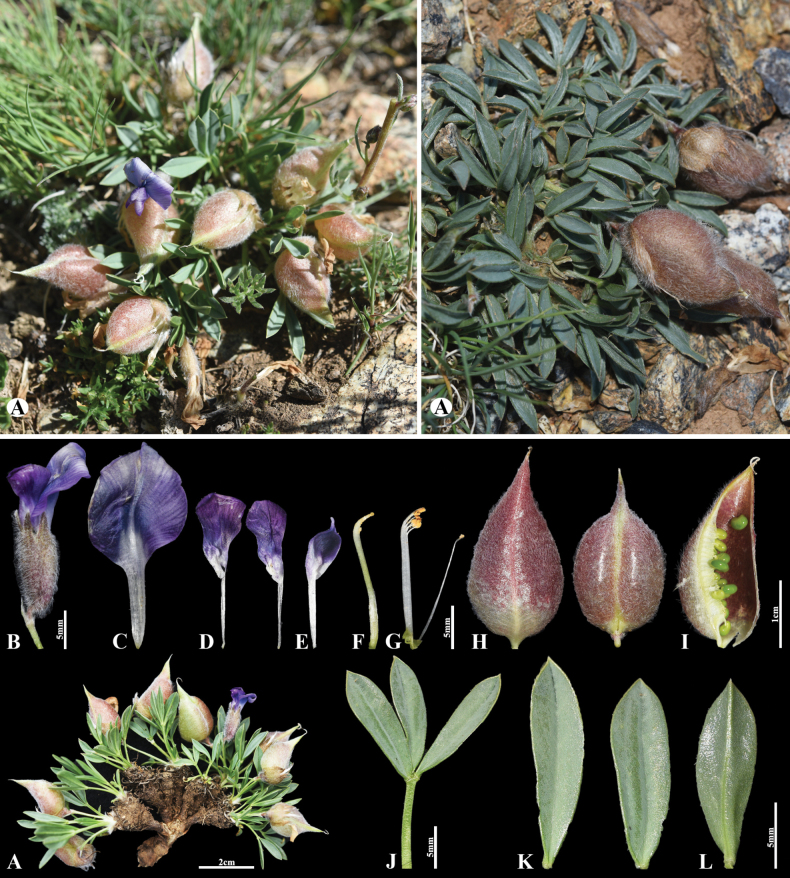 Figure 1
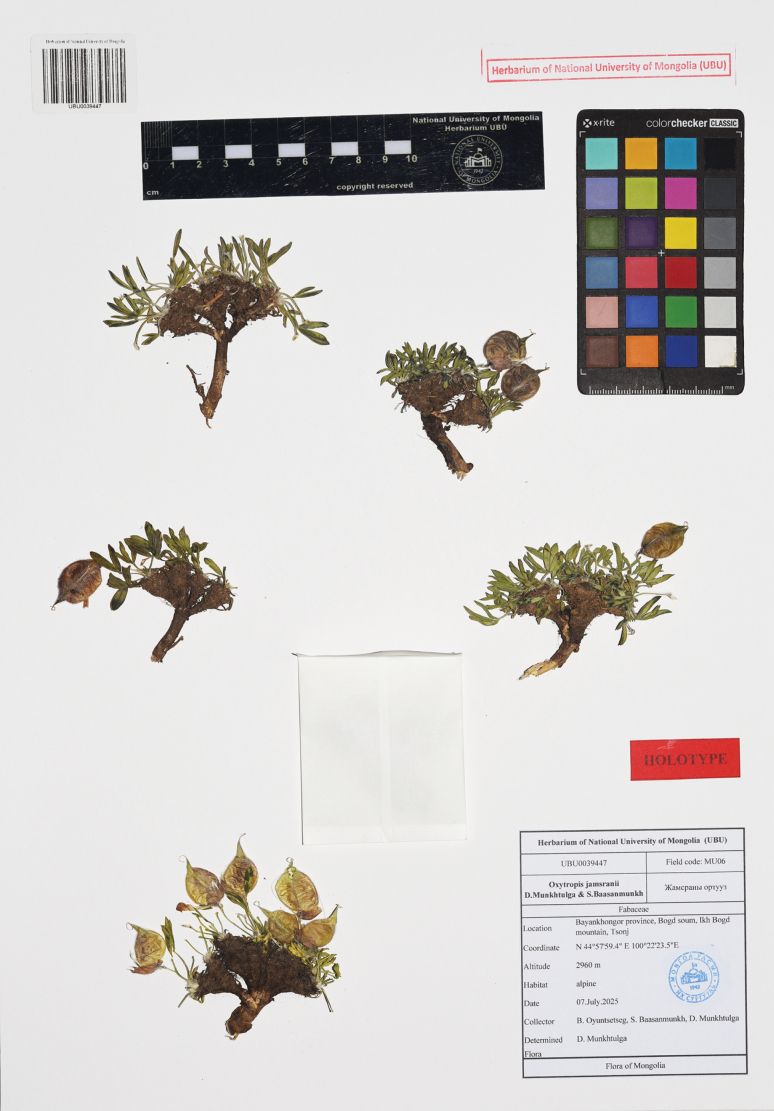 Figure 2
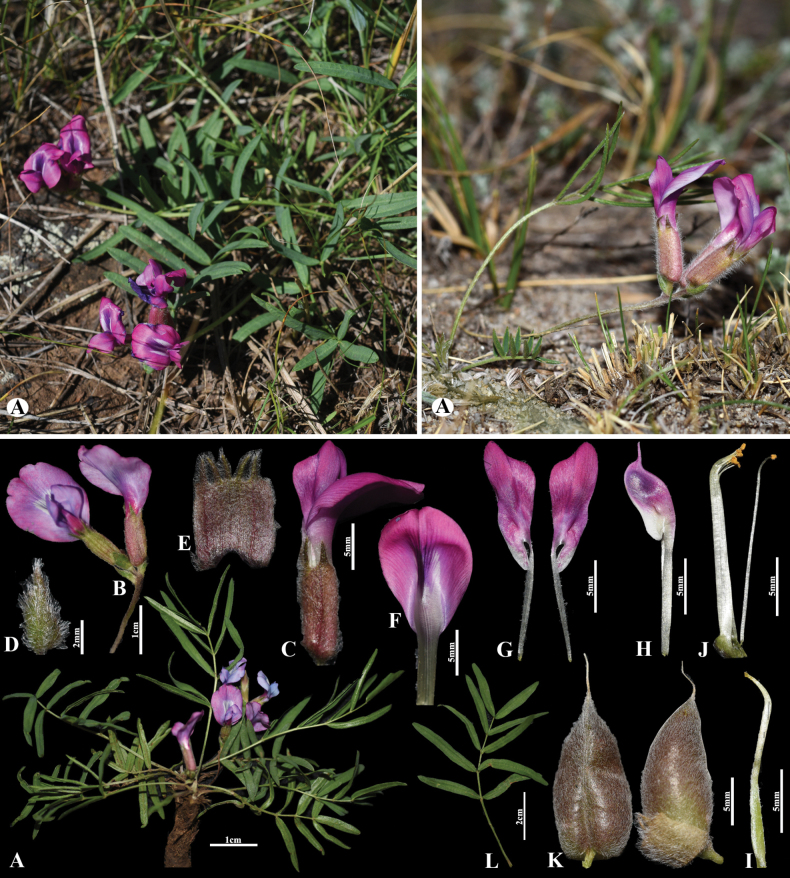 Figure 3
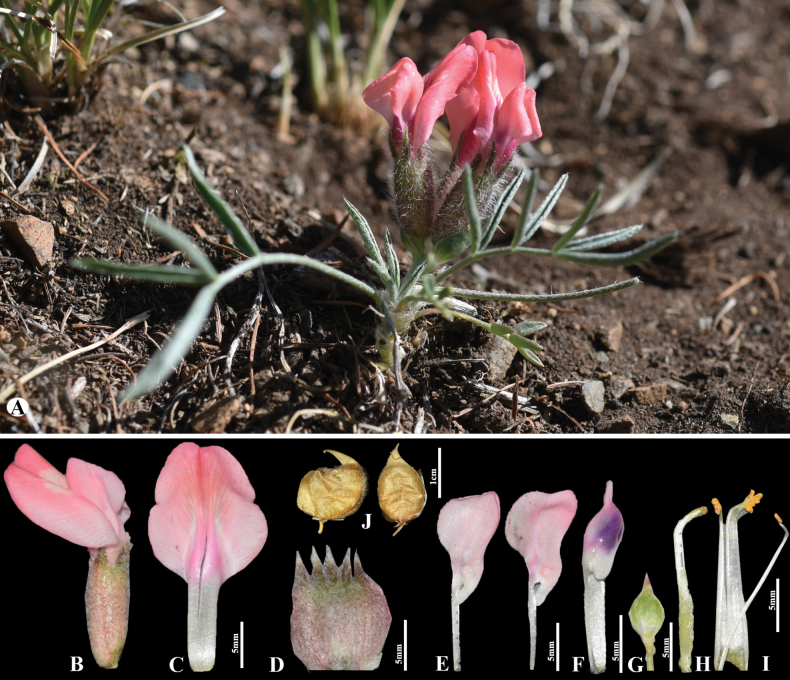 Figure 4
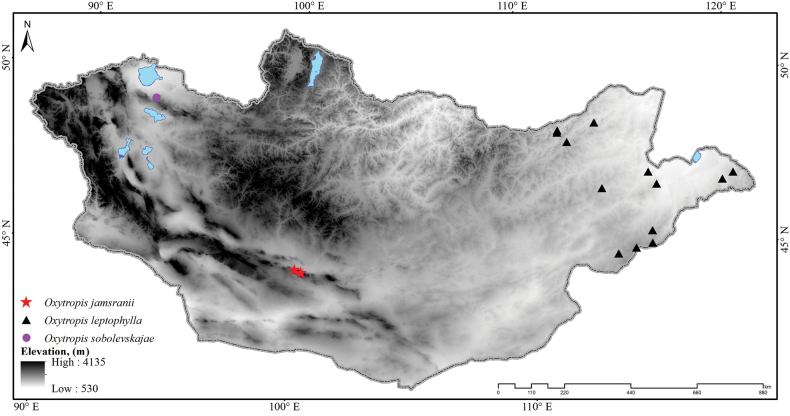 Figure 5
| Characteristics |
|
|
|
|---|---|---|---|
| Plants | subglabrous | almost glabrous | white pubescence |
| Raceme | 1–2-flowered | 2–5-flowered | 1–2-flowered |
| Leaves | 2–3 cm long, glabrous or diffuse sparsely-haired; leaflets 3 | 1–2 cm or 7–10 cm long, glabrous; leaflets 4–6 pairs | 1.5–6.5 cm long, densely covered with appressed, slightly squarrose hairs; leaflets 2–3-paired |
| Corolla | purple-bluish-purple | raspberry-red pink | whitish-pink or light crimson |
| Pods | broad-ovate, 20–30 mm long | broad-ovate, 15–25 mm long | globose-ovate, 17–25 mm long |
Peer Reviews
No public reviews on file for this paper yet. If you reviewed it on a platform where reviews are public (OpenReview, ICLR, NeurIPS, ICML), you can paste yours below so the community can read it here.
Videos
No videos yet. Explain this paper in a talk, walkthrough, or lecture? Add one.
Taxonomy
TopicsPlant Ecology and Taxonomy Studies · Plant Taxonomy and Phylogenetics · Soil and Environmental Studies
Introduction
The genus Oxytropis L. (locoweed), comprising more than 600 accepted species (Malyshev 2008; POWO 2025), is one of the largest and most diverse genera in Fabaceae (Malyshev 2008). Its native range spans the subarctic and temperate regions of the Northern Hemisphere (POWO 2025). In Mongolia, nearly 100 Oxytropis taxa have been reported, representing five subgenera and 20 sections (Ulziykhutag 2003; Malyshev 2008; Baasanmunkh et al. 2022). Recently, a new species O. oyunmaae Munkht. & Baasanm., was described from the Khusvgul Region of Mongolia (Baasanmunkh et al. 2025a).
The section Xerobia Bunge, comprising montane xerophytes, includes 27 species distributed across Central Asia and Asian Russia (Malyshev 2008). Amongst these, 15 species have been reported from Mongolia, including four endemics and eight subendemics (Baasanmunkh et al. 2021, 2022). This section is characterised by imparipinnate leaves with 2–8 pairs of leaflets and racemes bearing 1–8 flowers. The flowers are large (20–30 mm long), with sessile or stipitate (stipe to 5 mm) legumes that are ovoid or cylindrical, 5–27 mm and membranous to thickly leathery (Polozhii 1994; Malyshev 2008; Zhu et al. 2010). Recent studies have examined genetic diversity and phylogenetic relationships (Kholina et al. 2021) as well as natural selection on leaf shape (Wang et al. 2021) in several species of section Xerobia from China, Siberia and Mongolia. Within the section, only one species, Oxytropis sobolevskajae Pjak, has been described from the Republic of Tuva, Russia (Pyak 2014).
In the present study, a new species, O. jamsranii, from section Xerobia in Mongolia, is described, based on extensive morphological evidence. Additionally, O. sobolevskajae is newly recorded for the Mongolian flora.
Materials and methods
Field surveys for collecting Oxytropis specimens and detailed field photographs have been conducted across Mongolia since 2020, yielding over 200 herbarium specimens deposited in the UBU (Herbarium of the National University of Mongolia). A targeted expedition was undertaken in the Ikh Bogd Mountains, Bayankhongor Province, from 2–14 July 2025; this southern Mongolian range reaches a maximum elevation of 3,600 m. Additional herbarium specimens were examined from the Herbaria ALTB, LE, MW, NS, GFW, UBA and UBU (Thiers 2023) and FloraGREIF (https://floragreif.uni-greifswald.de). Photo observations of selected Oxytropis species were cross-verified through the “Flora of Mongolia” project on iNaturalist platform (https://www.inaturalist.org/projects/flora-of-mongolia; Baasanmunkh et al. (2025b)). A distribution map was produced, based on these herbarium specimen records using ArcGIS (Esri 2012).
Results and discussion
In this study, a new species, Oxytropis jamsranii Munkht. & Baasanm., is described from the Ikh Bogd Mountains, Jinst Soum, Bayankhongor Province, Mongolia. In addition, O. sobolevskajae is reported for the first time from the Mongolian flora. Taxonomic notes for three species in section Xerobia including O. jamsranii, O. leptophylla (Pall.) DC. and O. sobolevskajae are given.
Taxonomic treatment
Oxytopis subgenus Oxytropis , section Xerobia Bunge, subsection Ampulla
Oxytropis
jamsranii
Taxon classificationPlantaeFabalesFabaceae
Munkht. & Baasanm. sp. nov.
702F7ED0-2AFA-5B08-B3A0-23DAF77E4922
urn:lsid:ipni.org:names:77371484-1
Diagnosis.
Oxytropis jamsranii is morphologically most similar to O. leptophylla and O. sobolevskajae within section Xerobia, but differs in having 3-foliolate leaves with lanceolate, short-cuspidate leaflets 10–15 mm long [vs. O. leptophylla, 4–6 pairs, linear, obtuse or acute, 5–10 (20) mm; vs. O. sobolevskajae, 2–3 pairs, linear or linear-oblong, slightly acute, 10–35 mm long]; calyx 12–14 mm long, with dense, long white trichomes (vs. O. leptophylla, 8–11 mm long, with soft distant white, with some black hairs; vs. O. sobolevskajae, 11–13 mm long, with black, appressed, sinuous hairs and more sparse, long, white, squarrose, slightly curved hairs) (Table 1).
Oxytropis jamsranii Munkht. & Baasanm., sp. nov. A. General habits; B. Flower; C. Standard; D. Wings; E. Keel; F. Pistil; G. Stamens; H. Pods; I. Pod valve; J. Leaves; K. Leaf, adaxial view; L. Leaf, abaxial view (photo credits: D. Munkhtulga).
Type.
Mongolia • Bayankhongor Province, Bogd Soum, 44°57'59.4"N, 100°22'23.5"E, 2,960 m a.s.l., 07 July 2025, B. Oyuntsetseg, S. Baasanmunkh & D. Munkhtulga MU06 [Holotype UBU0039447! (Fig. 2)].
Holotype of Oxytropis jamsranii Munkht. & Baasanm (UBU0039447).
Description.
Acaulous perennial herb, ca. 5 cm tall, forming small mats; with very short caudex branches; herbage grey-green, subglabrous. Stipules scarious, appressed-pilose, ciliate along margins. Leaves 2–3 cm long, slightly shorter than or equalling peduncles, petiole and rachis glabrous or sparsely appressed white long trichomes. Leaflets 3, lanceolate, short-cuspidate, 10–15 × 3–4 mm, glabrous, rarely appressed white-pilose on both surfaces. Racemes 1- or 2-flowered; peduncles appressed sparsely white-haired. Bracts linear, 2–3 × ca. 1.5 mm, greenish, leaf-like, densely sericeous-pubescent. Calyx membranous, grey-green to dark purple, tubular, 12–14 mm long, densely covered with long white trichomes; lobes acuminate, 2.5–3 mm. Corolla purple to bluish-purple; standard 20–22 mm long with broad-oval, undivided lamina; wings 16–18 mm long, shorter than standard, apex obliquely emarginated; keel 13–15 mm, with a beak ca. 2 mm at apex. Legume membranous, broadly ovate, inflated and cyst-like, 1-locular, 20–30 (including a 3–5 mm long beak) × 12–15 mm, with a ventral septum up to 2.5 mm broad, covered with white, squarrose, soft hairs.
Distribution.
Endemic to Mongolia (Fig. 5).
Habitat.
This species occurs in gravelly alpine areas and montane grasslands.
Etymology.
The species is named in honour of Prof. Tseden Jamsran (Цэдэн Жамсран, born in 1935), a distinguished Mongolian botanist who made significant contributions to the study and documenation of the flora of Mongolia (such as Flora of the Gurvan Saikhan Mountains).
Oxytropis
leptophylla
Taxon classificationPlantaeFabalesFabaceae
(Pall.) DC., Astragalogia 77 (ed. quarto), no. 12 (1802)
3F61B928-3424-5FC8-B5B4-B61DC8B79FB1
Diagnosis.
Morphologically, O. leptophylla is most similar to O. diversifolia E.Peter. but differs in having leaves 2–10 cm long, 9–13-foliolate (vs. leaves 3–5 cm long, 3-foliolate), racemes compact to rather lax, 2–5-flowered (vs. racemes 1–2-flowered).
Oxytropis leptophylla in Mongolia. A. General habits; B. Raceme; C. Flower; D. Bract; E. Calyx; F. Standard; G. Wings; H. Keel; I. Pistil; J. Stamens; K. Pods; L. Leaves (photo credits: D. Munkhtulga).
Type.
Russia • Eastern Siberia, Buryatia: “≡ Astragalus leptophyllus Pall. Itin. III. s. l., s.d. fl., fr., Herb. Pallas” [Lectotype BM000958890, designated by Byalt and Sytin (2022); Syntype M0185403].
Distribution.
China (north-central), Mongolia (east) and Russia (Krasnoyarsk, Chita, Tuva) (POWO 2025).
Habitat.
This species occurs in sandy steppes and rocky steppe slopes.
Additional specimens examined.
Mongolia • East Mongolia Region: Sukhbaatar Province, Erdenetsagaan Soum, Zotol-Khan Mountain, 14 June 1980, I. A. Gubanov 5669 (MW0183848, MW0183848); • Khentii Province, Bayankhutag Soum, Zaan-Shiree Mountain, 47°14'43.9"N, 111°33'59.0"E, 1,200 m a.s.l., 19 June 1987 V. I. Grubov, E. Ganbold, A. L. Budantsev, R. V. Kamelin & Sh. Dariimaa 17 (MW0183847); • Dornod Province, Khalkhgol Soum, Numrug River, 47°05'00.0"N, 119°30'00.0"E, 800 m a.s.l., 29 June 1987, V. I. Grubov, E. Ganbold, A. L. Budantsev, R. V. Kamelin & Sh. Dariimaa 746 (MW0183845); • Dornod Province, Khalkhgol Soum, Numrug River, 46°59'18.0"N, 119°23'34.2"E, 877 m a.s.l., 17 July 2017, B. Oyuntsetseg & S. Baasanmunkh s.n. (UBU0011943); • Sukhbaatar Province, Erdenetsagaan Soum, Bichigt Boomt, 45°43'01.9"N, 116°11'15.5"E, 912 m a.s.l., 08 August 2023, B. Oyuntsetseg, D. Munkhtulga & A. Undruul EP13 (UBU0035024); • Dornod Province, Khalkhgol Soum, Sumiin Khooloi, 47°15'1852.04"N, 118°59'32.59"E, 910 m a.s.l., 20 May 2024, D. Munkhtulga s.n. (UBU0040642, UBU0041010).
Oxytropis
sobolevskajae
Taxon classificationPlantaeFabalesFabaceae
Pjak, Nordic J. Bot. 32(2): 139 (2013)
722A0F8F-AD71-5977-BBCD-707A91688408
Diagnosis.
Morphologically, O. sobolevskajae is most similar to O. leptophylla, from which it differs in several key characteristics: leaflets 3–10-paired, abaxially sparsely appressed-hairy, adaxially glabrous (vs. 2–3-paired, abaxially rather densely appressed-hairy, adaxially sparsely hairy or glabrous); and inflorescences equalling the leaves, with flowers in umbellate racemes of 2–5 (vs. clearly shorter than leaves, flowers solitary or rarely 2) (Pyak 2014). Additionally, O. sobolevskajae occurs only in western Mongolia, whereas O. leptophylla is found in central and eastern Mongolia. O. sobolevskajae is also similar to O. klementzii N.Ulziykh., but differs in its inflated, thinly membranaceous, globose-ovate pods with a long beak, covered with white, squarrose, slightly sinuous, soft hairs (vs. hard, thickly coriaceous, nutlet-shaped pods covered with pubescent tomentose).
Oxytropis sobolevskajae in Mongolia. A. General habit; B. Flower; C. Standard; D. Calyx; E. Wings; F. Keel; G. Bract; H. Pistil; I. Stamens; J. Pods (photo credits: D. Munkhtulga).
Type.
Russia • Republic of Tuva: Pii-Khem District, Seserlig River Valley, near the bridge, north-exposed steppe slopes with sparse bushes, 51°52'12"N, 94°21'16"E, 759 m a.s.l., 1 Jun 2009, A. I. Pyak s.n. (Holotype: TK, Isotypes: LE, NS).
Distribution.
According to the distribution map provided by Pyak (2014), the Tuva population of this species occurs near the border with western Mongolia. Field expeditions were conducted in western Mongolia adjacent to the Tuva border, where we newly found O. sobolevskajae in Malchin Soum, Uvs Province.
Distribution map of three Oxytropis species in Mongolia. Oxytropis jamsranii (red stars), O. leptophylla (black triangle), O. sobolevskajae (pink circle).
Habitat.
This species occurs in petrophytic meadows and rocky steppe areas.
Additional specimens examined (New record).
• Uvs Province, Malchin Soum, 49°41'17.9"N, 93°15'39.4"E, 1,622 m a.s.l., 31 May 2024, B. Oyuntsetseg, G. Bayarmaa & D. Munkhtulga West2409 (UBU0036128).
Supplementary Material
XML Treatment for Oxytropis jamsranii
XML Treatment for Oxytropis leptophylla
XML Treatment for Oxytropis sobolevskajae
The reference list from the paper itself. Each links out to its DOI / PubMed record.
- 1Baasanmunkh S Urgamal M Oyunstsetseg B Grabovkaya-Borodina A Oyundelger K Gundegmaa V Tsegmed Z Kechaykin AA Kechayink AA Pyak AI Zhao LQ Choi HJ (2021) An updated checklist of endemic vascular plants of Mongolia. Diversity 13: 619. 10.3390/d 13120619 · doi ↗
- 2Baasanmunkh S Urgamal M Oyuntsetseg B Sukhorukov AP Tsegmed Z Son DC Erst A Oyundelger K Kechaykin AA Norris J Kosachev P Ma J-S Chang KS Choi HJ (2022) Flora of Mongolia: Annotated checklist of native vascular plants.Phyto Keys 192: 63–169. 10.3897/phytokeys.192.7970235437387 PMC 8938380 · doi ↗ · pubmed ↗
- 3Baasanmunkh S Munkhtulga D Oyuntsetseg B Choi HJ (2025 a) Oxytropis oyunmaae sp. nov. (Fabaceae) from Khuvsgul province, Mongolia. Nordic Journal of Botany 10: e 04853. 10.1002/njb.04853 · doi ↗
- 4Baasanmunkh S Oyuntsetseg B Tsegmed Z Undruul A Munkhtulga D Urgamal M Nyambayar N Javzandolgor C Bayarmaa C Narangarvuu D Batbayar N Nyamsuren K Namuulin T Munkhzul O Indra G Batsugar G Tsengel E Kim YM Callaghan CT Choi HJ (2025 b) i Naturalist projects represent a valuable resource for aggregating plant observations and engaging society: A case study of the Flora of Mongolia project. Plants, People, Planet: 1–12. 10.1002/ppp 3.70054 · doi ↗
- 5Byalt VV Sytin AK (2022) Lectotypification of some names, published by PS Pallas, in Astragalus L. and Phaca L. (Fabaceae).Skvortsovia 8(2): 25. 10.51776/2309-6500_2022_8_2_25 · doi ↗
- 6Esri (2012) Advancing the power of geography. For business, government, and society. https://www.esri.com/enus/about/about‐esri/overview
- 7Kholina A Kozyrenko M Artyukova E Sandanov D Selyutina I (2021) Genetic diversity of Oxytropis section Xerobia (Fabaceae) in one of the centres of speciation.Genetica 149: 89–101. 10.1007/s 10709-021-00115-933713007 · doi ↗ · pubmed ↗
- 8Malyshev LI (2008) Phenetics of subgenera and sections in the genus Oxytropis DC. (Fabaceae) bearing on ecology and phylogeny.Contemporary Problems of Ecology 1: 400–440. 10.1134/S 1995425508040073 · doi ↗