Alfvén Waves in Partially Ionised Solar Steady-State Plasmas
Nada F. Alshehri, Istvan Ballai, Gary Verth, Viktor Fedun

TL;DR
This paper studies how Alfvén waves behave in solar plasmas with partial ionisation and steady particle flows.
Contribution
The study introduces a two-fluid model to show how steady flows modify Alfvén wave properties in partially ionised solar plasmas.
Findings
Steady flows cause Doppler shifts and propagation direction reversal in Alfvén waves.
Flow-dependent damping rates and a new mode linked to neutral flow and collisions are identified.
Conditions for flow-driven mode conversion are determined in partially ionised solar plasmas.
Abstract
Our study investigates the properties of Alfvén waves in partially ionised solar plasmas in the presence of steady, field-aligned, flows of charged and neutral particles. Our work aims to understand how such flows modify wave propagation and damping in environments where ion-neutral collisions are significant. We employ a two-fluid model that treats ions and neutrals as separate colliding fluids and incorporates background steady flows for both species. Using a combination of analytical dispersion analysis and numerical solutions, we examine the impact of these flows on the behaviour of Alfvén waves. Our results show that steady flows lead to substantial modifications of wave properties, including Doppler shifts, propagation direction reversal, flow-dependent changes in damping rates, and the appearance of a new mode associated with neutral flow and collisional coupling. We also…
Genes, proteins, chemicals, diseases, species, mutations and cell lines named across the full text — each resolved to its canonical identifier and authoritative record.
Click any figure to enlarge with its caption.
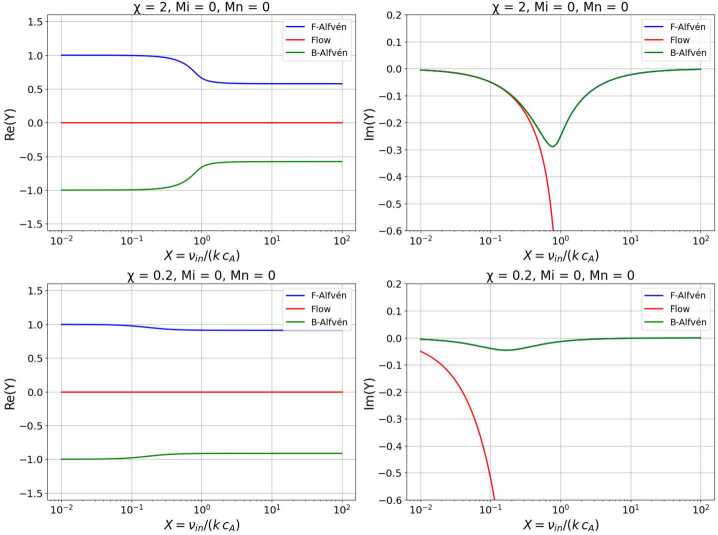 Figure 1
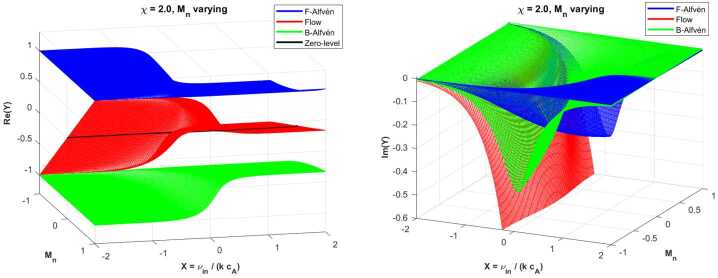 Figure 2
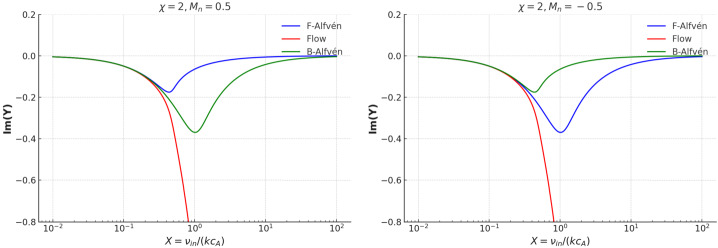 Figure 3
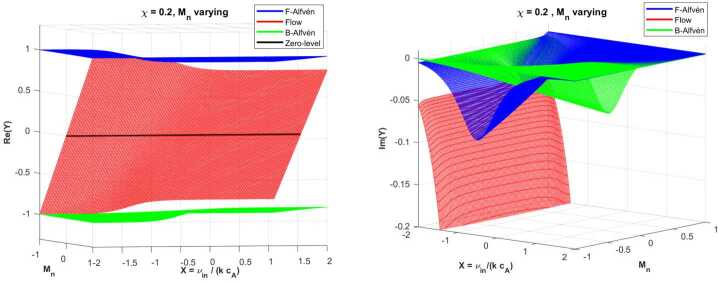 Figure 4
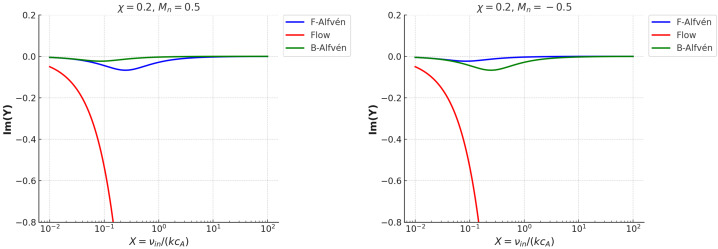 Figure 5
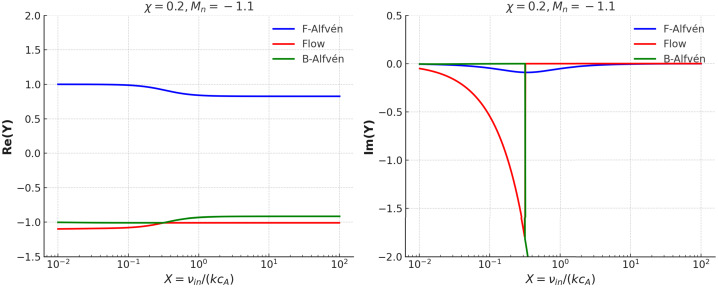 Figure 6
- —King Khalid University and the Ministry of Education in the Kingdom of Saudi Arabi
- —https://doi.org/10.13039/501100000288Royal Society
- —Science and Technology Facilities Council (STFC)
- —https://doi.org/10.13039/501100000271Science and Technology Facilities Council
Peer Reviews
No public reviews on file for this paper yet. If you reviewed it on a platform where reviews are public (OpenReview, ICLR, NeurIPS, ICML), you can paste yours below so the community can read it here.
Videos
No videos yet. Explain this paper in a talk, walkthrough, or lecture? Add one.
Taxonomy
TopicsSolar and Space Plasma Dynamics · Ionosphere and magnetosphere dynamics · Dust and Plasma Wave Phenomena
Introduction
The importance of magnetohydrodynamic (MHD) waves in partially ionised plasmas for energy dissipation and plasma dynamics has led to an increased interest in the properties of these waves over recent years. In contrast to fully ionised plasmas (e.g. the solar corona), partially ionised plasmas display a string of distinct physical effects like ion-neutral frictional heating, collisional heat transfer, charge exchange, peculiar transport mechanisms such as Cowling’s resistivity, and isotropic thermal conduction by neutrals. These effects are all crucial for a thorough understanding of astrophysical plasmas in a variety of environments (Ballester et al. 2018). Recent research revealed that in the low solar atmosphere (photosphere and chromosphere), ion-neutral collisions represent a very effective energy dissipation mechanism that can lead to plasma heating (e.g. Khomenko and Collados 2012; Martínez-Sykora, De Pontieu, and Hansteen 2012; Russell and Fletcher 2013; Leake et al. 2014; McMurdo et al. 2023). The framework that can cast the effects due to collisions between particles requires a multi-fluid approach, where each of the constituent fluid is treated separately, and the governing equations of each fluid are coupled to each other through terms that describe the collisional transfer of energy and momentum between particles (Khomenko et al. 2014; Hunana et al. 2022). In practice, in the solar chromosphere, charged particles (electrons and protons in the case of a pure hydrogen plasma) are strongly coupled via long-range electrostatic collisions, and, therefore, it is customary to treat the plasma as a mixture of charged particles and neutrals. In this case, the temporal scales of dynamical processes (waves, in our case) of interest are of the order of the collisional frequency of particles. Although in principle, all charged particles can collide with neutrals, the collisions between electrons and neutrals are usually neglected, as the great mass difference between them leads to an insignificant transfer of energy or momentum. The theory behind waves in a two-fluid plasma is well established (see, e.g., Zaqarashvili, Khodachenko, and Rucker 2011; Soler et al. 2013; Soler, Carbonell, and Ballester 2013; Alharbi et al. 2022; Kumar et al. 2024).
The behaviour of Alfvén waves in partially ionised plasmas is significantly more complex than that of their counterparts in fully ionized plasmas, where Alfvén waves can be described by the set of ideal MHD equations, and the magnetic field is frozen into the fluid. In contrast, dynamics in partially ionised plasmas require dissipative equations arising from collisional interaction between species. In partially ionised plasmas, Alfvén waves undergo natural damping, making them an ideal candidate to explain plasma heating (Soler et al. 2016, 2017; Kuźma et al. 2020; Melis, Soler, and Terradas 2023; McMurdo et al. 2023; Kumar et al. 2024). Waves are important not only to explain plasma heating but also to serve as tools for diagnosing the magnetic field or the ionisation state of the plasma. In this respect, torsional Alfvén waves observed in solar prominence fibrils (Kohutova, Verwichte, and Froment 2020) were used in the study by Ballai (2020) to determine the ionisation degree of the plasma. The effect of background flows on the stability of various configurations in partially ionised plasmas has been investigated by several authors (Soler et al. 2012; Ballai, Oliver, and Alexandrou 2015; Martínez-Gómez, Soler, and Terradas 2015; Melis and Soler 2025)
Our study examines the properties of Alfvén waves propagating in a partially ionised plasma in the presence of a differentiated field-aligned steady-state flow for the two species of particles. Our analysis builds on the earlier research by Soler et al. (2013) that investigated the propagation of Alfvén waves in a partly ionised two-fluid plasma for a static equilibrium. In a partially ionised plasma, when particles are not strongly coupled to each other, different species may flow at different speeds. In the solar photosphere, the plasma is very weakly ionised, and the dynamics is often driven by convection. At the same time, the photosphere is permeated by a weak magnetic field, forming the photospheric carpet. Given its very low ionisation degree, the photospheric plasma is moved by pressure forces, and the motion of neutrals drags the small amount of charged particles with them. As charges are still coupled to the magnetic field, this results in a drift of the neutral and charged species, resulting in different speeds at which they move. In the higher region of the partially ionised solar atmosphere, the collisions are not so frequent, and it is natural to consider that the motion of low-density neutral species is different from the motion of charged particles that keep gyrating around the background magnetic field; therefore, it is again natural to imagine that the two species possess different speeds. Interestingly, several studies have evidenced clear differences in the Doppler velocity of ions and neutrals (Khomenko, Collados, and Díaz 2016; Anan, Ichimoto, and Hillier 2017; Stellmacher and Wiehr 2017; Zapiór, Heinzel, and Khomenko 2022; González Manrique et al. 2024; Hillier 2024).
Our article is structured as follows. In Section 2 we introduce the mathematical background and derive the dispersion relation of Alfvén waves propagating in a partially ionised plasma in the presence of an equilibrium flow of particles. Section 3 focuses on the numerical solutions of the dispersion relation and discusses the modifications in the damping rate of waves due to the presence of plasma flows for different ionisation degrees. Finally, in Section 4 we present our conclusions, summarising our main findings and their implications for Alfvén wave propagation in partially ionised plasmas.
Mathematical Background and the Dispersion Relation of Alfvén Waves
In a partially ionised solar plasma, we consider a frequency regime that is of the order of the collisional frequency between particles; therefore, we consider the dynamics within the framework of a two-fluid description where the charged particles (electrons and positive ions) are strongly coupled and they form a single charged fluid. Neutral atoms interact with charged particles through closed-range collisions, which is an effective mechanism for energy and momentum transfer between species. In our analysis, we are going to denote the charged and neutral species by indices i and n, respectively. The infinitely extended system is permeated by a homogeneous unidirectional magnetic field in the positive \documentclass[12pt]{minimal} \usepackage{amsmath} \usepackage{wasysym} \usepackage{amsfonts} \usepackage{amssymb} \usepackage{amsbsy} \usepackage{mathrsfs} \usepackage{upgreek} \setlength{\oddsidemargin}{-69pt} \begin{document}z\end{document} direction ( \documentclass[12pt]{minimal} \usepackage{amsmath} \usepackage{wasysym} \usepackage{amsfonts} \usepackage{amssymb} \usepackage{amsbsy} \usepackage{mathrsfs} \usepackage{upgreek} \setlength{\oddsidemargin}{-69pt} \begin{document}{\mathbf{B}}{0}=B{0}{\mathbf{\hat{z}}})\end{document} , and waves are described within Cartesian geometry.
We assume that the charged and neutral species have a steady and constant flow along the magnetic field, and these are denoted by \documentclass[12pt]{minimal} \usepackage{amsmath} \usepackage{wasysym} \usepackage{amsfonts} \usepackage{amssymb} \usepackage{amsbsy} \usepackage{mathrsfs} \usepackage{upgreek} \setlength{\oddsidemargin}{-69pt} \begin{document}v_{0i}\end{document} and \documentclass[12pt]{minimal} \usepackage{amsmath} \usepackage{wasysym} \usepackage{amsfonts} \usepackage{amssymb} \usepackage{amsbsy} \usepackage{mathrsfs} \usepackage{upgreek} \setlength{\oddsidemargin}{-69pt} \begin{document}v_{0n}\end{document} , respectively. Since we will concentrate on Alfvén waves only, we will consider a pressure-less plasma in which the Alfvén waves are polarised in the \documentclass[12pt]{minimal} \usepackage{amsmath} \usepackage{wasysym} \usepackage{amsfonts} \usepackage{amssymb} \usepackage{amsbsy} \usepackage{mathrsfs} \usepackage{upgreek} \setlength{\oddsidemargin}{-69pt} \begin{document}y\end{document} direction and propagate along the background magnetic field. With these considerations, the linearised two-fluid MHD equations, therefore, are given by
\documentclass[12pt]{minimal} \usepackage{amsmath} \usepackage{wasysym} \usepackage{amsfonts} \usepackage{amssymb} \usepackage{amsbsy} \usepackage{mathrsfs} \usepackage{upgreek} \setlength{\oddsidemargin}{-69pt} \begin{document}$$ \rho _{0i}\left ( \frac{\partial }{\partial t}+{\mathbf{v}}_{0i}\cdot \nabla \right ) \textbf{v}_{i}=\frac{1}{\mu }(\nabla \times \textbf{b}) \times \mathbf{B}-\rho _{0i} \nu _{in} (\textbf{v}_{i}-\textbf{v}_{n}), $$\end{document} \documentclass[12pt]{minimal} \usepackage{amsmath} \usepackage{wasysym} \usepackage{amsfonts} \usepackage{amssymb} \usepackage{amsbsy} \usepackage{mathrsfs} \usepackage{upgreek} \setlength{\oddsidemargin}{-69pt} \begin{document}$$ \rho _{0n}\left (\frac{\partial}{\partial t}+{\mathbf{v}}_{0n}\cdot \nabla \right ) \textbf{v}_{n}=-\rho _{0i} \nu _{in}(\textbf{v}_{n}- \textbf{v}_{i}), $$\end{document} \documentclass[12pt]{minimal} \usepackage{amsmath} \usepackage{wasysym} \usepackage{amsfonts} \usepackage{amssymb} \usepackage{amsbsy} \usepackage{mathrsfs} \usepackage{upgreek} \setlength{\oddsidemargin}{-69pt} \begin{document}$$ \frac{\partial \textbf{b}}{\partial t}=\nabla \times (\textbf{v}_{i} \times \mathbf{B})+\nabla \times (\textbf{v}_{0i}\times \mathbf{b}). $$\end{document}In the above equations \documentclass[12pt]{minimal} \usepackage{amsmath} \usepackage{wasysym} \usepackage{amsfonts} \usepackage{amssymb} \usepackage{amsbsy} \usepackage{mathrsfs} \usepackage{upgreek} \setlength{\oddsidemargin}{-69pt} \begin{document}{\mathbf{v}}{i}\end{document} and \documentclass[12pt]{minimal} \usepackage{amsmath} \usepackage{wasysym} \usepackage{amsfonts} \usepackage{amssymb} \usepackage{amsbsy} \usepackage{mathrsfs} \usepackage{upgreek} \setlength{\oddsidemargin}{-69pt} \begin{document}{\mathbf{v}}{n}\end{document} are the ion and neutral velocity perturbations, \documentclass[12pt]{minimal} \usepackage{amsmath} \usepackage{wasysym} \usepackage{amsfonts} \usepackage{amssymb} \usepackage{amsbsy} \usepackage{mathrsfs} \usepackage{upgreek} \setlength{\oddsidemargin}{-69pt} \begin{document}{\mathbf{B}}\end{document} and \documentclass[12pt]{minimal} \usepackage{amsmath} \usepackage{wasysym} \usepackage{amsfonts} \usepackage{amssymb} \usepackage{amsbsy} \usepackage{mathrsfs} \usepackage{upgreek} \setlength{\oddsidemargin}{-69pt} \begin{document}{\mathbf{b}}\end{document} are the equilibrium and perturbed magnetic fields, \documentclass[12pt]{minimal} \usepackage{amsmath} \usepackage{wasysym} \usepackage{amsfonts} \usepackage{amssymb} \usepackage{amsbsy} \usepackage{mathrsfs} \usepackage{upgreek} \setlength{\oddsidemargin}{-69pt} \begin{document}\rho _{0i}\end{document} and \documentclass[12pt]{minimal} \usepackage{amsmath} \usepackage{wasysym} \usepackage{amsfonts} \usepackage{amssymb} \usepackage{amsbsy} \usepackage{mathrsfs} \usepackage{upgreek} \setlength{\oddsidemargin}{-69pt} \begin{document}\rho _{0n}\end{document} are the equilibrium ion and neutral mass densities, \documentclass[12pt]{minimal} \usepackage{amsmath} \usepackage{wasysym} \usepackage{amsfonts} \usepackage{amssymb} \usepackage{amsbsy} \usepackage{mathrsfs} \usepackage{upgreek} \setlength{\oddsidemargin}{-69pt} \begin{document}\mu \end{document} is the magnetic permeability of free space, while \documentclass[12pt]{minimal} \usepackage{amsmath} \usepackage{wasysym} \usepackage{amsfonts} \usepackage{amssymb} \usepackage{amsbsy} \usepackage{mathrsfs} \usepackage{upgreek} \setlength{\oddsidemargin}{-69pt} \begin{document}\nu _{in}\end{document} and \documentclass[12pt]{minimal} \usepackage{amsmath} \usepackage{wasysym} \usepackage{amsfonts} \usepackage{amssymb} \usepackage{amsbsy} \usepackage{mathrsfs} \usepackage{upgreek} \setlength{\oddsidemargin}{-69pt} \begin{document}\nu _{ni}\end{document} are the ion-neutral and neutral-ion collisional frequencies. Since we consider elastic collisions between particles, we can write \documentclass[12pt]{minimal} \usepackage{amsmath} \usepackage{wasysym} \usepackage{amsfonts} \usepackage{amssymb} \usepackage{amsbsy} \usepackage{mathrsfs} \usepackage{upgreek} \setlength{\oddsidemargin}{-69pt} \begin{document}\rho _{i} \nu _{in} = \rho _{n} \nu _{ni}\end{document} . For the Alfvén waves studied here, the pressure gradients do not contribute in the leading order. For the sake of completeness, we provide quantitative estimates of these neglected terms in the Appendix that show that ion and neutral pressure forces are negligible compared with collisional drag across the regimes explored.
Moreover, the induction Equation 3 should, strictly speaking, include a resistive term arising from electron collisions with both ions and neutrals. However, for the sake of analytical clarity, we have chosen to neglect this term. We emphasise that Cowling diffusion, while known to be significant in the upper chromosphere (Khodachenko et al. 2004), is deliberately omitted from the present analysis to isolate the effects of ion-neutral collisional friction. Accordingly, our results are most applicable to chromospheric regions where collisional drag is the dominant dissipative process, such as the lower-to-middle chromosphere, where the collisional coupling between particles remains dominant.
Perturbations are Fourier-analysed and they are written proportional to the exponential factor \documentclass[12pt]{minimal} \usepackage{amsmath} \usepackage{wasysym} \usepackage{amsfonts} \usepackage{amssymb} \usepackage{amsbsy} \usepackage{mathrsfs} \usepackage{upgreek} \setlength{\oddsidemargin}{-69pt} \begin{document}e^{i(kz-\omega t)}\end{document} , where \documentclass[12pt]{minimal} \usepackage{amsmath} \usepackage{wasysym} \usepackage{amsfonts} \usepackage{amssymb} \usepackage{amsbsy} \usepackage{mathrsfs} \usepackage{upgreek} \setlength{\oddsidemargin}{-69pt} \begin{document}k\end{document} is the real wavenumber and \documentclass[12pt]{minimal} \usepackage{amsmath} \usepackage{wasysym} \usepackage{amsfonts} \usepackage{amssymb} \usepackage{amsbsy} \usepackage{mathrsfs} \usepackage{upgreek} \setlength{\oddsidemargin}{-69pt} \begin{document}\omega = \omega {r}+i\omega {i}\end{document} is the complex frequency of waves, where the real part describes the propagation of waves and the imaginary part their damping rate. Since we are dealing with Alfvén waves polarised in the \documentclass[12pt]{minimal} \usepackage{amsmath} \usepackage{wasysym} \usepackage{amsfonts} \usepackage{amssymb} \usepackage{amsbsy} \usepackage{mathrsfs} \usepackage{upgreek} \setlength{\oddsidemargin}{-69pt} \begin{document}y\end{document} -direction, we write \documentclass[12pt]{minimal} \usepackage{amsmath} \usepackage{wasysym} \usepackage{amsfonts} \usepackage{amssymb} \usepackage{amsbsy} \usepackage{mathrsfs} \usepackage{upgreek} \setlength{\oddsidemargin}{-69pt} \begin{document}{\mathbf{v}}{\alpha}=(0,v{\alpha},0)\end{document} , where the index \documentclass[12pt]{minimal} \usepackage{amsmath} \usepackage{wasysym} \usepackage{amsfonts} \usepackage{amssymb} \usepackage{amsbsy} \usepackage{mathrsfs} \usepackage{upgreek} \setlength{\oddsidemargin}{-69pt} \begin{document}\alpha =i,n\end{document} denotes the two species of the problem and \documentclass[12pt]{minimal} \usepackage{amsmath} \usepackage{wasysym} \usepackage{amsfonts} \usepackage{amssymb} \usepackage{amsbsy} \usepackage{mathrsfs} \usepackage{upgreek} \setlength{\oddsidemargin}{-69pt} \begin{document}{\mathbf{b}}=(0,b,0)\end{document} .
Employing an extended, yet straightforward computation, the dispersion relation of waves travelling through partially ionised plasmas in the presence of steady plasma flows can be written as
\documentclass[12pt]{minimal} \usepackage{amsmath} \usepackage{wasysym} \usepackage{amsfonts} \usepackage{amssymb} \usepackage{amsbsy} \usepackage{mathrsfs} \usepackage{upgreek} \setlength{\oddsidemargin}{-69pt} \begin{document}$$ \omega ^{3}+ \left [i\nu _{in} (1+\frac{1}{\chi}) - k( 2 v_{0i} + v_{0n}) \right ] \omega ^{2} $$\end{document} \documentclass[12pt]{minimal} \usepackage{amsmath} \usepackage{wasysym} \usepackage{amsfonts} \usepackage{amssymb} \usepackage{amsbsy} \usepackage{mathrsfs} \usepackage{upgreek} \setlength{\oddsidemargin}{-69pt} \begin{document}$$ + \left \{k^{2} (v_{0i}^{2}+2v_{0i}v_{0n} -c_{A}^{2})-ik \nu _{in} \left [v_{0i}\left (\frac{2}{\chi}+1\right )+v_{0n}\right ]\right \} \omega $$\end{document} \documentclass[12pt]{minimal} \usepackage{amsmath} \usepackage{wasysym} \usepackage{amsfonts} \usepackage{amssymb} \usepackage{amsbsy} \usepackage{mathrsfs} \usepackage{upgreek} \setlength{\oddsidemargin}{-69pt} \begin{document}$$ +i k^{2} \nu _{in} \left [v_{0i} v_{0n} +\frac{1}{\chi} (v_{0i}^{2}- c_{A}^{2}) \right ] + k^{3} v_{0n} (c_{A}^{2} - v_{0i}^{2}) = 0, $$\end{document}where \documentclass[12pt]{minimal} \usepackage{amsmath} \usepackage{wasysym} \usepackage{amsfonts} \usepackage{amssymb} \usepackage{amsbsy} \usepackage{mathrsfs} \usepackage{upgreek} \setlength{\oddsidemargin}{-69pt} \begin{document}\chi =\rho {0n}/\rho {0i}\end{document} is the ionisation fraction of the plasma and \documentclass[12pt]{minimal} \usepackage{amsmath} \usepackage{wasysym} \usepackage{amsfonts} \usepackage{amssymb} \usepackage{amsbsy} \usepackage{mathrsfs} \usepackage{upgreek} \setlength{\oddsidemargin}{-69pt} \begin{document}c{A}^{2}=B{0}^{2}/\mu \rho _{0i}\end{document} is the square of the Alfvén speed.
To simplify our task, we write the above dispersion relation in dimensionless form and introduce the dimensionless parameters \documentclass[12pt]{minimal} \usepackage{amsmath} \usepackage{wasysym} \usepackage{amsfonts} \usepackage{amssymb} \usepackage{amsbsy} \usepackage{mathrsfs} \usepackage{upgreek} \setlength{\oddsidemargin}{-69pt} \begin{document}X=\nu {in}/k c{A}\end{document} denoting the strength of collisions, \documentclass[12pt]{minimal} \usepackage{amsmath} \usepackage{wasysym} \usepackage{amsfonts} \usepackage{amssymb} \usepackage{amsbsy} \usepackage{mathrsfs} \usepackage{upgreek} \setlength{\oddsidemargin}{-69pt} \begin{document}Y=\omega /k c_{A}\end{document} the dimensionless frequency of waves, \documentclass[12pt]{minimal} \usepackage{amsmath} \usepackage{wasysym} \usepackage{amsfonts} \usepackage{amssymb} \usepackage{amsbsy} \usepackage{mathrsfs} \usepackage{upgreek} \setlength{\oddsidemargin}{-69pt} \begin{document}M_{i}=v_{0i}/c_{A}\end{document} and \documentclass[12pt]{minimal} \usepackage{amsmath} \usepackage{wasysym} \usepackage{amsfonts} \usepackage{amssymb} \usepackage{amsbsy} \usepackage{mathrsfs} \usepackage{upgreek} \setlength{\oddsidemargin}{-69pt} \begin{document}M_{n}=v_{0n}/c_{A}\end{document} as the ion and neutral Mach numbers. In this form, the damping rate of waves is associated with the imaginary component of \documentclass[12pt]{minimal} \usepackage{amsmath} \usepackage{wasysym} \usepackage{amsfonts} \usepackage{amssymb} \usepackage{amsbsy} \usepackage{mathrsfs} \usepackage{upgreek} \setlength{\oddsidemargin}{-69pt} \begin{document}Y\end{document} , whereas the real part of \documentclass[12pt]{minimal} \usepackage{amsmath} \usepackage{wasysym} \usepackage{amsfonts} \usepackage{amssymb} \usepackage{amsbsy} \usepackage{mathrsfs} \usepackage{upgreek} \setlength{\oddsidemargin}{-69pt} \begin{document}Y\end{document} is associated with the wave frequency. At the same time, the real and imaginary parts of \documentclass[12pt]{minimal} \usepackage{amsmath} \usepackage{wasysym} \usepackage{amsfonts} \usepackage{amssymb} \usepackage{amsbsy} \usepackage{mathrsfs} \usepackage{upgreek} \setlength{\oddsidemargin}{-69pt} \begin{document}Y\end{document} can also be interpreted as phase speed of waves in units of the Alfvén speed. In the new notations, the dispersion relation of Alfvén waves becomes
\documentclass[12pt]{minimal} \usepackage{amsmath} \usepackage{wasysym} \usepackage{amsfonts} \usepackage{amssymb} \usepackage{amsbsy} \usepackage{mathrsfs} \usepackage{upgreek} \setlength{\oddsidemargin}{-69pt} \begin{document}$$ Y^{3}+ \left [iX \left (1+\frac{1}{\chi}\right )-2M_{i}- M_{n}\right ] Y^{2}+ $$\end{document} \documentclass[12pt]{minimal} \usepackage{amsmath} \usepackage{wasysym} \usepackage{amsfonts} \usepackage{amssymb} \usepackage{amsbsy} \usepackage{mathrsfs} \usepackage{upgreek} \setlength{\oddsidemargin}{-69pt} \begin{document}$$ +\left \{M_{i}^{2}+2 M_{i} M_{n} -1 -iX\left [M_{i}\left ( \frac{2}{\chi}+1\right )+ M_{n} \right ]\right \} Y + $$\end{document} \documentclass[12pt]{minimal} \usepackage{amsmath} \usepackage{wasysym} \usepackage{amsfonts} \usepackage{amssymb} \usepackage{amsbsy} \usepackage{mathrsfs} \usepackage{upgreek} \setlength{\oddsidemargin}{-69pt} \begin{document}$$ +iX \left [M_{i} M_{n} +\frac{M_{i}^{2}- 1}{\chi} \right ] + M_{n} (1 - M_{i}^{2}) = 0. $$\end{document}If the two Mach numbers are set to zero, i.e., \documentclass[12pt]{minimal} \usepackage{amsmath} \usepackage{wasysym} \usepackage{amsfonts} \usepackage{amssymb} \usepackage{amsbsy} \usepackage{mathrsfs} \usepackage{upgreek} \setlength{\oddsidemargin}{-69pt} \begin{document}M_{0i}=M_{0n}=0\end{document} (static equilibrium), the above dispersion relation becomes identical to the relation obtained earlier by Soler et al. (2013). Figure 1 shows the variation of the dimensionless frequency of waves with respect to the dimensionless collisional rate between particles. Figure 1. The real (left column) and imaginary (right column) parts of \documentclass[12pt]{minimal} \usepackage{amsmath} \usepackage{wasysym} \usepackage{amsfonts} \usepackage{amssymb} \usepackage{amsbsy} \usepackage{mathrsfs} \usepackage{upgreek} \setlength{\oddsidemargin}{-69pt} \begin{document}Y\end{document} for weakly ionised ( \documentclass[12pt]{minimal} \usepackage{amsmath} \usepackage{wasysym} \usepackage{amsfonts} \usepackage{amssymb} \usepackage{amsbsy} \usepackage{mathrsfs} \usepackage{upgreek} \setlength{\oddsidemargin}{-69pt} \begin{document}\chi =2\end{document} , top row) and strongly ionised ( \documentclass[12pt]{minimal} \usepackage{amsmath} \usepackage{wasysym} \usepackage{amsfonts} \usepackage{amssymb} \usepackage{amsbsy} \usepackage{mathrsfs} \usepackage{upgreek} \setlength{\oddsidemargin}{-69pt} \begin{document}\chi =0.2\end{document} , bottom row) plasmas in a static equilibrium \documentclass[12pt]{minimal} \usepackage{amsmath} \usepackage{wasysym} \usepackage{amsfonts} \usepackage{amssymb} \usepackage{amsbsy} \usepackage{mathrsfs} \usepackage{upgreek} \setlength{\oddsidemargin}{-69pt} \begin{document}( M_{i}=M_{n}=0)\end{document} . The variation of \documentclass[12pt]{minimal} \usepackage{amsmath} \usepackage{wasysym} \usepackage{amsfonts} \usepackage{amssymb} \usepackage{amsbsy} \usepackage{mathrsfs} \usepackage{upgreek} \setlength{\oddsidemargin}{-69pt} \begin{document}Y\end{document} is represented as a function of the dimensionless variable \documentclass[12pt]{minimal} \usepackage{amsmath} \usepackage{wasysym} \usepackage{amsfonts} \usepackage{amssymb} \usepackage{amsbsy} \usepackage{mathrsfs} \usepackage{upgreek} \setlength{\oddsidemargin}{-69pt} \begin{document}X\end{document} . The forward (F) and backwards (B) propagating Alfvén waves are shown by green and blue lines, respectively. The mode shown in red is the non-propagating (evanescent) entropy mode.
These figures clearly show that in the absence of collisions (or very low collisional coupling between particles), Alfvén waves propagate with frequencies that are identical to their fully ionised plasma counterpart ( \documentclass[12pt]{minimal} \usepackage{amsmath} \usepackage{wasysym} \usepackage{amsfonts} \usepackage{amssymb} \usepackage{amsbsy} \usepackage{mathrsfs} \usepackage{upgreek} \setlength{\oddsidemargin}{-69pt} \begin{document}\omega =\pm kv_{A}\end{document} , or \documentclass[12pt]{minimal} \usepackage{amsmath} \usepackage{wasysym} \usepackage{amsfonts} \usepackage{amssymb} \usepackage{amsbsy} \usepackage{mathrsfs} \usepackage{upgreek} \setlength{\oddsidemargin}{-69pt} \begin{document}Y=\pm 1\end{document} ). With the increase of the collisional rate, the frequency of Alfvén waves decays (irrespective of the ionisation degree of the plasma) up to the level when the collisional frequency matches the natural frequency of Alfvén waves ( \documentclass[12pt]{minimal} \usepackage{amsmath} \usepackage{wasysym} \usepackage{amsfonts} \usepackage{amssymb} \usepackage{amsbsy} \usepackage{mathrsfs} \usepackage{upgreek} \setlength{\oddsidemargin}{-69pt} \begin{document}X\approx 1\end{document} ), beyond which the plasma becomes a strongly coupled system. In this case, the frequency of Alfvén waves saturates, i.e., it becomes independent of the collisional rate between particles. In all cases, the frequency of waves is lower when the ion-neutral system is strongly coupled and the Alfvén waves transition from pure ion Alfvén modes to combined ion-neutral Alfvén waves with a reduced effective Alfvén speed \documentclass[12pt]{minimal} \usepackage{amsmath} \usepackage{wasysym} \usepackage{amsfonts} \usepackage{amssymb} \usepackage{amsbsy} \usepackage{mathrsfs} \usepackage{upgreek} \setlength{\oddsidemargin}{-69pt} \begin{document}B_{0}/\sqrt{\mu _{0}(\rho _{i}+\rho _{n})}\end{document} . Now the inertia of ions is increased by the presence of collisionally coupled neutrals. It is also clear that the modifications in the frequency of waves due to collisions are more pronounced in the case of weakly ionised plasmas. The imaginary part of the frequency describing the damping rate due to collisions reveals that waves will have their strongest damping when the collisional frequency approximately matches the natural frequency of the plasma, as this frequency regime proves the most ideal setup for an effective transfer of momentum between species and the damping rate of the forward and backwards Alfvén waves is identical. It is also clear that in the weakly and strongly coupled cases, Alfvén waves have weak damping. When the collisional frequency of waves becomes very large, the ion-neutral mixture behaves like a single fluid, and that explains the similar behaviour of wave damping in the two extreme cases. Alfvén waves propagating in a weakly ionised plasma undergo heavier damping than when propagating in a strongly ionised plasma.
A special class of solutions of the dispersion relation are denoted by the red line, and these are the modes that are non-propagating, very often labelled as “entropy” modes. In the context of Alfvén modes, this terminology is misleading as pure Alfvén waves do not generate entropy modes because they are incompressible and do not modify the density or pressure of the system. However, dissipative processes (like the collisions of particles considered in our study) can generate entropy modes in a different way. While ions are tied to the magnetic field, moving with the Alfvén waves, neutrals, not feeling the magnetic field directly, tend to lag behind. Collisions between the two species try to enforce coupling, but imperfect coupling leads to momentum exchange and energy dissipation. This dissipation means that wave energy is converted into entropy variations (localized heating), effectively generating entropy modes. In our analysis, we will use the terminology of “flow” mode to denote the modified “entropy” mode due to plasma flows and their connection to neutral advection in the presence of a steady flow. From Figure 1, it is obvious that the real part of these modes is zero, while the imaginary part of the solutions shows very strong damping, and their damping rate increases significantly with the increase of the collisional rate between particles.
The problem we are going to investigate can be simplified by considering a coordinate system attached to ions; therefore, using a Galilean transformation of the coordinate system, we can introduce the new quantities \documentclass[12pt]{minimal} \usepackage{amsmath} \usepackage{wasysym} \usepackage{amsfonts} \usepackage{amssymb} \usepackage{amsbsy} \usepackage{mathrsfs} \usepackage{upgreek} \setlength{\oddsidemargin}{-69pt} \begin{document}Y^{\prime}=Y-M_{i}\end{document} , \documentclass[12pt]{minimal} \usepackage{amsmath} \usepackage{wasysym} \usepackage{amsfonts} \usepackage{amssymb} \usepackage{amsbsy} \usepackage{mathrsfs} \usepackage{upgreek} \setlength{\oddsidemargin}{-69pt} \begin{document}M_{i}=0\end{document} and \documentclass[12pt]{minimal} \usepackage{amsmath} \usepackage{wasysym} \usepackage{amsfonts} \usepackage{amssymb} \usepackage{amsbsy} \usepackage{mathrsfs} \usepackage{upgreek} \setlength{\oddsidemargin}{-69pt} \begin{document}M_{n}^{\prime}=M_{n}-M_{i}\end{document} . As a result, the dispersion relation Equation 5 transforms into
\documentclass[12pt]{minimal} \usepackage{amsmath} \usepackage{wasysym} \usepackage{amsfonts} \usepackage{amssymb} \usepackage{amsbsy} \usepackage{mathrsfs} \usepackage{upgreek} \setlength{\oddsidemargin}{-69pt} \begin{document}$$ Y^{\prime \,3} + \left [ iX\left (1 + \frac{1}{\chi}\right ) - M_{n}' \right ] Y^{\prime \,2} - \left [ 1 + iX M_{n}' \right ] Y' + \left [ M_{n}'-\frac{iX}{\chi} \right ] = 0, $$\end{document}where now \documentclass[12pt]{minimal} \usepackage{amsmath} \usepackage{wasysym} \usepackage{amsfonts} \usepackage{amssymb} \usepackage{amsbsy} \usepackage{mathrsfs} \usepackage{upgreek} \setlength{\oddsidemargin}{-69pt} \begin{document}M_{n}'\end{document} denotes the relative drift between neutrals and ions and \documentclass[12pt]{minimal} \usepackage{amsmath} \usepackage{wasysym} \usepackage{amsfonts} \usepackage{amssymb} \usepackage{amsbsy} \usepackage{mathrsfs} \usepackage{upgreek} \setlength{\oddsidemargin}{-69pt} \begin{document}Y'\end{document} is now measured in the ion rest frame. For simplicity, in what follows, we are going to drop the dash symbol.
Numerical Solutions of the Dispersion Relation
To investigate the influence of background plasma flows on the properties of Alfvén waves, we evaluate numerically the roots of the dispersion relation Equation 6 across a range of ion and neutral flow conditions. Our study examines two distinct cases, systematically varying the Mach numbers of constituent species, while maintaining different ionisation levels ( \documentclass[12pt]{minimal} \usepackage{amsmath} \usepackage{wasysym} \usepackage{amsfonts} \usepackage{amssymb} \usepackage{amsbsy} \usepackage{mathrsfs} \usepackage{upgreek} \setlength{\oddsidemargin}{-69pt} \begin{document}\chi =2\end{document} and \documentclass[12pt]{minimal} \usepackage{amsmath} \usepackage{wasysym} \usepackage{amsfonts} \usepackage{amssymb} \usepackage{amsbsy} \usepackage{mathrsfs} \usepackage{upgreek} \setlength{\oddsidemargin}{-69pt} \begin{document}\chi =0.2\end{document} ), corresponding to weakly and strongly ionised plasmas, respectively.
Weakly Ionised Plasmas (\documentclass[12pt]{minimal}
			\usepackage{amsmath}
			\usepackage{wasysym}
			\usepackage{amsfonts}
			\usepackage{amssymb}
			\usepackage{amsbsy}
			\usepackage{mathrsfs}
			\usepackage{upgreek}
			\setlength{\oddsidemargin}{-69pt}
			\begin{document}$\chi =2$\end{document}χ=2)
First, we investigate the behaviour of Alfvén waves in a partially ionised plasma relevant to deeper layers of the solar atmosphere, where we consider that the number density of neutrals is twice that of ions ( \documentclass[12pt]{minimal} \usepackage{amsmath} \usepackage{wasysym} \usepackage{amsfonts} \usepackage{amssymb} \usepackage{amsbsy} \usepackage{mathrsfs} \usepackage{upgreek} \setlength{\oddsidemargin}{-69pt} \begin{document}\chi =2\end{document} ), i.e., we deal with a weakly ionised case. The first set of results investigates the behaviour of Alfvén waves when the relative speed of neutrals, \documentclass[12pt]{minimal} \usepackage{amsmath} \usepackage{wasysym} \usepackage{amsfonts} \usepackage{amssymb} \usepackage{amsbsy} \usepackage{mathrsfs} \usepackage{upgreek} \setlength{\oddsidemargin}{-69pt} \begin{document}M_{n}\end{document} , is varied between 1 and −1 to assess the influence of the flow of neutral species on wave propagation and damping. The negative values of the neutral Mach number denote counter-flowing neutral species compared to the direction of the equilibrium magnetic field. The real and imaginary parts of the solutions are shown in the two panels of Figure 2. To better understand the changes in the damping rate of waves, we also provide two cuts at \documentclass[12pt]{minimal} \usepackage{amsmath} \usepackage{wasysym} \usepackage{amsfonts} \usepackage{amssymb} \usepackage{amsbsy} \usepackage{mathrsfs} \usepackage{upgreek} \setlength{\oddsidemargin}{-69pt} \begin{document}M_{n}=\pm 0.5\end{document} in Figure 3. Figure 2. The variation of the real and imaginary parts of the dimensionless variable \documentclass[12pt]{minimal} \usepackage{amsmath} \usepackage{wasysym} \usepackage{amsfonts} \usepackage{amssymb} \usepackage{amsbsy} \usepackage{mathrsfs} \usepackage{upgreek} \setlength{\oddsidemargin}{-69pt} \begin{document}Y\end{document} as a function of the dimensionless collisional variable \documentclass[12pt]{minimal} \usepackage{amsmath} \usepackage{wasysym} \usepackage{amsfonts} \usepackage{amssymb} \usepackage{amsbsy} \usepackage{mathrsfs} \usepackage{upgreek} \setlength{\oddsidemargin}{-69pt} \begin{document}X\end{document} , with \documentclass[12pt]{minimal} \usepackage{amsmath} \usepackage{wasysym} \usepackage{amsfonts} \usepackage{amssymb} \usepackage{amsbsy} \usepackage{mathrsfs} \usepackage{upgreek} \setlength{\oddsidemargin}{-69pt} \begin{document}\chi =2\end{document} for varying \documentclass[12pt]{minimal} \usepackage{amsmath} \usepackage{wasysym} \usepackage{amsfonts} \usepackage{amssymb} \usepackage{amsbsy} \usepackage{mathrsfs} \usepackage{upgreek} \setlength{\oddsidemargin}{-69pt} \begin{document}M_{n}\end{document} . The two panels show the real and imaginary parts of \documentclass[12pt]{minimal} \usepackage{amsmath} \usepackage{wasysym} \usepackage{amsfonts} \usepackage{amssymb} \usepackage{amsbsy} \usepackage{mathrsfs} \usepackage{upgreek} \setlength{\oddsidemargin}{-69pt} \begin{document}Y\end{document} . The forward (F), backwards (B) Alfvén waves, together with the flow mode, are shown by different colours, with \documentclass[12pt]{minimal} \usepackage{amsmath} \usepackage{wasysym} \usepackage{amsfonts} \usepackage{amssymb} \usepackage{amsbsy} \usepackage{mathrsfs} \usepackage{upgreek} \setlength{\oddsidemargin}{-69pt} \begin{document}X\end{document} plotted on a logarithmic scale. The black line denotes the boundary between forward and backwards propagating flow modes.Figure 3. The variation of the imaginary parts of the dimensionless variable \documentclass[12pt]{minimal} \usepackage{amsmath} \usepackage{wasysym} \usepackage{amsfonts} \usepackage{amssymb} \usepackage{amsbsy} \usepackage{mathrsfs} \usepackage{upgreek} \setlength{\oddsidemargin}{-69pt} \begin{document}Y\end{document} as a function of the dimensionless collisional variable \documentclass[12pt]{minimal} \usepackage{amsmath} \usepackage{wasysym} \usepackage{amsfonts} \usepackage{amssymb} \usepackage{amsbsy} \usepackage{mathrsfs} \usepackage{upgreek} \setlength{\oddsidemargin}{-69pt} \begin{document}X\end{document} , with \documentclass[12pt]{minimal} \usepackage{amsmath} \usepackage{wasysym} \usepackage{amsfonts} \usepackage{amssymb} \usepackage{amsbsy} \usepackage{mathrsfs} \usepackage{upgreek} \setlength{\oddsidemargin}{-69pt} \begin{document}\chi =2\end{document} for the particular values of \documentclass[12pt]{minimal} \usepackage{amsmath} \usepackage{wasysym} \usepackage{amsfonts} \usepackage{amssymb} \usepackage{amsbsy} \usepackage{mathrsfs} \usepackage{upgreek} \setlength{\oddsidemargin}{-69pt} \begin{document}M_{n}=\pm 0.5\end{document} .
In the left-hand side panel of Figure 2 displaying the real part of the solutions, the forward (blue surface) and backwards (green surface) Alfvén waves are propagating in a symmetric way. In dimensionless units, in the absence of collisions ( \documentclass[12pt]{minimal} \usepackage{amsmath} \usepackage{wasysym} \usepackage{amsfonts} \usepackage{amssymb} \usepackage{amsbsy} \usepackage{mathrsfs} \usepackage{upgreek} \setlength{\oddsidemargin}{-69pt} \begin{document}X=0\end{document} ), the two Alfvén modes propagate with a dimensionless frequency \documentclass[12pt]{minimal} \usepackage{amsmath} \usepackage{wasysym} \usepackage{amsfonts} \usepackage{amssymb} \usepackage{amsbsy} \usepackage{mathrsfs} \usepackage{upgreek} \setlength{\oddsidemargin}{-69pt} \begin{document}Y=\pm 1\end{document} . The dependence of the dimensionless frequency of waves with respect to the variable \documentclass[12pt]{minimal} \usepackage{amsmath} \usepackage{wasysym} \usepackage{amsfonts} \usepackage{amssymb} \usepackage{amsbsy} \usepackage{mathrsfs} \usepackage{upgreek} \setlength{\oddsidemargin}{-69pt} \begin{document}X\end{document} resembles the variation shown in the top right panel of Figure 1. Therefore, with the increase of the rate of collisional coupling between ions and neutrals, the inertia of field lines increases, leading to a smaller propagation speed (or frequency) of Alfvén waves. When the collisional rate is high, the ion-neutral mixture behaves like a fluid, and the propagation speed of the two Alfvén modes becomes the effective Alfvén speed. One fundamentally different aspect of the investigated problem compared to the case of Alfvén waves in a static equilibrium is the appearance of a third mode, called the flow mode (red surface). This mode propagates solely due to the presence of an ambient neutral flow. As a result, the entropy (non-propagating) mode that was present in the static plasma becomes advected by the flow and becomes propagating. This mode is not a natural wave as it has no restoring force, and it propagates with the speed of the neutral flow, \documentclass[12pt]{minimal} \usepackage{amsmath} \usepackage{wasysym} \usepackage{amsfonts} \usepackage{amssymb} \usepackage{amsbsy} \usepackage{mathrsfs} \usepackage{upgreek} \setlength{\oddsidemargin}{-69pt} \begin{document}M_{n}\end{document} , in the absence of collisions.
For a weak degree of collisionality, the neutrals are weakly coupled to ions, and the flow mode varies linearly with \documentclass[12pt]{minimal} \usepackage{amsmath} \usepackage{wasysym} \usepackage{amsfonts} \usepackage{amssymb} \usepackage{amsbsy} \usepackage{mathrsfs} \usepackage{upgreek} \setlength{\oddsidemargin}{-69pt} \begin{document}M_{n}\end{document} . With the increase in the collisional rate, the flow mode displays an influence due to the presence of magnetised ions, and this behaviour can be easily understood. When \documentclass[12pt]{minimal} \usepackage{amsmath} \usepackage{wasysym} \usepackage{amsfonts} \usepackage{amssymb} \usepackage{amsbsy} \usepackage{mathrsfs} \usepackage{upgreek} \setlength{\oddsidemargin}{-69pt} \begin{document}X\approx 1\end{document} , ion-neutral collisions become frequent enough so that neutrals try to drag ions along, and vice versa. Since ions are tied to the magnetic field, neutrals feel an indirect magnetic restoring force through their coupling to the ions. As a result, the neutral flow mode develops a magnetically influenced character and the frequency of the flow mode approaches the frequency of the nearby Alfvén mode (approaches the forward Alfvén mode for \documentclass[12pt]{minimal} \usepackage{amsmath} \usepackage{wasysym} \usepackage{amsfonts} \usepackage{amssymb} \usepackage{amsbsy} \usepackage{mathrsfs} \usepackage{upgreek} \setlength{\oddsidemargin}{-69pt} \begin{document}M_{n}>0\end{document} and backwards Alfvén mode when \documentclass[12pt]{minimal} \usepackage{amsmath} \usepackage{wasysym} \usepackage{amsfonts} \usepackage{amssymb} \usepackage{amsbsy} \usepackage{mathrsfs} \usepackage{upgreek} \setlength{\oddsidemargin}{-69pt} \begin{document}M_{n}<0\end{document} ). The bending of the flow mode reflects partial hybridisation of the flow mode. Although modes undergo changes in their frequency for intermediate collisional rates, they maintain their identity, i.e., no mode conversion takes place.
The variation of the imaginary part of \documentclass[12pt]{minimal} \usepackage{amsmath} \usepackage{wasysym} \usepackage{amsfonts} \usepackage{amssymb} \usepackage{amsbsy} \usepackage{mathrsfs} \usepackage{upgreek} \setlength{\oddsidemargin}{-69pt} \begin{document}Y\end{document} in terms of the dimensionless collisional frequency, \documentclass[12pt]{minimal} \usepackage{amsmath} \usepackage{wasysym} \usepackage{amsfonts} \usepackage{amssymb} \usepackage{amsbsy} \usepackage{mathrsfs} \usepackage{upgreek} \setlength{\oddsidemargin}{-69pt} \begin{document}X\end{document} , and the neutral Mach number (right-hand side panel of Figure 2) reveals that for small values of the collisional coupling between species, the three waves propagate with very low damping. When \documentclass[12pt]{minimal} \usepackage{amsmath} \usepackage{wasysym} \usepackage{amsfonts} \usepackage{amssymb} \usepackage{amsbsy} \usepackage{mathrsfs} \usepackage{upgreek} \setlength{\oddsidemargin}{-69pt} \begin{document}X\gg 1\end{document} , the particles are tightly coupled and the mixture behaves like a single fluid. In this regime, due to the strong coupling of neutrals to ions, the relative drift of the two species is very much reduced, leading to a minimal damping of Alfvén waves. The two panels in Figure 3 reveal that at an intermediate level of collisions (near \documentclass[12pt]{minimal} \usepackage{amsmath} \usepackage{wasysym} \usepackage{amsfonts} \usepackage{amssymb} \usepackage{amsbsy} \usepackage{mathrsfs} \usepackage{upgreek} \setlength{\oddsidemargin}{-69pt} \begin{document}X=1\end{document} ), the damping of the two Alfvén modes shows an asymmetry driven by the coupling with the flowing neutral species. Accordingly, for neutrals flowing in the direction of the magnetic field, the neutrals coupled to the forward-propagating Alfvén wave reduce the damping rate of these waves, while the backwards-propagating wave suffers more friction. A symmetrical phenomenon occurs for neutrals flowing in the negative direction; now the forward propagating Alfvén waves have stronger damping, while the presence of neutrals decreases the damping rate of backwards propagating waves. These results confirm directional damping asymmetry due to neutral counter-flow. In addition, the presence of flowing neutrals also moves the peak of the damping rates towards smaller values of \documentclass[12pt]{minimal} \usepackage{amsmath} \usepackage{wasysym} \usepackage{amsfonts} \usepackage{amssymb} \usepackage{amsbsy} \usepackage{mathrsfs} \usepackage{upgreek} \setlength{\oddsidemargin}{-69pt} \begin{document}X\end{document} , suggesting that the flow of neutrals enhances the momentum exchange between species.
The imaginary part of the flow mode has an interesting behaviour. After a very weak damping (in line with the other two Alfvén waves) for weakly coupled plasma, the flow mode quickly undergoes a heavy damping, similar to the result obtained in the case of a static background. In this figure (like for the remaining figures), we limit the extent of the vertical axis to be able to focus on the damping rates of the two Alfvén waves; however, the damping rate of the flow modes keeps increasing, so these waves are overdamped. Around \documentclass[12pt]{minimal} \usepackage{amsmath} \usepackage{wasysym} \usepackage{amsfonts} \usepackage{amssymb} \usepackage{amsbsy} \usepackage{mathrsfs} \usepackage{upgreek} \setlength{\oddsidemargin}{-69pt} \begin{document}X=1\end{document} , ions and neutrals collide frequently enough to interact, but not so frequently that they move together. This regime corresponds to a strong momentum exchange in which neutrals are able to drag the ions, while ions respond via the magnetic tension in the field. The collisional coupling between species leads to a dissipative force that acts upon neutrals. As specified earlier, unlike Alfvén modes, the flow mode has no inherent restoring force and it relies entirely on fluid inertia and collisions. When collisions become important, there is nothing to balance the frictional loss; therefore, flow modes experience heavy damping. For a collision-dominated plasma ( \documentclass[12pt]{minimal} \usepackage{amsmath} \usepackage{wasysym} \usepackage{amsfonts} \usepackage{amssymb} \usepackage{amsbsy} \usepackage{mathrsfs} \usepackage{upgreek} \setlength{\oddsidemargin}{-69pt} \begin{document}X \gg 1\end{document} ), the species are effectively coupled together, leading to vanishing drift of species, i.e., vanishing friction. As a result, the flow mode fades away and the only mode that survives is the Alfvén mode, which propagates with the effective Alfvén speed.
Strongly Ionised Plasmas (\documentclass[12pt]{minimal}
			\usepackage{amsmath}
			\usepackage{wasysym}
			\usepackage{amsfonts}
			\usepackage{amssymb}
			\usepackage{amsbsy}
			\usepackage{mathrsfs}
			\usepackage{upgreek}
			\setlength{\oddsidemargin}{-69pt}
			\begin{document}$\chi =0.2$\end{document}χ=0.2)
Figure 4 shows the variation of the dimensionless frequency of waves in terms of the dimensionless collisional frequency and the relative neutral Mach number when the plasma is strongly ionised ( \documentclass[12pt]{minimal} \usepackage{amsmath} \usepackage{wasysym} \usepackage{amsfonts} \usepackage{amssymb} \usepackage{amsbsy} \usepackage{mathrsfs} \usepackage{upgreek} \setlength{\oddsidemargin}{-69pt} \begin{document}\chi =0.2\end{document} ). Figure 4. Similar to Figure 2, but here the curves are obtained for \documentclass[12pt]{minimal} \usepackage{amsmath} \usepackage{wasysym} \usepackage{amsfonts} \usepackage{amssymb} \usepackage{amsbsy} \usepackage{mathrsfs} \usepackage{upgreek} \setlength{\oddsidemargin}{-69pt} \begin{document}\chi =0.2\end{document} and for varying \documentclass[12pt]{minimal} \usepackage{amsmath} \usepackage{wasysym} \usepackage{amsfonts} \usepackage{amssymb} \usepackage{amsbsy} \usepackage{mathrsfs} \usepackage{upgreek} \setlength{\oddsidemargin}{-69pt} \begin{document}M_{n}\end{document} .
First of all, compared to the weakly ionised case (see Figure 2), the forward and backwards Alfvén branches are largely flat, with only slight shifts in frequency as \documentclass[12pt]{minimal} \usepackage{amsmath} \usepackage{wasysym} \usepackage{amsfonts} \usepackage{amssymb} \usepackage{amsbsy} \usepackage{mathrsfs} \usepackage{upgreek} \setlength{\oddsidemargin}{-69pt} \begin{document}M_{n}\end{document} varies. This result is easy to understand as in the case of strong ionisation ( \documentclass[12pt]{minimal} \usepackage{amsmath} \usepackage{wasysym} \usepackage{amsfonts} \usepackage{amssymb} \usepackage{amsbsy} \usepackage{mathrsfs} \usepackage{upgreek} \setlength{\oddsidemargin}{-69pt} \begin{document}\chi \ll 1\end{document} ), ions dominate the inertia of the system. Neutrals play a minor role in the total momentum, and their drift (positive or negative) produces small Doppler shifts through collisional coupling, but not strong frequency modifications. That is why, the flow mode varies almost linearly with the strength of the neutral flow and couples very weakly to the Alfvén modes for large values of \documentclass[12pt]{minimal} \usepackage{amsmath} \usepackage{wasysym} \usepackage{amsfonts} \usepackage{amssymb} \usepackage{amsbsy} \usepackage{mathrsfs} \usepackage{upgreek} \setlength{\oddsidemargin}{-69pt} \begin{document}X\end{document} . Thanks to this weak coupling, no mode conversion or avoided crossing is observed. Therefore, in the strongly ionised case, the flow mode behaves mostly like a hydrodynamic wave.
The effects of the coupling between particles and flows can also be seen in the variation of the imaginary part of the dimensionless frequency displayed in the right-hand side panel of Figure 4, together with the 2D cuts through the surfaces at \documentclass[12pt]{minimal} \usepackage{amsmath} \usepackage{wasysym} \usepackage{amsfonts} \usepackage{amssymb} \usepackage{amsbsy} \usepackage{mathrsfs} \usepackage{upgreek} \setlength{\oddsidemargin}{-69pt} \begin{document}M_{n}=\pm 0.5\end{document} (Figure 5). The flow mode shows an increased damping with collisions despite the coupling with ions. However, this behaviour can be understood in the light of the hydrodynamic nature of the flow modes. Figure 5. The imaginary parts of \documentclass[12pt]{minimal} \usepackage{amsmath} \usepackage{wasysym} \usepackage{amsfonts} \usepackage{amssymb} \usepackage{amsbsy} \usepackage{mathrsfs} \usepackage{upgreek} \setlength{\oddsidemargin}{-69pt} \begin{document}Y\end{document} for strongly ionised plasma ( \documentclass[12pt]{minimal} \usepackage{amsmath} \usepackage{wasysym} \usepackage{amsfonts} \usepackage{amssymb} \usepackage{amsbsy} \usepackage{mathrsfs} \usepackage{upgreek} \setlength{\oddsidemargin}{-69pt} \begin{document}\chi =0.2\end{document} ), when \documentclass[12pt]{minimal} \usepackage{amsmath} \usepackage{wasysym} \usepackage{amsfonts} \usepackage{amssymb} \usepackage{amsbsy} \usepackage{mathrsfs} \usepackage{upgreek} \setlength{\oddsidemargin}{-69pt} \begin{document}M_{n}=0.5\end{document} (left panel) and \documentclass[12pt]{minimal} \usepackage{amsmath} \usepackage{wasysym} \usepackage{amsfonts} \usepackage{amssymb} \usepackage{amsbsy} \usepackage{mathrsfs} \usepackage{upgreek} \setlength{\oddsidemargin}{-69pt} \begin{document}M_{n}=-0.5\end{document} (right panel). The colour coding for the modes is consistent with that used in the real part plots.
Since we are dealing with a strongly ionised plasma, the Alfvén modes are mildly affected by the presence of flowing neutrals. At small collisional coupling, ions move freely and drag neutrals weakly, so the wave damping is small. The attenuation of wave peaks in the region near \documentclass[12pt]{minimal} \usepackage{amsmath} \usepackage{wasysym} \usepackage{amsfonts} \usepackage{amssymb} \usepackage{amsbsy} \usepackage{mathrsfs} \usepackage{upgreek} \setlength{\oddsidemargin}{-69pt} \begin{document}X=1\end{document} , where friction between particles takes its maximal value. In the strongly collisional limit, \documentclass[12pt]{minimal} \usepackage{amsmath} \usepackage{wasysym} \usepackage{amsfonts} \usepackage{amssymb} \usepackage{amsbsy} \usepackage{mathrsfs} \usepackage{upgreek} \setlength{\oddsidemargin}{-69pt} \begin{document}X\gg 1\end{document} , ions and neutrals are tightly coupled, reducing relative drift and thus damping. The asymmetry that can be seen in the 2D cuts between forward/backwards modes is due to the direction of neutral flow. In the presence of flowing neutrals, these introduce a directional drag on the plasma through the ion-neutral collisions. This drag is not symmetric with respect to the wave propagation direction. For neutrals propagating in the positive direction, the forward propagating Alfvén wave experiences a larger relative velocity with respect to the neutrals, leading to enhanced momentum exchange between particles, increasing collisional damping. In this case, the backwards Alfvén wave moves against the neutral flow, so the relative velocity is smaller, meaning less damping. When neutrals flow in the negative direction, the backwards wave experiences a larger relative velocity with respect to neutrals, leading to stronger damping. The forward wave moves into the neutral stream, reducing relative velocity and resulting in weaker damping.
Compared with the case of weakly ionised plasmas, which proved to be a highly dissipative environment, especially when \documentclass[12pt]{minimal} \usepackage{amsmath} \usepackage{wasysym} \usepackage{amsfonts} \usepackage{amssymb} \usepackage{amsbsy} \usepackage{mathrsfs} \usepackage{upgreek} \setlength{\oddsidemargin}{-69pt} \begin{document}X\approx 1\end{document} (making them ideal for energy conversion and heating), strongly ionised plasmas support longer-lived Alfvén modes, which retain their structure and can propagate further. In weakly ionised plasmas, the magnetic field exerts less control on the bulk plasma motion, so neutral drag significantly enhances damping. In contrast, in strongly ionised plasmas, the dynamics is dominated by ions that confer an effective shield to the magnetic waves from neutral friction, leading to reduced damping. Weak ionisation introduces asymmetric damping for forward and backwards propagating Alfvén waves (clearly seen in the 2D cuts), because of directional effects induced by the neutral flow. In contrast, in the strong ionisation limit, the damping profiles maintain nearly symmetric and mild damping, with small shifts in the damping profile. In weakly ionised plasmas, the neutral drag dominates, so the asymmetry in damping is pronounced. That is why, the neutral flow breaks the symmetry between forward and backwards wave propagation. In contrast, in a strongly ionised plasma, the plasma is tightly coupled to the magnetic field, so the neutral flow has less impact, and damping becomes more symmetric.
Special Case: Mode Conversion
Before concluding our results, let us discuss a special case that illustrates the intricate role of the ion and neutral flows on the properties of waves. Let us consider a particular case of strongly ionised plasmas shown in Figure 6. In this case, Figure 6 shows the variation of the real and imaginary parts of the dimensionless quantity \documentclass[12pt]{minimal} \usepackage{amsmath} \usepackage{wasysym} \usepackage{amsfonts} \usepackage{amssymb} \usepackage{amsbsy} \usepackage{mathrsfs} \usepackage{upgreek} \setlength{\oddsidemargin}{-69pt} \begin{document}Y\end{document} with respect to the collisional parameter \documentclass[12pt]{minimal} \usepackage{amsmath} \usepackage{wasysym} \usepackage{amsfonts} \usepackage{amssymb} \usepackage{amsbsy} \usepackage{mathrsfs} \usepackage{upgreek} \setlength{\oddsidemargin}{-69pt} \begin{document}X\end{document} when \documentclass[12pt]{minimal} \usepackage{amsmath} \usepackage{wasysym} \usepackage{amsfonts} \usepackage{amssymb} \usepackage{amsbsy} \usepackage{mathrsfs} \usepackage{upgreek} \setlength{\oddsidemargin}{-69pt} \begin{document}M_{n}=-1.1\end{document} , i.e., we study the properties of the possible waves in the presence of a relatively strong counter-flowing species. Figure 6. Special case of mode conversion for \documentclass[12pt]{minimal} \usepackage{amsmath} \usepackage{wasysym} \usepackage{amsfonts} \usepackage{amssymb} \usepackage{amsbsy} \usepackage{mathrsfs} \usepackage{upgreek} \setlength{\oddsidemargin}{-69pt} \begin{document}\chi =0.2\end{document} , and \documentclass[12pt]{minimal} \usepackage{amsmath} \usepackage{wasysym} \usepackage{amsfonts} \usepackage{amssymb} \usepackage{amsbsy} \usepackage{mathrsfs} \usepackage{upgreek} \setlength{\oddsidemargin}{-69pt} \begin{document}M_{n}=-1.1\end{document} . The two panels show the real (left-hand) and imaginary (right-hand) parts of \documentclass[12pt]{minimal} \usepackage{amsmath} \usepackage{wasysym} \usepackage{amsfonts} \usepackage{amssymb} \usepackage{amsbsy} \usepackage{mathrsfs} \usepackage{upgreek} \setlength{\oddsidemargin}{-69pt} \begin{document}Y\end{document} , highlighting mode conversion and damping.
In this case, the flow mode propagates backwards and at about \documentclass[12pt]{minimal} \usepackage{amsmath} \usepackage{wasysym} \usepackage{amsfonts} \usepackage{amssymb} \usepackage{amsbsy} \usepackage{mathrsfs} \usepackage{upgreek} \setlength{\oddsidemargin}{-69pt} \begin{document}X\approx 0.3\end{document} the flow and the backwards Alfvén mode merge, undergoing a mode conversion. In the strongly ionised case, ions dominate the dynamics; therefore, even weak collisions are enough to drag neutrals along, enhancing momentum exchange between ion and neutral fluids. The counter-flowing species enhance the coupling between modes. The flow mode, which is primarily dominated by the presence of neutrals at low values of the collisional coupling, starts feeling the presence of magnetised ions through collisions. As a result, the frequency of the flow mode reduces, and at the conversion point it matches the frequency of the backwards propagating Alfvén mode. At conversion, the momentum and energy partition of the two modes match, and they resonantly exchange identities. During this process, the flow mode gains magnetic behaviour, and it becomes the new backwards Alfvén mode. On the other hand, the original backwards propagating Alfvén wave transitions to a neutral-damped flow-like mode. The process of mode conversion comes together with an exchange of energy between modes. While Alfvén modes carry primarily magnetic energy, flow modes are predominantly hydrodynamic waves, and during the conversion, these energy forms are interchanged between the interacting modes.
The mode conversion is also visible in the variation of the damping rate of the three modes with the collisional coupling of species. The forward propagating Alfvén waves have a typical damping rate, similar to the cases discussed earlier. The damping rate of these modes reaches its maximum at a collisional rate where the exchange of momentum between species is optimal, i.e., near \documentclass[12pt]{minimal} \usepackage{amsmath} \usepackage{wasysym} \usepackage{amsfonts} \usepackage{amssymb} \usepackage{amsbsy} \usepackage{mathrsfs} \usepackage{upgreek} \setlength{\oddsidemargin}{-69pt} \begin{document}X\approx 1\end{document} . On the other hand, the damping of the flow mode and the backwards propagating Alfvén wave is different. Flow modes have a very rapid damping, similar to the earlier results up to the point of conversion. Parallel to the interchange between the identities of flow and backwards Alfvén modes, the damping rate of the modes is also swapped. As a result, the flow mode becomes practically undamped, while the backwards Alfvén wave damps very effectively.
Conclusion
In this study, we investigated the propagation of Alfvén waves in partially ionised solar plasmas with field-aligned steady flows of charged and neutral components. Using a two-fluid model, we explored the modifications in the properties of Alfvén waves (in a system of reference attached to ions) induced by the presence of background flows and how the damping of these modes is changed. Our work constitutes an extension of previous studies of Alfvén waves in static plasmas by explicitly incorporating species-specific background flows.
By linearising the governing equations and applying a standard Fourier analysis, we derived the dispersion relation that describes the propagation and damping characteristics of waves. Our results indicate that the introduction of steady flows fundamentally modifies wave behaviour. The dispersion relation develops asymmetries, frequency shifts, and in some regimes, flow-induced mode coupling. The presence of the neutral flow leads to the emergence of a new propagating mode (flow mode) that originates from the non-propagating entropy solution in the static case. The flow mode is associated with the advection of perturbations by the neutral flow. While not a true wave in the traditional sense (no restoring force), it acquires apparent propagation due to flow advection. This mode interacts with the Alfvén modes when collisional coupling becomes significant. The flow mode exhibits a strong damping, provided modes are not coupled. The flow mode facilitates interactions between modes, and it is a mode that has (for low levels of collisional coupling) hydrodynamic character.
While ion-neutral collisions provide the mechanism for coupling, the neutral flow adds directionality, asymmetry, and energy into the system. The magnitude and direction of the neutral flow select which Alfvén mode the flow mode couples with more strongly. Relative flow between ions and neutrals creates a net drift, enhancing or reducing the effectiveness of momentum exchange. For \documentclass[12pt]{minimal} \usepackage{amsmath} \usepackage{wasysym} \usepackage{amsfonts} \usepackage{amssymb} \usepackage{amsbsy} \usepackage{mathrsfs} \usepackage{upgreek} \setlength{\oddsidemargin}{-69pt} \begin{document}M_{n}>0\end{document} , the flow mode couples more with the forward Alfvén mode. In contrast, for \documentclass[12pt]{minimal} \usepackage{amsmath} \usepackage{wasysym} \usepackage{amsfonts} \usepackage{amssymb} \usepackage{amsbsy} \usepackage{mathrsfs} \usepackage{upgreek} \setlength{\oddsidemargin}{-69pt} \begin{document}M_{n}<0\end{document} , the flow mode couples more with the backwards Alfvén mode. In other words, the flow of the neutral species can control the degree of mixing of the flow mode with one of the Alfvén waves. The same flow, together with particle collisions, leads to the hybridisation of modes and a distortion of the identity of the modes. When the ion-neutral coupling is strong (intermediate \documentclass[12pt]{minimal} \usepackage{amsmath} \usepackage{wasysym} \usepackage{amsfonts} \usepackage{amssymb} \usepackage{amsbsy} \usepackage{mathrsfs} \usepackage{upgreek} \setlength{\oddsidemargin}{-69pt} \begin{document}X\end{document} ), the flow mode inherits magnetic characteristics, and Alfvén modes become “dragged” by the flow. As a result, we no longer have a clear separation between “magnetic” and “neutral” modes. All three modes become hybrids, but the degree of hybridisation depends on the relative flow speed of neutrals.
In weakly ionised plasmas, neutral flows strongly influence the damping and phase speed of waves. The direction of the neutral flow introduces asymmetries in the damping of forward and backwards propagating Alfvén waves, with enhanced dissipation occurring when wave propagation is counter to neutral drift.
In contrast, in strongly ionised plasmas, where ions dominate inertia, the effect of neutral flows is somehow smaller. However, under specific conditions, collisional coupling enables efficient energy exchange between the flow mode and a backwards-propagating Alfvén wave. This manifests as a clear mode conversion, characterised by the exchange of modal identity and energy content. The flow-induced mode conversion occurs most efficiently when the real frequencies of the two modes approach, and is accompanied by a complementary transfer of magnetic and kinetic energy, as demonstrated through energy partition analysis. During this conversion, the wave that was originally magnetically dominated becomes increasingly hydrodynamic in character, and vice versa. Our results suggest that even modest flows can strongly influence wave energetics and damping behaviour.
The obtained results might form the theoretical background for the diagnostic potential of damping asymmetries in identifying the presence and direction of neutral flows in the solar chromosphere, where the differential flow between species is likely to occur.
Finally, our study used a number of simplifications that allowed us to derive a relatively simple dispersion relation. One critical assumption was the presence of a homogeneous flow. In reality, flows are often sheared, which gives rise to a more effective energy exchange between the background flow and waves, as well as energy exchange between different waves. Although these aspects were somehow recovered by our analysis, the presence of a shear flow can enhance these phenomena. It is our intention to expand the current analysis to shear flows in the near future. In addition, our analysis focused solely on the simplest Alfvén waves to shed light on the effects introduced by homogeneous flows. We intend to expand the current analysis to other kinds of waves that could propagate in partially ionised solar plasmas. We deliberately considered collisional coupling between particles as the dominant transport mechanism. As specified earlier, in the upper chromosphere, resistive effects due to the Cowling resistivity might become dominant, in which case additional damping mechanisms have to be added to the governing equation that will lead to additional damping of Alfvén waves.
The reference list from the paper itself. Each links out to its DOI / PubMed record.
- 1Khomenko, E., Collados, M., Diaz, A., Vitas, N.: 2014, Fluid description of multi-component solar partially ionized plasma. Phys. Plasmas 21.
- 2Martínez-Gómez, D., Soler, R., Terradas, J.: 2015, Onset of the Kelvin-Helmholtz instability in partially ionized magnetic flux tubes. Astron. Astrophys. 578(A 104). DOI. ADS.