Implementation and Educational Impact of a Story-Centered Curriculum Using a Large Language Model: A Class on Internal Disorders for Physiotherapy Students
Shota Okuno, Kenta Kawamitsu, Tamotsu Yamaguchi

TL;DR
A story-centered curriculum using an AI model improved learning outcomes for physiotherapy students studying internal disorders.
Contribution
Using a large language model to create longitudinal story-based scenarios for physiotherapy education.
Findings
Students in the story-centered curriculum showed significantly greater improvement in test scores.
Over 90% of students reported positive experiences with immersion and learning retention.
Participation in the SCC program was an independent predictor of better post-test performance.
Abstract
Background Story-centered curricula (SCC) can effectively enhance clinical reasoning and learner engagement; however, developing high-fidelity scenarios is resource-intensive. We developed an SCC using a large language model (LLM; ChatGPT, GPT-4) to generate longitudinal respiratory cases for physiotherapy students and evaluated its educational impact. Methodology This single-institution, quasi-experimental study used a non-randomized historical control design. Physiotherapy students in a 15-session course were divided into an SCC group, which completed eight LLM-generated narrative sessions, and a control group, which received traditional case-based sessions without a continuous storyline. The primary outcome was the change in score on a 30-item, 300-point proficiency test administered before and after the intervention. Secondary outcomes included five Likert-scale items evaluating…
Genes, proteins, chemicals, diseases, species, mutations and cell lines named across the full text — each resolved to its canonical identifier and authoritative record.
Click any figure to enlarge with its caption.
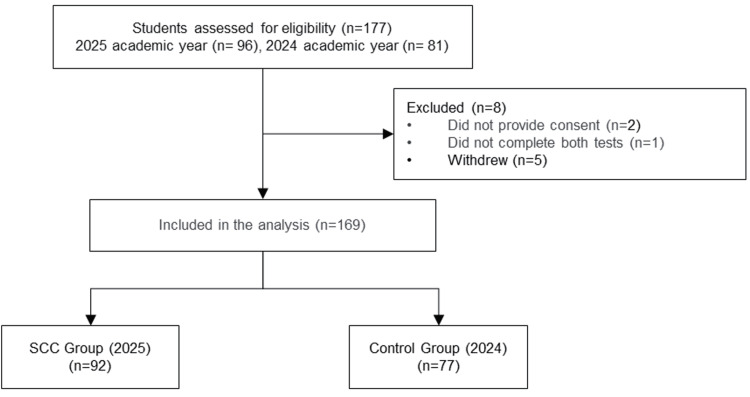 Figure 1
| Characteristic | SCC group (N = 92) | Control group (N = 77) | Test statistic | P-value |
| Age, year | 19.5 (19.0, 21.0) | 20.0 (19.0, 20.0) | U = 3,781 | 0.507 |
| Sex | ||||
| Male | 31 (34) | 30 (39) | χ² = 0.51 | 0.583 |
| Female | 61 (66) | 47 (61) | ||
| Program | ||||
| Daytime | 75 (82) | 65 (84) | χ² = 0.16 | 0.770 |
| Evening | 17 (18) | 12 (16) | ||
| Pre-test score, points | 90 (70, 100) | 90 (70, 110) | W = 4,228 | 0.085 |
| Post-test score, points | 195 (160, 223) | 180 (150, 200) | W = 2,841 | 0.013 |
| Δ Score, points | 105 (78, 140) | 80 (50, 110) | W = 2,403 | <0.001 |
| Item | 5 (strongly agree) | 4 (agree) | 3 (neutral) | 2 (disagree) | 1 (strongly disagree) | Positive responses (4+5, %) |
| Understanding | 41 (44.6) | 44 (47.8) | 4 (4.3) | 2 (2.2) | 1 (1.1) | 85 (92.4) |
| Clinical reasoning | 46 (50.0) | 43 (46.7) | 3 (3.3) | 0 (0.0) | 0 (0.0) | 89 (96.7) |
| Immersion | 58 (63.0) | 29 (31.5) | 4 (4.3) | 0 (0.0) | 1 (1.1) | 87 (94.6) |
| Learning retention | 57 (62.0) | 31 (33.7) | 4 (4.3) | 0 (0.0) | 0 (0.0) | 88 (95.7) |
| Satisfaction | 60 (65.2) | 25 (27.2) | 6 (6.5) | 1 (1.1) | 0 (0.0) | 85 (92.4) |
| Variable | β | 95% CI | P-value |
| SCC group | 23.87 | 11.32, 36.42 | <0.001 |
| Age (years) | 0.63 | -1.00, 2.26 | 0.448 |
| Sex (male) | -11.70 | -24.71, 1.30 | 0.077 |
| Pre-test score | -0.33 | -0.55, -0.10 | 0.005 |
| Program (evening) | 2.50 | -15.13, 20.13 | 0.780 |
Peer Reviews
No public reviews on file for this paper yet. If you reviewed it on a platform where reviews are public (OpenReview, ICLR, NeurIPS, ICML), you can paste yours below so the community can read it here.
Videos
No videos yet. Explain this paper in a talk, walkthrough, or lecture? Add one.
Taxonomy
TopicsSimulation-Based Education in Healthcare · Innovations in Medical Education · Nursing Roles and Practices
Introduction
In professional healthcare and rehabilitation training, simulation-based education in settings that approximate real clinical environments has proven effective [1-3]. Particularly, learning frameworks that emphasize narrative and context, where learners tackle a series of challenges as characters in a story, are crucial for integrating knowledge application with clinical reasoning. A prominent design framework for this is goal-based scenarios (GBS), which encourages “learning-by-doing,” as learners work toward achieving specific goals [4]. The story-centered curriculum (SCC) is an extension of the GBS design philosophy to encompass an entire curriculum. In an SCC, multiple GBS (goal-oriented tasks) are linked within a single, coherent narrative, allowing learners to iteratively engage in decision-making, practice, feedback, and reflection in a manner that mirrors real professional workflow [5]. Such a narrative-centered learning environment enhances learner agency, problem-solving skills, and engagement [6]. The narrative-based design is vital for integrating knowledge application and clinical reasoning within authentic professional and clinical contexts.
Furthermore, a narrative-based simulation education is expected to enhance learning outcomes by leveraging technology. A meta-analysis of technology-enhanced simulation education demonstrated positive effects on knowledge, skills, behaviors, and patient outcomes [2]. Among physiotherapists, simulation-based education has been shown to improve clinical decision-making for low back pain [7] and maintain comparable levels of clinical competence, even when replacing 25% of clinical practice hours in the cardiopulmonary field with simulation [8]. However, designing and implementing immersive scenarios that promote active learner engagement requires substantial human and time resources [9], and the high development burden, particularly the significant time commitment required from faculty, remains a major challenge to the widespread adoption of approaches such as SCC [10]. While Japan is advancing active, competency-based learning in healthcare education, constraints on faculty time and development budgets persist; at the same time, educational digitalization across the school system, including tablet-based learning in primary and secondary schools, highlights the need for scalable, technology-enabled curricula.
Large language models (LLMs) are artificial intelligence (AI) technologies trained on massive text datasets, capable of performing highly accurate tasks, such as generating text, summarizing information, and answering questions. ChatGPT (OpenAI), a rapidly evolving LLM, has demonstrated medical knowledge and explanatory capabilities comparable to passing-level performance on the United States Medical Licensing Examination [11]. Its advanced language generation and contextual retention make it a promising tool for generating cross-disciplinary narratives and clinical case scenarios [12]. Furthermore, simulation-based education using ChatGPT has provided a more realistic and immersive learning experience than traditional static case problems, as scenarios dynamically evolve in response to learner inputs [13,14]. However, current ChatGPT-based simulation education does not integrate the entire curriculum into a unified narrative, as seen in approaches such as SCC. Hence, leveraging LLMs to generate SCC narratives has the potential to minimize the development burden while maximizing the effectiveness of simulation-based education.
This study aimed to develop and evaluate an SCC utilizing ChatGPT for physiotherapy students in the field of internal disorders. The study sought to examine whether this AI-supported narrative learning approach could improve learners’ comprehension, immersion, and clinical reasoning compared with traditional case-based instruction.
Materials and methods
Study design
This quasi-experimental study employed a non-randomized controlled trial design. The participants were physiotherapy students enrolled in a course on internal disorders at a single institution. The study included two cohorts, namely, the SCC group, comprising students from the 2025 academic year who received an intervention based on the SCC, and the control group, comprising students from the 2024 academic year who received conventional instruction. The exclusion criteria were as follows: (1) failure to provide informed consent, (2) failure to complete both pre- and post-course proficiency tests, and (3) withdrawal from the program during the study period, including leave of absence or dropout. No formal sample size calculation was performed because the aim was to evaluate the educational effectiveness of the SCC intervention across student populations.
Outcome measures
The outcome measures included age, sex, program type (daytime/evening division), and pre- and post-course proficiency test scores for both the SCC and control groups. The proficiency test consisted of 30 multiple-choice questions based on past and similar items from the Japanese national physiotherapy licensing examination. Each question was worth 10 points, with a possible maximum score of 300. The content, difficulty, and timing of the pre- and post-tests were identical for both groups, and no feedback was provided to the participants.
Additionally, participants in the SCC group completed a learner survey after the course. The survey comprised five items, rated on a five-point Likert scale, with 5 = strongly agree, 4 = agree, 3 = neutral, 2 = disagree, and 1 = strongly disagree. The five items evaluated the following domains: Understanding: the degree to which the stories helped the students develop a concrete understanding of chronic obstructive pulmonary disease (COPD) and sputum management; clinical reasoning: the extent to which the stories fostered an understanding of the rationale for specific evaluations and interventions; immersion: the degree to which the stories created a sense of presence, as if the students were physiotherapists interacting with patients; learning retention: the perceived memorability and ease of learning from the story-based format; and satisfaction: students’ overall satisfaction and desire to participate in similar courses in the future.
Course structure and educational intervention
The course on internal disorders consisted of 15 sessions, each lasting 180 minutes. The first seven sessions (sessions 1-7) focused on lectures covering the foundational knowledge of respiratory diseases, including pathophysiology, treatment, and rehabilitation. The educational intervention was implemented during the latter eight sessions (sessions 8-15). In these sessions, the SCC group participated in SCC format learning, which featured a continuous narrative centered on two fictional patient cases (Mr. T and Ms. M) generated using ChatGPT (GPT-4; OpenAI, San Francisco, CA, USA). Clinical problems related to COPD, sputum management, and physical assessment were integrated into the storyline, and students engaged in reasoning and making decisions as active participants within the narrative. In contrast, the control group participated in a problem-based learning, where a standalone case was introduced in each session. Unlike the SCC format, the control group did not receive a continuous storyline or detailed patient information. All sessions were conducted face-to-face, and online video materials were assigned as homework for preparation and review. The proficiency test was administered via Google Forms with automated scoring, ensuring consistency and minimizing evaluator bias.
Instructional material development
The instructional materials were developed based on the principles of SCC, an educational framework designed to foster practical knowledge and clinical reasoning skills by engaging learners as active participants in a narrative. The story focused on two fictional patients with respiratory diseases: Mr. T (COPD) and Ms. M (pneumonia). The narrative was generated through ChatGPT. Prompts were carefully designed to include essential clinical information, such as patient history, symptoms, physical assessment findings, medical staff comments, patient and family perspectives, and value-based decision-making. Multiple narrative variations were generated, and the final scenarios were reviewed and refined by faculty members experienced in respiratory rehabilitation to ensure clinical accuracy and educational validity. A learning management system (Google Classroom; Google LLC, Mountain View, CA, USA) was used to manage all course-related activities, including story delivery, assignment distribution, submissions, and feedback.
Example prompts used for generating the narratives are presented below.
Prompt for Mr. T (COPD): A 68-year-old male with COPD (GOLD stage III, receiving home oxygen therapy) presents complaints of sputum retention and exertional dyspnea. Provide clinical information, including age, medical history, vital signs, respiratory sounds, walking test results, and other relevant findings, in chronological order. Include comments from physicians and nurses, patient statements, and family perspectives to create a realistic and immersive narrative suitable for student learning.
Prompt for Ms. M (Pneumonia): A 78-year-old female hospitalized with pneumonia, with a history of diabetes and hypertension. On admission, she had a fever of 38°C and a productive cough, with chest X-ray showing infiltrates in the right lower lung field and elevated inflammatory markers. Nursing notes indicate reduced appetite, and the family expressed concerns about her ability to return to living independently after discharge. Create a scenario where students act as physiotherapists conducting the initial evaluation.
To enhance learning engagement, Notebook LM (formerly Project Tailwind; Google LLC) was used to generate audio narration scripts based on the story texts, allowing students to experience the material visually and auditorily. The complete story scripts are provided in the Appendices.
Educational effect evaluation
The educational effects were evaluated using two measures, i.e., a learner questionnaire and a proficiency test. The learner questionnaire assessed the following five domains: understanding, clinical reasoning, immersion, learning retention, and satisfaction. The primary outcome was the change in the proficiency test score (Δ Score), calculated as the difference between the final and initial test scores.
Statistical analysis
The responses from the learner questionnaire were summarized for each domain in the SCC group. Subsequently, comparisons between the SCC and control groups were conducted. Statistical tests were selected according to the data type and distribution. Continuous variables were expressed as medians with interquartile ranges (IQRs), regardless of normality. Between-group comparisons used the t-test for normally distributed variables, the Wilcoxon rank-sum test for non-normally distributed variables, and the chi-square test for categorical variables. To identify independent factors associated with knowledge improvement, a multiple linear regression analysis was performed. The change in proficiency test score (Δ Score) was the dependent variable, and SCC participation, age, sex, program type (daytime/evening division), and pre-course proficiency test score were the independent variables. This analysis allowed the evaluation of the independent effect of SCC while adjusting for baseline characteristics. Regression coefficients, 95% confidence intervals (CIs), and p-values were reported. All analyses were performed using R statistical software (version 4.4.1), and a p-value <0.05 was considered statistically significant.
Results
The final sample consisted of 169 participants, with 92 in the SCC group and 77 in the control group (Figure 1). The median age was 19.5 years for the SCC group and 20.0 years for the control group. The SCC group included 31 (34%) males, compared with 30 (39%) males in the control group. There were no statistically significant differences between the SCC and control groups concerning age, sex, program type, or other baseline characteristics. Detailed participant characteristics are presented in Table 1.
Flowchart of student inclusion and exclusion.SCC: story-centered curriculum
Learner questionnaire outcomes
All 92 participants in the SCC group completed the post-course learner questionnaire, resulting in a 100% response rate. Positive responses, defined as scores of 4 or 5, exceeded 90% for all five evaluated domains: understanding 85 (92.4%), clinical reasoning 89 (96.7%), immersion 87 (94.6%), learning retention 88 (95.7%), and satisfaction 85 (92.4%) (Table 2).
Proficiency test outcomes
There was no significant difference in median pre-course proficiency test scores between the SCC group (90 (IQR 70 to 100)) and the control group (90 (70 to 110)). However, post-course median scores were significantly higher in the SCC group compared to the control group (195 (160 to 223) vs. 180 (150 to 200); p = 0.013). Furthermore, the median change in proficiency test scores was greater in the SCC group (105 (78 to 140)) compared to the control group (80 (50 to 110); p < 0.001) (Table 1).
Multiple regression analysis
Multiple linear regression demonstrated that participation in the SCC intervention was an independent predictor of greater improvement in proficiency test scores (β = 23.87, 95% CI 11.32 to 36.42; p < 0.001), even after adjusting for age, sex, program type, and pre-course proficiency test scores (Table 3).
Discussion
This study found that participation in an SCC incorporating an LLM was associated with two key outcomes: (1) enhanced learner satisfaction and immersion, and (2) improved comprehension, knowledge retention, and performance on proficiency tests.
The learner questionnaire results indicated that the LLM-based SCC developed in this study successfully promoted satisfaction and immersion. This is consistent with previous findings, whereby case-based and story-driven learning approaches have been reported to enhance learner satisfaction [15]. As a theoretical basis for the role of immersion in promoting learning, Dede [16] proposed that immersive interfaces, such as virtual reality (VR) and augmented reality (AR), enabled situated learning by allowing learners to acquire knowledge within authentic contexts and activities. Furthermore, learning in contexts that closely resemble real-world situations facilitated the transfer of acquired knowledge to practical settings.
However, systematic reviews have noted that implementing and maintaining immersive interfaces, such as VR technology, involves substantial initial costs [17]. Particularly, within healthcare education, the high initial investment and ongoing maintenance of equipment remain major barriers [18]. In addressing these challenges, the text-based LLM approach adopted in this study offers the advantage of enabling the design of a relatively low-cost virtual environment where learners can practice history-taking, clinical reasoning, and communication skills through simulated patient interactions [19]. This study has practical significance in applying the advantages of LLMs within the SCC framework, successfully achieving high immersion and educational effectiveness in a cost-efficient manner.
The LLM-based SCC developed in this study improved comprehension, clinical reasoning, and knowledge retention, resulting in higher proficiency test scores. The finding that SCC enhanced learners’ subjective evaluations and objective test performance can be interpreted from the perspective of cognitive learning mechanisms. This improvement aligns strongly with situated learning theory [20], which posits that learning is most effective when it occurs within authentic, practice-based contexts. In medical education, case-based learning has proven to enhance knowledge organization and clinical application by providing contextual frameworks, as demonstrated in a systematic review by Thistlethwaite [21]. The SCC developed in this study builds upon this principle by offering a richer context through a continuous narrative, promoting deeper knowledge application and retention.
Furthermore, the principle of retrieval practice may have contributed to the learning gains. Repeatedly retrieving information from memory has consistently been demonstrated in cognitive psychology research to enhance long-term knowledge retention [22]. Within the SCC in this study, learners were repeatedly required to evaluate changing patient conditions and make intervention decisions throughout the storyline, which integrated the retrieval and application of knowledge into the learning process. This repeated engagement likely reinforced memory consolidation and contributed to improved proficiency test scores.
Nonetheless, certain limitations of this study must be acknowledged. This was a single-institution, non-randomized historical control study and, therefore, is susceptible to confounding factors, such as cohort differences, student background, faculty experience, and influences outside the curriculum. However, even after controlling for potential confounders through multiple regression analysis, significant differences in Δ proficiency test scores remained, which is noteworthy. The primary outcomes were limited to short-term knowledge acquisition. Long-term retention, clinical performance, and patient-related outcomes were not assessed, indicating the need for longitudinal studies.
Despite these limitations, this study makes significant contributions. It demonstrates that educators can leverage LLMs as “creative partners” to efficiently develop high-quality, context-rich learning materials. This can accelerate the implementation and dissemination of simulation-based education, particularly in resource-limited settings. Future directions include harnessing LLMs interactively to create adaptive learning environments in which storylines dynamically branch based on learners’ responses, providing personalized and optimized educational experiences.
Conclusions
This study demonstrated that the SCC significantly improved participants’ test performance, learning retention, and immersion compared to conventional approaches. These findings suggest that integrating SCC into clinical education provides a more engaging and effective training experience, fostering active participation and sustained motivation. The consistently positive feedback from learners indicates that SCC is both feasible and acceptable, underscoring its potential for broader implementation in physiotherapy and other health professional education. By confirming SCC’s effectiveness, our results offer valuable guidance for educators seeking innovative approaches to enhance clinical education and point toward a promising direction for future curriculum development.
The reference list from the paper itself. Each links out to its DOI / PubMed record.
- 1Features and uses of high-fidelity medical simulations that lead to effective learning: a BEME systematic review Med Teach Issenberg SB Mc Gaghie WC Petrusa ER Lee Gordon D Scalese RJ 10282720051614776710.1080/01421590500046924 · doi ↗ · pubmed ↗
- 2Technology-enhanced simulation for health professions education: a systematic review and meta-analysis JAMA Cook DA Hatala R Brydges R 97898830620112190013810.1001/jama.2011.1234 · doi ↗ · pubmed ↗
- 3Does simulation-based medical education with deliberate practice yield better results than traditional clinical education? A meta-analytic comparative review of the evidence Acad Med Mc Gaghie WC Issenberg SB Cohen ER Barsuk JH Wayne DB 7067118620112151237010.1097/ACM.0b 013e 318217 e 119PMC 3102783 · doi ↗ · pubmed ↗
- 4The design of goal-based scenarios J Learn Sci Schank RC Fano A Bell B 30534531994
- 5The story-centered curriculume Learn Magazine Schank RC 142007
- 6Integrating learning, problem solving, and engagement in narrative-centered learning environments Int J Artif Intell Educ Rowe JP Shores LR Mott BW 115133212011
- 7Simulation in physiotherapy students for clinical decisions during interaction with people with low back pain: randomised controlled trial BMC Med Educ Sandoval-Cuellar C Alfonso-Mora ML Castellanos-Garrido AL 3752120213424376710.1186/s 12909-021-02812-7PMC 8268327 · doi ↗ · pubmed ↗
- 8Simulation can contribute a part of cardiorespiratory physiotherapy clinical education: two randomized trials Simul Healthc Blackstock FC Watson KM Morris NR 3242820132325018910.1097/SIH.0b 013e 318273101 a · doi ↗ · pubmed ↗