A novel 19-gauge integrated electrocautery-puncture needle for endoscopic ultrasound-guided biliary drainage
Tingting Yu, Suning Hou, Yongzhan Zhao, Linghan Xue, Xiaohan Xu, Senlin Hou, Lichao Zhang

Abstract
Genes, proteins, chemicals, diseases, species, mutations and cell lines named across the full text — each resolved to its canonical identifier and authoritative record.
Click any figure to enlarge with its caption.
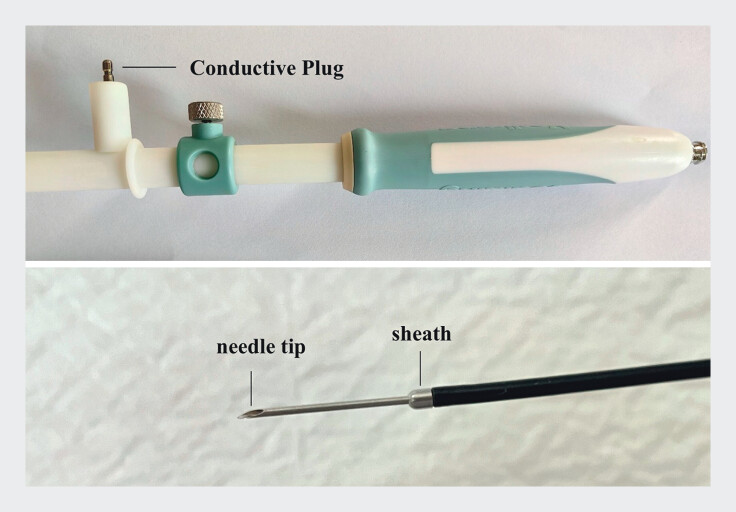 Fig. 1
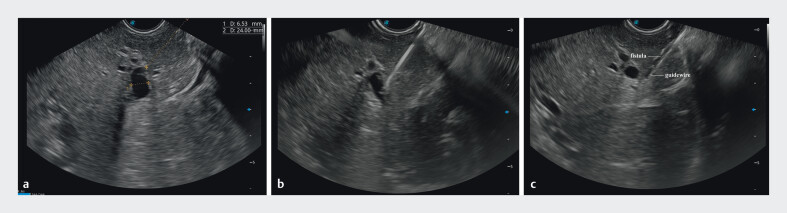 Fig. 2
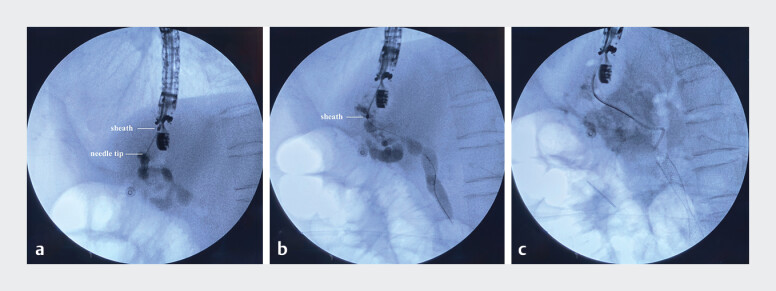 Fig. 3
- —The S&T Program of Hebei
- —Natural Science Foundation of Hebei Province10.13039/501100003787
- —Medical Science Research Project of Hebei
Peer Reviews
No public reviews on file for this paper yet. If you reviewed it on a platform where reviews are public (OpenReview, ICLR, NeurIPS, ICML), you can paste yours below so the community can read it here.
Videos
No videos yet. Explain this paper in a talk, walkthrough, or lecture? Add one.
Taxonomy
TopicsGallbladder and Bile Duct Disorders · Organ Transplantation Techniques and Outcomes · Medical Device Sterilization and Disinfection
Endoscopic ultrasound-guided biliary drainage (EUS-BD) has been established as a primary drainage modality for malignant biliary obstruction, with expanded clinical indications 1 2 . Following successful puncture of the target bile duct with a 19-gauge needle and guidewire placement, replacement of the needle with a cystotome for dilation of the fistula tract may be required 3 4 , which increases procedural complexity. Here, we designed a novel 19-gauge integrated electrocautery-puncture needle with puncture and dilation functions to address this challenge ( Fig. 1 ).
The display of a novel 19-gauge integrated electrocautery-puncture needle with an 8.5 French sheath.
A 68-year-old woman was admitted to our hospital with jaundice and was diagnosed with a distal malignant biliary stricture. She had undergone a total gastrectomy with Roux-en-Y reconstruction for gastric cancer 2 years ago. Due to her cachexia, ascites, and the high risk of perforation associated with prolonged ERCP procedures, we opted for EUS-BD as the preferred intervention. The dilated bile duct in segment II of the liver was selected as the target bile duct, with a diameter of approximately 6.5 mm and a puncture depth of 24 mm ( Fig. 2 a ). The novel 19-gauge integrated electrocautery-puncture needle was used to puncture the selected bile duct ( Fig. 2 b ). Thereafter, a 0.025-inch guidewire (Jagwire, Boston Scientific, USA) was advanced into the left intrahepatic duct, and then to the common bile duct, and finally into the intestinal cavity. Following needle withdrawal into the sheath, the sheath is advanced along the guidewire to dilate the fistula ( Fig. 2 c , Fig. 3 a, b , Video 1 ). Finally, a fully covered self-expandable metal stent (FCSEMS) was advanced over the guidewire to traverse the stricture and then papilla (EUS-guided antegrade stenting), and a 7-Fr and 10-cm-long double-pigtail plastic stent was inserted into the left hepatic duct (EUS-guided hepaticogastrostomy) ( Fig. 3 c ).
Endoscopic ultrasound images. a The left dilated intrahepatic bile duct (segment 2) and puncture pathway. b The target bile duct was punctured using a novel 19-gauge needle. c The fistula tract dilated by the sheath.
Fluoroscopic images. a The access of the needle tip through the digestive wall into the intrahepatic bile duct. b The activated sheath was advanced along the guidewire into the bile duct. c The released fully covered self-expandable metal stent and plastic stent.
A novel 19-gauge integrated electrocautery-puncture needle applied in EUS-BD.Video 1
The novel 19-gauge integrated electrocautery-puncture needle eliminates the need for exchanging the cystotome during EUS-BD procedures, thereby mitigating the risk of guidewire dislodgement and reducing procedural time.
Endoscopy_UCTN_Code_TTT_1AS_2AH
The reference list from the paper itself. Each links out to its DOI / PubMed record.
- 1Khoury T Sbeit W Fumex F Endoscopic ultrasound- versus ERCP-guided primary drainage of inoperable malignant distal biliary obstruction: systematic review and meta-analysis of randomized controlled trials Endoscopy 20245695596310.1055/a-2340-069738843824 · doi ↗ · pubmed ↗
- 2Doyle JB Sethi A Endoscopic Ultrasound-Guided Biliary Drainage J Clin Med 20231210.3390/jcm 12072736 PMC 1009513937048819 · doi ↗ · pubmed ↗
- 3Isayama H Nakai Y Itoi T Clinical practice guidelines for safe performance of endoscopic ultrasound/ultrasonography-guided biliary drainage: 2018 J Hepatobiliary Pancreat Sci 20192624926910.1002/jhbp.63131025816 PMC 7064894 · doi ↗ · pubmed ↗
- 4Yu T Hou S Du H Simplified single-session EUS-guided transhepatic antegrade stone removal for management of choledocholithiasis in patients with surgically altered anatomy Gastroenterology Rep 202412 goae 05610.1093/gastro/goae 056PMC 1119934238933338 · doi ↗ · pubmed ↗