Respiratory microbiomes reflect whale health
Carolyn A Miller, Enrico Pirotta, Sharon Grim, Michael J Moore, John W Durban, Peter L Tyack, Holly Fearnbach, Samantha G M Leander, Amy R Knowlton, Amy M Warren, Monica A Zani, Regina Asmutis-Silvia, Heather M Pettis, Amy Apprill

TL;DR
This study shows that the microbes in whale breath can reveal important health information about endangered North Atlantic right whales.
Contribution
The study introduces a non-invasive method using respiratory microbiomes and health metrics to assess whale health.
Findings
Respiratory microbiome data significantly correlate with health metrics like body condition in North Atlantic right whales.
Distinct bacterial taxa are associated with whales of different health statuses, including potential pathogens and lipid-rich environment taxa.
Non-invasive drone-based sampling combined with microbiome analysis is effective for whale health assessment.
Abstract
As important members of the marine ecosystem, baleen whales are frequently managed and protected, but methodology to assess their health remains limited. Recent technological advances, such as the use of drones, support the non-invasive collection of promising health-associated data, including respiratory exhalant microbiota. Here, we considered five health metrics paired with respiratory exhalant samples to examine the utility of characterizing respiratory microorganisms for health diagnostics of North Atlantic right whales (Eubalaena glacialis), one of the most endangered baleen whale species. In 2016–2024, we used drones to collect 103 exhalant samples from 85 individuals to examine the associated microbiome, using amplicon sequencing methods targeting bacteria and archaea. The health status of sampled whales was characterized using an index of body condition derived from full-body…
Genes, proteins, chemicals, diseases, species, mutations and cell lines named across the full text — each resolved to its canonical identifier and authoritative record.
Click any figure to enlarge with its caption.
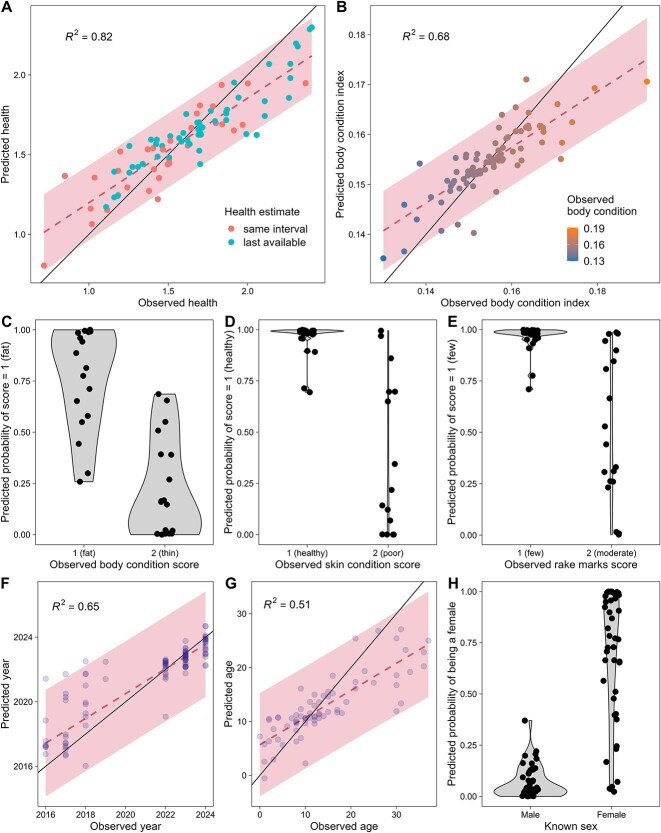 Figure 1
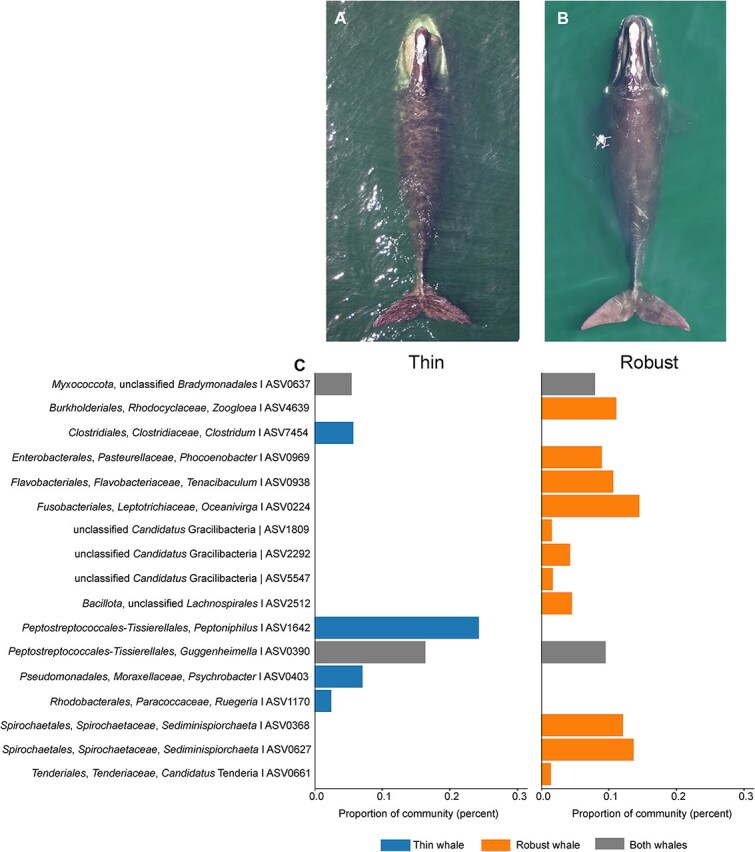 Figure 2
- —NOAA Cooperative Institute agreement
- —Office of Naval Research10.13039/100000006
- —Strategic Environmental Research and Development Program10.13039/100013316
Peer Reviews
No public reviews on file for this paper yet. If you reviewed it on a platform where reviews are public (OpenReview, ICLR, NeurIPS, ICML), you can paste yours below so the community can read it here.
Videos
No videos yet. Explain this paper in a talk, walkthrough, or lecture? Add one.
Taxonomy
TopicsMarine animal studies overview · Microbial Community Ecology and Physiology · Coral and Marine Ecosystems Studies
Quantifying the health of wildlife is important for status assessments and management of populations that are increasingly threatened by the cumulative risk posed by sublethal effects of increasing anthropogenic stressors. Microorganisms play a key role in animal health and disease, yet knowledge of microbial associates is lacking for most wildlife species, especially whales, due to their large size and high mobility within the ocean. Drone-based collection and subsequent identification of respiratory exhalant microorganisms was recently used to show microbiota consistency and variability in whales [1, 2]. However, the respiratory microbiomes of free ranging whales have not been examined for any individuals with a described health state, thus the utility of characterizing microorganisms for whale health diagnostics remains unknown.
North Atlantic right whales (Eubalaena glacialis; NARW) present an ideal case study to examine if and how the respiratory exhalant microbiome reflects whale health. Following centuries of intensive whaling, the species was recognized as critically depleted and nearing extinction as early as the 1930s, which provided motivation for scientists and management agencies to monitor the life history and health of each whale remaining in the population (currently <400) [3]. NARW health status varies widely, ranging from emaciated individuals with skin lesions, rake marks, and cyamid ectoparasites, to relatively robust individuals appearing in good overall health [4].
Here, we collated multi-metric health data for 85 distinct NARW from which 103 respiratory exhalant samples were collected in Cape Cod Bay, Massachusetts, USA, during the spring feeding seasons 2016–2024. We analyzed five metrics of individual health status: a body condition index derived from vertical drone-based images using photogrammetric techniques [5], an estimate of overall individual health from a model for NARW survival and calving probability [6, 7], and three categorical variables from a visual health assessment (VHA) [8]. Respiratory exhalant microbiota were examined in drone-captured samples using small subunit ribosomal RNA gene partial sequencing methodology, with amplicon sequence variants (ASVs) employed to differentiate distinct microbial taxa, often at single nucleotide resolution (Supplementary Information).
To examine the relationships of the five health metrics, animal age, sex, and sampling year with the respiratory microbiota, we applied elastic net regression analysis to a variable subset of the relative abundance of ASVs selected using a pre-screening procedure (Table S1). Cross-validation suggested the final models resulted in small to moderate median absolute error (MAE) and good predictive power (Table S1). Of the five health metrics, the best performing model was for the modeled health metric [6, 7] (R^2^ = 0.82; MAE = 0.1; Fig. 1A); the model’s predictive power held when health estimates and sample collection were offset in time, suggesting the respiratory microbiome may act as an indicator of long-term health status. ASV relative abundances also supported reasonable predictions of the body condition index (Fig. 1B), and 39 ASVs were shared with the elastic net for the modeled health metric. Similarly, respiratory microbiome was associated with VHA scores (Fig. 1C–E), although the sample size for the VHA models was smaller (Table S1). In addition to the associations with health, model results highlighted that the respiratory microbiome was predictive of sampling year, with more precise predictions in recent years when sample size was also larger (Fig. 1F). This result was supported by the elastic net for year when excluding seawater-prevalent ASVs (Fig. S1), suggesting that this connection to year is not related to seawater microbial changes. The model for age showed the poorest predictive power, with an MAE of several years, but observed and predicted ages were nonetheless moderately correlated (Fig. 1G). Finally, respiratory microbiome was found to vary between non-calf females and males; the elastic net performed better at predicting sex for males, suggesting that microbiome differences in females may be influenced by reproductive status (Fig. 1H).
We also investigated relationships between the health metrics and a set of summary microbial diversity metrics, rather than the relative abundance of individual ASVs. This analysis did not reveal strong correlations (Supplementary Information).
We further examined the microbial taxa retained by the elastic net model for body condition index from photogrammetry by exploring their relative abundance in two adult males: the thinnest (Fig. 2A) and the most robust (Fig. 2B) in the dataset, sampled one year apart. This comparison revealed generally host-associated taxa, albeit represented at low relative abundance, including four ASVs present only in the thin whale’s exhalant microbiota, 11 only in the robust whale’s microbiota, and 2 (Bradymonabacteria and Guggenheimella) associated with both individuals (Fig. 2C). The thin whale hosted Clostridum and Peptoniphilus, bacteria that can cause mammalian infections [9, 10], Psychrobacter, found in cetacean respiratory exhalant, blowholes or mouths [1, 11], and Ruegeria, a common marine heterotroph [12, 13]. The robust whale’s exhalant included microbial taxa that may be indicative of circulating diet-derived fat (Fig. 2C): two Sediminispirochaeta bacteria identified in lipid-rich environments [14] and three Candidatus Gracilibacteria phyla (BD1–5) that rely on externally derived fatty acids due to a lack of biosynthetic pathways [15]. The robust whale also harbored marine-mammal-associated Phocoenobacter, Tenacibaculum, and Oceanivirga bacteria [16–18], and ASVs associated with Candidatus Tenderia, Zoogloea, and Lachnospirales. The role of these specific bacteria in whale health is speculative and requires research.
We identified relevant correlations between NARW exhalant microbiota and several metrics of individual health. These results suggest that respiratory exhalant microbiota could potentially be used as a biomarker of individual health status; however, these correlations require validation using a larger dataset, which may also grant greater accuracy and precision of health predictions. In particular, a larger sample size would support the development of a model for assessing health that accounts for the effect of contextual variables (e.g., age, sex, individual differences, and sampling year) on respiratory microbiota. These findings provide motivation to further explore the specific role of microorganisms in whale health. With the cumulative, sublethal effects of multiple anthropogenic stressors threatening the viability of baleen whales and other wildlife populations [19], understanding factors that contribute to whale health and identifying suitable health indicators, including their microbiota, is important to their management and longevity.
Supplementary Material
CL_NARW_health_microbiome_Suppl_materials_Oct9resub4_wraf231
Supplementary_Table_3_wraf231
The reference list from the paper itself. Each links out to its DOI / PubMed record.
- 1Apprill A, Miller CA, Moore MJ. et al. Extensive core microbiome in drone-captured whale blow supports a framework for health monitoring. m Systems 2017;2:e 00119–7. 10.1128/m Systems.00119-1729034331 PMC 5634792 · doi ↗ · pubmed ↗
- 2Vendl C, Slavich E, Wemheuer B. et al. Respiratory microbiota of humpback whales may be reduced in diversity and richness the longer they fast. Sci Rep 2020;10:12645. 10.1038/s 41598-020-69602-x 32724137 PMC 7387350 · doi ↗ · pubmed ↗
- 3Pettis HM, Hamilton PK. North Atlantic Right Whale Consortium 2024 Annual Report Card. Report 2025.
- 4Rolland RM, Schick RS, Pettis HM. et al. Health of North Atlantic right whales Eubalaena glacialis over three decades: from individual health to demographic and population health trends. Mar Ecol Prog Ser 2016;542:265–82. 10.3354/meps 11547 · doi ↗
- 5Durban JW, Moore MJ, Chiang G. et al. Photogrammetry of blue whales with an unmanned hexacopter. Mar Mammal Sci 2016;32:1510–5. 10.1111/mms.12328 · doi ↗
- 6Pirotta E, Tyack PL, Durban JW. et al. Decreasing body size is associated with reduced calving probability in critically endangered North Atlantic right whales. R Soc Open Sci 2024;11:240050. 10.1098/rsos.24005038420631 PMC 10898963 · doi ↗ · pubmed ↗
- 7Pirotta E, Schick RS, Hamilton PK. et al. Estimating the effects of stressors on the health, survival and reproduction of a critically endangered, long-lived species. Oikos 2023;2023:e 09801. 10.1111/oik.09801 · doi ↗
- 8Pettis HM, Rolland RM, Hamilton PK. et al. Visual health assessment of North Atlantic right whales (Eubalaena glacialis) using photographs. Can J Zool 2004;82:8–19. 10.1139/z 03-207 · doi ↗