Correction: Enhanced proteasomal activity is essential for long term survival and recurrence of innately radiation resistant residual glioblastoma cells
Jacinth Rajendra, Keshava K. Datta, Sheikh Burhan Ud Din Farooqee, Rahul Thorat, Kiran Kumar, Nilesh Gardi, Ekjot Kaur, Jyothi Nair, Sameer Salunkhe, Ketaki Patkar, Sanket Desai, Jayant Sastri Goda, Aliasgar Moiyadi, Amit Dutt, Prasanna Venkatraman, Harsha Gowda, Shilpee Dutt

Abstract
Genes, proteins, chemicals, diseases, species, mutations and cell lines named across the full text — each resolved to its canonical identifier and authoritative record.
Click any figure to enlarge with its caption.
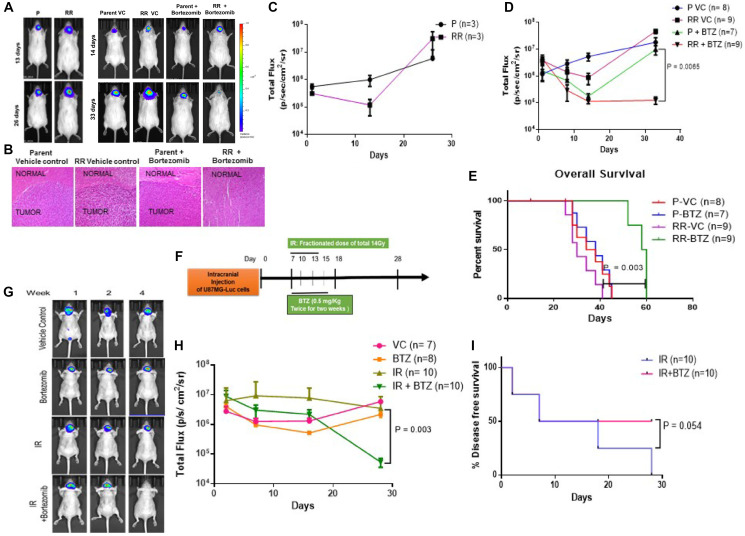 Figure 1
Peer Reviews
No public reviews on file for this paper yet. If you reviewed it on a platform where reviews are public (OpenReview, ICLR, NeurIPS, ICML), you can paste yours below so the community can read it here.
Videos
No videos yet. Explain this paper in a talk, walkthrough, or lecture? Add one.
Taxonomy
TopicsUbiquitin and proteasome pathways · Clusterin in disease pathology · Ferroptosis and cancer prognosis
This article has been corrected: This article has been corrected: In Figure 6A, the representative bioluminescence image of mouse after 14 days of treatment with Vehicle Control (VC) of the orthotopic Radiation Resistant (RR) tumor is an accidental duplicate of the mouse image with a tumor from parental cells treated for 14 days with Bortezomib. The authors stated that the discrepancy in the representative images must have happened inadvertently during the compilation of Figure 6A and mentioned that because these are representative images this has no bearing on the results or the conclusion of this manuscript. The authors provided raw data which included the original images of the mice for the RR VC (n = 8) and Parent+Bortezomib (n = 7) groups and Excel sheets with ROI of the tumors. The corrected Figure 6A, which uses the original data and features replaced representative mouse images for both RR VC and Parent+Bortezomib groups at day 14, is shown below. The authors declare that these corrections do not change the results or conclusions of this paper and apologize for any inconvenience caused.
Original article: Oncotarget. 2018; 9:27667–27681. 27667-27681. https://doi.org/10.18632/oncotarget.25351