Incidence of constrained condylar and hinged knee implants and mid- to long-term survivorship: a register-based study from the Nordic Arthroplasty Register Association (NARA)
Jake VON HINTZE, Ville PONKILAINEN, Annette W-DAHL, Nils P HAILER, Ove FURNES, Anne M FENSTAD, Mona BADAWY, Alma B PEDERSEN, Martin LINDBERG-LARSEN, Mika J NIEMELÄINEN, Keijo MÄKELÄ, Antti ESKELINEN

Abstract
Genes, proteins, chemicals, diseases, species, mutations and cell lines named across the full text — each resolved to its canonical identifier and authoritative record.
Click any figure to enlarge with its caption.
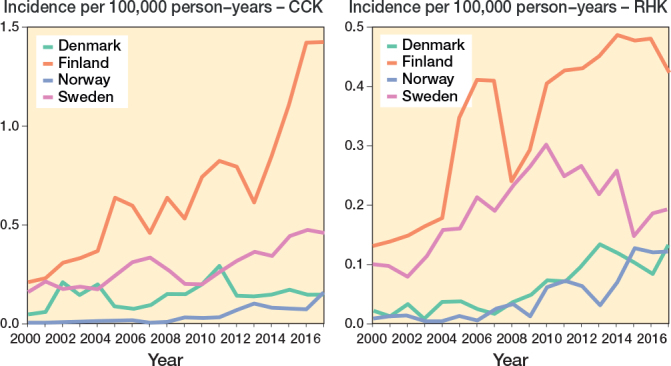 Figure 4
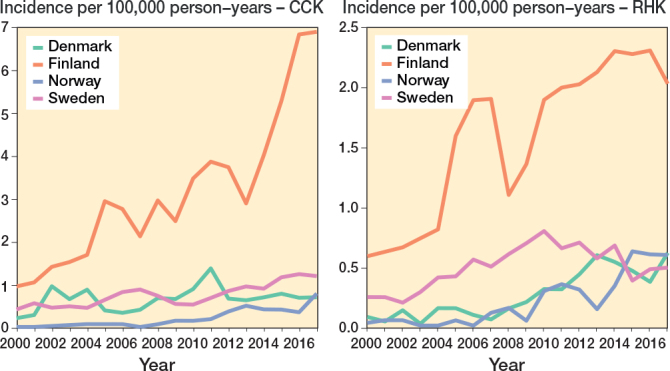 Figure 4
Peer Reviews
No public reviews on file for this paper yet. If you reviewed it on a platform where reviews are public (OpenReview, ICLR, NeurIPS, ICML), you can paste yours below so the community can read it here.
Videos
No videos yet. Explain this paper in a talk, walkthrough, or lecture? Add one.
Taxonomy
TopicsTotal Knee Arthroplasty Outcomes · Orthopaedic implants and arthroplasty · Knee injuries and reconstruction techniques
We noted an error in the age- and sex-adjusted incidence rates, which have now been corrected in the Results section and in Figure 4. We are sorry for this mistake.
On behalf of the authors
Jake von Hintze
Original version
The demographics of the study cohorts showed that there were intergroup differences in the distribution of indications and age groups, as well as intercountry differences in the use of different implants and patellar buttons (Table 1, Figure 3, see Appendix). Of the 4 Nordic countries, Finland had the highest incidence of both CCK and RHK procedures over the study period (Figure 4). In 2017, the incidence rates of CCK procedures were 1.4 per 100,000 person-years in Finland, 0.5 in Sweden, 0.2 in Norway, and 0.2 in Denmark. In the same year, the corresponding rates for RHK procedures were 0.4 in Finland, 0.2 in Sweden, and 0.1 in Norway and Denmark.
Corrected version
The demographics of the study cohorts showed that there were intergroup differences in the distribution of indications and age groups, as well as intercountry differences in the use of different implants and patellar buttons (Table 1, Figure 3, see Appendix). Of the 4 Nordic countries, Finland had the highest incidence of both CCK and RHK procedures over the study period (Figure 4). In 2017, the incidence rates of CCK procedures were 6.9 per 100,000 person-years in Finland, 1.2 in Sweden, 0.8 in Norway, and 0.7 in Denmark. In the same year, the corresponding rates for RHK procedures were 2.0 in Finland, 0.6 in Norway and Denmark, and 0.5 in Sweden.
Original version
Age- and sex-adjusted incidence rates for CCK and RHK implants in 4 Nordic countries between 2000 and 2017. For Abbreviations, see Figure 2.
Corrected version
Age- and sex-adjusted incidence rates for CCK and RHK implants in 4 Nordic countries between 2000 and 2017. For Abbreviations, see Figure 2.
Figure 2. Flowchart of the cohorts. TKA = total knee arthroplasty; NARA = Nordic Arthroplasty Register Association; MS = minimally stabilized knee; CCK = constrained condylar knee; RHK = rotating hinge knee.