Kidney Function Tests in Health Checkups for Specified Skilled Workers: A Case-based Suggestion
Ami Isoda, Soichiro Saeki, Daisuke Katagiri, Tatsuya Kikuchi, Naho Matsubara, Yuri Katayama, Harui Bamba, Hideki Takano, Chihaya Hinohara

TL;DR
A case highlights the need to include kidney function tests in health screenings for foreign workers in Japan to prevent delayed diagnoses and complications.
Contribution
The paper proposes adding kidney function assessments to pre-employment health checkups for specified skilled workers in Japan.
Findings
A young Myanmar woman developed severe kidney dysfunction after arriving in Japan, which was not detected in her initial health screening.
Including estimated glomerular filtration rate (eGFR) in health checkups could help detect chronic kidney disease early.
Early detection of renal issues is crucial to prevent complications and ensure treatment continuity for foreign workers.
Abstract
Approximately 250,000 foreign nationals reside in Japan under the specified skilled worker (SSW) visa category. Due to Japan’s aging population and declining birth rate, a labor shortage is anticipated, prompting an increase in the intake of SSWs. All SSWs are required to undergo pre-arrival health screenings, but renal function assessments, such as the estimated glomerular filtration rate (eGFR), are not currently included. We present a case of a woman in her early 20s from Myanmar who developed severe anemia and renal dysfunction after arriving in Japan as an SSW. Before arrival, an initial health checkup identified anemia with a hemoglobin level of 10.3 g/dL, but renal function tests were not conducted. Ten months later, her hemoglobin had dropped to 7.7 g/dL, and her serum creatinine level was elevated to 7.83 mg/dL. Subsequent testing revealed severe renal dysfunction, and imaging…
Genes, proteins, chemicals, diseases, species, mutations and cell lines named across the full text — each resolved to its canonical identifier and authoritative record.
Click any figure to enlarge with its caption.
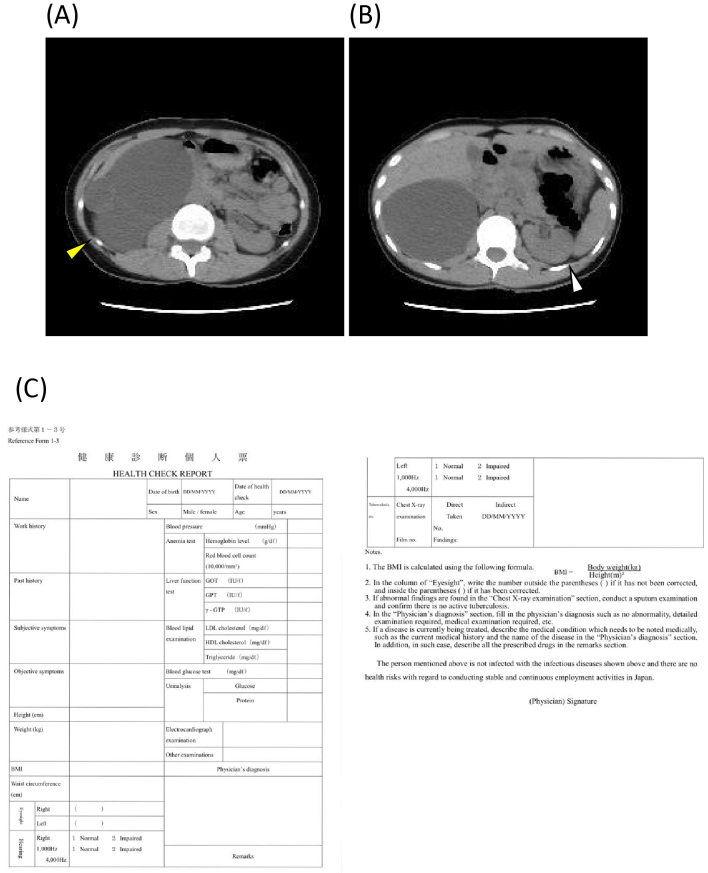 Figure 1
Peer Reviews
No public reviews on file for this paper yet. If you reviewed it on a platform where reviews are public (OpenReview, ICLR, NeurIPS, ICML), you can paste yours below so the community can read it here.
Videos
No videos yet. Explain this paper in a talk, walkthrough, or lecture? Add one.
Taxonomy
TopicsHealth Promotion and Cardiovascular Prevention · Healthcare cost, quality, practices · Chronic Kidney Disease and Diabetes
Approximately 250,000 foreign nationals reside in Japan under the specified skilled worker (SSW) visa category ^(1)^. With a rapidly aging population and declining birthrate, Japan faces a serious labor shortage ^(2)^, prompting an expanded intake of SSWs to improve Japan’s international competitiveness and bolster economic productivity ^(3)^. All SSWs must undergo pre-arrival health examinations ^(1)^; however, these do not currently include renal function assessments such as the estimated glomerular filtration rate (eGFR).
We describe a case of a woman in her early 20s from Myanmar who presented to our hospital with severe anemia and kidney dysfunction after arriving in Japan as an SSW. She had no notable past medical history and had never undergone a health checkup in her home country. Before arriving in Japan as an SSW, an initial health checkup revealed anemia with a hemoglobin level of 10.3 g/dL. Urine protein and occult blood test results were negative. Kidney function tests, such as measuring serum creatinine (sCre) and blood urea nitrogen (BUN) levels, were not conducted.
Approximately 10 months later, during a routine health checkup, her hemoglobin level further declined to 7.7 g/dL, and her sCre level was elevated at 7.83 mg/dL, indicating severe renal dysfunction. The patient was promptly referred to our hospital for further evaluation. Laboratory tests revealed BUN and sCre levels of 102.0 mg/dL and 9.28 mg/dL, respectively. Her eGFR was 5.3 mL/min/1.73 m^2^. Computed tomography revealed that multiple cysts had almost completely replaced her right kidney, whereas her left kidney was markedly atrophic (Figure 1A, B), suggesting a congenital malformation. Hemodialysis was immediately initiated (patient data directly before the initiation of hemodialysis available as Supplementary Figure S1). Although the exact cause of her renal disease remains unclear, her clinical course following dialysis initiation strongly indicated the irreversibility of end-stage kidney disease. She subsequently returned to Myanmar and continued maintenance hemodialysis three times per week.
This case highlights a critical gap in the current health checkup requirements for SSWs. Although anemia was identified during the initial screening, the omission of renal function assessment delayed the diagnosis of chronic kidney disease. The pre-employment health checkups for SSWs included chest radiography, physical examination (height, weight, vision, hearing), blood pressure measurements, blood tests (complete blood count, liver function tests), and urinalysis. However, kidney function tests such as eGFR were not included (Figure 1C) ^(4)^.
Although GFR evaluation using the estimation formula (eGFR) is not yet universally practiced worldwide, sCre levels are routinely measured, and the use of the estimation formula is a common approach for the initial assessment of sCre and GFR levels ^(5)^. Unlike Japan’s current SSW health screening, some countries incorporate kidney function tests in their immigrant health screenings, such as sCre measurement in Canada ^(6)^ and both sCre and eGFR assessments in Australia ^(7)^. The number of SSWs is increasing in Japan ^(1)^, and it is essential to recognize potential cases in this population similar to those presented here. Once hemodialysis has been initiated, it is often challenging for individuals to return to their home country and continue treatment smoothly. Therefore, waterfront measures are critical for the safety of both patients and medical institutions.
According to the medical fee points under the Ministry of Health, Labour and Welfare, the cost of adding sCre and eGFR to routine blood tests would be only 160 yen per person. In contrast, while the incidence is much lower, maintenance hemodialysis costs an estimated 40,000 to 50,000 yen per session and must be performed three times weekly indefinitely. This ongoing treatment places a substantial financial burden on patients. Although SSWs are eligible for Japan’s national health insurance ^(8)^, which typically covers 70% of medical costs, patients on dialysis may obtain a Grade 1 Physical Disability Certificate for additional financial support.
In conclusion, we suggest updating the pre-employment health checkup protocol for SSWs to include kidney function tests to address this critical gap and support better health outcomes in this growing population. This small addition could have significant public health and economic benefits for an increasingly essential workforce.
Article Information
Conflicts of Interest
None
Acknowledgement
We thank the Department of Nephrology and International Health Care Center, National Center for Global Health and Medicine, for their support.
Informed Consent
Informed consent was obtained from the patient included in the report.
Supplement
Supplementary Figure S1
The reference list from the paper itself. Each links out to its DOI / PubMed record.
- 1Status of residence “Specified Skilled Worker” [Internet]. Immigration Services Agency of Japan. Retrieved December 18, 2024 [cited 2025 Jun 1]. Available from: https://www.moj.go.jp/isa/applications/ssw/nyuukokukanri 07_00215.html
- 2Nakatani H. Population aging in Japan: policy transformation, sustainable development goals, universal health coverage, and social determinates of health. Glob Health Med. 2019;1(1):3-10.33330747 10.35772/ghm.2019.01011 PMC 7731274 · doi ↗ · pubmed ↗
- 3Widarahesty Y. “Diversity in the Workplace”: Indonesian Muslim migrant workers’ experiences in Japan. J Glob Strategis. 2024;18(2):355-82.
- 4List of application and notification forms related to Specified Skilled Worker [Internet]. Immigration Services Agency of Japan. Retrieved December 18, 2024 [cited 2025 Jun 1]. Available from: https://www.moj.go.jp/isa/applications/ssw/10_00020.html
- 5KDIGO. Clinical practice guideline for the evaluation and management of chronic kidney disease. Kidney Int. 2024;105(4s):S 117-314.38490803 10.1016/j.kint.2023.10.018 · doi ↗ · pubmed ↗
- 6Updated health risk levels and medical requirements: essential changes for migration to Australia [Internet]. Migration Law. Retrieved April 28, 2024 [cited 2025 Jun 1]. Available from: https://noborderslawgroup.com.au/articles/updated-health-risk-levels-and-medical-requirements-essential-changes-for-migration-to-australia/
- 7Canadian Panel member guide to immigration medical examinations 2020 [Internet]. Government of Canada. Retrieved April 28, 2024 [cited 2025 Jun 1]. Available from: https://www.canada.ca/en/immigration-refugees-citizenship/corporate/publications-manuals/panel-members-guide.html
- 8Saeki S. Universal health coverage for immigrants in Japan. Lancet Reg Health West Pac. 2025;57:101539.40236268 10.1016/j.lanwpc.2025.101539 PMC 11999367 · doi ↗ · pubmed ↗