Immobility-induced hypercalcemia following complex lower limb trauma: A case report
Mai Nishijo, Calver Pang, Keith Anderson, Charles Yuen Yung Loh

TL;DR
A young man with severe lower limb trauma developed dangerous high calcium levels due to prolonged immobility, highlighting the need for calcium monitoring in similar trauma patients.
Contribution
This case report adds to the understanding of immobility-induced hypercalcemia in trauma patients and emphasizes the importance of calcium monitoring.
Findings
A 22-year-old male with complex trauma developed hypercalcemia two months post-injury.
Hypercalcemia was attributed to prolonged immobilization after excluding malignancy and primary hyperparathyroidism.
Intravenous fluids successfully managed the hypercalcemia.
Abstract
Immobilization-induced hypercalcemia is a rare but potentially life-threatening complication in patients with prolonged immobility, particularly in those with severe trauma. We describe a 22-year-old male polytrauma patient with a Gustilo-Anderson grade 3b open tibial-fibular fracture and traumatic brain injury. During prolonged recovery complicated by multiple surgical interventions, he developed moderate hypercalcemia two months post-injury. Common causes such as malignancy and primary hyperparathyroidism were excluded. Hypercalcemia was attributed to prolonged immobilization and successfully managed with intravenous fluids. This case highlights the need for routine calcium monitoring in trauma patients with prolonged immobilization. Early recognition and management of hypercalcemia are critical to prevent serious complications.
Genes, proteins, chemicals, diseases, species, mutations and cell lines named across the full text — each resolved to its canonical identifier and authoritative record.
Click any figure to enlarge with its caption.
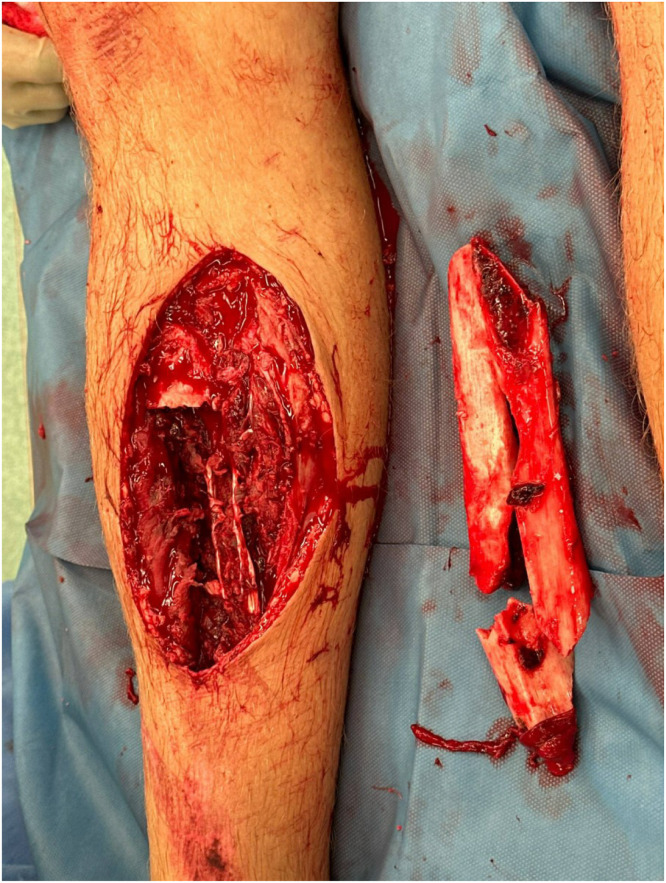 Figure 1
Peer Reviews
No public reviews on file for this paper yet. If you reviewed it on a platform where reviews are public (OpenReview, ICLR, NeurIPS, ICML), you can paste yours below so the community can read it here.
Videos
No videos yet. Explain this paper in a talk, walkthrough, or lecture? Add one.
Taxonomy
TopicsBone health and treatments · Bone and Joint Diseases · Orthopedic Infections and Treatments
Introduction
Immobility-induced hypercalcemia is an uncommon clinical entity, often under-recognized in trauma patients. While typically mild and asymptomatic, severe hypercalcemia can result in serious complications including arrhythmias, neurological dysfunction, and even respiratory arrest.1^,^2 We report a case of a young polytrauma patient who developed moderate symptomatic hypercalcemia during prolonged immobilization following lower limb reconstruction.
Case presentation
A 22-year-old male patient presented following a high-energy road traffic accident. Injuries included a Gustilo-Anderson grade 3b open tibial-fibular fracture with significant bone loss, traumatic brain injury (TBI), and multiple closed fractures. Initial orthopedic management involved debridement and application of an external fixator (bone gap 16 cm) (Figure 1), followed by a transposition flap and split-thickness skin graft. He was planned for treatment with a Taylor Spatial Frame and bone transport once the soft tissue defect healed.Figure 1. Lower limb open tibial-fibular fracture following initial debridement, demonstrating a 16 cm bone gap.Figure 1:
Subsequent reconstructive efforts were complicated by soft tissue incarceration, for which a tissue expander was inserted. The expander later extruded, requiring salvage with a free ALT musculocutaneous flap, which unfortunately became congested. Initial management with leech therapy was unsuccessful, necessitating surgical debridement. The subsequent soft tissue defect was managed with a medial gastrocnemius flap and lower limb shortening. The patient is currently undergoing rehabilitation with a plan for bone transport once the soft tissue injury is fully healed.
At two months post-injury, he developed abdominal pain and nausea. Blood tests revealed elevated adjusted serum calcium (2.92 mmol/L, peaking at 3.28 mmol/L). Serial electrocardiography showed no abnormalities. Endocrinology consultation excluded alternative etiologies such as hyperparathyroidism and malignancy. A diagnosis of immobilization-induced hypercalcemia was made. Management consisted of intravenous fluids with gradual normalization of calcium levels over several weeks. Ongoing calcium monitoring was instituted throughout his rehabilitation phase.
Discussion
This case highlights the importance of regular calcium monitoring in complex trauma patients with prolonged immobility. The exact pathophysiology is not fully understood but is thought to result from increased osteoclastic bone resorption due to the lack of mechanical stress on bone. Furthermore, osteocytes produce elevated levels of sclerostin during inactivity, suppressing osteoblastic bone formation, thereby amplifying calcium release into the circulation.1^,^3
Although more prevalent in patients with spinal cord injuries, cases have been reported in trauma patients with prolonged bed rest and limited weight-bearing capacity. In this patient, concurrent TBI and reduced physiotherapy participation, along with multiple surgical setbacks, led to significant immobility, likely contributing to the development and severity of hypercalcemia. Given the frequency of prolonged immobilization in complex lower limb reconstructions, plastic and orthopedic surgical teams should be vigilant for this rare but serious metabolic complication.
Management begins with identifying the condition through clinical suspicion and serum calcium measurement. Initial treatment includes intravenous fluids. If ineffective, pharmacological agents such as bisphosphonates, calcitonin, or denosumab may be warranted.4^,^5 Regular monitoring is essential, particularly during rehabilitation phases, to ensure timely detection and treatment.
Conclusion
Prolonged immobilization following complex orthopedic trauma can lead to significant hypercalcemia. Clinicians should routinely monitor calcium levels in high-risk trauma patients, as early recognition and prompt management are essential to prevent systemic complications.
Declaration of competing interest
None declared.
The reference list from the paper itself. Each links out to its DOI / PubMed record.
- 1Tettero J.M.Van Eeghen E.Kooter A.J.Extreme hypercalcaemia caused by immobilisation due to acute spinal cord injury BMJ Case Rep 142021 e 24138610.1136/bcr-2020-241386 PMC 817450134083190 · doi ↗ · pubmed ↗
- 2Yusuf M.B.Akinyoola A.L.Orimolade A.E.Determinants of hypercalcemia and hypercalciuria in immobilized trauma patients Bonekey Rep 420157092613136010.1038/bonekey.2015.78PMC 4455687 · doi ↗ · pubmed ↗
- 3Cano-Torres E.A.González-CantúA.Hinojosa-Garza G.Castilleja-Leal F.Immobilization induced hypercalcemia Clin Cases Miner Bone Metab 13120164610.11138/ccmbm/2016.13.1.046PMC 486995427252745 · doi ↗ · pubmed ↗
- 4Malberti F.Treatment of immobilization-related hypercalcaemia with denosumab Clin Kidney J 5620124914952606979010.1093/ckj/sfs 133PMC 4400556 · doi ↗ · pubmed ↗
- 5Ahamed I.Jauhar N.Hypercalcemia due to immobilization J Endocr Soc 5Supplement_12021 A 196