Comparing the Lecture-Based Learning With the Four-Component Instructional Design (4C/ID) Model of Learning in Enhancing the Skills of Consent-Taking in the Emergency Department: A Quasi-experimental Study
Abdus Salam Khan, Muhammad Nasir Ayub Khan, Muhammad I Khan

TL;DR
This study compares traditional lectures with interactive training to improve consent-taking skills in emergency departments, finding that interactive methods boost confidence and performance.
Contribution
The study demonstrates the effectiveness of the 4C/ID model over traditional lectures for consent-taking training in high-pressure clinical settings.
Findings
Both groups had similar knowledge retention, but the 4C/ID group performed better in practical skill assessments.
Participants in the 4C/ID group reported greater confidence and satisfaction with the training.
Interactive, task-based training is more effective for ethical communication in emergency settings.
Abstract
Introduction The emergency department (ED) is the first point of care for critically ill patients who require rapid stabilization and treatment, which frequently involves obtaining informed consent. The environment of the ED is challenging due to the complex interaction between staff and patients and their families, with numerous tasks needing to be performed within a limited time window. That is why consent-taking in the ED by healthcare professionals and nurses is sometimes inconsistent with best practices, leading to ethical and legal concerns. Informed consent-taking in the ED is critical yet challenging, with traditional lecture-based training often failing to equip healthcare professionals with practical skills. This study compares the Four-Component Instructional Design (4C/ID) model, a task-driven, interactive approach with lecture-based learning (traditional methods) for…
Genes, proteins, chemicals, diseases, species, mutations and cell lines named across the full text — each resolved to its canonical identifier and authoritative record.
Click any figure to enlarge with its caption.
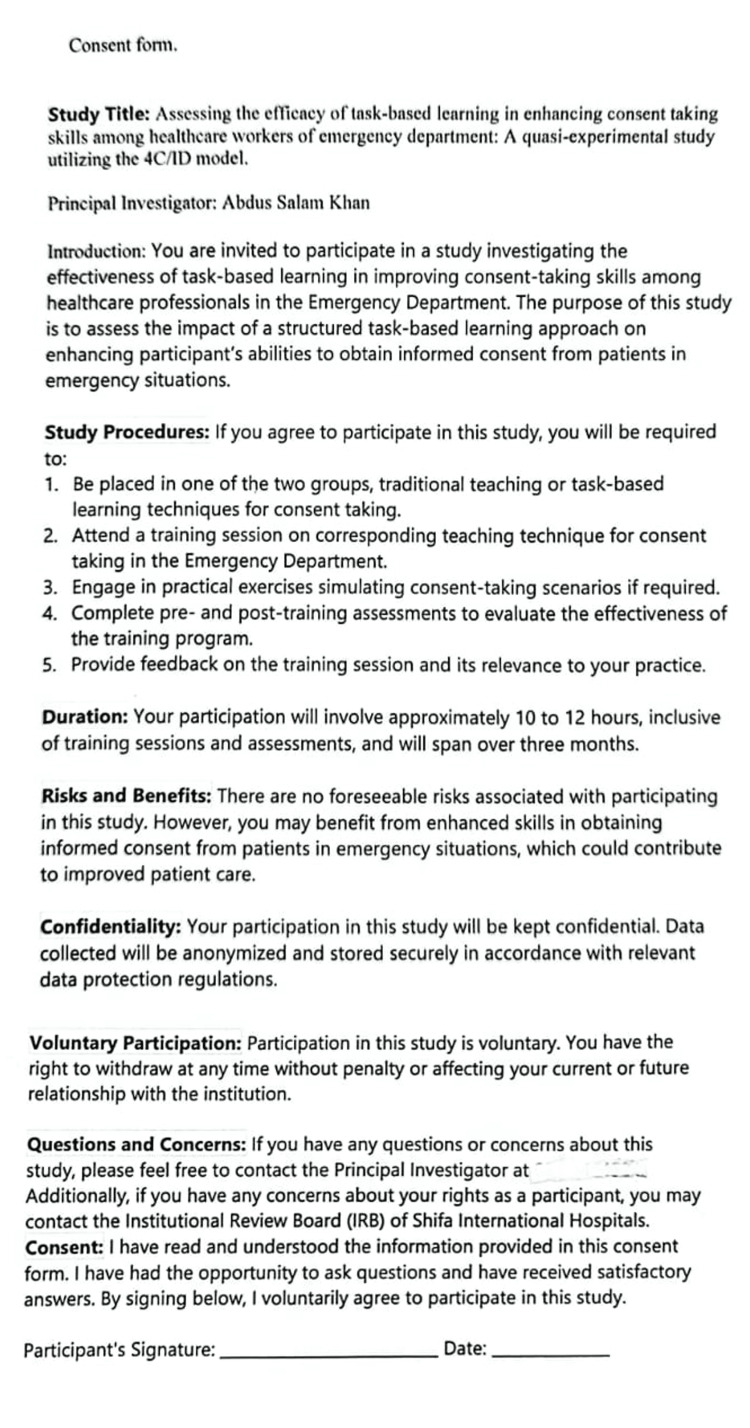 Figure 1
| Characteristics | Group A (n=10) | Group B (n=11) | Total (n=21) |
| Gender | |||
| Female | 6 | 6 | 12 |
| Male | 4 | 5 | 9 |
| Profession | |||
| Doctors | 7 | 7 | 14 |
| Nurses | 3 | 4 | 7 |
| Mean age (years) | 29.1 ± 3.2 | 26.4 ± 2.8 | 27.7 ± 3.2 |
| Test Score | Group A (Mean ± SD) | Group B (Mean ± SD) | p-value* |
| Pre-test | 21.00 ± 3.20 | 21.18 ± 2.60 | 0.887 |
| Post-test | 21.90 ± 2.38 | 21.73 ± 2.87 | 0.883 |
| OSCE | 17.44 ± 2.46 | 18.64 ± 1.22 | 0.168 |
| Sum of squares | df | Mean square | F | Sig. | Partial Eta Squared | Noncentrality parameter | Observed powera | |
| Contrast | 6.331 | 1 | 6.331 | 1.654 | 0.215 | 0.084 | 1.654 | 0.23 |
| Error | 68.898 | 18 | 3.828 |
Peer Reviews
No public reviews on file for this paper yet. If you reviewed it on a platform where reviews are public (OpenReview, ICLR, NeurIPS, ICML), you can paste yours below so the community can read it here.
Videos
No videos yet. Explain this paper in a talk, walkthrough, or lecture? Add one.
Taxonomy
TopicsInnovations in Medical Education · Interprofessional Education and Collaboration · Problem and Project Based Learning
Introduction
Healthcare decision-making in emergency settings poses unique challenges. Healthcare staff must balance patients' autonomy with the urgent delivery of care [1]. In the emergency department (ED), this balance is often compromised. The time-sensitive and high-stress environment makes taking informed consent difficult [2-3], even though it is essential for patient-centered care and improved outcomes. Patients and families have frequently been found in states of anxiety, confusion, and emotional distress, further complicating communication and decision-making. In practice, consent-taking often falls short due to time constraints, complex decisions, and insufficient training [4]. Traditional didactic teaching is inadequate, as it does not provide the experiential preparation needed for real-world emergency scenarios [5].
Active learning strategies such as task-based learning and role-play are increasingly recognized as effective for skill development in healthcare education [5]. However, their systematic application in emergency care, particularly within structured frameworks like the Four-Component Instructional Design (4C/ID) model, remains underexplored [6]. Various studies described the value of instructional design, like the 4C/ID model, and showcase the value of teaching through role play [7-9]. While interprofessional learning has been shown to enhance collaboration, its integration with 4C/ID in high-pressure clinical settings has not been adequately studied. In Pakistan, consent practices are especially inconsistent, relying heavily on observational learning and occurring in a context where awareness of patient rights is limited [7].
This study evaluated the effectiveness of the 4C/ID model in improving informed consent skills among interprofessional ED staff. It also explored participants’ experiences and the model’s impact on interprofessional collaboration.
Materials and methods
Study design
We conducted a quasi-experimental study to evaluate the effectiveness of a task-based learning intervention grounded in the 4C/ID model compared to a lecture-based study [9]. We hypothesized that the 4C/ID model is more effective than lecture-based learning for teaching communication skills in the ED. The intervention targeted four key elements of informed consent: capacity, communication, voluntary decision-making, and disclosure. The primary outcome of the study was the Objective Structured Clinical Examination (OSCE) score, assessed immediately after the intervention, with multiple-choice question (MCQ) scores as a secondary endpoint.
The effectiveness of the training was assessed using Kirkpatrick’s four-level evaluation model [10] with Level 1 (Reaction): Participant perceptions were explored through a structured focus group discussion; Level 2 (Learning): Knowledge was measured using pre- and post-intervention multiple-choice tests; and Levels 3 and 4 (Behavior and Results): Skills and application were assessed via OSCE stations and standardized simulated scenarios.
Setting and participants
The study was conducted in the ED of Shifa International Hospital, a tertiary care teaching facility in Islamabad, Pakistan. Eligible participants were emergency physicians and nurses with at least one year of clinical experience. Exclusion criteria included prior participation in 4C/ID-based training or documented communication impairments. Recruitment was conducted via departmental WhatsApp groups and direct invitations. Written informed consent was obtained from all participants (Appendix A).
Sampling and randomization
A total of 21 healthcare professionals (14 physicians and seven nurses) participated in the study. To ensure balance by gender and professional role, participants were stratified into four groups (male nurse, female nurse, male doctor, female doctor) and then randomly allocated into one of the two study groups using a lottery method. Since the staff comprised young individuals both in doctors and nurses group, the vast majority had the same experience level.
Interventions
Participants were allocated to one of two groups: the control group (Group A) received a one-hour didactic lecture on informed consent. The intervention group (Group B) attended a four-hour interactive workshop designed according to 4C/ID principles. This included a brief lecture, followed by progressively complex role-play scenarios simulating real consent-taking encounters (Appendix B). Facilitators provided structured feedback, gradually reducing support to encourage learner autonomy.
Data collection instruments
We used the following instruments to evaluate the three levels of Kirkpatrick: level 2 (knowledge acquired), and levels 3 and 4 (skill and behavior change). We used pre- and post-intervention knowledge assessments to measure participants knowledge acquisition, addressing research question through 25 MCQs about the training content (Appendix C). The MCQs were prepared by two educationalists, pilot-tested on non-participants, and reviewed by an expert panel before use in this study.
We evaluated skills and behavior (levels 3 and 4) assessment by OSCE stations (Appendix D). The content of the OSCEs were blueprint-aligned to the four domains of informed consent. Each station was assessed by two independent, trained raters using standardized checklists. Standardized patients were employed to ensure realism. The evaluators of the OSCE stations were blinded to the participant's group to minimize bias. These evaluators were junior faculty and not the participants of the study.
The qualitative component of data was collected from purposive sample of six intervention participants, representing variation in gender and role, who participated in a focus group discussion (Appendix E). Sessions were audio-recorded, transcribed verbatim, and thematically analyzed following Braun and Clarke’s framework [11]. Two researchers independently coded the data, resolving discrepancies through discussion to enhance credibility.
Data analysis
Data was entered and statistical analyses were conducted using IBM SPSS Statistics for Windows, Version 23 (Released 2015; IBM Corp., Armonk, New York, United States). Descriptive statistics (mean, standard deviation, and proportions) were used to summarize demographic characteristics such as age, gender, and professional distribution of participants. For inferential analysis, independent sample t-test was applied to compare the pre-test and post-test scores between Group A (control group) and Group B (intervention group), and also to assess the differences in OSCE scores between the two groups. To evaluate the range of the mean difference in scores and assess the precision of the results, 95% Confidence Interval (CI) was used and statistical significance was set at p<0.05. However, p-values greater than this threshold were also interpreted in the context of educational and practical relevance.
The focused group discussion (FGD) was thematically analyzed to identify participants perception of the teaching methods, with a particular focus on the 4C/ID model of teaching.
Results
Participant characteristics
A total of 21 healthcare professionals participated in the study (14 physicians and nurse nurses; 12 female participants and nine male participants). Participants were randomized into Group A (traditional lecture, n=10) and Group B (4C/ID-based intervention, n=11). Demographic characteristics, including gender, profession, and mean age, were balanced across groups (Table 1).
Quantitative findings
All participants took part in the class and also the OSCE stations, and there were no dropouts.
Knowledge Outcomes
Baseline pre-test scores showed no significant difference between groups (Group A: 21.00 ± 3.20 vs. Group B: 21.18 ± 2.60; p=0.887). Both groups improved after their respective interventions, but post-test scores remained comparable (Group A: 21.90 ± 2.38 vs. Group B: 21.73 ± 2.87; p=0.883).
Skills and Performance Outcomes
Group B achieved higher mean OSCE scores compared with Group A (18.64 ± 1.22 vs. 17.44 ± 2.46), although this difference was not statistically significant (p=0.168). The results failed to show any clear superiority or any potential benefit of the 4C/ID model for practical skill acquisition (Table 2).
*Table 2: Test scores by groupOSCE: Objective Structured Clinical Examination; The value of statistical significance was p<0.05.
Experience of the participants in the ED ranged from one to six years (mean 2.19; SD 1.401). Due to a high turnover rate in the department and a training program for emergency medicine, the majority of participants had an experience of one or two years. Due to small sample size of our experiment, plotting the experience against the OSCE result showed no effect due to the years of ED experience (Table 3).
Qualitative findings
Thematic analysis of the focus group discussions with intervention participants identified five major themes, which complemented the quantitative results and provided a deeper insight into the learning experience.
Challenges With Traditional Lectures
Participants described lecture-based sessions as information-dense, fast-paced, and difficult to retain, with limited opportunity for application.
“They give you too much information in a short span of time, so it’s hard to remember.” - Participant 3
Positive Perception of Interactive Learning
The 4C/ID-based sessions were valued for their engaging and participatory nature, which supported better retention and understanding.
“I wish I could learn everything through these interactive sessions.” - Participant 6
Role-Play as a Transformative Tool
Role-play exercises were highlighted as particularly effective in clarifying concepts and building confidence in consent-taking.
“My concepts became clearer when I saw things playing out in front of my eyes.” - Participant 4
Interprofessional Collaboration
Learning in mixed groups of doctors and nurses promoted mutual respect, understanding of roles, and appreciation of teamwork.
“It helped me understand the role of doctors, which will likely assist me in future collaborations.” - Participant 3
Improved Team Culture and Perceived Value
Participants emphasized that the interprofessional, interactive environment fostered stronger team culture and enhanced the perceived value of training.
“These interactions helped me understand more and created an interprofessional environment that was more helpful than I had imagined.” - Participant 2
Discussion
Informed consent is both a legal mandate and an ethical cornerstone of medical practice. Within the high-acuity environment of the ED, where time pressures and patient vulnerability are heightened, the process becomes even more complex. Equipping ED staff with the skills required to obtain valid consent is therefore critical. Traditional training methods have relied heavily on lectures, but recent advances in the education of health professionals increasingly emphasize experiential and interactive approaches designed to enhance skill transfer, interprofessional collaboration, and clinical preparedness.
This mixed-methods study compared conventional lecture-based teaching with a structured, task-based intervention grounded in the 4C/ID model. Quantitative findings revealed no significant differences in knowledge acquisition between groups, a pattern consistent with prior studies across medical education, where didactic and active approaches often achieve similar outcomes in theoretical learning. Freeman and colleagues, in their meta-analysis of STEM education, similarly found that factual knowledge can be conveyed effectively via both methods, although active strategies were associated with superior learner engagement and retention [6]. Our findings reinforce this distinction between short-term knowledge acquisition and long-term or applied learning benefits.
Although the difference in OSCE performance did not reach statistical significance, the intervention group consistently outperformed the control group, suggesting a trend toward enhanced practical skill development through the 4C/ID model. This aligns with prior evidence demonstrating that 4C/ID-based instruction facilitates the acquisition and transfer of complex professional skills. Comparable results have been observed in nursing and interprofessional training, where role-play improved learners’ confidence, communication, and ability to manage real-world interactions [12]. A meta-analysis done on the use of educational programs developed with 4C/ID showed a higher impact on performance [12]. Together, these results indicate that while lectures can disseminate core knowledge efficiently, experiential, scaffolded methods are better suited to fostering the nuanced communication and decision-making skills required for consent-taking [13].
The qualitative findings provide valuable depth to these observations. Participants in the lecture group acknowledged the efficiency of structured delivery but described difficulties with retention and application due to information overload, limitations well documented in the literature [14]. In contrast, those in the intervention group reported greater engagement, enjoyment, and retention. Role-play was perceived as transformative, enhancing both conceptual clarity and practical confidence. These reflections echo earlier studies of interprofessional simulation, which highlight improved teamwork, communication, and professional role understanding as key benefits of interactive approaches [15].
The interprofessional element of the intervention was particularly noteworthy. Nursing participants emphasized the value of training alongside physicians, fostering mutual respect and appreciation of roles. This finding is consistent with reports from diverse settings, including the Middle East, where interprofessional education has been associated with improved collaboration and safer patient care [16]. Within the ED context, where effective teamwork is essential for both patient safety and efficiency, the contribution of such approaches is particularly salient [17-18].
Taken together, these findings support the growing consensus that lectures remain effective for rapid dissemination of knowledge, but complex, communication-intensive skills such as consent-taking are best developed through structured, interactive, and interprofessional strategies [19-20]. The 4C/ID model, with its emphasis on authentic tasks, scaffolding, and guided practice, provides a particularly suitable framework for this type of training.
Practical implications
This study underscores the need for emergency medicine educators and clinical leaders to adopt a blended approach to training for consent-taking. Lectures should continue to be used for delivering foundational knowledge efficiently, but they must be complemented by structured 4C/ID-based workshops and role-play to ensure meaningful skill transfer, engagement, and learner confidence. EDs should actively integrate such short, focused sessions into routine staff development programs, as they can be delivered without disrupting clinical operations and have the potential to significantly strengthen communication competencies in time-sensitive environments. Moreover, designing consent-training initiatives for mixed groups of physicians and nurses should become standard practice, as this fosters interprofessional collaboration and mutual respect, ultimately contributing to safer patient care [21-22]. Given its scalability and minimal resource requirements, the 4C/ID model represents a practical and evidence-based solution that should be prioritized, particularly in low- and middle-income settings where simulation facilities and training resources are limited.
Limitations
This study has several limitations. The small sample size, single-center design, and short intervention duration restrict the generalizability of findings. The lack of long-term follow-up further limits conclusions regarding the sustainability of the observed improvements. Conducting the intervention in a busy ED, characterized by high staff turnover and scheduling constraints, also posed challenges to delivering consistent, high-quality teaching. Despite these limitations, the study offers valuable insights for educators working in resource-constrained environments and demonstrates the feasibility of implementing structured, task-based training within demanding ED settings.
Conclusions
This study demonstrated that while both lecture-based and 4C/ID-based methods are effective for conveying theoretical knowledge, the 4C/ID model offers added advantages for practical skill development and interprofessional collaboration. Interactive, task-based approaches such as role-play appear particularly well-suited for preparing healthcare professionals to manage ethically complex and communication-intensive processes such as informed consent in the ED. Future research on role-play should include larger, interprofessional, multi-center cohorts with longitudinal follow-up to examine sustainability, transferability, and cost-effectiveness of such interventions.
The reference list from the paper itself. Each links out to its DOI / PubMed record.
- 1Informed consent: an ethical obligation or legal compulsion?J Cutan Aesthet Surg Satyanarayana Rao KH 33351200810.4103/0974-2077.41159 PMC 284088520300341 · doi ↗ · pubmed ↗
- 2Practices of informed consent for emergency procedures at a tertiary care hospital in Lahore, Pakistan Cureus Munawar T Ismail F Mehmood Qadri H 015202310.7759/cureus.50322 PMC 1077778138205463 · doi ↗ · pubmed ↗
- 3Patients' perception and actual practice of informed consent, privacy and confidentiality in general medical outpatient departments of two tertiary care hospitals of Lahore BMC Med Ethics Humayun A Fatima N Naqqash S Hussain S Rasheed A Imtiaz H Imam SZ 14920081881641310.1186/1472-6939-9-14PMC 2564960 · doi ↗ · pubmed ↗
- 4Challenges regarding informed consent in recruitment to clinical research: a qualitative study of clinical research nurses' experiences Trials Godskesen T Björk J Juth N 8012420233808243410.1186/s 13063-023-07844-6PMC 10712041 · doi ↗ · pubmed ↗
- 5Optimizing emergency medicine training: integrating simulation and technology MJDI Daniel A Thomas J 14015832021
- 6Purpose, pleasure, pace and contrasting perspectives: teaching and learning in the emergency department AEM Educ Train Sadka N Lee V Ryan A 05202110.1002/aet 2.10468 PMC 799592333796807 · doi ↗ · pubmed ↗
- 7The Four-Component Instructional Design Model 9 2025 2019 https://www.4cid.org/wp-content/uploads/2021/04/vanmerrienboer-4cid-overview-of-main-design-principles-2021.pdf
- 8From lecture to learning tasks: use of the 4C/ID model in a communication skills course in a continuing professional education context J Contin Educ Nurs Susilo AP van Merriënboer J van Dalen J Claramita M Scherpbier A 27828444201310.3928/00220124-20130501-7823654295 · doi ↗ · pubmed ↗